

ISTA 1A is a nonsimulation integrity screen, ISTA 2A provides partial simulation for preliminary design refinement, and ISTA 3A is a general simulation candidate for eligible parcel packages. Choose by the actual shipping unit, route, test purpose and written customer requirements. The numbers are not universal protection grades: the wrong package or distribution scope can make an apparently stronger test answer the wrong question.
For China-sourced products, start with what leaves the factory and what reaches the final customer. A product may travel inside an export mastercase before a warehouse puts it into a different delivery carton. That change matters when you assess a supplier’s existing report or request a new laboratory quotation.
Choose the test by its purpose and shipment scope
Choose the transit test by the question it needs to answer, then check whether the filled package and distribution route fall within its scope. Basic screening, preliminary design refinement and parcel simulation serve different purposes. A useful selection ends with an agreed laboratory plan and acceptance criteria, rather than a procedure number copied into a purchase order.
- Decision: Identify the handled package, distribution legs and written customer program before selecting a protocol.
- Best for: Use integrity screening for a screening question; consider parcel simulation for an eligible parcel-delivery package.
- Common mistake: Treating a mastercase report as proof for a repacked consumer carton.
- Risk: A passing result applies to the identified configuration and evaluation; it does not guarantee every shipment.
Identify the shipping unit before choosing the test
Identify the package and the decision before comparing test names. ISTA’s test-procedure descriptions distinguish nonsimulation integrity screening, more thorough partial-simulation screening for preliminary designs, and general simulation of transport hazards; they also identify member-specific performance tests. This distinction changes the brief: a development benchmark and a customer-required distribution evaluation can call for different protocols, even for the same product.
Ask the logistics team to describe each handling stage: factory dispatch, consolidated or unitized movement, destination storage, repacking and final delivery. Record where a carton remains intact and where products move into another package. “Ships internationally” leaves too much unresolved; it does not tell the laboratory whether the relevant object is a strapped load, an individual export case or a parcel handed to a delivery network.
Next, obtain the buyer’s written retailer, carrier or fulfillment-program requirement, if one applies. A named program may specify a protocol outside this comparison, and a unitized load may need a different evaluation from an individual carton. Give the laboratory the actual document and destination context rather than asking it to confirm that any report bearing an ISTA name will be acceptable.
A shipping unit is the filled package handled as one unit on the distribution leg being evaluated. A China export mastercase, its unitized load and a repacked consumer parcel are different configurations; evidence for one does not automatically establish suitability of the others. Draw the packaging change into the route map, because that is where an existing report can stop answering the buyer’s question.
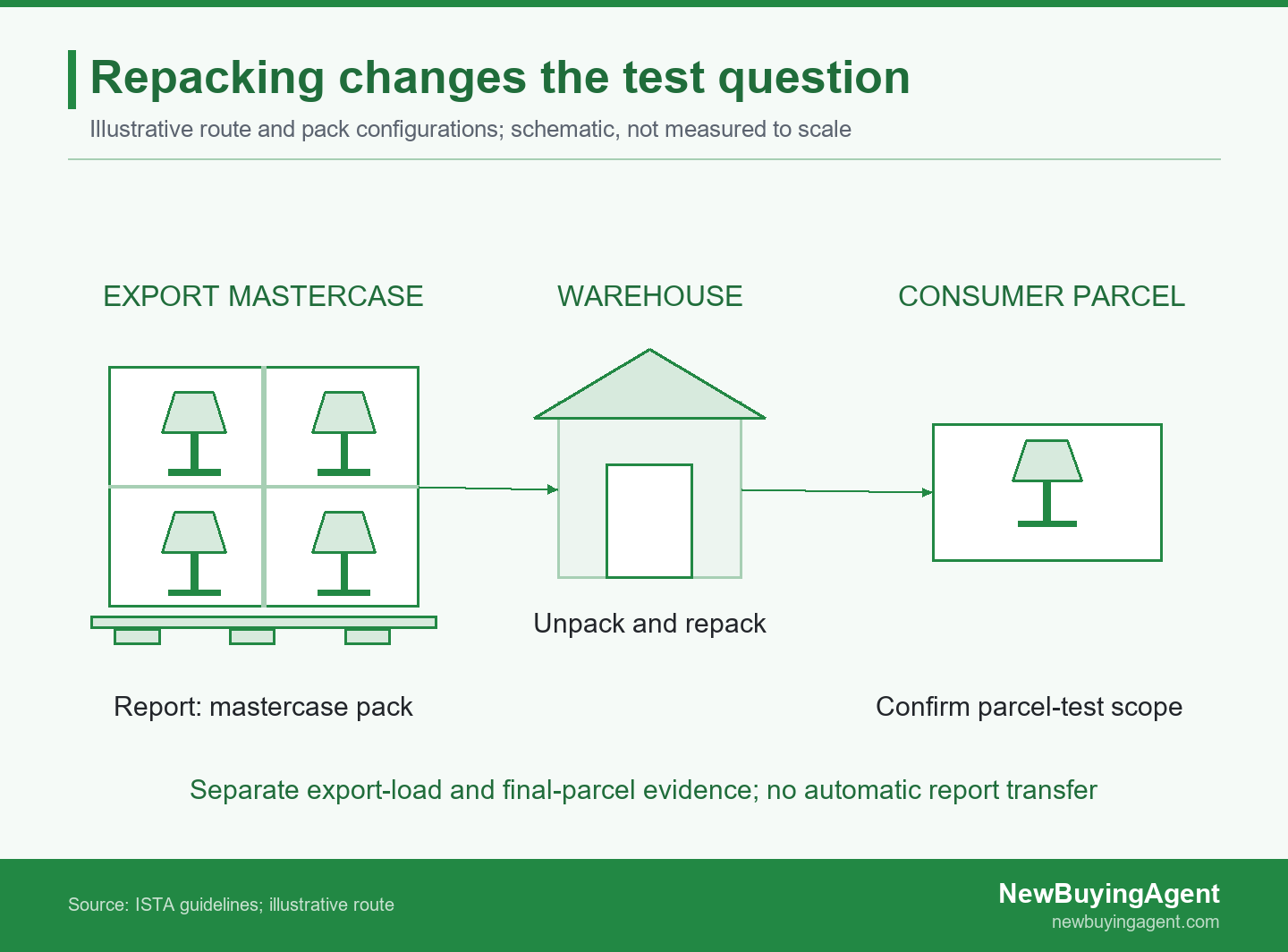
Warehouse repacking changes the shipping unit, so mastercase evidence does not automatically cover the consumer parcel.
Compare ISTA 1A, 2A and 3A on the same criteria
Compare 1A, 2A and 3A on purpose, package scope and the decision their results can support, using the same product and distribution question. The matrix below summarizes ISTA’s public overviews, with the individual source links in the explanations that follow. It is a selection aid rather than a reproduction of current complete procedures; the responsible laboratory should confirm the applicable edition, eligibility and methods before quoting or testing.
| Criterion | ISTA 1A | ISTA 2A | ISTA 3A |
|---|---|---|---|
| Stated purpose | Nonsimulation integrity screening | Partial simulation; preliminary design refinement | General simulation for parcel delivery |
| Published weight scope | Individual pack: 150 lb (68 kg) or less | Individual pack: 150 lb (68 kg) or less | Parcel: 70 kg (150 lb) or less |
| Overview exposure examples | Vibration and shock | Atmospheric conditioning, compression, vibration and shock | Shock and random vibration, with package-class-specific elements |
| Useful decision | Compare integrity against a consistent screen | Refine a preliminary package design | Assess an eligible parcel configuration against a fitting evaluation |
| Critical boundary | Does not simulate actual distribution | Not intended to predict shipping performance | General parcel simulation does not represent every specific route |
Based on this comparison, consider 1A for a defined integrity-screening question, 2A for broader preliminary design screening, and 3A for an eligible parcel package when that is the required evaluation. A unitized, nonparcel or customer-specific distribution requirement may lead outside these options. Choose the protocol whose purpose and scope match the question, then confirm the complete plan with the laboratory.
Use 1A for a defined integrity-screening question
The public 1A overview describes a nonsimulation integrity test for individual packaged-products weighing 150 lb (68 kg) or less. Its listed vibration and shock evaluation challenges the product and package together, without simulating actual distribution hazards. This can provide a consistent screening benchmark, but the overview is not a current complete procedure or a prediction that the package will survive every route.
The linked document identifies a technical version from 2014 and editorial changes from 2016. Use it to understand the screening purpose, while having the laboratory confirm the current controlled procedure and permitted methods. A buyer comparing early carton designs can ask what changed under a consistent screen; a buyer approving a delivery channel needs the channel’s actual evaluation requirements.
Use 2A to refine a preliminary package design
The public 2A overview describes partial simulation for individual packaged-products weighing 150 lb (68 kg) or less. It combines atmospheric conditioning, compression, vibration and shock to support more thorough preliminary design screening. That broader set of exposures does not make it a route-specific shipping approval, and the current complete procedure remains necessary to select methods and carry out the test.
Its technical version is dated 2011, with editorial changes dated 2012. Partial simulation is useful when the design question needs broader screening, but “international shipment” is not a sufficient selection rule. For example, adding atmospheric conditioning does not establish cold-chain qualification, and an individual-package evaluation does not automatically establish performance of a palletized export load.
Consider 3A for an eligible parcel-delivery package
The published 2018 3A overview covers packaged-products for parcel delivery by air or ground weighing 70 kg (150 lb) or less. It distinguishes standard, small, flat and elongated packages, so actual dimensions and shape matter as well as weight. This is general simulation: the overview warns that general data may not represent a specific route, and it does not replace the current complete procedure.
Keep the overview’s weight wording intact rather than converting all three protocols to a common kilogram limit. Ask the laboratory to classify the complete parcel and confirm the applicable sequence and any options. A light carton is not automatically in the right scope if it travels as part of a different shipping system or is subject to a separate customer program.
Send the laboratory a brief it can confirm
Send enough information for the laboratory to confirm a scope, rather than requesting a price for an unexplained test code. ISTA’s 2018 guidelines for selecting and using tests emphasize representative samples, detailed product and package identification, defined damage assessment and consideration of retesting after changes. The buyer brief below turns those principles into practical questions; it is an editorial working form, not an ISTA laboratory test instruction.
| Brief field | Buyer input or laboratory confirmation |
|---|---|
| Product and pack identity | Product/model/revision: ____; pack drawing and material-list revision: ____; contents/accessories: ____ |
| Handled unit and route | Filled shipping unit: ____; distribution legs: ____; repacking or consolidation point: ____ |
| Physical package | Gross weight: ____; external dimensions: ____; shape and closure: ____; photos attached: ____ |
| Decision and written requirement | Development question or approval purpose: ____; customer/carrier/program document and version: ____ |
| Proposed test scope | Laboratory-confirmed procedure and edition: ____; package class: ____; methods, options and exclusions: ____ |
| Samples and acceptance | Representative samples and replicate plan: ____; product function/cosmetic limits: ____; allowable package condition: ____ |
| Quotation and timing | Samples, conditioning, complete sequence, reporting and retest scope included: ____; cost: ____; completion assumptions: ____ |
| Results and change control | Report recipient and approval owner: ____; failure response: ____; pack/route changes requiring reassessment: ____ |
Define acceptance in observable terms before samples arrive. For a lamp, that might include the agreed functional checks, permitted finish marks and the condition in which the customer can safely remove the product. Have the responsible product team set those criteria and the laboratory confirm how they will be assessed. “No damage” alone can leave the parties disagreeing about a crushed retail box or a loose component.
When a new product and its packaging are being purchased together, NewBuyingAgent’s stated local factory resources and product/QC capability are relevant to getting a buildable product-and-pack definition from China. For example, a carton change may also require a different insert, accessory position or factory packing method. Include those changes in the product offer, while obtaining specialist test scope and interpretation from the responsible laboratory.
Follow the pack change from export shipment to consumer parcel
A report can be valid for the package it identifies and still leave the buyer’s next decision unanswered. Repacking creates this problem when the export case and final delivery carton contain different quantities or use different supports. The following invented lamp order shows how to separate those questions without assuming a test result, assigning a protocol to every leg or turning a development screen into parcel approval.
Illustrative example: one order, two shipping units
Illustrative assumptions: an importer replenishes an ongoing lamp range from China and controls the product and final-pack purchasing approval. The importer orders 2,400 lamps packed four per export mastercase, making 600 mastercases. The export shipment moves as unitized loads to a destination warehouse, which repacks each lamp into an 8 kg consumer parcel. These are invented planning inputs, not a client shipment or measured test result; the final parcel configuration has not been approved.
The supplier’s existing 1A report identifies the four-lamp mastercase, while the warehouse plans to use a single-lamp carton with different internal supports. The buyer still lacks the consumer carton’s dimensions and classification, the applicable written customer program and evidence for the new pack. The report therefore cannot answer the final-parcel question simply because the product name is unchanged.
The operational consequence is specific: do not use the mastercase report as the approval reference in the consumer-parcel packing instruction. Ask the warehouse for the actual filled parcel definition and retain the mastercase report against the export configuration it identifies. The purchase order can describe both packages, but the evidence needs to remain tied to the relevant handled unit.
Resolve the missing parcel evidence before approval
For this illustrative order, 3A is a candidate for the final parcel only after the laboratory confirms eligibility, classification and customer requirements. The unitized export leg needs its own appropriate plan. Obtain representative final packs, agree the evaluation and acceptance criteria, then assess the actual results before approving the configuration; a proposed procedure is not an approval or a passing test.
Give the factory and warehouse the same approved packing reference once the unresolved questions are answered. If the lab finds a problem, preserve which product, insert, carton and closure were tested, revise the affected design and agree the follow-up evaluation. That makes a later result interpretable: the team can see what changed and whether production uses the configuration supported by the evidence.
The example does not show that the parcel needs a higher-numbered test because it contains fewer lamps. It shows that a different handled package and delivery mode create a different evaluation question. The missing information, rather than the age or appearance of the supplier’s certificate, determines the next action.
Read the report as evidence for an identified configuration
Read the report against the identified product, packaging and evaluation before treating its conclusion as evidence for the purchase. Confirm the procedure edition rather than assuming the date on a downloaded overview is current: ISTA’s procedure-change guidance encourages use of the most current version to avoid outdated-procedure problems and additional retesting. This check belongs in the laboratory scope confirmation as well as the report review.
Check the report’s product and pack descriptions, photographs, sample records, test sequence and stated acceptance criteria. Look for deviations, omitted options, observations during testing and the final results, not just a summary marked “pass.” If a carton drawing, material revision or accessory arrangement cannot be matched to the production pack, ask the laboratory and factory to resolve the gap before relying on the result.
Keep laboratory evidence and production conformity as separate questions. The report addresses the samples evaluated under its conditions; factory checks establish whether the order uses the agreed materials, contents and packing method. A cheaper replacement insert or a changed closure can break that connection even when the outer carton still carries the same product label.
For a buyer retaining existing China suppliers, NewBuyingAgent’s existing-factory management service provides a relevant China-side route for production follow-up, staged QC and reporting. Use agreed checks to compare the factory’s actual carton, insert and pack-out with the approved product requirements and surface deviations while they can still be corrected. Specialist laboratory testing and its interpretation remain with the responsible laboratory.
Put the approved pack into the China product order
Put the approved package into the product specification and purchase order in enough detail for the factory to reproduce it. A test code alone leaves purchasing staff free to substitute components that look similar but were never evaluated together. Identify the applicable pack revision, order and destination, and make responsibility for proposed changes clear before production purchasing and packing begin.
- Define the complete pack: product and accessories, inner supports, outer carton, closure, labels and packing orientation.
- Identify the approved reference: drawings, material specifications, photos, packing instructions and the relevant laboratory evidence.
- Connect each distribution leg: state which pack leaves the factory and who controls any destination repacking.
- Control substitutions: identify who reviews material, geometry, supplier or route changes and when a laboratory reassessment is needed.
This also improves quote comparison. A lower product price may exclude the specified insert, use a different carton grade or assume that destination repacking is somebody else’s responsibility. Ask the supplier to price the defined package and identify separate development, samples and testing costs. Keep those commercial questions visible without pretending that one standard code implies a fixed global fee or turnaround.
For a new or repeat China product purchase that needs an agreed pack, request a China product-supply offer from NewBuyingAgent. Share the product specification, quantity, target price, destination and timing, together with the route, current pack revision, expected replenishment needs and approval responsibilities. Its local factory resources and product/QC capability can support a product offer incorporating those requirements, so the purchasing team can carry the agreed configuration into the next order alongside the specialist test plan.
Questions about choosing an ISTA transit test
Is ISTA 3A mandatory for every ecommerce shipment?
ISTA 3A is not a blanket requirement for every ecommerce shipment. Check the actual retailer, carrier, fulfillment program or customer specification and the package eligibility before deciding what test to commission. A program may name a different procedure or require additional documentation. Obtain that requirement in writing and include it in the lab brief so the quotation answers the acceptance question you actually face.
Does an international shipment automatically need ISTA 2A?
An international shipment does not automatically call for ISTA 2A. International movement can include unitized export loads, warehouse handling and a separate parcel-delivery leg, each involving a different handled package. Describe those stages and the evaluation purpose to the laboratory instead of selecting a protocol from the country of origin alone. Ask which plan fits the identified unit and the relevant written requirements.
Which test is cheapest and fastest?
Compare laboratory quotes only after their scope has been confirmed. Package classification, representative samples, replicate testing, conditioning, selected options, reporting and any follow-up work can change the quotation and schedule. Ask what is included and what assumptions could extend completion, including sample availability and a design revision after failure. A low headline fee is not a useful saving if it evaluates the wrong package or omits the required work.
Does an ISTA pass approve the shipment for every purpose?
An ISTA transit-test pass does not approve a shipment for every purpose. It supports the identified product-and-package evaluation under the stated conditions, rather than proving all-route protection, general product compliance or dangerous-goods authorization. Customer acceptance and any applicable specialist approvals need their own evidence. Keep the report linked to the tested configuration, then confirm production conformity and resolve any separate acceptance requirements before shipment.
NewBuyingAgent
Related Resources



Get Started Today
Let's Turn Your Sourcing Goals into RealityWeChat:+86 15157124615
WhatsApp:+86 15157124615
Address:Building 10 #39 Xiangyuan Road, Hangzhou, China
