

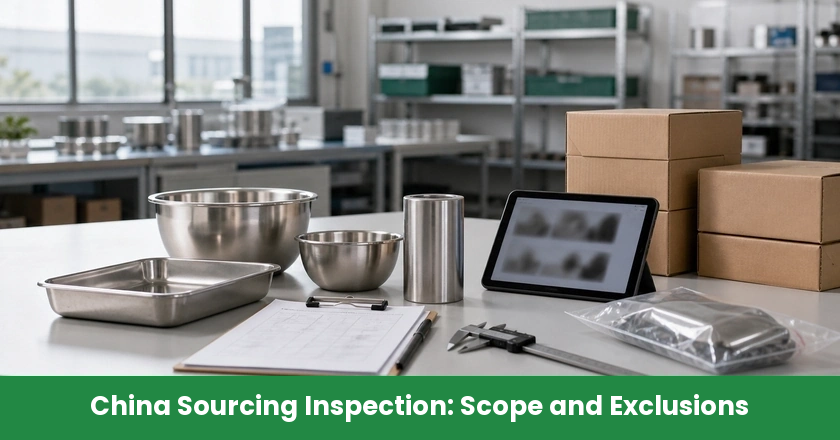
A one-line “final inspection” fee is not enough to compare China sourcing proposals. The useful question is whether that line produces evidence for a real buyer decision: what was checked, what was not checked, who owns the gap, and what must happen before goods can move.
An AQL reference, an on-site visit, a laboratory test, and a market-compliance document can each answer different questions. A good proposal connects them where needed. It does not imply that one label covers all of them.
What an Inspection Line Item Should Actually Promise
An inspection line item is useful only when it identifies the product, timing, sample basis, checks, report, and decision path.
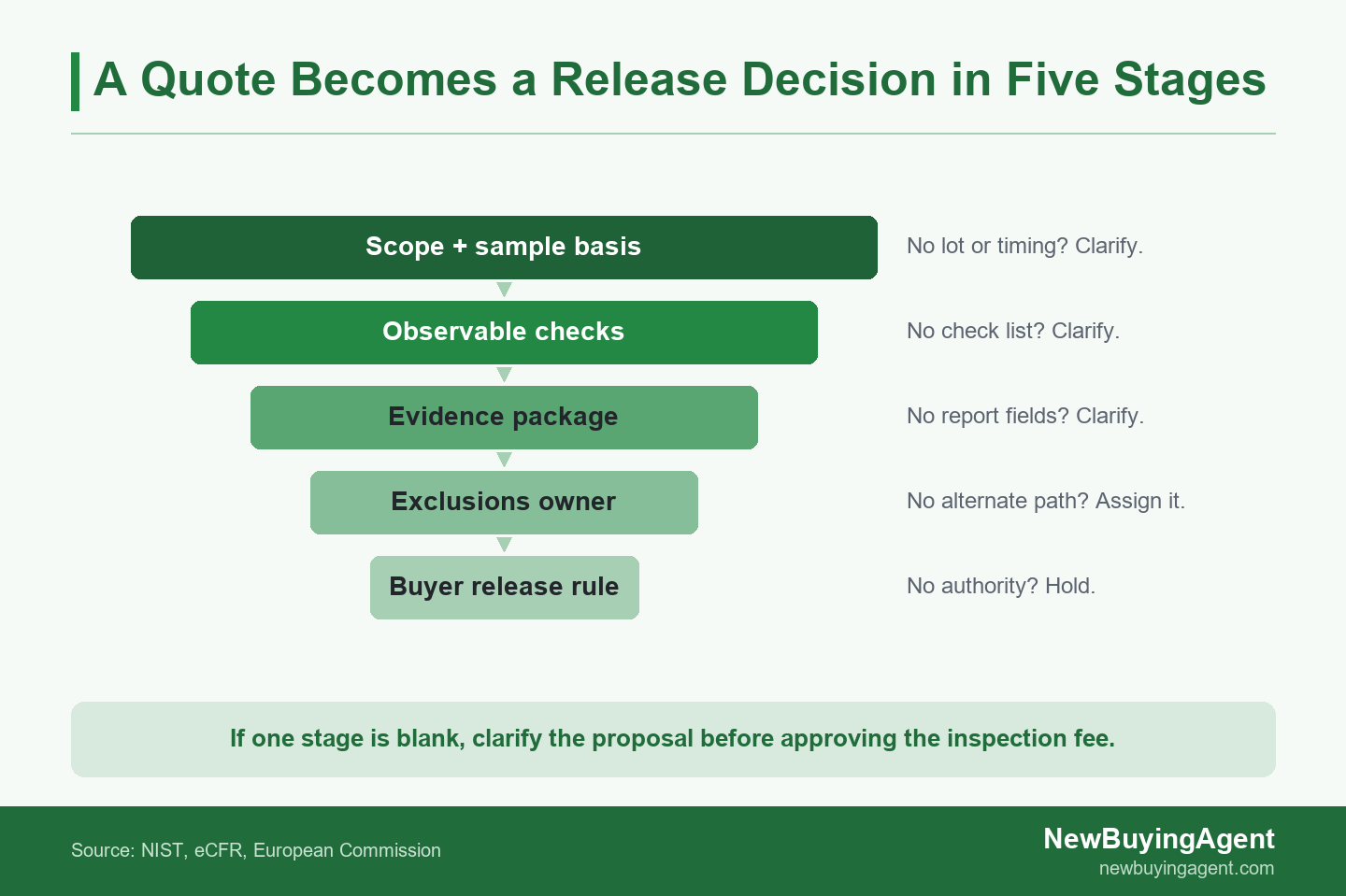
Five-stage inspection proposal funnel from scope and sample basis to buyer release rule
That creates an evidence path: the written route from a requested check to its proof and decision owner. If a proposal says “pre-shipment inspection” but omits the approved product version, visit timing, or person allowed to release goods, the buyer cannot tell whether the price covers a useful control or merely a visit.
- Scope: the product revision, SKU group, cartons, functions, markings, and workmanship to be checked.
- Evidence: the report, photos, measurements, sample record, and corrective-action proof delivered to the buyer.
- Exclusions: work outside the visit and the party responsible for an alternate control.
- Decision owner: the person who can accept, hold, correct, reinspect, or release.
Ask the proposal to point back to the approved specification rather than leave an inspector to infer the standard from a sales sample. The China manufacturing and product guide gives useful context for the product and factory inputs that should exist before a visit is booked.
| Proposal field | Decision-ready description | Warning sign |
|---|---|---|
| Scope | Named product revision and observable checks | “General quality check” |
| Sample basis | Lot, production stage, plan, and timing | “AQL applies” with no further detail |
| Evidence | Report format, photos, measurements, and due time | “Pass/fail report” only |
| Exclusions | Separate owner and evidence route | Assumed testing or certification coverage |
| Release | Named owner and corrective path | Inspector appears to have unrestricted release authority |
Sampling Terms: What AQL Does and Does Not Buy
A sampling plan defines what is measured, when, on what material, how, and by whom; an AQL label alone does not settle those choices. NIST’s planning guidance sets out those elements.
Acceptance quality limit, commonly shortened to AQL, is a sampling reference used with a stated lot and acceptance rules. It can be useful in a final-inspection proposal, but it is not shorthand for “every item was checked” or “the shipment cannot contain defects.” The buyer still needs the lot size, inspection level or sampling basis, defect classifications, acceptance and rejection rule, and the approved product requirements against which the sample is judged.
Acceptance sampling supports a decision about a lot under stated rules; it does not inspect every unit or prove that no defect exists. NIST makes this boundary explicit, and its overview of lot acceptance plans explains that another sample can be part of the decision rule.
Match the Sample to the Production State
The proposal should state which production state and lot the sample represents, so the buyer can see the risk the visit can observe.
An in-process visit can reveal whether a carton assembly or component change is taking hold. A final inspection can observe only finished goods that are available at the agreed time. Neither visit repairs an incomplete specification. Ask whether the sample is drawn from the correct finished lot, whether cartons are sealed or still open, and whether the relevant revision is physically present. Those details prevent a technically neat report from becoming commercially irrelevant.
Write the Accept, Hold, and Reinspect Rule
The proposal needs a written route for accepting, holding, correcting, and reinspecting findings before release is considered.
A sampling outcome is only the start of a decision. The proposal should say which findings are reported immediately, who may authorize correction, how corrective evidence is captured, and when a reinspection is triggered. It should also state whether the factory can continue packing while a buyer reviews a major finding, or whether the affected quantity must remain identifiable. Your commercial release rule should be equally clear, because an inspection result has little value when nobody knows its permitted next step.
Turn Included Checks Into Evidence
A proposal should turn each included check into an observable output: the condition checked, the evidence captured, the severity rule, and the disposition route.
“Quantity, appearance, function, packing, and labeling” may be a reasonable start, but it is not yet a scope. For quantity, name the count method and carton population. For appearance, identify the approved sample, color reference, artwork, or workmanship standard. For function, state the test condition and acceptable result. For packing, specify the carton marking, relevant loading or drop requirement, and photo angles. The same approach makes a defect classification useful: it needs a written standard and a buyer action, not only a label.
When a buyer has an existing China factory, NewBuyingAgent can connect production observations to supplier follow-up and quality evidence. That connection is strongest when the product specification, production timing, and release requirement are already clear enough to guide the work.
Read Exclusions as Ownership Boundaries
A field inspection should not be treated as a substitute for laboratory testing or conformity assessment when a target-market rule requires those activities. In the United States, 16 CFR Part 1107 sets testing and certification requirements for covered children’s products; in the EU, the applicable conformity procedure depends on the product rules and may require a suitable organisation, as explained by Your Europe.
A field inspection is an on-site observation of specified product, packaging, and production conditions. It can produce practical evidence of visible condition and execution against an approved check list. It does not, by its label alone, establish a laboratory result, a safety certification, an intellectual-property clearance, or every market-specific compliance duty.
Excluded checks are not automatically unimportant; they are an ownership decision that needs another control, budget, or written acceptance.
Ask: “If this visit does not cover this risk, what covers it, who orders it, and which document or decision closes it?” A separate laboratory booking, an approved supplier certificate, a technical-file review, or a buyer-accepted limitation can be legitimate answers. Silence is not.
Ask for an Evidence Package, Not a Pass/Fail Label
For regulated goods, test and certificate information can support a compliance record; inspection photos and a pass/fail report serve a different evidence purpose. For example, 16 CFR Part 1110 sets certificate requirements for products subject to applicable CPSC rules, while the European Commission’s CE-marking guidance assigns manufacturers the applicable conformity-assessment and technical-file responsibilities.
For the inspection portion, request an evidence package proportional to the order: inspection date and location, product and carton identifiers, sampled quantity, a check list tied to the approved revision, defect photos with severity, measurement records where relevant, corrective actions, and report delivery time. If a test report or declaration is needed for the target market, list it as its own requested document with a source, version, and owner.
Use a Five-Part Gate Before You Approve the Fee
Approve an inspection line only after you can name the trigger, evidence, decision owner, corrective action, and release condition.
- Trigger: What production event or date activates the visit?
- Evidence: Which report fields, photos, records, or documents must be delivered?
- Owner: Who reviews the evidence and may request correction?
- Corrective action: What happens after a critical, major, or minor finding?
- Release condition: Which items must be closed before cargo, payment, or production moves forward?
This is an editorial commercial-control rule, not a certification procedure. Its value is that it makes proposals comparable. Two agents can quote the same fee while offering different sample timing, evidence quality, reinspection rules, and buyer control. The five-part gate exposes those differences before the order reaches a time-sensitive release point.
Illustrative Scenario: A Kitchenware Order With Split Evidence
In the illustrative kitchenware order, an inspection fee becomes decision-ready only after the buyer separates carton checks, functional checks, laboratory evidence, and release authority.
The Corrective Decision
The illustration holds release until the revised product version, inspection evidence, and assigned document route reconcile.
A home-and-kitchen brand has an illustrative 8,400-unit kitchenware repeat order from a China factory. The order has 2 carton configurations and 1 product specification revision. The factory’s final-inspection quote names AQL, but it does not say which lot will be sampled, which defect classes apply, what photos or measurements are required, or who holds release authority. The quote names AQL but not the sample basis, defect classes, or evidence format.
The buyer can ask a field inspector to check visible product condition, functional points, carton marking, and packing execution. But the market-specific laboratory or conformity evidence has no documented path. Treating the visit as a substitute for that evidence would turn an unspoken exclusion into a release risk. The issue is not whether the final inspection is useful; it is whether the proposal joins the right evidence to the right decision.
The buyer revises the proposal to identify the product revision, sample basis, photo list, measurement record, document-request list, defect rule, reinspection trigger, and closeout owner. Release stays on hold until the product manager can reconcile the inspection report, corrective evidence, and any separately required document against the approved revision. This is an illustrative scenario, not a customer outcome, cost-saving claim, or compliance conclusion.
Where NewBuyingAgent Fits in Proposal Review
NewBuyingAgent's China-side factory-management support can connect production follow-up and quality evidence to the buyer's approved product and release requirements. Buyers with existing suppliers can see the relevant China-side factory management support.
A useful brief is not “please inspect.” It names the product and revision, quantity, target market, key visible and functional checks, required documents, production timing, and the buyer’s decision owner. The wider NewBuyingAgent service options show where proposal review fits within product, supplier, quality, and logistics coordination. Buyers can review NewBuyingAgent client cases for broader cross-industry sourcing experience. Neither a proposal nor a review should be presented as a blanket guarantee of defect-free goods or market compliance.
A Six-Question Proposal Review
Before accepting the fee, ask for the scope, exclusions, evidence format, defect rule, reinspection rule, and release owner in writing.
- Which product revision, lot, and production stage are included?
- What is the sample basis and which rule governs acceptance?
- Which checks create photos, measurements, or a report entry?
- Which tests, certificates, or technical documents sit outside the field visit?
- Who owns each exclusion and the corrective or reinspection decision?
- What evidence must be complete before the buyer releases the order?
Bring the product, quantity, target market, approved specification, production timing, and evidence requirements to discuss an inspection scope with NewBuyingAgent.
Related Guides
Proposal clarity works best when it connects to the wider product, factory, and production-control context.
Frequently Asked Questions
Does an AQL inspection mean every unit was checked?
AQL-based acceptance sampling uses a defined sample and decision rules, rather than a claim that every unit was checked. NIST’s acceptance-sampling guidance supports that boundary. The proposal should identify the lot, sample basis, inspection timing, defect classifications, and acceptance or rejection rule. It does not establish that every unit is defect-free or that every product requirement has been tested.
Can an inspection report replace laboratory testing?
No, a field inspection cannot automatically replace laboratory testing or conformity evidence when your product and target market require those steps. A field visit can verify specified visible, functional, packaging, and production conditions. Separate laboratory, certification, or document requirements need their own confirmed scope, source, version, and owner. Check the rules applicable to your product and market before relying on any report.
What evidence should an inspection proposal include?
Ask for the sampled quantity, check list, defect classification, photos or measurements, report timing, corrective-action record, and release decision route. Also ask how the report refers to the approved product revision and carton configuration. If an exclusion is covered through another provider or document, name that document, its expected date, and the person who verifies it before release.
Who should approve reinspection after a defect is found?
The proposal should name the buyer-side decision owner and state what corrective evidence is needed before reinspection or release is authorized. An inspector can record findings and a factory can perform corrective work, but the commercial decision should follow the buyer’s approved release rule. Put the escalation contact, expected evidence, timing, and reinspection trigger in writing before production reaches its final stage.
NewBuyingAgent
Related Resources
Get Started Today
Let's Turn Your Sourcing Goals into RealityWeChat:+86 15157124615
WhatsApp:+86 15157124615
Address:Building 10 #39 Xiangyuan Road, Hangzhou, China
