


You can vet a China sourcing agent without flying there, but you cannot do it by reading a polished website and asking for a low quote. Remote vetting works only when you ask for evidence that is hard to fake, run small commercial tests, and observe how the agent behaves when details become inconvenient.
A reliable agent is not simply someone who replies quickly or speaks fluent English. The real test is whether the agent can translate your commercial goal into a controlled China-side execution path: clear requirements, realistic pricing, accountable production follow-up, evidence-based quality checks, and shipment visibility. If the agent cannot show how those pieces connect, a friendly introduction call is not enough.
This framework is written for buyers who need to qualify a sourcing partner remotely before committing deposit money, launch inventory, or a broader product pipeline. It avoids vague trust signals and focuses on proof: identity, process, documentation, communication, incentive alignment, and response under pressure.
Key Takeaways
- Evidence: Remote vetting should rely on documents, process samples, past-work artifacts, and live response behavior.
- Alignment: A reliable agent can explain trade-offs between cost, quality, timing, packaging, and destination requirements.
- Risk: The biggest warning sign is not a high quote; it is an agent who cannot explain what is included and what is not.
- Process: Vet the agent with a small real task before trusting a large order.
- Transparency: Ask how updates, inspection evidence, corrective actions, and shipment handover will be reported.
- Decision: Choose the agent whose operating proof matches your product risk, not the one with the smoothest sales call.
What Reliable Means When You Cannot Visit China
Remote vetting starts with the same principle used in broader business due diligence: verify claims through independent evidence where possible. The U.S. International Trade Administration gives general guidance on performing due diligence, and its International Company Profile service shows why third-party background checks can matter when buyers cannot visit in person.
For a sourcing agent, reliability means three things. First, the agent must be commercially clear: what is being quoted, what assumptions are built into the price, and what risks are excluded. Second, the agent must be operationally disciplined: how product details, samples, production status, quality evidence, and shipment records are controlled. Third, the agent must be accountable when the plan changes: how delays, defects, or document gaps are escalated.
Remote vetting is strongest when you turn each of those three meanings into a test. Ask for a written quote breakdown, a sample status report, a mock inspection evidence pack, a communication cadence, and a corrective-action example. You are not only checking whether the agent has the answer. You are checking whether the answer arrives in a form your team can actually use.
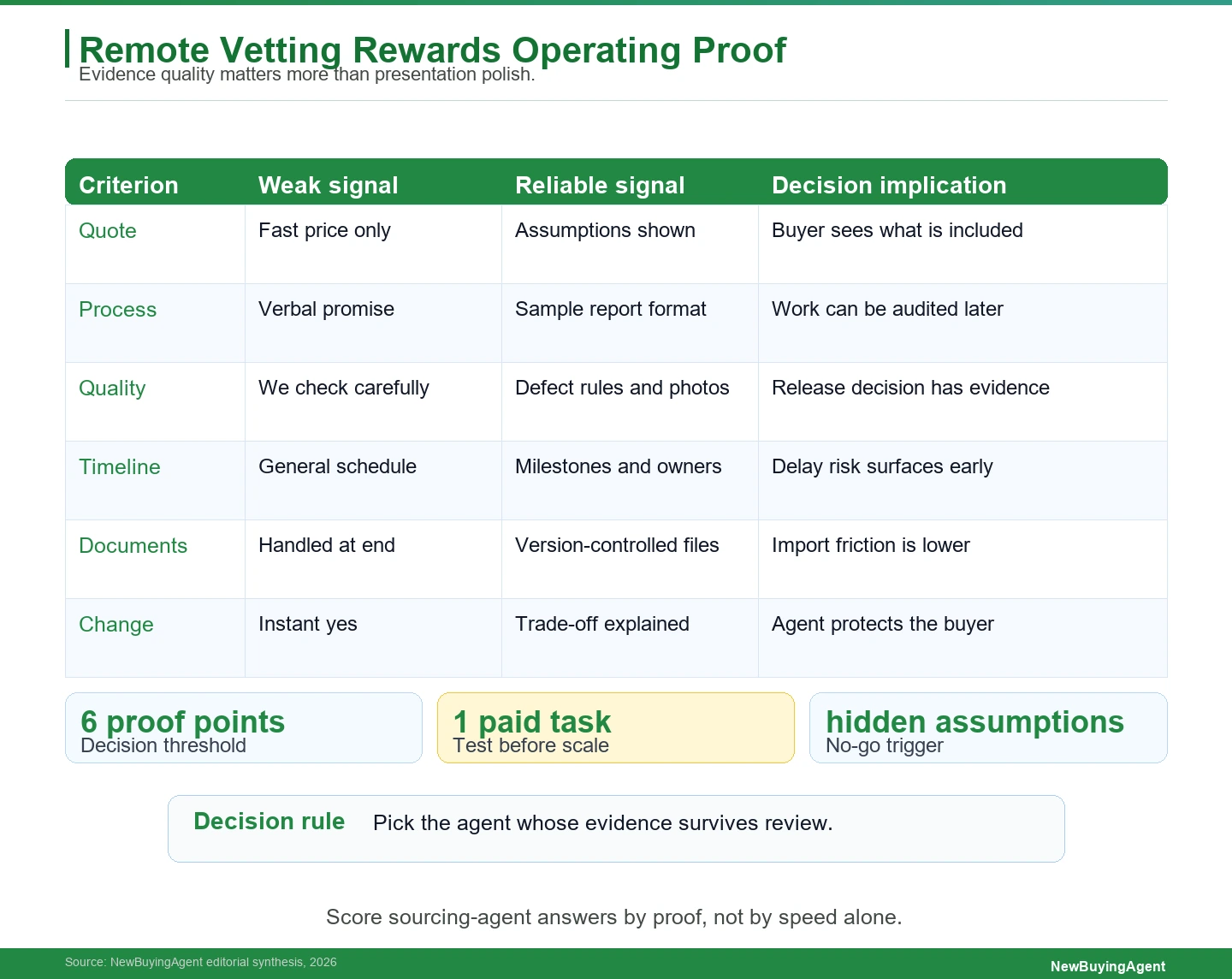
A remote sourcing-agent decision should reward operating proof over presentation polish; the best answer is the one your team can audit later.
A Remote Vetting Scorecard You Can Actually Use
The scorecard below is not a formality. It is a way to separate trust signals from working signals. Trust signals include years in business, testimonials, and professional presentation. Working signals include how the agent defines acceptance criteria, records updates, handles defects, and explains pricing. You need both, but working signals should carry more weight.
Identity and Business Continuity Evidence
Ask for the agent's legal business name, operating address, contact structure, team roles, and invoicing entity. Confirm that the people you speak with are the people who will remain involved after deposit. A reliable partner should not disappear behind a generic inbox once the order becomes active.
You should also ask how work is covered if the main contact is unavailable. Remote buyers often underestimate continuity risk. The agent may sound capable, but if knowledge lives in one chat thread with one person, a holiday, resignation, illness, or overloaded schedule can turn into a silent production gap.
Process Evidence, Not Just Promises
A strong sourcing agent can show sample formats: requirement intake, quotation assumptions, production status updates, inspection photo logs, defect escalation notes, and shipment handover records. These do not need to reveal confidential client data. They can be sanitized. What matters is whether the agent has a repeatable way to record decisions.
If the agent says every project is different and therefore no process sample exists, be careful. Product categories do differ, but the need for clear requirements, version control, quality evidence, and payment milestones does not disappear. A complete absence of working templates often means the buyer will become the process designer.
Commercial Behavior Under a Real Quote Test
Give the agent a realistic product brief and ask for a quote with assumptions. The goal is not to get the cheapest answer. The goal is to see whether the agent asks intelligent questions before quoting. A reliable agent will clarify material grade, packaging expectation, test requirements, order quantity, destination, timeline, and acceptable alternatives.
Watch for quotes that look precise but hide the real assumptions. If the quote does not specify packaging, inspection scope, sample cost, tooling, freight condition, payment timing, or document responsibility, the price may be a placeholder. Placeholder pricing can feel fast during vetting and become expensive during execution.
Evidence of Quality and Compliance Thinking
A useful quality system does not need to be overcomplicated, but it should borrow the logic of documented processes. ISO 9001 is a helpful reference for process consistency, while ISO 19011 offers guidance on auditing management systems. A sourcing agent does not need to turn your order into a certification project, but they should understand why evidence, traceability, and corrective action matter.
Ask how the agent defines major, minor, and critical defects for your category. Ask what happens if a defect is found at inline stage versus final stage. Ask who approves rework evidence. If the answer is only, "we will check carefully," you do not yet have a reliable operating method.
Documentation Checks Before Any Deposit
Before deposit, the buyer should request a small but concrete evidence pack. It can include the agent's business registration or equivalent company identity document, invoice sample, standard service scope, sample report template, payment milestone description, and a written explanation of what happens if the production schedule slips.
If intellectual property is involved, do not rely on verbal comfort. The USPTO China resources page and IPR toolkits explain why buyers should treat IP protection as a jurisdiction-specific issue, and the USPTO China IP page is a useful starting point for understanding the landscape. Remote vetting should therefore include how samples, drawings, molds, artwork, and brand files are shared and controlled.
For document responsibility, buyers should also review Trade.gov guidance on common export documents. A sourcing agent can support documentation discipline, but the buyer still needs enough visibility to confirm product descriptions, commercial invoice details, packing list logic, and shipment records before goods move.
Commercial Tests That Expose Alignment
A small paid test is often more revealing than a long interview. Ask the agent to quote one product with two acceptable quality tiers, two packaging options, and a target shipping destination. Then ask them to explain which option they would recommend and why. A reliable agent should be able to discuss trade-offs without pushing only the cheapest or fastest path.
Another useful test is a change request. After receiving the first quote, change one important variable: add a retail carton, tighten a tolerance, change the finish, reduce the quantity, or require earlier delivery. The agent's response will reveal whether the first quote was built on real assumptions or copied from a loose template.
You should also test refusal. Ask whether an unrealistic target is possible. A reliable agent should be willing to say no, or at least explain the risk clearly. If every requirement is accepted instantly, the buyer may be hearing sales optimism rather than execution judgment.
Communication Tests During Live Work
Remote buyers often overvalue response speed and undervalue response quality. A fast answer that does not resolve the decision is not good communication. During vetting, ask for one update in the format you expect during production: status, open risks, evidence received, next action, owner, and deadline.
The update should be concise enough for a busy buyer to read but specific enough to support decisions. For example, "production is on schedule" is weak. Better: "metal frames are 60 percent welded, powder coating starts Friday, packaging sample is pending buyer approval, and carton drop evidence will be sent before final packing." The second update gives the buyer something to manage.
Also check channel discipline. If important decisions are scattered across chat messages, emails, calls, and unlabelled files, remote coordination becomes fragile. A reliable agent should be able to summarize decisions and keep version-controlled records, even when daily communication happens through fast channels.
One more remote test is useful: ask the agent to restate your brief in their own words before quoting. This reveals whether they understood the product, commercial priority, destination constraints, packaging expectation, and approval sequence. If the restatement is shallow, the quote will probably be shallow too. If the restatement identifies open questions and risk points, the buyer has a stronger basis for deciding whether the agent can think beyond a transactional price request.
How NewBuyingAgent Should Be Evaluated in This Model
When a buyer shares product specs, volume, target price, destination, and timing, NewBuyingAgent quotes and supplies China-sourced products covering product selection, cost negotiation, quality management, production follow-up, logistics, and delivery. In remote vetting, buyers should evaluate whether that quote-to-supply path gives them enough evidence to make commercial decisions without being physically present.
The best starting point is to compare your project against the public service scope on the what we do page, review practical context in the China sourcing guide, and look at the case examples to understand the kinds of execution problems that typically need structured follow-through.
A buyer does not need to fly to China to ask hard questions. Ask what evidence you will receive at each stage, how exceptions are escalated, what is included in the quote, and where your approval is required. If the answers are clear before deposit, the relationship starts with a better operating baseline.
Red Flags That Justify a No-Go
- The agent will not provide a written scope or quote assumptions.
- The agent avoids explaining how inspection evidence and corrective actions are recorded.
- The agent accepts every target price, deadline, or material request without qualification.
- The agent cannot separate sample approval from mass-production release.
- The agent treats packaging, labels, and documents as late-stage details.
- The agent refuses a small paid test but asks for a large commitment.
- The agent cannot show who owns communication after deposit. Buyers who want to structure a remote qualification conversation can start through the contact page.
Frequently Asked Questions
Can I choose a China sourcing agent without visiting China?
Yes, if you replace travel with evidence. Remote vetting should include business identity checks, process samples, written quote assumptions, a small real task, communication testing, and clear release rules before larger money is committed.
What is the strongest sign of a reliable sourcing agent?
The strongest sign is not a low quote or a friendly call. It is the ability to explain trade-offs, document decisions, provide stage-by-stage evidence, and handle exceptions without hiding uncertainty.
Should I ask for factory photos during remote vetting?
Factory photos can help, but they are not enough. Ask for dated production evidence, inspection samples, document flow, and a clear explanation of how your product requirements will be controlled after the order starts.
How much should the first test order prove?
A first test should prove communication, quote clarity, sample handling, defect escalation, and shipment handover. It does not need to prove every future scenario, but it should show whether the agent's process survives real work.
Is the cheapest sourcing agent usually the riskiest?
Not always. The bigger issue is unexplained cheapness. If an agent can show what is included, what is excluded, and why the cost is lower, the quote may be legitimate. If the assumptions are hidden, the risk is high.
What should I ask before paying a deposit?
Ask for the written scope, quote assumptions, sample timeline, payment milestones, quality evidence plan, packaging responsibility, document responsibility, escalation path, and the person who will own day-to-day updates after payment.
NewBuyingAgent
Related Resources

Get Started Today
Let's Turn Your Sourcing Goals into RealityWeChat:+86 15157124615
WhatsApp:+86 15157124615
Address:Building 10 #39 Xiangyuan Road, Hangzhou, China
