

A Chinese supplier's ISO certificate can be genuine and still cover a different company, factory, or activity from the one offered for your order. To verify ISO certificate scope, compare the complete certificate and its annexes with the supplier's proposed responsibilities, then confirm current coverage independently. The useful outcome is a documented qualification decision, rather than a folder containing an impressive-looking certificate.
ISO certificate scope is the stated boundary of certification: the organization, locations, products or services, and activities covered by the certified management system.
What Must Match Before You Rely on the Certificate?
Rely on a certificate for supplier qualification only when its certified entity, operating sites, activities, and current status support the role you need. Match those boundaries to the proposed order before treating certification as a fulfilled purchasing condition. A valid record answers whether certification exists; it does not automatically answer whether the supplier's proposed work falls inside that certification.
- Entity: Match the certified legal entity to the company and factory taking responsibility for the work.
- Scope: Read the full scope and annexes for the actual production site and required activities.
- Status: Confirm current status with the issuer and appropriate independent records.
- Decision: Keep unresolved coverage as a specific approval condition; assess product conformity separately.
Start with the Supplier Role You Need to Qualify
Define the supplier role before assessing its certificate: manufacturing, design, trading, assembly, or another responsibility may require different coverage. Write down which entity will perform the work, where it will happen, and why certification matters to your purchasing decision. This gives you a boundary to compare with the certificate and prevents a supplier's sales description from quietly expanding the certified scope.
For quality-system certification, this distinction is especially important. A quality management system means the processes an organization uses to manage and improve quality. ISO's supplier guidance explains that conformity to ISO 9001 does not substitute for product or service conformity. You still need the applicable product requirements, specifications, and acceptance evidence.
Start a qualification checklist with the proposed manufacturing location, responsible legal entity, required operations, and your certification condition. Specify whether that condition comes from your contract, internal supplier policy, or a customer's requirement. If certification is simply supporting evidence, record that distinction too. Certification is a purchasing condition only where the applicable requirements make it one.
The China sourcing guide provides broader purchasing context. Keep certificate review connected to the actual product, commercial terms, and delivery needs rather than allowing one document to replace supplier qualification.
An active certificate for a different operating boundary does not establish certified coverage of the proposed work. The practical question is whether the right company, site, and activity are covered for the role you are approving.
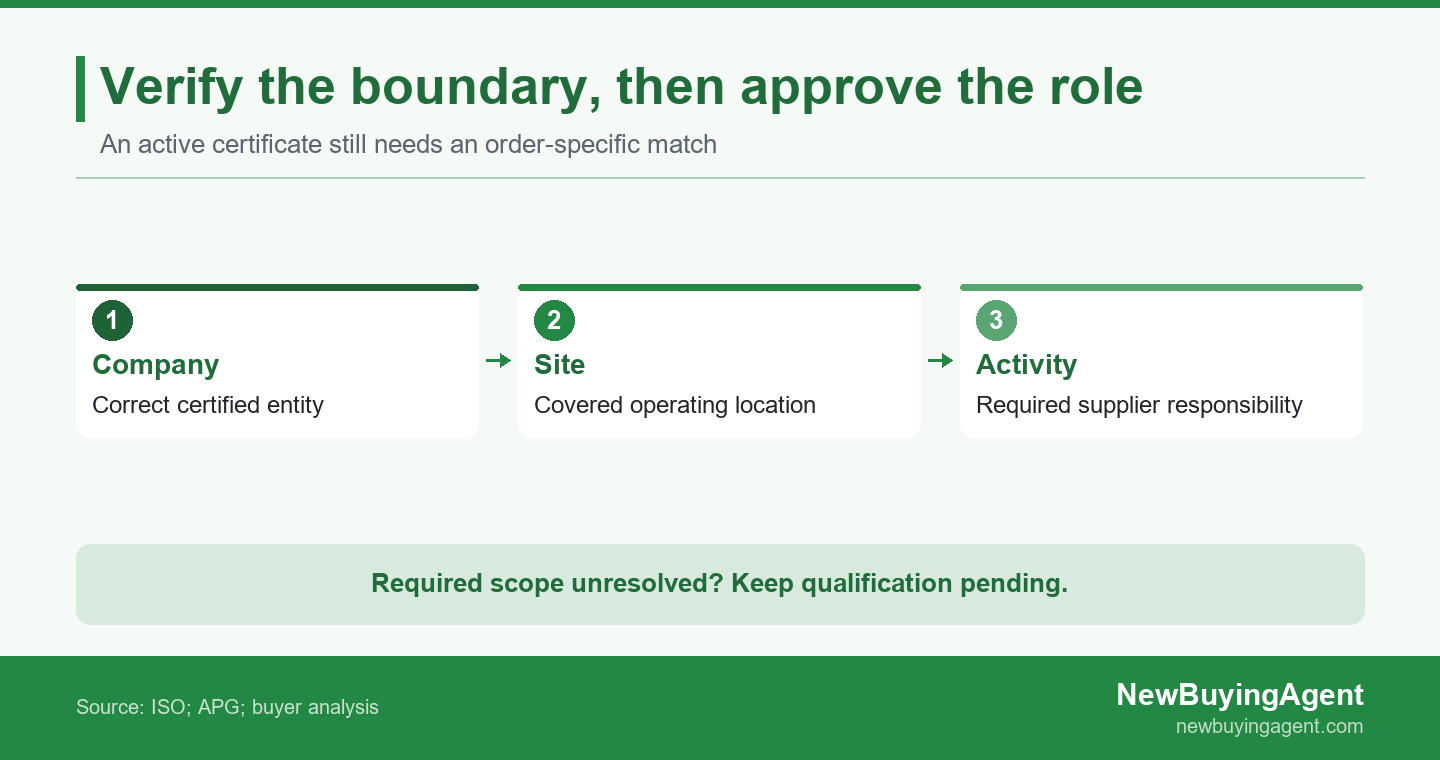
Match the certified company, site and activity to the proposed supplier role before qualification.
Match the Certified Entity and Operating Sites
Compare the certificate holder and covered locations with the supplier's contractual and operational identities, using the full certificate rather than a cropped image. A company name match is insufficient when a different affiliated entity or unlisted factory will manufacture the order. Resolve translation differences and address changes with documentary evidence, while keeping genuinely different entities and sites separate in your qualification record.
Request the complete certificate, every referenced annex, and the supplier's explanation of the production assignment. Record the certificate number, standard, issue and expiry dates, issuer, certified entity, scope wording, and site addresses. Keep the original wording alongside any English translation. A missing annex is a missing part of the boundary, even when the front page looks complete.
These are recognizable verification fields: IAF CertSearch's information guide lists scope, certified locations, certification-body information, and accreditation-body details. Compare the available record with the document; do not stop at a green status indicator.
If the contract names a trading company but manufacturing is assigned to another entity, identify which role each certificate supports. An affiliate relationship does not, by itself, make all group companies certified. Ask for evidence that connects the certified legal entity and listed locations to the proposed work.
For an address mismatch, ask whether it is a spelling variation, an administrative rename, or a physical relocation. Keep the qualification condition open until the explanation is supported. A salesperson's assurance that two addresses mean the same factory cannot replace confirmation of the certified boundary.
Read the Activities, Products, and Boundaries
Read the scope as a description of covered operations, rather than as a broad quality endorsement. Compare its product or service categories and activity wording with the work offered for your order. Manufacturing, design, sales, and distribution describe different responsibilities; a broad phrase may need clarification before you can decide whether the required operation is included at the relevant site.
The 2016 ISO 9001 Auditing Practices Group scope guidance discusses identifying covered product or service types, locations, and main operational processes. It is educational auditing guidance, not a certification decision or an independently binding requirement for your purchase.
Build a scope matrix with your required responsibility in one column and the certificate's exact wording in another. Mark the match as supported, unclear, or outside the supplied scope. Avoid silently translating “sales of metal products” into “manufacture of your metal component.”
For a new purchase, NewBuyingAgent’s product-supply service combines local China factory resources with product-development and quality-control capability. Define the product, required activities, and certification condition together so factory pre-vetting and the product offer address your actual purchasing needs. The aim is a suitable product supply arrangement, with quality and commercial requirements considered together.
Separate Design Responsibility from Manufacturing
Manufacturing scope alone does not establish certified coverage of design responsibilities being offered. If you supply a finished drawing and the factory only builds to it, assess that manufacturing role. If the supplier will develop the design, choose materials, or change dimensions, identify that additional responsibility and check whether the supplied certification evidence addresses it.
The distinction matters when a quotation promises engineering changes that the certificate does not clearly cover. Ask who controls design revisions, who authorizes substitutions, and which organization owns the resulting technical record. Then direct any certification-scope question to the issuer instead of asking the salesperson to interpret an unclear boundary.
You may still evaluate design capability through other evidence. Keep that evaluation separate from a claim that design is included in certified scope, and respect any contractual requirement that specifically calls for such coverage.
Check Outsourced Work and Additional Locations
An outsourced operation needs an explanation of the applicable controls and responsibilities. Its existence alone neither proves nor disproves certification coverage. A certified manufacturer may use external processes, but that does not justify claiming that every subcontractor holds the manufacturer's certificate.
Ask the supplier to distinguish its own covered activities from external processing. For example, if a component is manufactured at a listed site and surface treatment is outsourced, establish who specifies, approves, and checks that treatment. If the complete manufacturing assignment moves to another factory, examine the new site and entity rather than treating the move as a minor purchasing detail.
For a certificate that references multiple locations, obtain the annex connecting each location to its activities. Headquarters, sales offices, warehouses, and production sites may perform different work. A location list without that distinction may leave your intended manufacturing role unresolved.
Keep the issuer question precise: does the current certification cover the named entity's specified activity at the stated address, and where is that coverage documented? Operational controls and certification boundaries need related, but separate, answers.
Verify Current Status and the Issuing Body
Confirm current certificate status through an independent route, then check whether the issuer and any accreditation claim are appropriate for the certification presented. Use an official issuer website or contact obtained independently, rather than relying solely on a link printed on the supplier's file. Save the dated result and any clarification of scope, because a historical PDF cannot establish today's status.
ISO's certification explanation states that ISO does not issue certificates and describes accreditation as independent confirmation of competence. Verify the certification body and its relevant accreditation scope where accredited certification is required; an ISO logo is not an issuer confirmation.
If a database search produces no match, verification remains unresolved. IAF CertSearch's verification guidance identifies possible reasons including data not being added, confidential naming, or a removed certificate. A negative search alone does not establish fraud. Check the number, naming, and issuer directly before drawing that conclusion.
Use the issuer's own process when clarification is needed. The SGS certified-client directory, for example, accepts a certification ID or company-and-location search and directs unresolved verification questions to SGS. Ask for the current full scope and annex, not merely confirmation that a number exists.
Use Chinese Records with Their Actual Coverage
SAMR's certificate-query notice, effective September 30, 2026, requires Chinese authorized certification bodies to provide free, real-time validity lookup through an issuer channel. CNCA basic-information lookup covers certificates issued under CNCA rules; certificates under a body's own rules use that body's channel. Do not assume that CNCA is a universal directory of every certificate.
The notice separates issuer validity queries from national basic-information queries. An issuer cannot substitute a redirection to CNCA for its own required validity-query provision. For your review, identify the applicable certification rules first, then use the appropriate channel and retain the response.
Where CNAS accreditation is claimed, the CNAS information-query links provide separate routes for certification-body information and certification-certificate information. Use the body route to investigate the relevant accreditation claim and approved scope. Accreditation of a certification body is different from certification of your supplier, and neither substitutes for matching the supplier’s site and activity to the order.
If the records conflict, identify the conflicting field and seek a written issuer explanation. Keep the associated approval condition open while the conflict is resolved; do not quietly choose whichever record is more convenient.
Choose Clarification, Conditional Approval, or a Hold
Approve only the supplier role supported by the evidence, and keep unmet contractual certification conditions open. A spelling difference may need clarification, while an unlisted production site may prevent approval under your purchasing rules. The decision should identify what remains unverified, who can resolve it, and whether any work may proceed before that condition is satisfied.
This scope matrix compares four illustrative findings against a buyer-defined requirement for certified manufacturing at the assigned site. It is a qualification aid, not a universal legal approval rule. Product conformity and other purchasing conditions remain separate.
| Finding | What is established | What remains open | Qualification decision |
|---|---|---|---|
| Entity, site, activity, and current status match | Required manufacturing coverage is supported | Product acceptance and other conditions | Accept this certification condition |
| Address spelling differs | A potentially matching certified site | Documented identity of the location | Clarify before recording a match |
| Scope covers sales, not manufacture | Certified trading activity | Required manufacturing coverage | Hold manufacturing qualification |
| Assigned production site is absent from supplied annex | Coverage at listed sites | Coverage of the assigned site | Hold the site-specific condition |
Based on this comparison, the severity of the mismatch comes from the responsibility it leaves unsupported. Conditional approval must state its limits and cannot override a mandatory purchasing condition without an authorized change.
Example: The Certificate Covers a Different Furniture Site
Consider an illustrative 1200-chair order for folding metal chairs. Before purchase-order approval, the buyer requires certified manufacturing at the actual production site. The supplier provides an active certificate describing metal-furniture manufacture at Plant A, but its production proposal assigns final manufacture and assembly to Plant B. This is an example, not a reported NewBuyingAgent client case.
The supplied annex does not list Plant B. The buyer has evidence of a certified manufacturing boundary, but not of the boundary proposed for the 1200-chair order. An attractive factory video or a promise that the plants share ownership does not close that specific evidence gap.
The buyer asks for the complete current annex and an issuer confirmation identifying the covered locations and activities. Manufacturing qualification for Plant B stays on hold. A production visit may help assess operations, but it cannot extend the certificate's scope.
The resulting decision depends on the response. If only Plant A is covered, the buyer can consider assigning the order there after checking capacity and timing, or qualifying Plant B with the required evidence. Any exception needs the buyer's authorized approval and must be permitted by the contract. Until one route is established, the result is a bounded hold, rather than an assumed successful qualification.
Keep a Qualification Record That Survives Supplier Changes
Save an approval record that connects the certificate to the entity, site, activity, and order responsibility actually reviewed. Include the issuer check, open conditions, decision owner, and changes that trigger another review. This prevents a later buyer from reading “ISO certified” in a supplier file and applying the approval to a different factory or newly offered responsibility.
Make the qualification checklist usable by someone who did not conduct the original review. Store the complete document and annex, the exact scope wording, the independent verification date and result, and the reason the certified boundary meets the purchasing condition. Record pending questions as conditions with an owner, rather than burying them in email.
Reopen the relevant check when the legal entity, manufacturing location, design responsibility, external processing arrangement, or certification status changes. An unchanged repeat-order quantity does not make an altered production assignment acceptable. Keep order acceptance evidence alongside, but distinct from, the certificate-scope conclusion.
For an established supplier, NewBuyingAgent’s China-side factory management uses a local team and quality-control capability to support production progress and order-quality decisions. Name the existing factory, assigned work, and unresolved production questions when defining that support. It can reduce your coordination burden while keeping production and inspection evidence connected to the order; certification coverage still requires issuer evidence.
For a new China purchase, send the purchasing requirements: product specification, quantity, target price, destination, and delivery timing, together with the certificate and proposed site details. NewBuyingAgent can use its factory resources to develop a product-supply offer around those needs. State the certification condition explicitly so supplier qualification, the FOB quotation, and order-quality expectations start from the same purchasing brief.
Frequently Asked Questions
Does an ISO 9001 certificate certify the product?
No. ISO 9001 certification concerns the quality management system within its certified scope, not conformity of every product supplied. A buyer still needs the product specification, applicable destination requirements, and suitable acceptance evidence. Treat the certificate as one supplier-qualification input. It cannot replace a required product certification, a relevant test report, or inspection against your order's acceptance criteria, and its scope must match the supplier responsibility being assessed.
Does a missing database result mean the certificate is fake?
No. A missing result means the search has not resolved verification; it does not by itself prove that the certificate is fake. Check the certificate number, entity name, and applicable directory coverage, then contact the issuer through an independently obtained official channel. Request current status and complete scope evidence. Keep any required qualification condition open while the response is pending instead of treating either a negative search or a sales assurance as conclusive.
Can a trading company have a valid ISO certificate?
Yes. A trading company can hold management-system certification for the activities stated in its certified scope. That may support a trading, sales, or distribution role without demonstrating certified manufacturing at the factory producing your goods. Identify the manufacturer and its location separately when your qualification condition requires manufacturing coverage. Check what the trading company's certificate actually covers before accepting or rejecting it for the responsibility you intend to approve.
Should scope be checked again for repeat orders?
Yes. Recheck relevant scope and status when the certified entity, production location, responsibilities, certification record, or purchasing condition changes. Do not assume that a previous approval covers a newly assigned factory or an added design role. Retain a dated verification record and define review triggers in your supplier file. Repeat-order familiarity may make the commercial discussion easier, but it does not extend the certificate's documented boundary to changed work.
NewBuyingAgent
Related Resources


Get Started Today
Let's Turn Your Sourcing Goals into RealityWeChat:+86 15157124615
WhatsApp:+86 15157124615
Address:Building 10 #39 Xiangyuan Road, Hangzhou, China
