

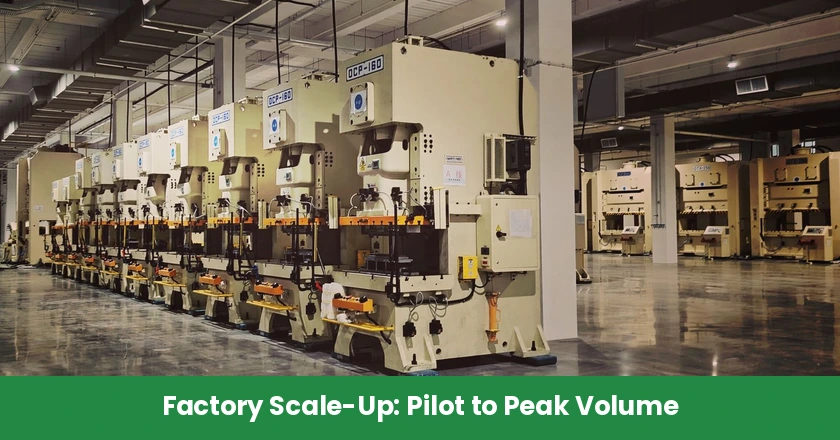
A successful pilot shows that a Chinese factory can make the approved product under the conditions tested. It does not establish that the factory can repeat that result throughout a peak order. To verify scale-up, connect the actual production route to its good-unit output, the resources supporting that rate, and the hours available before the delivery deadline. The useful result is a supported quantity and schedule, with clear conditions for increasing volume.
What Peak-Volume Readiness Actually Requires
Peak-volume readiness combines product quality, sustained output, and availability. Before releasing the peak quantity, verify the intended process route, its limiting operation, downstream inspection and packing, material supply, trained staffing, any subcontracted work, and the production calendar. Treat these as connected checks: an idle molding machine cannot compensate for an overloaded finishing station, and a strong hourly rate cannot compensate for hours already allocated to another order.
- Demand: Define the peak as acceptable units by variant and date, rather than a monthly factory total.
- Production conditions: Observe the route that will make the order, including normal workers and quality checks.
- Output calculation: Reconcile measured good output with reserved usable hours, without counting losses twice.
- Volume release: Release larger quantities only after the trial closes the specific gap that could prevent delivery.
Define Peak Demand and Follow the Slowest Process
Peak demand is a dated requirement for acceptable products, not simply a larger purchase-order quantity. List units by product revision and variant, required shipment dates, and the manufacturing window that remains after material receipt and product approval. Then follow every operation to identify the bottleneck, the slowest process that limits output of the route. The relevant question is whether that step can deliver enough good output during the actual peak window.
Start with a route map: material preparation, forming or assembly, finishing, testing, packing, and final release. Include waiting stages such as curing, drying, or outside finishing. The EPA’s cellular-manufacturing guidance describes mapping product routes and measuring operation cycle times and transfers between operations. For a buyer, this is a useful way to find what the supplier’s headline machine count leaves out.
The limiting step deserves more attention than the fastest machine. NIST’s manufacturing research identifies a bottleneck as the machine that most impedes production-line throughput. A backlog before a station is a reason to investigate that station, although it is not sufficient evidence by itself. Ask whether the delay reflects processing speed, missing material, quality holds, or scheduling. Each cause needs a different correction.
Next reconcile the rate with the calendar. Request the hours allocated to this product on the limiting equipment, with existing work, maintenance, changeovers, and planned shutdowns identified. Separate an installed machine from an available machine. If the factory’s calculation assumes both shifts are free but only one is reserved, its rate cannot support the proposed delivery quantity. Keep the quantity conditional until the supplier confirms the usable hours in writing.
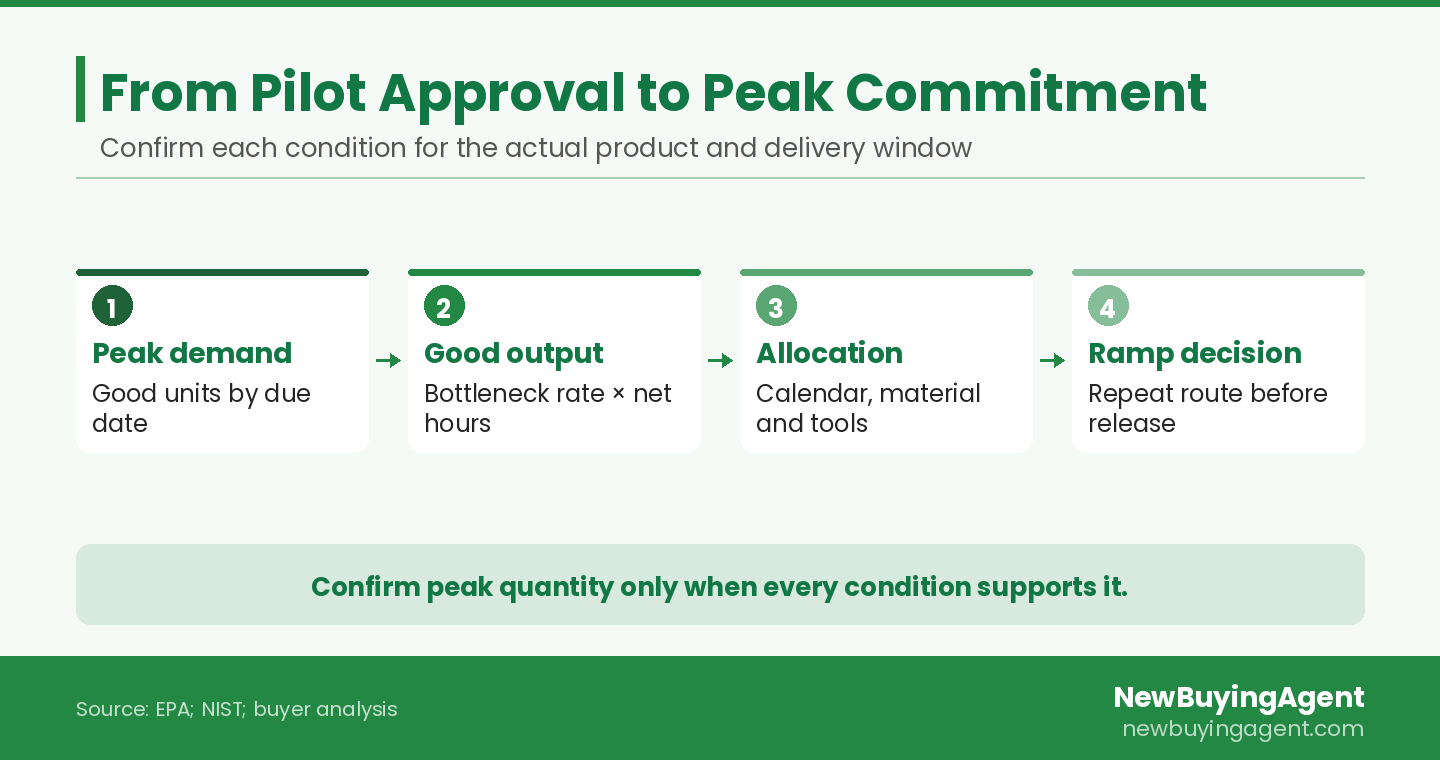
Peak-volume commitment follows demand, measured good output, allocated resources, and a verified ramp decision
Test the Production Route That Will Make the Peak Order
A useful ramp trial uses the production route intended for the peak order, with departures documented. Confirm tooling, material grade, product revision, process settings, operators, inspection method, and packing arrangement before the run. A sample-room technician hand-finishing a few excellent pieces may prove the design, but that result does not establish output from the regular line. The trial should answer the unresolved production question, rather than repeat a sample approval.
Use the China manufacturing and product guide to identify category-specific processes worth checking, then request records for the actual product. For a household item, that might mean mold and fixture identifiers, a material lot, an approved finish reference, and packing instructions. Record any extra technicians, borrowed equipment, or unusually favorable conditions. If those resources will not be available during peak production, their output should not form the delivery promise.
Measure Good Output on the Bottleneck
Count good units over a defined time period and keep the loss records beside the count. A gross machine rate measures pieces started or produced, whereas the buyer needs products that satisfy the agreed acceptance criteria. State whether the denominator is scheduled time, time after planned exclusions, or machine-running time. A rate without that definition cannot be multiplied reliably by the factory’s proposed shift hours.
Vorne’s OEE calculation method separates availability, performance, and quality losses. Its quality factor uses good count relative to total count and excludes parts requiring rework from first-pass good output. That distinction helps explain why a fast machine can still deliver fewer usable pieces. It does not establish an OEE percentage that every supplier must reach.
Ask for time-stamped output, rejects, rework, stops, and the reasons for each stop. Reconcile the tally with the inspection record and quantities transferred to packing. If an observed good-unit rate already includes rejects, do not multiply it by another yield factor for the same rejects. Likewise, avoid subtracting the same changeover from both measured time and future available hours. Keep the calculation simple enough that production and purchasing can reproduce it.
Keep Quality Checks Valid at Higher Speed
Higher speed is useful only if the product still meets the agreed criteria and the checking method can detect relevant defects. Keep the approved dimensions, appearance, function, and packing requirements visible during the ramp trial. Ask whether the faster run changes cooling, curing, handling, test time, or operator workload. A higher piece count accompanied by unresolved quality holds is not a verified increase in deliverable output.
Quality capability and production capacity answer different questions. NIST’s process-capability definition compares output from an in-control process with specification limits. A capability index can inform a dimensional-quality assessment, but it is not a count of production hours available for your order. Ask which characteristic, product revision, operating conditions, and measurements the supplier’s study covers.
The time pattern also matters. NIST’s process-stability guidance describes stability as a constant mean and variance over time and places demonstrated stability before capability assessment. In practical terms, a pooled average can conceal deterioration late in a shift. Have the factory retain measurements in production order so its quality staff can investigate changes instead of showing only one favorable summary.
The buyer and supplier should agree how a concerning trend, failed check, or changed setting affects the next production step. Use a qualified quality specialist when statistical interpretation is necessary. Do not impose a universal capability-index threshold or assume that every product requires the same study. The evidence should match the characteristic that matters and the risk created by increasing the rate.
Check the Resources That a Second Shift Does Not Create
A second shift adds working time only when the supporting resources can sustain it. It does not create another mold, trimming fixture, drying area, material batch, test instrument, or subcontractor allocation. Check the resources at the limiting step and those immediately after it. A credible plan names what is available, when it is available, and who will operate or maintain it; a headcount promise alone leaves those questions unanswered.
The scope of SGS’s vendor assessment and technical audit includes current and projected workload, equipment capabilities, material controls, and personnel resources. These are useful categories for structuring a supplier discussion. The service description does not certify the capacity of an individual factory, so request the supporting records for your own order rather than treating an audit label as the conclusion.
- Materials: confirm released quantities, receipt dates, storage needs, and the effect of a missed delivery.
- People: identify normal operators, trained substitutes, shift supervision, maintenance coverage, and inspector availability.
- Shared equipment: verify tool and fixture access, planned maintenance, and other products using the same stations.
- Outside work: identify the producing site, its allocated slot, transport time, acceptance checks, and responsibility for defects.
For an existing China supplier, the practical difficulty is often comparing the promised shift plan with what is happening on the floor. NewBuyingAgent’s factory-management service covers supplier communication, production progress, quality management, and logistics. Its China-side quality-control capability is relevant when extra shifts could weaken consistency or delay completed goods. Prepare the PO, approved sample, current output records, and shipment schedule so the factory-management scope follows the specific order.
An alternative route also needs evidence. If a spare machine requires another tool or outside finishing moves the bottleneck to transport, the recovery plan may not restore the required output. Ask for a recent demonstration or a planned verification of the proposed alternative. Do not count backup capacity twice when it is also the resource supporting the original schedule.
Use a Ramp Trial to Set the Release Decision
A ramp trial should produce an explicit quantity decision, with an owner and timing agreed before production starts. Identify who confirms the route, records output and losses, checks the product, and approves the next volume increase. Agree when results will be available and what happens if a condition is missed. This prevents a trial from becoming an informal factory demonstration followed by an unsupported peak-order promise.
Use staged decisions that address the actual uncertainty. If the remaining issue is shift-to-shift output, observe the normal shift change. If it is material variation, include the relevant production material. If it is packing backlog, follow goods through packing rather than ending observation at the forming machine. There is no single trial duration that demonstrates all of these conditions.
A short ramp record can contain the planned quantity, actual accepted output, usable hours, quality findings, unresolved constraints, corrective action, and the next decision date. Ask the production owner to explain the gap and the quality owner to confirm whether the product remains acceptable. If the correction changes equipment or the producing site, verify that changed route before relying on its projected rate. Escalate a missed condition before issuing the next firm release, with a revised delivery option for purchasing to evaluate.
Why a 500-Unit Pilot Does Not Prove a 12,000-Unit Peak Order
Illustrative example: an importer approves a 500-unit pilot of molded household bins and requests 12,000 acceptable units within ten working days. These are assumed figures, not factory benchmarks or a NewBuyingAgent customer case. The factory proposes two shifts, but the pilot has not established whether the trimming and checking fixture can support the peak quantity.
The assumed route produces molded pieces at 100 units per hour, while its trimming and checking fixture delivers 75 accepted units per usable hour. Packing can handle 90 per hour. The factory has reserved 140 usable hours after breaks, planned setup, and other customers’ work are deducted. For these household bins in the illustrative example, 75 good units per hour across two shifts of seven net hours for ten working days yields 10,500 units, below the 12,000-unit peak request. The shortfall is 1,500 units. Faster upstream molding and packing cannot remove the trimming and checking fixture constraint.
The buyer therefore declines to confirm the unchanged ten-day plan. An added fixture is one option, but its effect on quality and the next limiting step remains unverified. In the illustrative example, reserving twelve working days at the same 75-good-unit hourly rate provides 168 usable hours and 12,600 units. Repeated normal-staff trials and the booked calendar support a staged twelve-day delivery plan. The buyer pursues that option and confirms all reserved usable hours before agreeing delivery of the requested peak quantity.
In this illustrative example, the extra 600 calculated units are headroom, not a guarantee against every disruption. A material delay or unexpected stop can still change the plan. The final decision also depends on whether the importer can accept the later delivery. If the deadline cannot move, the original route remains inadequate until another feasible route is demonstrated.
Put the Capacity Conditions in the Supply Commitment
The supply commitment should preserve the conditions that made the peak quantity credible. Record the approved product revision, acceptable quantity by date, allocated production resources, verified route, and response to a missed ramp condition. Include how changes will be disclosed and approved. Otherwise the supplier may quote against one route, prove another, and manufacture on a third while the buyer assumes the original evidence still applies.
Revalidation triggers should be specific to the product and agreement. As a sector-specific example, Ford’s June 2026 PPAP requirements identify demand exceeding verified capacity and specified operating-pattern, process, and tooling changes as submission triggers. Those are Ford automotive requirements, not universal obligations for Chinese consumer-goods factories. The transferable lesson is to agree which changes require renewed evidence before they become part of your delivery commitment.
For a new product-supply project, a buyer may have a firm launch quantity without reliable access to factories that fit the product’s materials and processes. NewBuyingAgent is a one-stop China sourcing agent service provider for global buyers. Its local China factory resources and product-development and quality-control capability support NewBuyingAgent’s product-supply service, turning purchasing requirements into quoted China-sourced products. A pilot-to-peak forecast helps that supply brief reflect the intended production scale rather than just the sample quantity.
Keep the written terms practical: quantity and revision, shipment milestones, the verified production assumptions, approved alternatives, and the person responsible for reporting a missed condition. Distinguish factory completion from arrival at the destination. Production capacity alone does not establish freight availability or the time needed for import procedures. Purchasing should evaluate any revised schedule against the buyer’s actual launch or replenishment need.
If the project needs a new China product-supply quote, send the purchasing requirements to NewBuyingAgent with product specifications, peak quantity by variant, target price, destination, and delivery timing. Include the pilot result, the intended ramp dates, and any delivery flexibility. That gives NewBuyingAgent context to quote product supply around the quantity, quality, and timing the buyer needs, rather than relying on an untested peak forecast.
Frequently Asked Questions
Is a short factory visit enough to verify peak production capacity?
A short factory visit can reveal obvious constraints, but it rarely establishes repeatable good output over the planned shifts and delivery window. Use the visit to trace the route, compare records with the floor, and identify the next observation needed. A prepared demonstration is particularly limited if it uses extra staff or borrowed equipment that the peak order will not have.
How much spare capacity should a buyer require before peak season?
The useful spare-capacity margin comes from the order’s demand uncertainty, observed losses, and recovery options, rather than one universal percentage for all factories. Test a realistic downside, such as a missed material delivery or unavailable fixture, and see whether the remaining schedule still works. More nominal spare machines do not help when they share the same unavailable tool or trained operator.
Does an ISO 9001 certificate prove a factory has enough capacity?
An ISO 9001 certificate does not quantify available output for a particular order, so buyers still need product-specific production evidence and an allocated calendar. Treat the certificate as a separate management-system document and verify its stated scope and validity. It should not replace the route, rate, and workload records needed to support the requested quantity and delivery date.
What if the factory will not disclose its other customers?
A factory can show anonymized machine loading and reserved production hours without naming other customers, while still allowing the buyer to check available capacity. Request hours by station, date, product family, and commitment status. If confidentiality prevents even that limited evidence, record the allocation as unverified and avoid treating the full installed capacity as available for your order.
NewBuyingAgent
Related Resources



Get Started Today
Let's Turn Your Sourcing Goals into RealityWeChat:+86 15157124615
WhatsApp:+86 15157124615
Address:Building 10 #39 Xiangyuan Road, Hangzhou, China
