

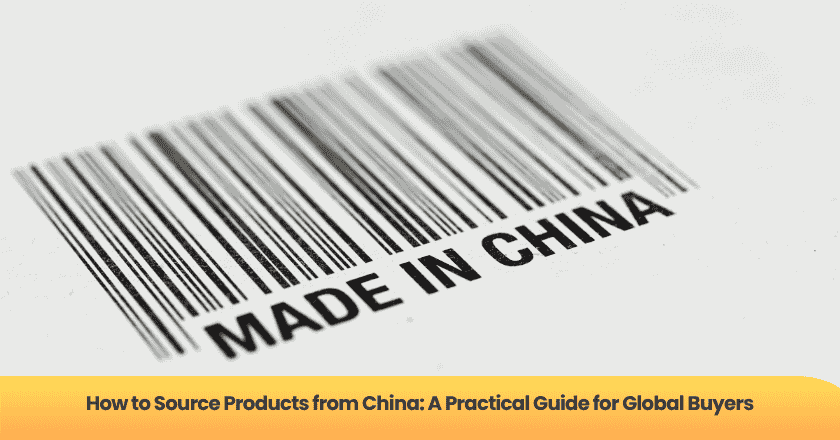
China supplies more than a quarter of the world's manufactured goods — and for most product categories, it remains the default starting point for serious buyers. But sourcing from China effectively is a skill, not just a transaction. The buyers who consistently save 5–10% versus comparable importers aren't doing so by accident; they operate with better systems, stronger factory relationships, and a clearer understanding of where cost actually leaks throughout the supply chain.
This guide walks through every stage of the sourcing process — from defining your product spec to clearing customs — drawing on practical experience from sourcing professionals, including insights from NewBuyingAgent, a one-stop China sourcing service backed by over 30 years of trade and manufacturing expertise under the ShiningHub Group.
Key Takeaways
- China remains the world's dominant manufacturing base across most product categories, and that position holds firmly in 2026
- A well-written product specification is the single most important document in any sourcing engagement — vague specs produce vague results
- Supplier verification requires more than an online profile; factory audits and reference checks are standard due diligence
- Quality control must be embedded throughout production, not bolted on at the very end
- Payment terms affect your true landed cost as much as unit price — negotiate both in the same conversation
- AI-driven product trend analysis is reshaping how buyers identify new products before committing capital to orders
- Choosing between direct factory sourcing and a professional full-service sourcing partner is a strategic decision, not a convenience choice
- Customs classification errors carry real financial penalties; verify HS codes before placing orders
China's Manufacturing Position in 2026
Despite recurring headlines about supply chain diversification, China's factory ecosystem holds a structural advantage that competing regions haven't meaningfully closed. Guangdong, Zhejiang, Jiangsu, and Fujian provinces together house hundreds of thousands of factories — each industrial cluster built around a specific product category. Yiwu dominates small consumer goods. Shenzhen drives electronics and smart devices. Foshan anchors furniture, ceramics, and building materials.
What makes this difficult to replicate elsewhere isn't factory count alone — it's the density of raw material suppliers, tooling specialists, component makers, and logistics operators concentrated within the same industrial zones. When a product needs modification — a revised colorway, updated component, or repackaged SKU — China's supply chain can turn it around in weeks. That responsiveness has real commercial value for buyers managing fast-moving catalogs.
In 2026, two additional factors reinforce China's position: the deployment of AI-assisted manufacturing (reducing defect rates and compressing lead times), and the maturation of cross-border logistics infrastructure connecting factories directly to overseas fulfillment networks. Both developments are operational at scale across major industrial zones.
Expert Tip: Don't assume coastal provinces always offer the lowest prices. Inland hubs like Chengdu and Wuhan are increasingly competitive on labor costs, particularly for assembly-intensive categories such as garments and light electronics.
Step 1: Define Your Product Requirements Before You Search
Most sourcing failures originate here — not at quality inspection, not at customs clearance. When buyers approach factories with vague specifications, they receive vague products back. A written product brief is the foundation everything else depends on.
A solid brief covers: material composition and grade, dimensional tolerances, required certifications (CE for EU markets, FCC for US electronics, FDA for consumables), target unit cost, Acceptable Quality Level (AQL — the statistical threshold defining what defect rate in a shipment is tolerable before rejection), packaging specifications, and estimated annual volume. Factories price differently for orders they expect to repeat; volume projections directly influence quote competitiveness.
For buyers developing new products rather than replicating existing ones, 2026 has introduced a meaningful shift in how early-stage research works. AI-powered market analysis tools now surface trending product categories by geographic region, drawing on e-commerce sales data, search volume trends, and social signals across platforms. Services have embedded this capability into their sourcing workflow — analyzing high-demand, market-winning products and feeding those insights directly into new product development recommendations, so buyers can act on data rather than intuition before committing capital.
Common Mistake to Avoid: Leaving "quality" undefined in the purchase order without a formal AQL. Without a documented threshold agreed before production begins, you have no contractual basis to reject a substandard shipment — regardless of how obvious the defects appear on arrival.
Step 2: Finding and Vetting Suppliers
Alibaba, Made-in-China.com, and Global Sources are the standard starting points for discovery and price benchmarking. The Canton Fair (held in Guangzhou each April and October) remains the most efficient venue for face-to-face factory evaluation at scale. Industry referrals — from other importers or sourcing professionals with direct category experience — often surface higher-quality factory contacts than any platform algorithm.
Once you have a shortlist, verification begins in earnest. Request the factory's business license, export license, and relevant product certifications. Critically, confirm whether the entity is an actual manufacturer or a trading company — an intermediary that purchases from factories and adds its own margin. Trading companies can offer advantages such as smaller MOQs or consolidated sourcing across categories, but you should know what you're paying for before accepting a quote.
Factory audits, conducted by your own team or a certified third-party inspection firm, remain the gold standard for supplier qualification. A structured two-day on-site audit covering production facilities, workforce conditions, and equipment maintenance history can prevent months of downstream problems. Sourcing operations with deep-rooted networks — some built over three decades, spanning tens of thousands of cooperative manufacturer relationships — can pre-qualify suppliers significantly faster because they've already accumulated the performance data.
Expert Tip: On Alibaba, treat "on-time delivery rate" and "response rate" as more meaningful signals than gold supplier status or total transaction volume. A factory consistently maintaining 92–94% on-time delivery is telling you something real. A paid platform badge is not.
Step 3: Sampling and Product Validation
Never commit to full production without reviewing physical samples. The sample stage is where your specification meets manufactured reality — and the gap between a product listing photograph and the actual item is frequently significant.
Request two rounds as a minimum. A pre-production prototype confirms design intent and material selection. A pre-production mass sample — pulled from the actual production run after it has started — confirms that line output matches the approved prototype. Factories sometimes produce exceptional samples under controlled bench conditions, then apply different standards to batch production. That second sample closes the gap before it becomes a container-load of rejected inventory.
Budget for sample freight. Most factories provide samples at nominal or no cost, but you cover international shipping — typically $40–$120 per express courier shipment depending on weight and origin.
Common Mistake to Avoid: Approving samples from photographs. Color accuracy, material texture, structural rigidity, and assembly fit are simply not verifiable from images, even high-resolution ones. Always assess the physical product before authorizing production.
Step 4: Pricing, MOQs, and Payment Terms
Unit price is just one variable in your true landed cost. The complete calculation runs: (unit price × order quantity) + quality inspection fees + export charges + freight (ocean or air) + destination country import duties + last-mile delivery. Buyers who focus exclusively on ex-works unit price while overlooking freight and duty implications routinely pay more than competitors who negotiated a slightly higher factory price but arranged better logistics terms.
MOQs vary dramatically by category — from 50 units for specialized components to 10,000+ for printed packaging — and are almost always negotiable for buyers offering advance payment or committing to a long-term relationship. Payment terms deserve the same negotiating attention. Standard new-supplier terms run 30% deposit against confirmed order, 70% balance against copy of the bill of lading (the document confirming goods are loaded and on board). Established buyers can negotiate net-30 or net-60 against shipment confirmation. Flexible credit terms affect working capital directly — particularly for buyers sourcing across multiple categories simultaneously. Letter of Credit (LC), a bank-guaranteed payment instrument, provides both-sides protection on large orders but adds processing time; for orders below $50,000 with established suppliers, T/T (telegraphic transfer) is standard.
Expert Tip: Negotiate price and payment terms in the same conversation, not separately. Offering a larger upfront deposit in exchange for a lower unit price is a legitimate and often effective tactic — factories respond to cash flow certainty as strongly as to volume commitments.
Step 5: Quality Control During Production
By the time goods arrive at your destination port, correcting a quality problem costs roughly ten times more than catching it during production. A structured QC program covers three stages: pre-production inspection (confirming raw materials meet spec before manufacturing begins), during-production inspection (checking workmanship at the 20–30% production milestone), and pre-shipment inspection (a random statistical batch check of finished goods before packing for export). Third-party inspection firms operate throughout China's manufacturing regions at roughly $200–$350 per man-day. Sourcing operations with on-the-ground QC networks can embed oversight at every stage with a continuity that remote management cannot replicate — NewBuyingAgent, for instance, maintains a network of over 20,000 trained product development and quality control specialists stationed across China's industrial clusters, monitoring production from raw material intake through to final shipment sign-off.
Common Mistake to Avoid: Relying on factory self-inspection reports as the sole quality record. A factory's internal QC checklist measures against their own standards, not yours. Always commission independent pre-shipment inspection for any order above a value threshold you cannot afford to reject outright.
Step 6: Shipping, Customs, and Import Compliance
Ocean freight — FCL (Full Container Load) or LCL (Less than Container Load, where your cargo shares a container and you pay only for the space used) — is the standard for most import orders. Transit times run 14–35 days by sea depending on routing. Air freight cuts that to 3–7 days at 4–6× the cost per kilogram, viable mainly for high-value, time-sensitive goods or urgent replenishment.
Engage your freight forwarder before production finishes, not after. Core documents for import clearance include the commercial invoice, packing list, bill of lading or airway bill, certificate of origin, and product-specific certifications required at the destination. Customs duties are determined by HS code — the Harmonized System classification number (six digits internationally, extended to eight or ten digits by individual countries) that defines the tariff rate applicable to your product. Misclassifying an HS code triggers penalties and delays that far exceed any short-term duty savings. Confirm the correct classification using your destination country's official customs portal before the order is placed.
Incoterms define where cost and risk transfer between buyer and seller. FOB (Free On Board, at the origin port) means the factory covers costs to the loading port; you own risk and cost from that point forward. DDP (Delivered Duty Paid) means the supplier handles everything through to your door — convenient, but it removes your control over freight selection and duty optimization.
Expert Tip: Most governments offer free online duty calculators on their customs portals. Run an HS code check on any new product category before committing. Getting this wrong after shipment is an expensive and entirely avoidable problem.
Step 7: Direct Factory Sourcing vs. Professional Sourcing Partners
Every growing importer eventually faces this question: manage China sourcing in-house, or work with a professional partner?
Direct factory sourcing gives you control, but it demands time, language capability, on-the-ground presence, and the bargaining leverage that only comes with substantial purchase volume. For buyers managing products across multiple categories, maintaining 10–20 factory relationships simultaneously is simply not scalable without a dedicated in-country team. Language barriers, time-zone gaps, and inconsistent factory reliability compound the problem fast.
Two distinct models dominate the professional sourcing services market. Traditional commission-based agents charge 5–20% on top of factory prices for supplier outreach and basic coordination — the buyer still negotiates price directly with each factory, and the commission stacks on top of that figure, raising total sourcing costs. The alternative is an end-to-end, order-driven model: the buyer submits requirements and places orders directly with the sourcing partner, who takes full ownership of every procurement step in China across all categories, with no commission charged. Factory management, quality oversight, and logistics coordination are absorbed into the service. The buyer simply waits for finished goods that meet their target price and specification — with no factory communication, price haggling, or QC follow-up required on their side.
NewBuyingAgent operates on exactly this model. Founded under the ShiningHub Group — a diversified trade and manufacturing group established in 1995 by founder Justin Chen — the platform has spent three decades building a cooperative network of over 50,000 factories across China, covering every major product category. That network depth is what allows NewBuyingAgent to consistently cut buyers' sourcing costs by 5–10% compared to direct factory sourcing: rather than a buyer approaching a single factory with limited leverage, NewBuyingAgent sources across a field of pre-vetted manufacturers and directs orders to those offering the best combination of price, quality, and reliability. Critically, NewBuyingAgent charges no commission and applies no hidden markups throughout the cooperation — and takes financial responsibility for quality: if products arrive with verifiable defects, losses are covered. For multi-category buyers who have historically juggled multiple factory relationships with uneven results, that single point of accountability changes the risk profile of importing from China entirely.

Common Mistake to Avoid: Selecting a sourcing partner based on website presentation or stated fees alone. Ask for active buyer references. Verify factory network breadth across your specific product categories. Confirm whether the partner takes financial ownership of quality failures — or simply forwards complaints back to the factory.
2026 Trends Every Importer Should Watch
AI integration has moved from concept to operational practice across the sourcing workflow. Demand forecasting, supplier risk scoring, logistics optimization, and product trend identification are all being transformed by tools now accessible to mid-scale buyers, not just enterprise procurement teams.
Sustainability compliance is gaining commercial teeth. The EU's Carbon Border Adjustment Mechanism (CBAM) and expanding ESG disclosure frameworks are adding documentation requirements to specific product categories. Factory-level carbon reporting is on track to become standard practice within two to three years — buyers who build compliant supplier relationships now avoid retrofitting costs later.
Cross-border direct-from-factory platforms are compressing traditional wholesale distribution margins by enabling factory-to-consumer pricing in major consumer markets. For brand-building importers, this shifts the competitive basis from price to product differentiation. The result: increased investment in private label development and exclusive product lines — which makes new product sourcing a strategic priority rather than a periodic exercise.
Expert Tip: If you compete in any market where direct-from-factory channels are active, your competitive edge is shifting from price to product exclusivity and brand identity. Invest in private label development early, and use demand-side data tools to identify differentiation opportunities before competitors reach them.
Frequently Asked Questions
Q: How much capital do I need to start sourcing from China?
Most buyers start with $1,000–$3,000 for initial product testing — covering MOQ requirements, sample freight, and basic pre-shipment inspection. A properly structured first import order with viable landed margins typically requires $10,000+, depending on category and target market.
Q: Is it safe to pay a Chinese factory before receiving goods?
Standard industry practice is 30% deposit against confirmed order, with 70% balance paid against copy of the bill of lading — meaning goods are already loaded before final payment is released. Third-party pre-shipment inspection and a reputable freight forwarder significantly reduce risk. Paying 100% upfront to any new supplier is not recommended.
Q: How do I find the correct import duty rate for my product?
Identify your product's HS code on your destination country's official customs portal. The HS code is the internationally standardized product classification number that determines your specific tariff rate. Most countries provide free online duty calculators. Confirm before ordering.
Q: What is the difference between a sourcing agent and a freight forwarder?
A sourcing agent handles supplier identification, price negotiation, production monitoring, and quality oversight in China. A freight forwarder manages shipping bookings, export documentation, and customs brokerage at your destination port. Full-service sourcing partners like NewBuyingAgent integrate both functions — along with full procurement ownership across all product categories — under a single agreement, which simplifies coordination and creates a clear accountability structure when issues arise.
Q: What does a commission-free sourcing model actually mean for buyers?
In a traditional commission-based arrangement, buyers pay the factory's product price plus an additional 5–20% agent fee on top. In a commission-free, order-driven model — the approach NewBuyingAgent uses — there is no separate fee layer. The buyer places the order directly with the sourcing partner at the agreed landed price; the partner absorbs all supplier management, QC, and logistics costs within that arrangement, with no hidden markups applied throughout the cooperation.
Q: What certifications will my products need?
Requirements vary by destination market and category: CE marking for the EU, FCC for US electronics, FDA compliance for food and cosmetics, and category-specific safety standards for children's products are among the most common. Confirm requirements before production starts — certifications generally cannot be added retroactively to already-manufactured goods.
Q: How long does a complete import cycle take?
From first supplier contact to goods in your warehouse: production runs 20–45 days for most categories, ocean freight adds 14–35 days, and customs clearance adds 3–7 business days. Plan for 60–90 days minimum on a first order with a new factory, and build buffer time for any sampling revisions.
NewBuyingAgent
Related Resources
Get Started Today
Let's Turn Your Sourcing Goals into RealityWeChat:+86 15157124615
WhatsApp:+86 15157124615
Address:Building 10 #39 Xiangyuan Road, Hangzhou, China
