

Set critical, major, and minor defect definitions by starting with the product requirement and the consequence of failure. Then describe the exact condition an inspector must observe, the method used to check it, and who approves an uncertain finding. Agree these definitions with the factory before routine inspection begins.
Defect severity classification is the assignment of a nonconformity to a consequence-based category for a specified product and use context.
This matters because a defect name rarely tells the whole story. A scratch on a hidden decorative surface and damage to a protective barrier may look similar in a photograph, yet require very different decisions.
Define the consequence before you assign the grade
A useful definition connects the requirement, consequence, observable condition, and inspection method in one record. It gives the factory and buyer a shared basis for deciding what a finding means, rather than leaving each inspector to interpret a broad label. Approve that record while there is still time to correct an ambiguous requirement or an unsuitable test.
- Critical: Identify hazardous or unsafe conditions and route uncertainty to the responsible safety specialist.
- Major: Identify a material loss of the product’s intended function or usability, after considering safety.
- Minor: Define lesser departures precisely; “cosmetic” still needs an agreed boundary.
- Evidence: State the location, method, reference sample, and result that distinguish one class from another.
- Agreement: Keep the approved revision with the inspection instructions and identify who can change it.
What critical, major, and minor mean for your product
Use the three classes as a starting structure, then write the conditions for your particular product. The consequence of a defect depends on what the item is supposed to do, who uses it, and where the defect occurs. A generic checklist can suggest questions, but it cannot decide whether a particular seam, coating, label, or component is safety relevant.
In US federal contracting, FAR 46.101 distinguishes critical nonconformance involving hazardous or unsafe conditions, major nonconformance involving failure or materially reduced intended usability, and minor nonconformance with little effect on effective use. Critical also includes a vital-agency-mission criterion in that context. The transferable lesson is the consequence distinction; those government-contracting provisions are not universal rules for commercial consumer products.
The following starting points need product-specific conditions, supporting requirements, and approval before use. They are not automatic classifications for every item with the same defect name.
| Class | Consequence to examine | Definition must identify | Uncertainty response |
|---|---|---|---|
| Critical | Hazardous or unsafe condition | Hazard, exposure, affected requirement | Hold affected goods; specialist review |
| Major | Material function or usability loss | Failed function and observable result | Technical-owner review |
| Minor | Lesser departure without material usability loss | Appearance boundary and inspection conditions | Compare with approved references |
The distinction becomes useful only when the record explains the consequence. A prominent appearance mismatch can breach a buyer’s commercial requirement without becoming a safety defect. Conversely, an almost invisible condition can deserve urgent safety review. Classification and the decision to accept, repair, or reject goods belong in connected but separate instructions.
Do not define severity through an AQL percentage. NIST’s explanation of acceptance sampling concerns deciding the disposition of a lot, rather than estimating its quality. Decide what constitutes each defect first; the agreed sampling plan then determines how the recorded findings affect the lot decision.
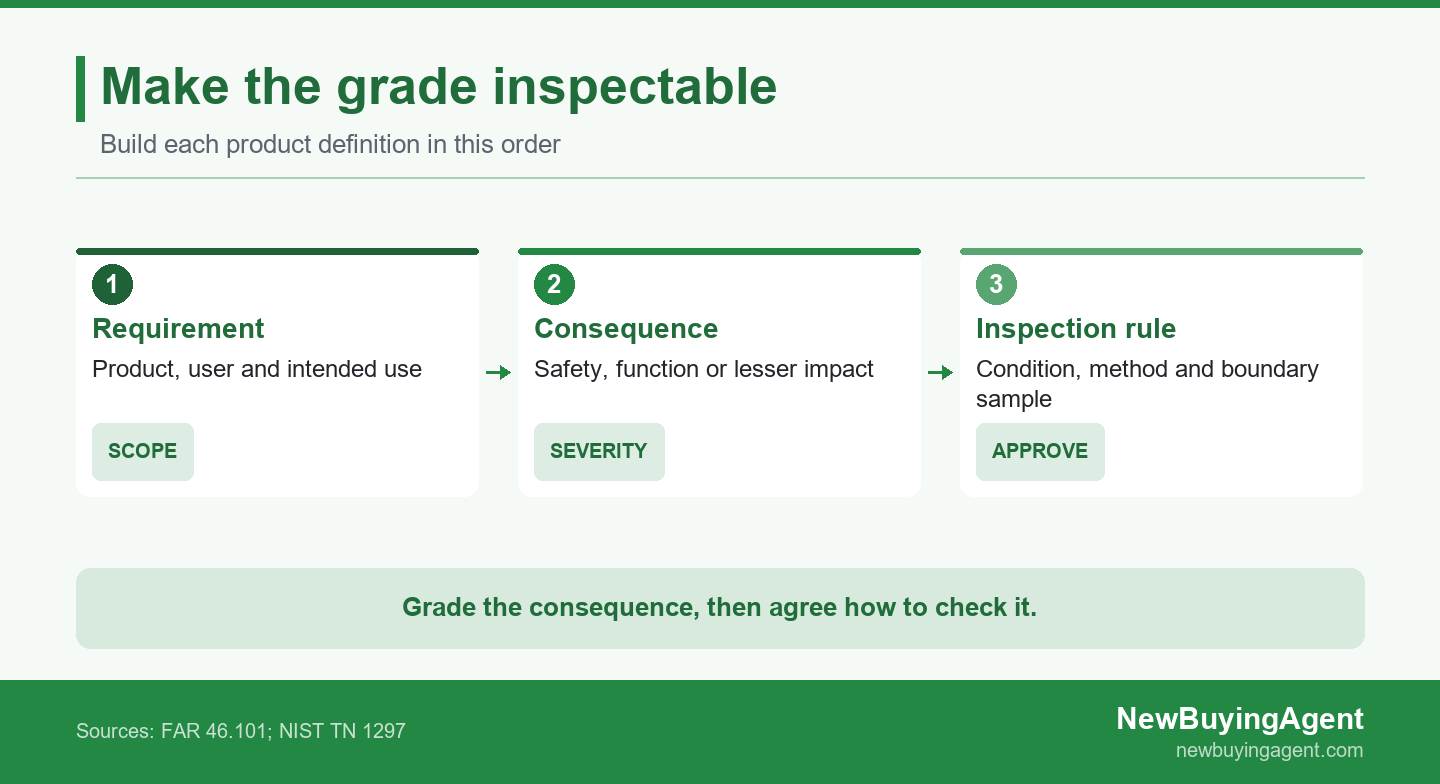
Define the product requirement, connect the defect to its consequence, then approve an observable inspection rule.
Start with the product, user, and destination market
Begin with the current specification, drawings, intended use, user group, packaging, instructions, and destination-market requirements. Mark which requirement each proposed defect entry would violate. If the team cannot identify the requirement or explain the consequence, pause that classification and resolve the missing information instead of letting a familiar defect label stand in for a decision.
Consider foreseeable use as well as the intended task. Health Canada’s consumer-product danger guidance includes foreseeable misuse when describing normal or foreseeable use under the Canada Consumer Product Safety Act. Its scope is Canadian consumer-product safety; for your product, identify the relevant users and exposure conditions rather than assuming that the absence of complaints proves safety.
Check documentation and labeling separately from appearance. UK government product-safety guidance includes technical documentation, appropriate labeling, and safe-use instructions among manufacturers’ and importers’ compliance activities. Product-specific rules and differences between Great Britain and Northern Ireland still matter. A missing warning therefore calls for a requirement and safety assessment, not an automatic “minor printing defect” label.
Make conflicts visible. An approved sample may establish a color or finish, while a drawing controls dimensions and an applicable safety requirement controls a protective feature. Record which document governs each characteristic. Do not let a visual reference silently override a technical limit, or treat a buyer’s cosmetic concession as permission to disregard a legal requirement.
For the broader production context, NewBuyingAgent’s China Manufacturing and Product Guide is a starting resource. Bring the resulting product questions back to your specification: what must function, what must be measured, and what needs qualified safety or compliance review before the factory receives an inspection instruction?
Make the defect observable and the test repeatable
Write what the inspector can actually find and how to find it. Replace “poor stitching” with a location, condition, and check: for example, zipper attachment separates during the approved closure check. Keep the symptom and consequence together so a loose decorative thread does not receive the same code as an attachment failure simply because both involve thread.
Specify the product state, lighting or viewing conditions where relevant, equipment, preparation, procedure, and acceptance boundary. Use limits from the applicable specification or validated method; do not invent a force, distance, cycle count, or viewing time merely to make the checklist look precise. Where the method is unfinished, identify the technical owner and resolve it before using the entry for routine acceptance.
The distinction between a clear instruction and consistent results is worth checking. NIST’s measurement terminology distinguishes agreement under the same conditions from agreement under changed conditions, which may include the observer or instrument. Applying that principle, ask whether a second inspector using the stated method would reach the same finding.
Keep consequence separate from frequency. The OPSS risk lexicon describes severity of harm through the effect on a subject in a particular scenario, while risk also involves likelihood. Finding a condition infrequently does not, by itself, reduce the seriousness of its consequence.
Use identified reference samples or clear photographs to show acceptable, borderline, and unacceptable appearance conditions. Include a scale and location where they matter, and preserve the references against deterioration. A photograph can clarify finish or placement; it cannot establish hidden strength, electrical protection, or another property that needs a different test.
When the challenge is consistent execution at existing suppliers, NewBuyingAgent’s management of existing China factories includes supplier communication, staged inspections, and real-time reporting. Provide the approved defect records with those instructions. Product engineering, safety requirements, and permission to accept an exception remain with the appropriately qualified buyer or designated authority.
Copy this product defect-definition record
Use one record for each meaningfully different condition, and keep its identifier stable when photographs or wording change. The fields below are a working template for agreement between the buyer, factory, and inspection team. Fill them with your actual requirements and methods, then approve the revision; an incomplete record should remain outside the active inspection instructions. Each record identifies a requirement, method, and approval.
| Field | Enter for your product |
|---|---|
| Identity | Product/SKU; revision; defect code; effective order or date |
| Requirement | Document, drawing, clause, or approved sample reference |
| Condition | Location; observable departure; relevant size or extent |
| Consequence | User, function, appearance, or safety effect and reasoning |
| Classification | Critical, major, or minor; reason and escalation trigger |
| Inspection method | Preparation; equipment; procedure; limit; result to record |
| References | Identified acceptable and unacceptable samples or photographs |
| Counting and response | Counting convention; affected scope; hold or review instruction |
| Approval | Technical owner; buyer/factory agreement; revision history |
For an adult garment-storage bag, a completed entry might read: “GB-Z01; zipper attachment; seam opens during closure check; major because the bag no longer closes as specified.” The method field would identify the approved procedure and its limit, while the reference field would identify the physical samples. This is an illustrative entry, not a ready-made test specification.
Create a separate code for a loose decorative thread that leaves the seam secure and falls outside the agreed appearance boundary. If a sharp needle fragment is found, preserve the evidence and activate the safety escalation instead of routing it through the cosmetic entry. One broad “thread problem” row would hide the very distinction the catalog needs to preserve.
For a new product order, NewBuyingAgent’s product sourcing and supply service supplies products against buyer needs, using local factory resources and product quality-control capability. Include the defect records in the sourcing brief so proposed products and production arrangements can be assessed against your quality expectations.
A loose thread that changed classification
Consider an adult garment-storage bag intended to protect clothing in a closet. A loose decorative thread and a separating zipper attachment may both appear in a supplier report as “loose thread,” but they do not describe the same condition. The following hypothetical example shows how a functional check changes the definition before the next production run.
Two findings with the same label
A retailer places a 2,400-unit order for garment-storage bags and reviews the first 120-bag pilot pack. The defect list has not yet been approved, and the supplier proposes treating every loose thread as minor. These quantities and circumstances are hypothetical; they describe an early definition review, not a statistically representative inspection or a NewBuyingAgent customer result.
On one sample, a loose decorative thread leaves the seam secure. On another, following the thread to the zipper attachment and performing the approved closure check makes the attachment separate, leaving the bag unable to close. The first finding concerns appearance; the second reveals loss of the specified closure function. The report needs those conditions, not just a close-up photograph of thread.
Replace the vague entry and verify it
After reviewing the use and finding no identified safety consequence in these two conditions, the quality lead creates separate cosmetic and major functional codes. The retailer withholds the 120-bag pilot pack for correction and definition approval. The supplier repairs the attachment and replaces the vague entry. Discovery of a sharp object or another possible hazard would require separate safety escalation, not this limited cosmetic-versus-function decision.
Inspectors compare corrected samples using the approved closure method and identified boundary samples, then recheck the pilot pack under the agreed inspection plan. They record which code applies and why. In this hypothetical example, agreement on classification completes the definition exercise; it does not itself release the 2,400-unit order, establish long-term durability, or prove the absence of other defects.
Align inspectors before the next production run
Before approving the catalog, let factory and buyer inspectors independently classify the same identified samples using the written methods. Compare their findings and reasons, including acceptable examples and difficult boundaries. Resolve disagreements by improving the requirement, observation, or method, then repeat the disputed checks; asking everyone to memorize a preferred answer will not resolve an ambiguous instruction.
NIST’s gauge-study guidance treats artifacts, operators, and gauges as study factors and examines repeatability, reproducibility, and stability. A small sample-alignment exercise is not a formal measurement-system study. If measured results drive a safety or performance decision, obtain the appropriate method validation and measurement assessment rather than relying on agreement alone.
Keep any safety risk assessment specific to the actual product. OPSS cautions that the probabilities in its PRISM worked examples should not be transferred to other assessments. Borrowing a familiar severity label or copying another product’s risk score cannot supply missing evidence for yours.
Issue the approved revision with its effective order or date, withdraw obsolete copies, and review affected entries when materials, construction, intended users, complaints, or applicable requirements change. Keep classification rules separate from the sampling and disposition instructions, while ensuring both use the same defect codes. This makes a later disagreement traceable to a specific requirement and version.
Share your specification, defect photos, destination, and order stage with NewBuyingAgent to discuss local support. NewBuyingAgent can review your sourcing or existing-factory needs with you and discuss supplier communication, staged inspections, and reporting. Agree the coordination scope and who retains technical approval before work begins. Contact NewBuyingAgent to discuss the scope.
Frequently asked questions
Who decides an unlisted defect?
The named technical owner should decide an unlisted defect after reviewing the requirement and evidence. Record the condition, location, method, and affected scope, then preserve the sample or photographs. Do not default to minor because the catalog is silent. If there is a possible safety issue, hold the affected goods pending appropriate specialist review and add an approved entry once the decision is supported.
How do you count a unit with several defects?
Record every observed code, then apply the counting convention agreed in the inspection plan. Counting nonconforming units differs from counting individual nonconformities. State how a unit with findings in several classes is handled, including any highest-severity reporting convention. Keep the underlying observations so a summary count does not erase another failure mode or distort the agreed acceptance calculation.
Does minor mean the defect is acceptable?
No. Minor describes the consequence category, not automatic permission to ship. A lesser appearance departure can still exceed the agreed limit or contribute to a failed acceptance decision. Follow the applicable specification and agreed inspection procedure. Where a commercial concession is permitted, document its scope and approval without changing the defect’s description or treating it as an exception to safety obligations.
Can you reuse one defect list for every product?
Reuse the record structure, but revalidate the definitions for each materially different product. Review the intended user, use conditions, materials, construction, destination, and applicable requirements before carrying over a grade or method. A successful example from another product does not establish your test limit. Retain only entries whose conditions and consequences still match, and approve the resulting product-specific revision.
NewBuyingAgent
Related Resources



Get Started Today
Let's Turn Your Sourcing Goals into RealityWeChat:+86 15157124615
WhatsApp:+86 15157124615
Address:Building 10 #39 Xiangyuan Road, Hangzhou, China
