

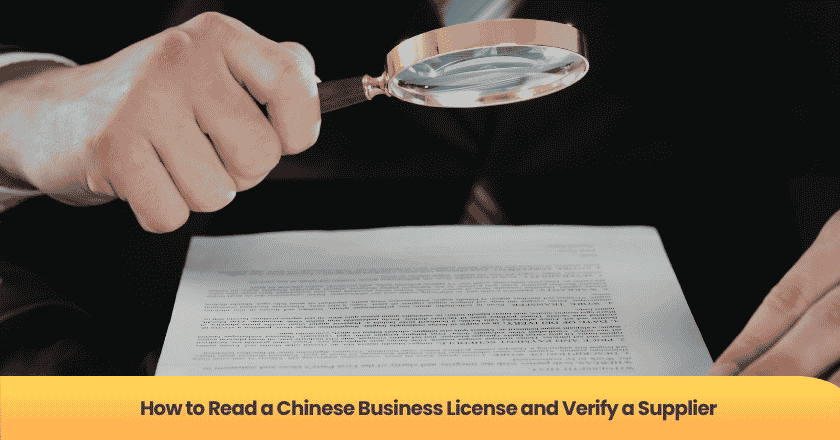
Most importers don't lose money because they picked the wrong product. They lose money because they trusted the wrong identity. The Chinese business license — 营业执照 — is the foundational document that proves an entity exists, what it's allowed to do, and who's behind it. Reading it correctly takes about 10 minutes. Most buyers spend 10 seconds, glance at the red logo, and move on. Below is the field-by-field reading: what each box on the license actually says, what to verify it against, and how to spot the forgeries that are increasingly hard to catch by eye.
Key Takeaways
- A modern Chinese business license has eight required fields that you can verify against the official government registry (GSXT) for free, in under 10 minutes.
- The 18-character Unified Social Credit Code (统一社会信用代码) is the single most important field — it's the entity's permanent identifier and the key to every official lookup.
- The legal entity name in Chinese characters is the binding identity — English transliterations on Alibaba storefronts often differ from the registered Chinese name, and that gap is where many disputes start.
- Verify on GSXT (the National Enterprise Credit Information Publicity System) as your authoritative source. Use Tianyancha or Qichacha as supplements that surface lawsuits and ownership history but don't replace GSXT.
- Match three things across documents: the license name, the bank account name, and the contract counterparty name. All three must be identical, character-for-character. Mismatch is the single most common indicator of fraud or shell arrangements.
What a Chinese Business License Actually Looks Like
Modern Chinese business licenses (issued in the current format since the 2014 "three-in-one" reform, updated again in 2020) are A4-size documents with a red header, the State Administration for Market Regulation (SAMR) seal, and a standardized layout. Two formats exist: the 正本 (zhèng běn, "original") which the company displays at its registered office, and the 副本 (fù běn, "duplicate") which is used for daily business operations. They are functionally equivalent for verification purposes; the duplicate is what the supplier will scan and email you.
The license has a QR code (since 2018) that scans to the company's GSXT page directly. If the QR code on the supplied license doesn't scan to a matching GSXT record, the license is either outdated, forged, or for a different entity. This is the fastest single check you can run.
Field-by-Field Reading
A modern license has these required fields. We'll walk through each one with what to verify.
1. Unified Social Credit Code (统一社会信用代码 / USCC)
18-character alphanumeric code at the top of the license.
This is the entity's permanent unique identifier — the Chinese equivalent of a US EIN combined with a state corporation registration number. It encodes the registration authority, organization category, region, subject ID, and a checksum digit, but you don't need to compute the checksum. You just need to copy the code exactly.
What to verify:
The USCC matches what GSXT returns when you search by it
The same USCC appears on the supplier's VAT invoices (fapiao 发票) — for enterprises, the taxpayer ID is the USCC, so a mismatch indicates the bank account or invoicing entity is different from the licensed entity
2. Entity Name (名称)
The full legal Chinese name. This is the binding name that contracts, bank accounts, and lawsuits reference.
Pay attention to the entity-type suffix:
有限公司 / 有限责任公司 ("Limited Liability Company" / Co., Ltd.) — most common for private factories
股份有限公司 ("Joint Stock Company") — typically larger or public-track companies
个人独资企业 ("Sole Proprietorship") — single-owner, often smaller trading or services
合伙企业 ("Partnership")
个体工商户 ("Individual Industrial and Commercial Household") — single-person micro-businesses, much weaker liability protection
Red flag: If the supplier's English name suggests a major manufacturer but the Chinese license is an 个体工商户, you're likely talking to a single-person reseller, not a factory.
3. Entity Type (类型)
States the legal form (matches the suffix in the name field). Usually consistent with field 2; if not, the license is suspicious.
4. Registered Address (住所)
The legally registered business address in Chinese.
This must match the supplier's claimed factory address. Note: the registered address is sometimes different from the operating address, especially for companies that registered in a Free Trade Zone or special industrial park for tax incentives but actually operate elsewhere. Differences are normal up to a point — but the registered address should be in the same city as the operating address, and ideally the same district.
What to verify:
The registered address resolves on Baidu Maps to a real location, not a P.O. Box or generic incubator
Street view (where available) shows commercial / industrial buildings, not residential apartments
For factories specifically, the address should be in an industrial park, factory district, or commercial zone — not a city-center residential area
5. Legal Representative (法定代表人 / 法人)
The named individual who has authority to bind the company. Their personal Chinese ID number is held by the registry but not printed on the license.
What to verify:
The legal representative is not on the Supreme People's Court list of judgment debtors (失信被执行人) — search the name on the SPC enforcement disclosure portal. Free, takes 30 seconds.
The legal representative is the same person signing your contracts (or has explicitly authorized the signer in writing)
The legal representative is not listed as the legal rep of 20+ other companies — multiple-listings is sometimes legitimate (group companies) but often indicates a "shell entity nominee" pattern
6. Registered Capital (注册资本)
The capital the company committed to register, denominated in RMB.
Since the 2014 reform, registered capital is "subscribed" rather than "paid up" by default — meaning the company committed to put up that amount eventually but may not have actually contributed it. So a "RMB 5,000,000 registered capital" company doesn't necessarily have RMB 5M in the bank.
What to look at:
A registered capital that's grossly mismatched with the company's claimed scale is a flag — a company claiming to run multiple production lines with RMB 30,000 (~USD 4,200) registered capital probably doesn't
Historical changes to registered capital (visible on Tianyancha) — sudden recent reductions can indicate distress; sudden increases pre-deal can indicate dressing for a transaction
7. Date of Establishment (成立日期)
When the entity was registered.
Newer is not necessarily worse, but combined with high claimed production capacity and aggressive pricing, a 6-month-old entity claiming to be a "20-year-experienced manufacturer" deserves scrutiny.
8. Business Scope (经营范围)
The set of activities the entity is legally authorized to engage in, written as a list of categories.
This is the field most often skipped by foreign buyers and the field most often misaligned with reality. A few patterns:
A "manufacturer" whose business scope only contains 销售 (sales) and 进出口 (import/export) is a trading company, not a factory. They source from a real factory and re-sell to you. Not necessarily fraud, but you should know.
A claimed electronics manufacturer whose business scope only lists textiles, plastics, or hardware is a serious mismatch — they may be using a different entity's manufacturing capacity, possibly without authorization.
For regulated products (food, cosmetics, medical devices), the scope must include the specific licensed activity — and that license itself is held separately and verifiable through specialized regulators (NMPA, GACC, etc.).
Verify the business scope matches what you're buying.
9. Operating Period (营业期限)
The license's validity period, often "long-term" (长期) or a specific date range.
Not particularly informative for fraud detection — most legitimate companies have long-term licenses. A specific end date is a flag if the date is approaching.
How to Verify on GSXT (The Official Registry)
The National Enterprise Credit Information Publicity System (国家企业信用信息公示系统), commonly called GSXT, is the authoritative public registry maintained by SAMR. It is your system of record. Tianyancha and Qichacha aggregate from GSXT plus add their own value (litigation data, ownership graphs); they're useful supplements but not authoritative.
URL: gsxt.gov.cn (Chinese-only; use a browser translator or screenshot to a translation app)
How to search:
1.Enter the entity's full Chinese name OR the 18-character USCC
2.Complete the captcha (often a slider puzzle)
3.The result shows the entity's official record, including all the fields above plus annual filing status
What to confirm matches:
USCC matches the license
Entity name matches character-for-character
Registered address matches
Legal representative matches
Status is 存续 (extant/operating) or 在营 (operating). Avoid entities marked as 已注销 (cancelled), 吊销 (revoked), or 停业 (suspended)
What's also visible on GSXT:
Annual filing compliance (if missing, the company may face administrative penalties)
Operational anomalies (经营异常) — entries where the registry has flagged the company
Administrative penalties (行政处罚) imposed on the company
If any of the verification fields don't match the supplied license, stop and investigate before sending money.
Expert Tip: Do the GSXT check yourself, even if a sourcing agent has already done it. The check is free and takes 5 minutes. The version of "supplier verified" you get from a third party is a summary; the GSXT page itself is the authoritative record. For high-stakes deals, viewing it yourself catches the rare cases where the third-party report diverges from current registry data.
Tianyancha and Qichacha — What They Add
These two Chinese commercial-data platforms ingest GSXT data and add layers that GSXT itself doesn't display:
Litigation history — ongoing and historical lawsuits, including who sued the company, for what, and the outcome. Critical: a supplier with multiple recent unpaid-debt judgments is a high-risk counterparty.
Ownership graphs — which companies are connected to this one through shared shareholders or directors. Useful for spotting shell-company webs.
Equity structure history — changes in shareholders over time. Sudden equity reshuffles before a transaction are sometimes warning signs.
Administrative penalties — same as GSXT but often with more searchable history.
News mentions — aggregated press coverage, useful for company reputation context.
Trademark and patent records
Both platforms are Chinese-language. Qichacha has a partial English interface; Tianyancha mostly does not. If you can't read Chinese, run them through a translation tool — the output is structured enough that machine translation handles it well.
Free vs paid tier: Both have free basic searches. Paid subscriptions unlock detailed lawsuit content, deeper relationship graphs, and credit-report-style summaries. For ad-hoc verification, free tier is sufficient; for ongoing supplier onboarding pipelines, the paid tier (RMB 360–1,500/year) is worth it.
Common Mistake: Treating Tianyancha or Qichacha as the authoritative source. They're aggregators. If GSXT says the entity is canceled but Tianyancha hasn't updated, GSXT wins. Always cross-check both — if they disagree, GSXT is the final word.
The Cross-Document Match Test
Before any deposit, verify these three documents reference the identical Chinese legal entity name:
The business license (营业执照)
The bank account holder name (from the bank verification letter / 开户许可证)
The contract counterparty name (NNN, OEM contract, PI, all the same entity)
Even small differences are problematic:
"深圳ABC科技有限公司" vs "深圳ABC科技股份有限公司" — different entity, same name root
"深圳ABC科技有限公司" vs "深圳ABC贸易有限公司" — different entity entirely
Wire instruction beneficiary name "ABC Trading" when license is "深圳ABC科技有限公司" — almost always a sign the bank account belongs to a related but different entity, and a serious red flag
If any of the three documents shows a different entity, ask the supplier to explain. Legitimate explanations exist (a parent/subsidiary structure where the trading entity invoices but the manufacturing entity ships). But the explanation should be documented, not waved away.
What 2026 Adds: New Fraud Patterns
Forged business licenses have become more sophisticated in 2024–2026. Specific patterns to watch:
Photoshopped USCC — the visible code matches a real, defunct or unrelated entity that does check out on GSXT. Fix: always cross-check the entity name against GSXT, not just the USCC, and verify the QR code on the license actually scans to the matching GSXT page.
"Borrowed" license from a related entity — supplier is unlicensed but uses a relative's licensed entity name on the document. Fix: business license name must match the bank account name and contract name (the cross-document test above).
Recently-changed legal representative — in some cases, a supplier under judgment swaps the legal representative with a "nominee" before transactions to evade the SPC debtor list. Fix: check the registered legal rep against the SPC list and check Tianyancha for recent changes.
Frequently Asked Questions
Can a supplier refuse to share their business license?
Legitimate, professional Chinese manufacturers always share the license on request. Refusal — or sharing only a partial photo, an outdated version, or a translated English-only summary — is a strong red flag. The license is public information; there is no legitimate confidentiality reason to withhold it.
Is the QR code on the business license enough to verify?
The QR code is a fast first check, but not sufficient on its own. Forgers can place a real entity's QR code on a forged license. Always cross-check the entity name and address from GSXT directly against what the supplier provided.
What's the difference between GSXT, Tianyancha, and Qichacha?
GSXT (gsxt.gov.cn) is the official government registry — the authoritative source. Tianyancha and Qichacha are private aggregators that ingest GSXT data and add lawsuits, ownership graphs, news mentions, and other commercial-intelligence layers. Use GSXT for verification, the aggregators for context.
Do I need to read Chinese to verify a supplier?
You can do most verification with translation tools — GSXT, Tianyancha, and Qichacha output structured data that translates well. The exception is reading the actual business license image: the entity name in Chinese characters must match exactly, character-for-character, across documents. For that comparison, a sourcing agent or Chinese-fluent contact is helpful.
What if the supplier is on the SPC judgment debtor list?
Don't proceed. Suppliers on the failed-debtor list have judgments outstanding against them that have not been satisfied. Adding new exposure to an entity that already can't pay its existing debts is a recipe for losing the new money too.
How can I tell a manufacturer from a trading company on the license?
Check the business scope. A real factory's scope includes 制造 (manufacturing) or 生产 (production) for the relevant product category. A pure trading company's scope contains only 销售 (sales) and 进出口 (import/export). Both can be legitimate counterparties, but you should know which you're dealing with — trading companies may not have direct factory control, which affects pricing and quality response time.
NewBuyingAgent
Related Resources
Get Started Today
Let's Turn Your Sourcing Goals into RealityWeChat:+86 15157124615
WhatsApp:+86 15157124615
Address:Building 10 #39 Xiangyuan Road, Hangzhou, China
