
A product can pass sample approval and still reach mass production with edited artwork, a changed label line, or a barcode that no longer scans. Freezing packaging and product specs before production means locking one approved version of the product and everything that carries it, so the factory produces and reprints against a controlled reference instead of the last file anyone emailed. A buyer sourcing from China should lock the specification and the sample, version the artwork, dieline, label and barcode, fix a print reference, and control every later change.
A spec freeze is the point at which the product specification and its packaging are locked to a named version that production must match, and from which any change can only be made through a recorded approval path.
The purchasing question is specific: which files and references make up that version, what evidence shows each one was locked, and what has to happen before production may start?
What a Spec Freeze Must Lock Before Production Starts
A first order is only as controlled as the frozen package behind it, so the buyer should lock the master specification, the approved sample, the packaging artwork, the label and barcode data, and the print reference before production starts. Each of those is a version, not a conversation. When one is left open, the factory can produce a product that looks close and is still wrong on a detail the buyer never approved.
- Freeze the specification and the sample: the written spec and the signed golden sample are the reference production is compared against.
- Version the artwork and dieline: the printed design and the cut, fold and glue drawing are locked to a named version.
- Check the barcode: the printed symbol and its human-readable digits must agree before the label is released.
- Freeze each label line: net quantity and origin statements are locked against the requirement they satisfy.
- Freeze the print reference and control changes: a named color reference and a versioned change path keep the approved version stable.
What Freezing Packaging and Product Specs Means
A spec freeze names the approved version of the product and its packaging, records what that version contains, and controls changes to it through production. For a first order, that means one controlled set of records rather than a folder of approved samples, emailed artwork and half-remembered color decisions. The freeze is not a promise that nothing will ever change; it is the rule that nothing changes silently.
The buyer's own quality plan and contract define the scope, and the established method comes from standards work. ISO 10007:2017 is the quality-management guideline for configuration management. It describes the configuration management process as planning, configuration identification, change control, configuration status accounting and configuration audit, and it is applicable to products from concept to disposal. Those five activities answer the buyer's problem at a smaller scale: identify what the product is, freeze what was approved, control what changes, and keep the record accurate.
Packaging also sits inside product development, so it helps to see how China manufacturing stages connect before writing a freeze; the China manufacturing and product guide explains how product requirements, tooling and production stages relate.
Two limits matter from the start. A freeze governs a defined version, so a product with no written specification cannot be frozen, only renegotiated. And a freeze is not a guarantee for later units; it is the reference that makes a later deviation visible and correctable.
Lock the Product Specification and the Golden Sample
One master specification plus the approved golden sample gives the factory a single controlled source for the product and makes any later change comparable to what was approved. The written specification carries the requirements; the sample settles the appearance and feel that words describe poorly. Together they form the frozen package that production is measured against.
For a buyer preparing a first China production run, NewBuyingAgent's local China factory resources and product-development/QC capability can connect that frozen package to the supply brief. Its product-supply service sources the product against the agreed master specification, the approved sample and the release condition set for the project.
The BOM and Tolerances Are Part of the Frozen Spec
The BOM, materials, dimensions and tolerances are written at a named version, so the factory produces each unit from the same controlled specification rather than a fresh interpretation. A bill of materials alone is not enough, because it lists parts without stating which values may vary and by how much. The frozen spec adds the tolerances, the approved material sources and the version, so a substitution or a dimension drift becomes a change rather than a judgment call.
Write the specification so that a reader who never saw the sample can still build the product: component, material, finish, dimension with tolerance, and the inspection method for each critical value. Mark which characteristics are critical and which are cosmetic, because that distinction decides how much evidence each one needs. A specification that only says "as per sample" hands the decision back to the factory.
The Golden Sample Is a Signed Reference, Not the Spec Itself
The golden sample is a signed reference tied to the frozen specification, so it settles appearance and feel without silently overriding the written spec. It is the physical answer to questions the drawing cannot settle, such as surface sheen, hand feel or how a seam should look. The rule that keeps it useful is precedence: when the sample and the written specification disagree, the buyer must have said in advance which one governs.
Keep the sample controlled. Sign and date it, store it where the factory cannot alter it, and photograph it under fixed lighting for the record. Send a clearly labelled reference copy to the factory, and state that it is a reference copy, not a production unit to be copied by eye. A sample that drifts between offices is not a reference; it is another opinion.
Lock the Packaging, Not Just the Product
Packaging is frozen only when the artwork, dieline, label and barcode versions are locked and checked, because a packaging file can be edited after it is sent. The product can be perfect and the order still fail if the sleeve prints the wrong size, the barcode does not scan, or a label line changes after approval. Packaging carries the identity, the compliance statements and the customer's first impression, so it belongs in the freeze alongside the product.
Treat packaging as a set of versioned files with named owners. The artwork is the printed design, the dieline is the technical drawing, the label is the content on the pack, and the barcode is the identity the retailer scans. Each has a version, an approver and a check, and none of them is locked merely because it was emailed.
Freeze the Artwork, Dieline and Barcode Data
Artwork, dieline and barcode data are locked to a version, and the barcode is checked against its symbol, so an edit or a retyped digit cannot pass silently. The dieline is the technical drawing that defines a package's cut, fold and glue lines, and it governs whether the printed sheet folds into the intended box. The artwork version governs what the customer sees, so a "minor" prepress fix is still a new version that needs approval.
The barcode is an identity control, not decoration. GS1 states that barcodes are symbols scanned electronically to encode key identifiers such as the Global Trade Item Number and key attributes such as batch or lot numbers, and that linear barcodes such as the UPC encode the GTIN for product identification. If the printed symbol and the number under it disagree, the retailer's system reads the wrong product or rejects the scan.
The number itself has a built-in check. GS1 describes the check digit as calculated from the other digits of a GTIN, using alternate multiplication by 3 and 1 and subtraction from the nearest equal or higher multiple of ten. A check digit is the final digit of the number that lets a system confirm the other digits are valid, so a retyped human-readable number can be wrong even when the symbol was printed from the correct file. Freeze the barcode data and verify the printed result before the label run is released.
Freeze Label Content and Origin Statements
Label content, including net quantity and origin statements, is frozen against the requirements that apply to the destination market, so a line cannot be changed after approval. Each line on a label exists for a reason: some satisfy a legal requirement, some carry a marketing claim, and some identify the product. Freezing the wording means recording why the line is there, not just what it says.
Some label lines are governed by specific rules. 16 CFR 500.6 requires the label of a consumer commodity to bear a declaration of the net quantity of contents separately and accurately stated on the principal display panel, appearing as a distinct item. That is a placement and wording requirement, so an unapproved edit to a net quantity line is not a cosmetic change; it can create a compliance gap on the whole run.
Origin statements are claims with a legal standard behind them. The FTC requires a product advertised as Made in USA to be "all or virtually all" made in the U.S., and the Made in USA Labeling Rule codified that standard for labels on products. Imported goods also carry a country-of-origin marking requirement, so the origin line must match the product and the destination. Freeze the origin line as approved wording and treat any change to it as a compliance decision, not a print detail.
Freeze the Print Color Reference
Print color is frozen with a named reference and a controlled workflow, so the approved color survives the press run and later reprints. A color name or a screen preview is not a reference, because the press, the substrate and the ink all shift what the customer finally sees. The frozen reference is the approved proof or standard that the press sheet is checked against.
Color can be managed across devices through a defined workflow. The International Color Consortium promotes open, vendor-neutral, cross-platform color management systems, and its v4 profile specification was approved as ISO 15076-1. The practical point for a buyer is that color survives a reprint when the same reference and the same controlled workflow are reused, so name both in the frozen package instead of approving a one-off sample that cannot be repeated.
Control Changes After the Freeze, Not Just the Freeze
Control every change after the freeze with a defined approval path, a version and an effectivity, so a shared file or material change applies to exactly the SKUs and orders it affects. A change is not a message to the factory; it is a new approved version that has to be scoped, recorded and made visible to everyone producing or checking the product. Without an effectivity, the same change can reach the wrong orders and the record stops describing what was shipped.
Effectivity is the date or order from which a controlled change applies, and it is what turns a change note into a rule. When a shared sleeve or a common material serves several SKUs, ask which ones use it and what each one's evidence becomes after the change. The answer may be a partial re-check for some SKUs and a full re-approval for others, and the change record should say which is which.
For buyers managing an existing Chinese factory, the harder part is following an approved change into production. NewBuyingAgent's existing-factory management service connects local follow-up and quality-control capability with that ongoing supply work, so a versioned change and its re-verification can be tracked instead of forgotten.
What Evidence Proves the Freeze Is Real
Evidence such as a signed specification, the retained sample, checked artwork proofs, a barcode verification record and a packaging performance test shows the freeze is real, not just declared. A freeze that exists only in an email is a hope; a freeze with records is a control that can be checked by anyone who joins the order later. The evidence set does not need to be long, but each item should answer a specific question about what was locked.
| Freeze element | What is locked | Evidence it is real | Owner |
|---|---|---|---|
| Product specification | BOM, materials, dimensions and tolerances at a named version | Signed specification and a retained golden sample | Buyer |
| Artwork and dieline | Printed design and the cut, fold and glue drawing | Approved artwork proof and dieline file | Buyer and factory |
| Barcode data | GTIN, human-readable digits and symbol placement | Barcode verification record | Factory, checked by buyer |
| Label content | Net quantity and origin statements at the approved wording | Approved label proof against the market requirement | Buyer |
| Print reference | The named color reference and the press check | Approved proof and press sheet check | Factory, checked by buyer |
| Packaging structure | Material and the performance the pack must survive | Packaging performance test record | Factory |
Read the table as a release rule: a freeze element without its evidence is open, and an open element cannot be released into production. The records also shorten the next order, because the factory is reprinting a known version instead of guessing at one.
Packaging structure is part of the freeze because it can be tested rather than assumed. ASTM D4169-22 provides a uniform basis for evaluating, in a laboratory, the ability of shipping units to withstand the distribution environment, by subjecting them to a sequence of anticipated hazard elements. The applicable distribution cycle and test levels depend on the product and the shipping lane, so the transferable lesson is to define what the packaging must survive before the freeze, not to claim that one test applies to every retail order.
The evidence earns its place when it changes the release decision: which SKUs are verified, which remain open, and what must happen before each one starts. Evidence that arrives after a run has begun may still help troubleshooting, but it has lost the chance to prevent the wrong release.
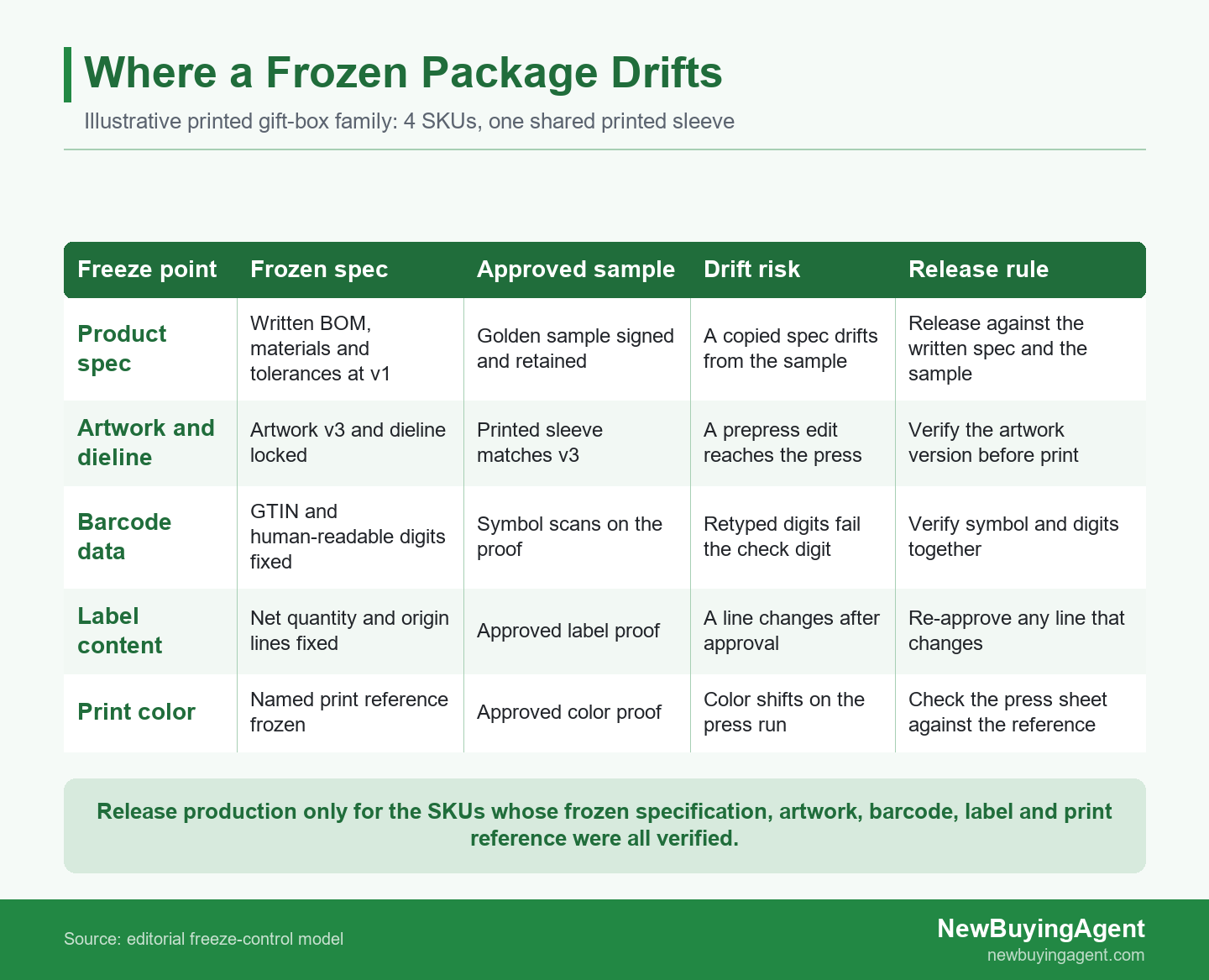
Conflict map of five packaging freeze points where the frozen spec, the approved sample and production can disagree
When a Frozen Package Slips Back Into Production
Separate reversible preparation from the release that depends on missing version control, and state the condition for release. This keeps a first order moving without treating an incomplete freeze as permission to start full production. In a real order the release is rarely all-or-nothing: some SKUs may be verified while others wait on a barcode check or an artwork re-approval.
Illustrative Example: A Frozen Sleeve That Changed
In this illustrative example, a home-goods brand is sourcing a printed gift-box set with a product insert and one shared printed sleeve, for 4 SKUs made up of 2 box sizes and 2 pack counts. The first order is 8,000 units from a new China factory, and one printed sleeve is shared by two of the four SKUs. Artwork v3 and a golden sample were approved, prepress has the files, and mass production is about to start.
Two gaps appear before the run. The factory's prepress operator re-saved the sleeve file to fix a spacing issue, substituting an older font and a changed origin line along the way. The GTIN itself stayed the same, but the human-readable digits under the symbol were retyped and no longer matched the symbol's check digit. Neither edit was versioned or sent back to the buyer for approval. The two SKUs that share the sleeve are now unverified against the frozen artwork, and a barcode whose digits do not match its symbol can fail a retail scan even when the product looks correct on the shelf.
The buyer's decision is to hold the printed sleeves and the two affected SKUs while allowing reversible work that does not use the disputed artwork. The factory is asked to verify the barcode against GS1 rules with a verifier, to re-approve the artwork as v4, and to check the origin line against the country-of-origin requirement before any sleeve is reprinted.
Before the affected SKUs are released, the buyer reviews the verifier result and the signed v4 artwork against the frozen package; after release, an in-process check confirms the printed sleeve. This illustrative example invents no measured scan result and no passed test, and a spec freeze is not a guarantee for every later unit; the product's own critical characteristics and its market rules govern the real scope.
Put the Spec Freeze Into the China Supply Brief
Put the freeze into the supply brief: the specification and sample, the packaging versions, the label and barcode checks, the print reference, the change path and the release condition. Written this way, competing suppliers quote the same controlled product, and "the same as the sample" is replaced by a version that can be checked. The brief also tells the factory what it must deliver before production may start.
For a product entering China sourcing, prepare the master specification and the approved golden sample, the artwork, dieline, label and barcode versions, the print reference, the quantity by SKU, the target price, the destination and the delivery timing. NewBuyingAgent can use its local China factory resources and product-development/QC capability to develop a product quotation around those requirements, including the frozen package and its release condition. With that brief ready, send your product requirements to NewBuyingAgent.
Frequently Asked Questions
Is an approved sample the same as a frozen specification?
No; an approved sample is a reference, while a frozen specification names the version, the materials, the tolerances and the packaging files that production must match. A sample shows one acceptable unit, but it cannot state a tolerance, a barcode rule or which artwork version applies. The freeze turns the sample into a reference inside a written, versioned package.
Does every artwork change after the freeze need a new version?
Any change that alters what the customer sees, what the barcode encodes, or what a label claims needs a new version and an approval, even when it looks minor. A font substitution, a moved logo or a reworded line all change the approved product. Recording the change as a new version is what keeps the printed pack traceable to an approval.
Does a frozen barcode number need to change when the label changes?
It depends on whether the change makes the trade item a different item to the customer or the retailer, so the buyer should apply the identification rules deliberately rather than reuse a number by habit. A new size, a new pack count or a changed declared attribute can change how the product is ordered and tracked. Decide the rule in advance and apply it consistently.
How should print color be frozen for a packaging run?
Freeze a named reference and a controlled workflow, such as an approved proof or standard with a defined profile, and check the press result against it rather than trusting a screen preview. A color name cannot be measured, and a screen shows color differently from a press. Naming the reference and the workflow lets a reprint reproduce the approved color instead of restarting the debate.
NewBuyingAgent
Related Resources

Get Started Today
Let's Turn Your Sourcing Goals into RealityWeChat:+86 15157124615
WhatsApp:+86 15157124615
Address:Building 10 #39 Xiangyuan Road, Hangzhou, China