

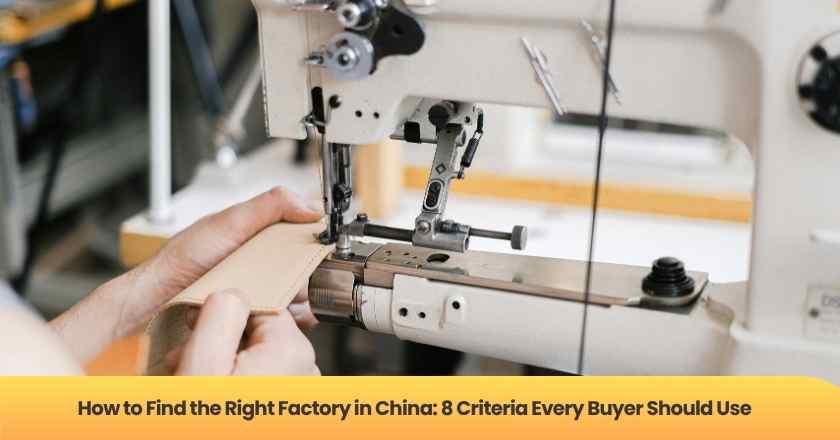
Two factories quote the same product at the same price, and on the surface they look interchangeable. One ships clean goods on time for three years; the other misses your launch and substitutes materials on the bulk run. Nothing in the quote told you which was which. The difference lived in criteria you could have checked but didn’t.
Choosing among factories in China isn't guesswork once you know what actually separates a reliable partner from a risky one. Eight concrete criteria — from legitimacy to landed cost — turn a wall of identical profiles into a ranked, defensible decision.
Key Takeaways
• Confirm legitimacy first — a verified business license and real production are the foundation every other criterion rests on.
• Weigh capacity and relevant experience together, since a factory must both fit your volume and know your product.
• Treat quality systems and certifications as verifiable facts, checking each by number rather than trusting a profile.
• Judge communication and responsiveness early, because friction at inquiry rarely improves once money is involved.
• Compare finalists on landed cost and terms, not the headline unit price that hides the real total.
Criteria 1–2: Legitimacy and Real Production
The first two criteria decide whether a factory is even worth evaluating further. Get these wrong and every later check is built on sand. They’re also the cheapest to verify, which is why they come first in any sensible process.
Criterion 1: Verified business license
Request the business license and confirm the registered name, production scope, and that the payment account matches. A manufacturer's scope names production of your product category; a reseller's names only trade or wholesale. This single document, checked properly, screens out a large share of intermediaries posing as factories.
Criterion 2: Evidence of actual manufacturing
Confirm the company physically makes your product, not just sells it. A live, unedited video walkthrough of the line, backed by export records showing it has shipped similar goods, is strong evidence. A supplier who can't or won't show the floor is often a trading company without one.
Expert Tip: Cross-reference three independent signals before treating a factory as legitimate: a verifiable business license, a presence in customs or export records, and a live floor walkthrough. Any one alone can be faked or borrowed — a reseller can flash a license that isn't theirs, or show a floor they don’t own. When all three line up and point to the same company making your kind of product, you've almost certainly found a real manufacturer rather than a middleman dressed as one.
Criteria 3–4: Capacity and Relevant Experience
A legitimate factory can still be the wrong fit. These two criteria test whether the company can handle your volume and actually knows how to make your specific product. Both matter; a plant with capacity but no relevant experience is as risky as an expert one that's already at full load.
Criterion 3: Capacity that fits your volume
Ask about monthly output, current order load, and how many lines could run your product. A factory near full capacity may push your order back or rush it past quality. You want headroom, not a plant straining to fit you between larger clients who outrank you.
Criterion 4: Experience with your product type
A factory skilled in one product isn't automatically competent in yours. Ask for examples of similar items it has made and references from buyers in your market. Specific, checkable experience beats a broad "we can make anything," which often means subcontracting the parts they can't produce in-house. A factory that has made your exact product hundreds of times has already solved the failure modes a newcomer will discover during your run.
Common Mistake to Avoid: Choosing a factory on capacity alone because it’s large and quotes a low price, without checking whether it has made your specific product before. A big plant optimized for a different category may treat your order as an unfamiliar one-off, with a steeper learning curve and more defects. Relevant experience often matters more than raw size. A smaller factory that makes your exact product daily frequently delivers better quality than a giant learning it on your dime.
Criteria 5–6: Quality Systems and Compliance
These criteria separate factories that talk about quality from those that systematically produce it. They’re also where forged or irrelevant documents do the most damage, so verification matters as much as the presence of a certificate. Treat both as facts to confirm, not claims to accept.
Criterion 5: Documented quality control
Look for documented QC (Quality Control — the inspection steps that catch defects during and after production) procedures, not verbal promises. A factory that can describe its in-line inspection routine usually runs it. Certifications like ISO 9001 signal a real system, though you should still confirm them rather than take them on faith.
Criterion 6: Verified, relevant certifications
Check certificates such as CE or RoHS by number against the issuing body, not the emailed PDF. Forged or expired documents are common enough that verification is routine. A genuine certificate that doesn't cover your specific product is just as unhelpful as a fake one, so confirm scope as well as authenticity.
Expert Tip: Ask to see the factory’s rework and scrap area during an audit, not just the polished assembly line. How a plant handles its defects reveals more about its real quality culture than a tidy showroom does. A factory with an organized rework process and honest scrap rates is managing quality actively and has nothing to hide. One that conceals this area, or claims it never produces a single defect, is either inexperienced or not showing you the truth of how it actually runs.
Criteria 7–8: Communication and Total Cost
The last two criteria shape the day-to-day reality of working together and the economics that decide whether the relationship is profitable. Both are easy to underweight against a tempting unit price, and both punish that neglect over the life of the relationship.
Criterion 7: Communication and responsiveness
Note response time, clarity of English, and willingness to share documents and answer technical questions directly. Friction at the inquiry stage rarely improves once money is involved. A factory that communicates clearly and engages with your spec is signaling how the whole relationship will run, especially when a problem needs solving mid-production and you need a straight answer fast rather than a reassuring silence.
Criterion 8: Landed cost, not unit price
Compare finalists on total landed cost — FOB price (Free On Board — the cost of goods loaded onto the vessel at the Chinese port, before freight and insurance), tooling, freight, duties, and fees — not the headline number. The cheapest unit price often carries the highest total. A low quote that hides a high MOQ (Minimum Order Quantity — the smallest batch they'll produce) or steep tooling can cost more than a higher one.
Common Mistake to Avoid: Ranking factories purely on the unit price in their quote. The lowest number frequently conceals a higher landed cost — inflated freight in a CIF quote, expensive tooling, a punishing minimum order, or cheaper materials that surface as quality problems later. Buyers who anchor on the headline price routinely pick a factory that turns out more expensive once everything is added. Normalize every quote to total landed cost on the same Incoterm before you rank them.
Applying the 8 Criteria in 2026
Criteria are only useful if you apply them in a sensible order and act on what they reveal. The practical workflow runs cheap checks first, reserves expensive ones for survivors, and builds in the resilience that 2026 conditions demand. This is how a checklist becomes a decision.
Sequence cheap checks before expensive ones
Run legitimacy and communication checks early, since they cost almost nothing and eliminate weak candidates fast. Reserve audits and sample rounds for the two or three factories that clear the easier criteria. This sequencing protects your time and budget for the suppliers that deserve real investment, and it means the money you spend on a paid audit goes only toward a factory that has already proven it exists, communicates well, and makes your kind of product.
Use remote tools to verify
Remote audits and digital QC reports are standard in 2026, so you can apply every criterion without traveling. Video walkthroughs, third-party audits, and shared inspection records let you score factories on legitimacy, capacity, and quality from your desk. Travel is no longer a barrier to thorough vetting.
Build redundancy into the decision
Don't apply the criteria to choose one factory and stop. Qualify a backup for your key product and consider a China+1 strategy — adding a second-country source such as Vietnam or India to spread risk. Single-source dependence is the costliest fragility in 2026, even when your chosen factory scores well on all eight criteria.
Expert Tip: Turn the eight criteria into a simple scored sheet, rating each shortlisted factory on every one rather than forming an overall gut impression. Scoring forces you to notice when a factory you like on price is quietly weak on capacity or compliance, and when a less charming one is strong everywhere that matters. The exercise also creates a record you can revisit when a new team member or sourcing agent inherits the relationship, so the reasoning behind your choice survives beyond your memory of the calls.
Frequently Asked Questions
Which of the 8 criteria matters most?
Legitimacy comes first, because every other criterion is meaningless if the company isn’t a real manufacturer. After that, the weighting depends on your product: tight-tolerance goods lean on quality systems and experience, while commodity items lean more on capacity and landed cost. The point of using all eight is that no single one reliably predicts a good partner on its own.
Can I evaluate factories in China without visiting?
Yes — remote evaluation is standard in 2026. Document checks, video walkthroughs, and third-party or agent-run audits let you apply every criterion from your desk. This makes thorough evaluation affordable even for first-time buyers and removes travel as a barrier to proper due diligence before you commit a deposit.
How do I check a factory's real production capacity?
Ask directly about monthly output, current order load, and the number of lines that could run your product, then confirm it against an audit. A factory near full capacity may delay or rush your order. You’re looking for genuine headroom, not a plant that has to strain to fit your order between larger, higher-priority clients.
Should I always pick the factory with the lowest price?
No — rank on total landed cost, not the headline unit price. The cheapest quote often hides inflated freight, expensive tooling, a high minimum order, or cheaper materials that become quality problems later. Normalize every quote to the same Incoterm and add all costs from factory to your door before deciding which factory is genuinely cheapest.
How long does it take to properly vet a factory?
It varies, but a thorough process — inquiry filtering, document verification, audit, and two sample rounds — typically runs several weeks. Rushing it to hit a launch date is how buyers skip the criteria that prevent costly mistakes. The time spent vetting is small against the cost of a failed first order with an unvetted factory.
Conclusion
The right factory rarely announces itself in a quote — it reveals itself across eight criteria: legitimacy, real production, capacity, experience, quality systems, compliance, communication, and total cost. Score your shortlist against all eight, run the cheap checks first, and build a backup even for your winner. Do that and the choice stops being a gamble and becomes a defensible decision. If you prefer seasoned local procurement experts handle these evaluations onsite, NewBuyingAgent stands as your trusted partner. It has built a network of 50,000 well-cooperating factories and trained 20,000 product development & quality control experts stationed across China to manage product selection, cost negotiation, quality management, and logistics—delivering products that meet market demand, arrive on time, and protect your bottom line. Contact now→ https://www.newbuyingagent.com/
NewBuyingAgent
Related Resources
Get Started Today
Let's Turn Your Sourcing Goals into RealityWeChat:+86 15157124615
WhatsApp:+86 15157124615
Address:Building 10 #39 Xiangyuan Road, Hangzhou, China
