

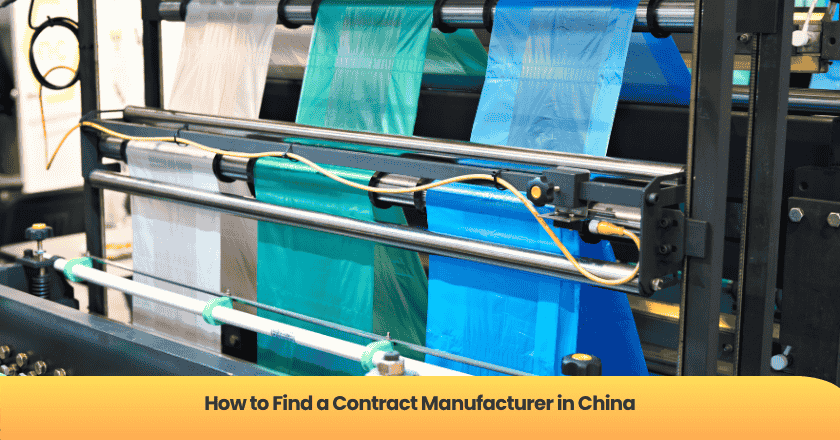
Finding a contract manufacturer in China sounds straightforward until you're three months into the process, sitting on a factory audit that raised more questions than answers, and your launch timeline is slipping. The reality is that China's contract manufacturing landscape has changed significantly — geopolitical pressure, post-pandemic supply chain restructuring, and the rise of AI-assisted sourcing have all reshaped what "finding a manufacturer" actually involves. This guide walks you through the process with enough detail to avoid the most expensive mistakes.
Key Takeaways
- Contract manufacturing in China remains cost-competitive in 2026, but the selection process demands more rigorous due diligence than it did five years ago.
- The best factories are rarely found on the first page of Alibaba. Trade shows, verified B2B platforms, and in-person audits remain the highest-yield discovery channels.
- Minimum order quantities (MOQs) are negotiable — but only if you know how to frame the conversation before your first inquiry.
- IP protection in China requires action before you share any technical documentation, not after a dispute arises.
- A long-term manufacturing partnership is built through consistent communication, on-site visits, and realistic production expectations — not just a signed contract.
- In 2026, sustainability compliance (carbon footprint documentation, REACH, RoHS) is increasingly a pre-qualification requirement, not an optional add-on.
What Contract Manufacturing in China Actually Means
Contract manufacturing (CM) is an arrangement where a company outsources the production of its goods to a third-party factory, which manufactures to the buyer's specifications. The buyer owns the product design, branding, and intellectual property; the factory provides labor, equipment, and production management. Think of it as renting a factory's capacity and expertise without carrying the fixed costs of owning one.
This model suits a wide range of businesses. Large consumer goods companies use it to scale production without capital expenditure on plant and machinery. Smaller brands — especially those launching on Amazon, Shopify, or through retail channels — use it to access manufacturing capabilities that would otherwise require tens of millions in investment.
China remains the world's most capable contract manufacturing hub, not purely because of labor costs (which have risen considerably since the early 2000s), but because of its unmatched industrial ecosystem. Raw materials, components, tooling, and logistics are often all within a short radius of the factory floor. That proximity compresses lead times and reduces coordination overhead in ways that few other manufacturing destinations can match.
That said, the landscape in 2026 looks different from even five years ago. Tariff pressure between the US and China, a growing "China Plus One" strategy adopted by multinationals (diversifying production across Southeast Asia alongside China), and increasing scrutiny of supply chain labor practices mean that finding a contract manufacturer now involves a broader set of considerations than price alone.
Expert Tip: Before you begin sourcing, map out your product's regulatory requirements for the target market — CE marking for Europe, FCC certification for the US, or food-contact compliance standards. A factory that can't support your compliance pathway will cost you more in the long run than one quoting slightly higher per-unit prices.
Where to Find Contract Manufacturers in China
Most buyers start with Alibaba or Global Sources, which is fine as a first step but rarely sufficient on its own. These platforms aggregate a large number of suppliers, and the verification badges (Gold Supplier, Verified, Trade Assurance) offer a baseline of credibility — but they are not a substitute for independent due diligence.
Beyond the major B2B platforms, the most reliable discovery channels include:
- Canton Fair (China Import and Export Fair): Held twice yearly in Guangzhou, it remains the single largest sourcing event in the world. Meeting factory representatives face-to-face filters out trading companies posing as manufacturers, and you can assess production capability directly from samples and catalog depth.
- Industry-specific trade shows: For electronics, electronicAsia and CES Asia; for textiles, Intertextile Shanghai; for hardware and tooling, the China International Hardware Show. Vertical shows attract manufacturers with genuine specialization.
- 1688.com: Alibaba's domestic Chinese platform, which lists factories that often don't export directly but are willing to work with overseas buyers through agents. Prices are generally 10–30% lower than on Alibaba's international-facing site because the listings aren't translated or marketed for export.
- LinkedIn and professional networks: Increasingly useful for finding factory sales managers or export managers directly, bypassing the inquiry queues on B2B platforms.
- Sourcing agents with factory networks: A reputable agent based in China can pre-screen factories against your specifications, which is particularly valuable for complex or highly regulated products.
Word of mouth still works. If you're in an industry with an active community — whether that's a private sourcing group, a trade association, or an entrepreneur network — referrals from buyers who have worked with a factory are worth more than any platform badge.
Common Mistake to Avoid: Sending a detailed RFQ (Request for Quotation) to twenty factories at once. Beyond being unmanageable to track, it signals to experienced manufacturers that you're running a pure price race rather than a partnership search. Start with four to six carefully selected candidates, and invest time in each initial conversation.
How to Vet a Contract Manufacturer Before You Commit
The vetting stage is where most sourcing mistakes are made — not because buyers skip it, but because they treat it as a paperwork exercise rather than a genuine investigation.
Start by confirming the factory's legal identity. Request their Business License (营业执照) and cross-reference it against China's National Enterprise Credit Information Publicity System (国家企业信用信息公示系统), which is publicly accessible. This tells you when the company was established, its registered capital, and its legal representative. A factory that has been operating for eight years under the same ownership is a different risk profile from one registered six months ago.
Next, ask for a customer reference list — specifically buyers in your target market who have run production in your product category. Follow up on at least two references by phone or video call. Ask them directly: what went wrong, how the factory handled it, and whether they would use them again.
A factory audit — whether conducted by you, a trusted agent, or a third-party inspection firm like Bureau Veritas, SGS, or TradeAider — should cover four areas: production capacity relative to your volumes, equipment condition and calibration records, quality control procedures (incoming material inspection, in-process checks, final inspection protocols), and workforce stability (high turnover in production staff is a serious red flag).
Sampling is non-negotiable. Any factory unwilling to produce a paid prototype or pre-production sample before a commercial order deserves immediate removal from your shortlist.
In 2026, environmental and social compliance has moved from "nice to have" to a procurement prerequisite for most regulated markets. Ask factories whether they hold ISO 14001 (environmental management) or SA8000 (social accountability) certifications, and whether they can provide a carbon footprint report for your product. Brands exporting to the EU in particular face increasing supply chain due diligence requirements under the CSDD Directive.
Expert Tip: During a factory visit, pay attention to the areas they don't show you. A well-managed factory will walk you through the entire floor, including raw material storage and waste handling. Reluctance to show specific areas often signals issues with materials sourcing or subcontracted production they haven't disclosed.
MOQ, Pricing, and Contract Terms
Minimum Order Quantity — the lowest volume a factory will accept per production run — is one of the most misunderstood aspects of working with Chinese manufacturers. Factories set MOQs based on their machine setup costs, raw material purchasing minimums, and production efficiency, not arbitrarily. The number isn't fixed.
Negotiating MOQ downward is possible, but the approach matters. Rather than simply asking for a lower quantity, offer something the factory values in return: a committed forecast for future orders, a higher per-unit price for the first run, or flexibility on delivery timeline that allows the factory to combine your run with another buyer's order.
Pricing should be broken down by component. Request an itemized cost structure — raw materials, labor, overhead, tooling amortization, and factory margin. This isn't about forcing transparency the factory doesn't want to give; it's about identifying where negotiation is realistic (material substitutions, packaging simplification) versus where the factory has genuine cost constraints.
Payment terms in China most commonly follow a 30% deposit on order confirmation and 70% balance before shipment. For new relationships, this is standard and reasonable. As the relationship matures, some buyers negotiate extended terms or Letters of Credit for larger orders, which reduces cash flow pressure on both sides.
Every production arrangement should be documented in a written contract covering product specifications, quality standards with defined rejection criteria, delivery terms, liability for defective goods, and the governing jurisdiction for disputes. For significant production programs, a China-based IP attorney should review the contract before signing.
Common Mistake to Avoid: Accepting verbal commitments on pricing without a written pro forma invoice that locks in the per-unit price, incoterm, and validity period. Exchange rate movements and raw material price swings can render a verbal quote meaningless within weeks.
IP Protection — The Part Most Buyers Address Too Late
China has significantly strengthened its intellectual property enforcement framework over the past decade, but legal recourse after a violation is still slow, expensive, and uncertain. Prevention is not just better than cure — it's essentially the only reliable strategy.
Register your trademarks in China before sharing any product specifications with factories. China operates on a first-to-file system, meaning that whoever files first owns the mark — regardless of prior use in another country. There are documented cases of factories or intermediaries filing a foreign brand's trademark in China and then holding that registration as leverage. Filing costs are modest; the cost of not filing can be catastrophic.
Use Non-Disclosure Agreements (NDAs), but don't rely on them as your primary protection layer. A China-specific NDA, drafted or reviewed by a local attorney and signed in Chinese, carries far more weight than a translated version of a Western-market document. Even so, enforcing an NDA against a factory that has copied your design requires litigation in Chinese courts — a process most small and medium businesses cannot sustain.
A practical approach is to compartmentalize your IP: share only what the factory needs to produce the current component or assembly. If your product has a proprietary mechanism or formula, consider whether that element can be produced by a separate supplier and assembled elsewhere.
Expert Tip: Before your first factory visit, document every element of your product design — drawings, specifications, prototypes — with dated records. In the event of a dispute, establishing that your IP predates the relationship with a specific factory is foundational to any legal claim.
Building a Long-Term Manufacturing Relationship
The factories that consistently deliver on quality, lead time, and responsiveness are not necessarily the cheapest. They are the ones that treat your business as a reliable, growing revenue stream worth investing attention in.
From the factory's perspective, a buyer who places sporadic orders, changes specifications without warning, and applies constant price pressure is their least preferred customer — regardless of volume. That dynamic affects how your orders are prioritized on the production schedule.
Invest in the relationship deliberately. Quarterly video calls with factory management, at minimum one annual on-site visit, and prompt payment create goodwill that compounds over time. When production issues arise — and they will — a factory that knows you as a fair, communicative partner will solve problems faster than one that views your account as a commodity.
Maintain a secondary source. Even your best manufacturing partner can face capacity constraints, equipment failures, or regulatory disruption. A pre-qualified backup factory, even one that handles only a small percentage of your volume, is inexpensive insurance against a supply interruption at the worst possible moment.
Common Mistake to Avoid: Treating the factory relationship as purely transactional and switching manufacturers purely on price. The institutional knowledge a factory builds around your product — tooling, quality expectations, your team's communication style — has real monetary value that doesn't appear on the invoice.
Frequently Asked Questions
How long does it take to find and qualify a contract manufacturer in China?
For a straightforward consumer product with standard regulatory requirements, budget six to twelve weeks from initial outreach to a confirmed production-ready supplier. Complex or highly regulated products — medical devices, electronics with certification requirements, anything with custom tooling — realistically take three to six months before first commercial production.
What's the difference between a factory and a trading company?
A factory (制造商) manufactures goods directly. A trading company (贸易公司) sources from factories and acts as an intermediary. Trading companies can be legitimate and useful — particularly for buyers needing smaller volumes across multiple product categories — but they add a markup and create a layer of distance between you and actual production. For contract manufacturing, working directly with the factory is generally preferable.
Can I visit a factory in China before placing an order?
Yes, and it's strongly recommended for any significant production program. Most reputable manufacturers welcome buyer visits. If a factory declines a pre-order visit without a credible explanation, treat that refusal as a serious red flag. For buyers who cannot travel, third-party audit firms can conduct a factory inspection on your behalf.
How do I handle quality control once production starts?
Define your quality standards in writing — with specific tolerances, defect classification (critical, major, minor), and an agreed acceptable quality limit (AQL) — before production begins. Engage an independent inspection firm for pre-shipment inspection on your first several orders. As the relationship matures and quality consistency is established, you can adjust the inspection frequency.
Is contract manufacturing in China still competitive in 2026 given the tariff environment?
For most product categories, yes — China's manufacturing infrastructure, supplier ecosystem, and production expertise maintain a structural cost advantage that tariffs reduce but don't eliminate. The picture varies significantly by product category and target market. Buyers serving the US market with tariff-sensitive goods are more likely to evaluate Vietnam, Mexico, or other alternatives. The right answer depends on your specific product economics.
NewBuyingAgent
Related Resources
Get Started Today
Let's Turn Your Sourcing Goals into RealityWeChat:+86 15157124615
WhatsApp:+86 15157124615
Address:Building 10 #39 Xiangyuan Road, Hangzhou, China
