

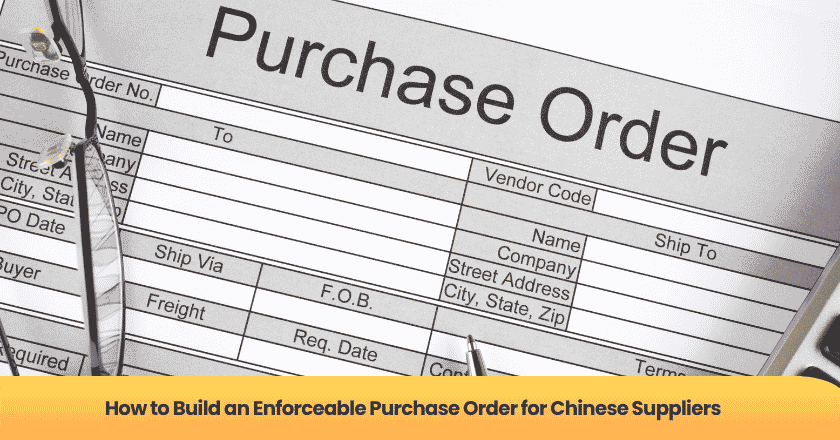
A working PO is the contract that determines whether quality issues, late delivery, or supplier substitutions become disputes you can win or losses you have to absorb. The template most US importers use is dangerously thin. Here's a better framework — and how to use each clause.
Key Takeaways
- A purchase order is not just an order form — it's a contract. The clauses you include (and the ones you don't) determine whether quality, delivery, and IP issues are enforceable in dispute.
- A well-built PO with Chinese suppliers is bilingual (English + simplified Chinese), reflects common practice among established US importers, and covers payment terms, quality assurance, delivery, IP protection, penalty clauses, and dispute resolution. The clauses you include determine whether disputes are recoverable.
- Most US importers use PO templates that lack enforceable quality clauses, lack clear penalty structures for late delivery, and lack China-jurisdiction language that makes the document defensible in Chinese courts.
- The 5 most important clauses: clear specifications referenced from technical documents, payment timing tied to milestones (not just dates), quality acceptance based on AQL standards, late-delivery penalty as % of order value per day, and Chinese jurisdiction with bilingual governing version.
- Use the framework above as a starting point. Customize for your specific product, supplier relationship, and risk profile. For high-value orders, have a US-based China legal expert review before deployment.
For US importers buying from Chinese suppliers, the purchase order is the contract. There's rarely a separate "master agreement" — the PO is what binds the supplier to specifications, timeline, and quality standards. Yet most US importers use PO templates that are thin: a few lines of product description, quantity, price, payment terms, and shipping instructions. When something goes wrong (and something will go wrong), there's no enforceable basis for the buyer to recover.
This guide walks through what a working PO looks like for Chinese suppliers — bilingual (English with simplified Chinese alongside), covering the essential clauses for enforceable contracts, reflecting common practice among established US importers in this market. It's not a replacement for legal counsel on high-stakes orders — but the framework below is substantially better than what most importers actually deploy today.
This guide walks through the major clauses, explains why each matters, and notes where customization is essential for specific situations.
Why Most US Importer POs Are Inadequate
Three patterns we see repeatedly when reviewing existing PO templates from new clients.
Pattern 1: Vague specifications. "100 units of Product X per attached spec." The "spec" is a one-page document with photos and dimensions. When the supplier delivers product that's technically compliant but visually different, there's no clear basis for rejection.
Pattern 2: No enforceable quality acceptance criteria. The PO says "products must meet quality standards" without defining what those standards are. When goods arrive with 8% defect rate, the buyer can complain but can't quantify the failure.
Pattern 3: No penalty structure. Late delivery, partial delivery, quality failure — none have specified consequences. The supplier knows there's no enforcement mechanism, so urgency is optional.
The framework below addresses all three.
The 12 Essential PO Clauses
Clause 1: Parties and contact information
Buyer name, registered address, US contact person, EIN. Supplier name, registered address (legal entity, not "Shenzhen XYZ Trading"), Chinese business license number, contact person.
This sounds basic but matters. The supplier's legal name in Chinese (and on their business license) is what would be defendable in Chinese courts. The English name on their email signature is often a marketing translation that wouldn't bind the legal entity.
Clause 2: Product specifications (by reference)
Reference complete technical specifications by document name and version number. Specifications should include: dimensions, materials with grade specifications, color references (Pantone numbers), finish requirements, packaging, labeling, country-of-origin marking.
Critical: specify versions. "Per spec document SP-2026-001 version 3.0 dated April 15, 2026" prevents disputes about which version was agreed.
Clause 3: Quantity, unit price, total value
Itemized by SKU. Currency specified (USD typically; some buyers use CNY for negotiating leverage). Total value clearly stated.
For multi-SKU orders, attach a line-item spreadsheet to the PO.
Clause 4: Payment terms
Payment timing tied to milestones, not just dates. Common structures:
30/70 split: 30% deposit at PO signing, 70% upon BL (bill of lading) presentation
30/40/30: 30% deposit, 40% upon production completion verified by inspection, 30% upon BL
Letter of credit: for higher-value orders or when supplier credit is uncertain
The 30/40/30 structure is most protective because it ties the largest single payment to verified production completion (with inspection report) — giving the buyer leverage if quality issues surface.
Specify acceptable payment methods (T/T to specified bank account, L/C through specified bank). Beneficiary account must match the supplier's legal entity name; payments to alternative accounts are an immediate fraud signal.
Clause 5: Production timeline and milestones
Production start date, sample approval deadline, production completion deadline, shipment ready date.
Each milestone tied to specific actions: "Production sample approved by Buyer in writing" not "after sample approval."
Clause 6: Quality acceptance criteria
AQL (Acceptable Quality Limit) standards: "AQL 2.5 / 4.0 (Major / Minor defects) per ISO 2859-1 with double sampling plan."
Pre-shipment inspection requirements: "Buyer or Buyer's designated inspection agent will conduct pre-shipment inspection. Goods must pass inspection before payment milestone or shipment release."
Rejection rights: "If inspection reveals defect rate exceeding AQL 2.5/4.0, Buyer reserves right to reject lot, require rework at Supplier's cost, or accept lot with negotiated discount."
Clause 7: Late delivery penalty
Specific penalty for late shipment: "0.5% of total PO value per day late, capped at 10% of total PO value." Some POs use 1% per day with 20% cap for higher pressure.
Force majeure exception with notification requirement: supplier must notify within 48 hours of foreseeing delay.
Clause 8: Quality penalty
For quality failures beyond AQL acceptance: rework cost, return shipping cost, or replacement orders at supplier's expense. Specify clearly.
Clause 9: IP protection
Reference NNN agreement (Non-Disclosure, Non-Use, Non-Circumvention) as separate document or incorporate clauses directly. For products with significant IP exposure, this clause is critical.
Confidentiality of designs, specifications, customer lists. No reproduction or sale to third parties without explicit buyer authorization.
Clause 10: Packaging and labeling
Detailed packaging specifications. Inner packaging, outer carton, palletization. Labeling requirements including country of origin marking, tracking labels (for children's products), brand marking, barcodes.
Clause 11: Shipping and Incoterms
FOB, EXW, CIF, DDP — specify clearly. Port of loading, port of destination. Booking responsibility (buyer arranges or supplier arranges).
For FOB (most common): supplier delivers to ship at named loading port. Buyer takes risk and cost from there.
Clause 12: Governing law and dispute resolution
This is the clause most US importers get wrong. Standard recommendation: bilingual document with Chinese as governing version, jurisdiction of People's Court at supplier's location, arbitration optional through CIETAC (China International Economic and Trade Arbitration Commission).
Why Chinese law/jurisdiction: enforcement against Chinese supplier is dramatically easier in Chinese courts than trying to enforce US judgment in China. US-jurisdiction clauses are often unenforceable as a practical matter.
Common Mistake: US importers specify New York or California jurisdiction in PO templates because that's familiar. Then when a dispute arises, they discover that even with a favorable US judgment, enforcing it against a Chinese supplier requires going through Chinese courts anyway — and the Chinese courts may not recognize the US judgment. The whole exercise becomes inefficient and expensive. Specifying Chinese jurisdiction from the start, with a bilingual document where Chinese is the governing version, is more enforceable.
How to Tailor PO Clauses to Your Situation
PO clauses should be tailored to product, supplier relationship, and risk profile. Five customization areas matter most.
Customization 1: Quality standards specific to your product. AQL 2.5/4.0 is general practice; specific products (medical devices, baby products, food contact) may need stricter standards. Specify product-specific quality requirements in addition to AQL.
Customization 2: Payment structure specific to relationship. First-time supplier: 30/70 with inspection. Established supplier with track record: 30/40/30 with relaxed inspection. Long-term partner: net-30 terms after delivery acceptance.
Customization 3: Penalty structure specific to risk. High-volume seasonal products (Christmas goods, fashion seasons) may need higher late-delivery penalties (1–2% per day). Lower-urgency products can use 0.3–0.5% per day.
Customization 4: IP protection scope. Products with significant proprietary designs need detailed NNN clauses or referenced separate NNN agreements. Commodity products with no IP exposure can use lighter IP clauses.
Customization 5: Specific product compliance. Children's products: reference CPSIA testing requirements and test reports. Electronics: reference FCC/CE certification requirements. Cosmetics: reference MoCRA compliance documentation.
Expert Tip: When deploying a new PO template with an existing supplier, expect pushback on stricter clauses (penalty structures, jurisdiction language, AQL standards). The supplier will negotiate. That's normal and expected. The right posture: hold firm on jurisdiction (this is non-negotiable for enforceability), be willing to negotiate penalty percentages (final landing point usually somewhere between aggressive opening and supplier counter), and accept softer language on AQL where existing supplier track record justifies it. Commission-free sourcing agents typically negotiate PO terms on behalf of clients with established supplier relationships, which usually reaches better terms than direct buyer-supplier negotiation.
When to Get Legal Counsel
A well-structured PO is sufficient for most standard sourcing situations. Three scenarios where US-based China legal counsel review is recommended:
1. High-value orders. Single PO above USD 100,000 generally justifies legal review. The cost of legal review (USD 1,500–5,000) is small relative to potential dispute exposure.
2. Significant IP exposure. Products with substantial proprietary IP, custom tooling investments, or first-of-kind designs warrant detailed legal review of IP protection clauses.
3. Complex multi-stage contracts. Multi-year supply agreements, exclusive supplier arrangements, or complex production agreements with multiple deliverable stages benefit from comprehensive legal counsel.
For most standard recurring POs with established suppliers, a well-built PO (with appropriate customization) is sufficient.
The Bottom Line
A purchase order is the contract that defines your protection when things go wrong with Chinese suppliers. Most US importers use templates that are dangerously thin — vague specifications, no quality acceptance criteria, no penalty structures, US-jurisdiction language that's hard to enforce in China.
A properly built PO addresses these gaps: bilingual EN/Chinese with Chinese as governing version, clause-by-clause coverage of payment, quality, delivery, IP, and dispute resolution, AQL-based quality acceptance with specific rejection rights, milestone-tied payment structure, late-delivery penalty with cap, Chinese jurisdiction for enforceability.
Use the 12-clause framework above as a starting point. Customize for your specific product, supplier relationship, and risk profile. For high-stakes orders, have legal counsel review. For most standard situations, the framework is substantially better than what most US importers currently use.
FAQ
Can I just modify a free PO template I found online?
Most free PO templates floating around online are inadequate. They're typically missing critical clauses (jurisdiction language, AQL standards, penalty structures) and don't have bilingual versions. Starting with a framework that covers all 12 clauses outlined above — and customizing for your specific situation — is materially better than starting with a thin template and trying to retrofit the missing pieces.
Do I really need a bilingual document?
For enforceability in Chinese courts: yes. Documents in English only can be enforced in Chinese courts but the process is slower and more expensive (translation must be certified, document review takes longer). Documents in Chinese (with English alongside, with Chinese as governing version) are more directly enforceable.
What if my Chinese supplier wants me to use their PO template?
Common situation. Most supplier templates favor the supplier (no penalty clauses, vague quality standards, supplier-favorable payment terms). Push back. Use your template, or substantially modify the supplier's template to add missing protective clauses. If supplier refuses, that's a signal about how negotiations will go on issues that arise during production.
How much should the late-delivery penalty be?
Common range: 0.3% to 1% of total PO value per day late, with cap of 10–20%. The right number depends on your urgency: seasonal products with Q4 retail launches need higher penalties to ensure on-time delivery; ongoing replenishment programs can use lower penalties. Penalty rates above 1% per day rarely add real protection — most disputes are resolved through negotiation regardless of nominal penalty rate.
What's the most commonly missed PO clause?
Specific quality acceptance criteria with AQL standards. Most PO templates have vague language ("products must meet quality standards") that's not enforceable. Specifying AQL 2.5/4.0 (or stricter for specific products) with double sampling plan per ISO 2859-1 gives concrete basis for inspection-based acceptance/rejection.
Should the PO template be in English first or Chinese first?
Bilingual (both side-by-side) is best practice. Specify which version is governing for legal interpretation — Chinese as governing version is more enforceable in Chinese courts. Suppliers usually accept Chinese-governing language without resistance because it favors them in domestic enforcement.
NewBuyingAgent
Related Resources
Get Started Today
Let's Turn Your Sourcing Goals into RealityWeChat:+86 15157124615
WhatsApp:+86 15157124615
Address:Building 10 #39 Xiangyuan Road, Hangzhou, China
