

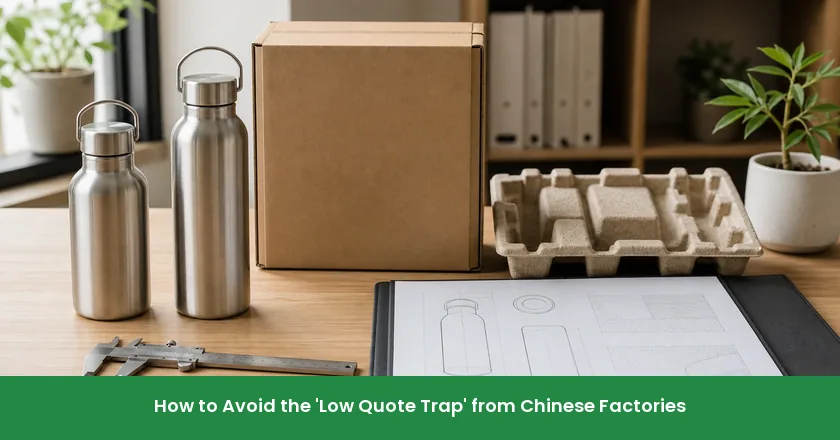
A factory quote is not a verdict on value. It is a set of assumptions expressed as a number. The number becomes useful only when it describes the same product, the same trade term, the same packing, and the same evidence expectations as the alternatives. When those assumptions drift, the lowest unit price can be the least complete offer.
That is the low quote trap. It does not mean that a lower-priced Chinese factory is automatically poor or acting in bad faith. It means the buyer is ranking figures before confirming what each figure includes. The practical fix is to hold the price comparison until the scope is matched, then judge the complete commercial offer.
What a Comparable Quote Must Prove
Use the Quote-Integrity Test before ranking price: match product, commercial basis, quality evidence, compliance records, and release conditions. In plain language, the test asks whether every factory is pricing the same thing, handing it over at the same point, and being held to the same proof.
The five conditions are connected. A bottle made from a different steel grade is not the same product. A quote under a different trade term does not assign cost and risk in the same way. A price that omits the agreed carton, inspection point, test, or document plan may be a valid starting offer, but it is not ready for a final ranking. One unresolved condition is enough to change the next action from choose to clarify.
- Product definition: material, dimensions, finish, components, artwork, and approved version.
- Commercial basis: quantity tier, currency, payment assumption, and named trade term.
- Quality evidence: sample reference, acceptance points, inspection scope, and rework response.
- Compliance records: the product- and destination-specific documents or tests that may be required.
- Release conditions: packing, labels, remaining approvals, and the point at which goods can move.
Do not average an open condition into an attractive unit price. A missing condition is not a small score deduction; it is an unknown cost, timing, or product-risk decision that has not yet been assigned to anyone.
The same rule applies whether you contact factories directly or give a defined requirement to NewBuyingAgent. A China-side sourcing partner can make the comparison work more orderly, but it still needs the buyer's actual product, market, and commercial requirements before any price can be evaluated honestly.
The Low Quote Trap Is Usually a Scope Mismatch
The trap is usually a scope mismatch, not proof that a low-priced factory is inherently poor. One factory may quote an existing stock material; another may price the specified material. One may include retail-ready boxes; another may assume bulk packing. One may allow a stated quality check; another may leave the acceptance rule open. Each choice can change the opening number without making either factory dishonest.
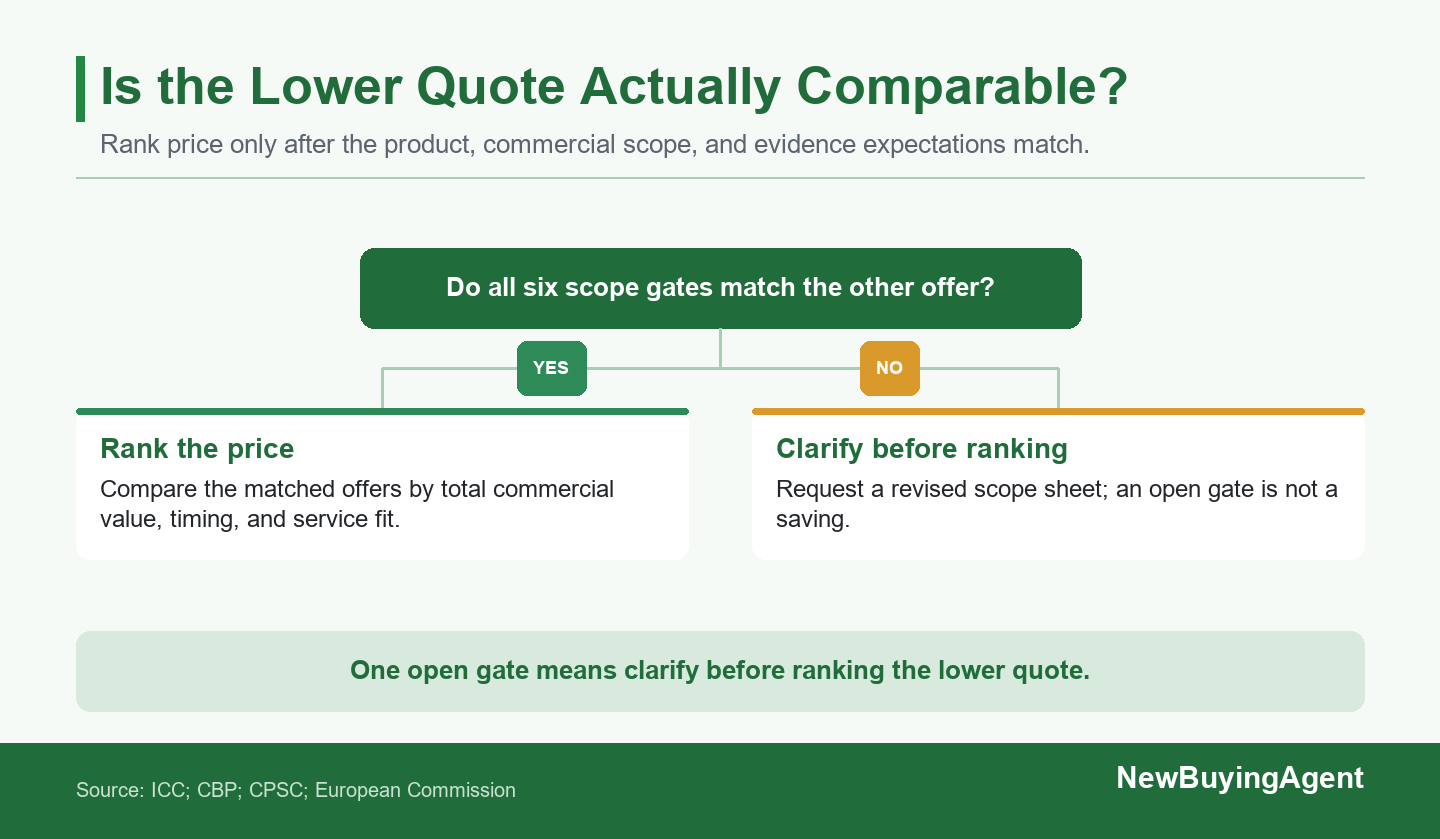
Rank price only after the product, commercial scope, evidence, and release conditions match. Otherwise, clarify the quote first.
The buyer's job is to expose the difference before negotiating. Ask a direct question: “What would have to change for this quoted price to be true?” The answer often reveals a lower material grade, a different minimum order quantity, less packaging, a later tooling charge, an excluded test, or a delivery boundary that is not equivalent to the other offer.
ICC's Incoterms 2020 rules allocate costs, risk, and obligations, so quotes using different terms are not automatically like for like.
ICC's Incoterms 2020 guidance is the reference point for that allocation. An EXW price, an FOB price, and a delivered-price proposal cannot be treated as interchangeable simply because the product photo looks the same.
Write the exact term and named place beside every number. Then state who covers export packing, inland movement, export procedures, freight, insurance, destination handling, and any work that sits between a finished product and the agreed handoff. The point is not to force every factory into one trade term. It is to compare the same term before deciding which price is lower.
Turn Offers Into a Like-for-Like Comparison
Ask every factory to answer the same scope sheet before you negotiate the unit price. A useful scope sheet is short enough to be answered quickly but precise enough that an omission becomes visible. It should travel with the request, sample approval, and final quote rather than living in a buyer's private spreadsheet.
| Comparison field | What must match | Question to send before ranking price |
|---|---|---|
| Product version | Material, dimensions, components, finish, and approved sample | Which specification revision does this price follow? |
| Commercial basis | Quantity, currency, payment assumption, Incoterm, and named place | Where do cost and risk transfer under this quote? |
| Packing and tooling | Inner pack, master carton, inserts, molds, printing, and setup charges | Which packing and one-time items are inside or outside this price? |
| Evidence plan | Test, certificate, label, inspection, or technical record needed for the product and market | What proof is needed, who owns it, and when is it available? |
| Release condition | Approval, quality threshold, packaging sign-off, and shipment handoff | What must be true before the order is released to move? |
Based on this comparison, the best next question is rarely “Can you lower the price?” It is “Can you confirm this exact scope on the same basis?” That question protects negotiation. Once both offers are truly comparable, a buyer can still seek a better price without accidentally negotiating away a needed material, record, or delivery condition.
CBP says commercial invoice value can require specified payments and costs, including packing, assists, royalties, and production costs.
For US-bound goods, CBP's commercial-invoice guidance is a useful reminder that a factory unit price is not automatically the whole commercial picture. This is not a reason to add every theoretical charge to a request; it is a reason to state the relevant inclusions, exclusions, and owner.
CBP describes reasonable care as an explicit importer responsibility in the informed-compliance context.
Treat that CBP guidance as a recordkeeping discipline: keep the product description, values, supporting documents, and quoted commercial basis clear enough that your own team can explain the transaction later. It is not a reason to turn the factory into the buyer's legal adviser.
Verify What a Quote Cannot Prove
A quote can describe a cost. It cannot, by itself, prove that the product version, required testing, documentation, or labels will meet the needs of the destination market. Before a deposit turns an estimate into an order, add an evidence plan beside the quote. The plan should identify the item, destination, required record, responsible party, and decision date.
CPSC guidance says applicable general-use products may require a GCC, while nearly all children's products require third-party testing before a CPC is issued.
For US examples, 16 CFR Part 1110 covers certificates of compliance, while 16 CFR Part 1107 covers testing and certification for the relevant products. A General Certificate of Conformity, or GCC, is a written US certificate for certain products subject to applicable CPSC rules; it should be discussed only when the actual product falls within the relevant requirements.
This is why “testing can be arranged later” is not a neutral sentence. It may be a sensible sequencing choice for a product still in development, but the buyer should know whether the quoted product, sample timing, test budget, and production release are conditional on that later work. Put the condition in writing instead of assuming the initial price includes it.
European Commission guidance says importers must check that non-EU products meet applicable requirements and that necessary documentation is available.
For EU-bound goods, the Commission's importer guidance makes the destination boundary explicit. The right document set is product-specific, so a factory should not make a broad compliance promise before the buyer has named the item and market.
EUR-Lex summarizes GPSR duties covering safety, traceability, and specified information for distance sales.
The EU's General Product Safety Regulation summary is a destination example, not a checklist for every product. GPSR means the EU General Product Safety Regulation. It makes the core point: product information, traceability, and safety evidence can affect the offer's real scope.
Use a simple release sentence in the quote file: “No production release until the product version, required evidence plan, and label or packing assumptions are confirmed.” That sentence does not create a legal guarantee. It gives the buyer a commercial pause point before a low number becomes a costly change request.
Worked Scenario: A Lower Unit Price That Was Not Lower
In the illustrative bottle scenario, the lower offer is held until material, packing, and evidence scope match.
Public sourcing outcomes vary by product and project. For context rather than a price guarantee, review NewBuyingAgent sourcing case examples
Hold the Changed Scope, Not the Whole Project
Hold the changed scope, request matched records, and rerank only after the revised quote can be compared.
An illustrative retailer is buying a private-label stainless-steel drinkware line for the US market.
12000 units across 2 bottle sizes; Quote A is USD 3.48 per unit and Quote B is USD 2.76 per unit.
Both factories received the same product photo, but the buyer has not signed an approved specification or evidence plan.
The lower quote uses 201 stainless steel while the requested approved sample specification states 304 stainless steel.
The lower quote excludes individual color-box packing and says testing will be discussed after deposit.
The USD 0.72 difference appears commercial, but the offers no longer represent the same material, packing, or evidence position. Ranking them by unit price would treat missing scope as savings.
Place Quote B on hold and ask for a revised scope sheet rather than reject the factory or accept the lower number.
Require a material declaration, the named packing configuration, and a product-specific test or certification plan where applicable; then request a revised quote on the same Incoterm and quantity basis.
Compare again only when the specification, packing, commercial term, and evidence plan match across both quotes.
This is an illustrative composite scenario. It does not assert that any actual factory changed material or omitted testing.
A proportionate response protects the project. Other valid work, such as artwork review or freight planning, can continue while the revision is prepared. A pause on one changed scope does not need to freeze every independent task.
Choose China-Side Support After the Brief Is Defined
NewBuyingAgent can scope a new product-supply requirement or support existing China factories with local production, quality, and logistics follow-up.
Once the brief is clear, the useful question is where the project starts. If you need a new China-sourced product offer, you can see how NewBuyingAgent supplies products from China from a defined purchasing requirement. That route is built around the outcome the buyer needs: an item that fits the stated price, quality, market, and delivery requirements.
For a new product brief, separate the commercial question from the execution question. First establish the item and quote scope: version, quantity, destination, trade term, and exclusions. Then identify the production controls: sample approval, packing artwork, inspection point, and release evidence. Finally show the decisions that remain with the buyer, such as market requirements and acceptance of a revised commercial assumption.
This structure keeps a scope question from being answered as a price question. It also gives the local team a document trail to follow when materials, components, or labels change. A useful handoff records which reference controls the request, who must confirm the next change, and when a deviation must return for buyer approval.
For example, a quote can look complete yet still be provisional because it names a bottle but not the steel grade, carton, label, test plan, or named delivery point. Treat those blanks as operating conditions, not minor administration. A defined requirement does not promise that every cost is known at the outset; it gives each unknown an owner and a decision moment. It also makes later confirmation easier when a buyer must decide whether a material, packing, or test change affects the original commercial basis.
If you already retain the China factories and the gap is local execution, use a different starting point. You can compare support for managing existing China factories around production progress, quality control, and logistics coordination. In both situations, the buyer still needs the same clear brief. China-side support works best when it is given a product definition and a decision standard, not a request for a bare price.
Send a Brief That Forces Comparable Answers
Send one brief that names product, quantity, target price, destination, timing, trade term, packing, and evidence needs.
Before asking for another quote, add one final line: “Please list every excluded cost, condition, or assumption that could change this price.” It makes the required response clear without demanding a premature commitment.
Keep the brief version-controlled: name the drawing, sample, artwork, or material reference that controls the request. Mark undecided items as questions rather than silently allowing a quotation to assume them. If quantities or destination are provisional, say so. That lets the recipient price a defined base while showing what would need revision later.
Attach the same brief to every conversation, rather than summarizing it differently in each email. Keep the quotation date, version, and unresolved points together so a later revision can be compared with the request it answers. This creates a simple record of what changed and prevents an apparently lower number from being treated as an approved scope.
That final line improves the quality of the response without forcing a premature decision. It tells the other party that a lower number is welcome, but only when its scope is visible. When you are ready to turn that brief into a China sourcing request, send a defined product brief to NewBuyingAgent.
Frequently Asked Questions
Use the same scope-matching principle for residual timing, cost, and service-fit questions.
Confirm what changed before you decide what the lower number means.
Does the lowest factory quote always mean poor quality?
No, a low quote can be legitimate when the product, terms, evidence, and delivery scope are genuinely the same as the alternatives. A factory may have better material access, available capacity, or a different margin target. The problem begins when the lower number describes a different material, packing level, trade term, inspection expectation, or release condition. Ask for those assumptions in writing before you make a quality judgment. A clear comparison may show that the lower offer is still the best commercial choice.
Which costs are often missing from an initial factory quote?
Common gaps include tooling, retail packing, printing, testing, inspection, inland movement, documentation, freight, insurance, and destination-side charges. Not every item belongs in every factory quote, and some will properly sit with the buyer under the agreed trade term. The important point is to name the owner and the amount or decision trigger for each relevant item, rather than adding every possible cost blindly. If an item remains uncertain, show it as a pending assumption instead of burying it in a later email.
Should I pay a deposit before product tests are complete?
For products with applicable testing or compliance requirements, tie the deposit and production decision to a written evidence plan rather than assuming a low quote includes the needed proof. The right sequence depends on the product, destination, sample status, and contract. If a test must follow a final sample or production unit, state that timing, budget owner, and release condition before the deposit is treated as approval to proceed. This keeps a future requirement visible without claiming that every category needs the same test path.
Can NewBuyingAgent help with a quote from my existing factory?
Yes, when you already retain a China factory, NewBuyingAgent can provide local production, quality, and logistics follow-up around that existing relationship. Start by sharing the current specification, quote, known open conditions, delivery target, and the evidence you need before release. The goal is not to replace a buyer's commercial judgment; it is to make the China-side execution and proof visible enough for that judgment to be made on time. This route is especially useful when the price is known but the production, inspection, packing, or delivery record still has open points.
NewBuyingAgent
Related Resources
Get Started Today
Let's Turn Your Sourcing Goals into RealityWeChat:+86 15157124615
WhatsApp:+86 15157124615
Address:Building 10 #39 Xiangyuan Road, Hangzhou, China
