

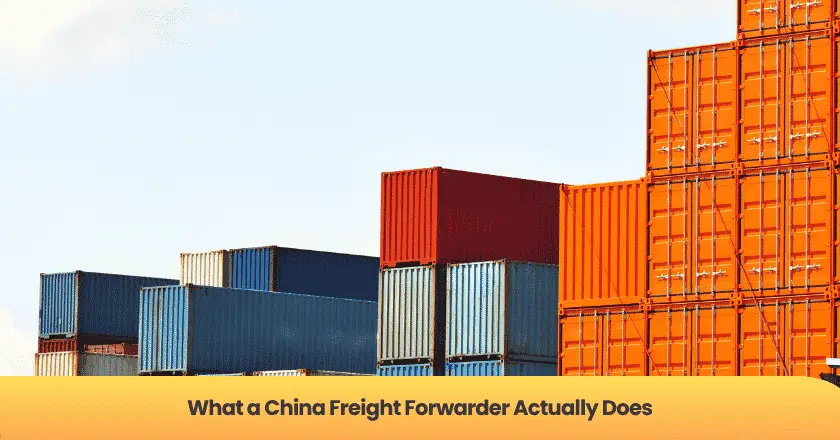
A buyer in Manchester opens his first container and finds 3,000 units in the wrong colourway. He calls his forwarder, who has been responsive and helpful for eleven weeks, and asks how this was allowed to happen. The answer is polite and entirely correct: the forwarder collected sealed cartons from a factory in Dongguan, booked them onto a vessel, cleared them for export and delivered them to a warehouse. Nobody in that chain ever opened a box.
Freight forwarders do a specific and valuable job, and the trouble starts when buyers assume the job is broader than it is. Understanding the boundary is what separates importers who use forwarders well from importers who feel let down by them.
Key Takeaways
• A china freight forwarder arranges transport and paperwork, and it does not verify what is inside your cartons.
• Forwarders, carriers and customs brokers are three different roles, and one company may fill one, two or all three.
• A supplier-nominated forwarder answers to the supplier, which matters the moment a dispute starts.
• The house bill of lading is your title to the goods, so check whose name sits on it before the vessel sails.
• Ask about free time, routing and exception handling before booking, because those decide your real cost far more than the rate does.
What a Freight Forwarder Is and What It Is Not
A freight forwarder is a logistics intermediary. It does not own ships or aircraft. It buys transport capacity in volume, resells it in smaller portions, and wraps services around the sale: booking, documentation, consolidation, customs coordination and problem-solving when a container misses its cut-off.
Forwarder, Carrier, NVOCC and Customs Broker
The carrier owns the vessel and issues the master bill of lading. An NVOCC (non-vessel operating common carrier, a company that issues its own bills of lading without owning ships) sits between carrier and forwarder, buying slots in bulk. The customs broker files your import entry at destination and is licensed separately. A single firm can hold several of these roles at once.
That overlap confuses buyers, and it matters practically. When your forwarder also acts as NVOCC, you receive a house bill of lading issued by them rather than the carrier's master bill. Your goods are then legally released against their document, which is fine with a solid company and a serious problem with a weak one.
Platform-based forwarders have taken a real share of the market, offering instant quoting and self-service booking through a dashboard. They suit standard cargo on busy lanes very well. Complex shipments with certification requirements or awkward dimensions still tend to go better with a named person who answers the phone, so many importers end up running both.
Where the Responsibility Starts and Stops
A forwarder's remit begins at cargo readiness and ends at delivery. Inside that window it owes you accurate booking, correct documents and honest communication. Outside it, the forwarder has no duty and usually no ability to help. Supplier selection, price negotiation, specification control and QC (quality control, checking goods against your written standard before shipment) all sit upstream of the point where a forwarder gets involved.
Some forwarders offer inspection as a paid add-on, typically subcontracted. That can work, but read what you are buying. A carton count and a photo of a pallet is not a product inspection, and the two get sold under similar language.
Expert Tip: Write down the boundary before your first booking. I keep a single page listing which party is accountable for each step: supplier for production and packing, inspection provider for the goods themselves, forwarder from pickup to delivery, broker for the entry. When something goes wrong, that page ends the argument in about four minutes. Most disputes I've watched drag on for weeks were not about fault at all. They were about two parties who each assumed the other was covering the same gap.
The Work a China Freight Forwarder Actually Performs
Behind a booking confirmation sits a stack of coordination that stays invisible until it fails. Knowing what that work involves helps you judge whether your forwarder is doing it well.
Booking Space, Routing and Consolidation
The forwarder secures space with a carrier for your dates, which is harder than it sounds during peak weeks when vessels roll cargo to the next sailing. It also chooses the routing, and a direct service against a transshipment service can differ by ten days on identical paperwork. For LCL cargo (less than container load, where your pallets share a container with other shippers), the forwarder consolidates your goods with others at a Chinese warehouse and deconsolidates at destination.
Consolidation is where a good forwarder earns its margin honestly. Poor consolidation puts your cartons under someone else's heavy freight, and no amount of packaging survives that.
Cut-off deadlines are the other half of booking. Cargo has to reach the terminal by one date, and the export declaration has to be filed by an earlier one. Missing the documentation cut-off rolls your container to the next sailing even when the goods are sitting at the port. A forwarder worth using tells you both dates at booking rather than reminding you the day before.
Documentation and Export Clearance
Chinese export clearance requires a customs declaration, commercial invoice, packing list and often a certificate of origin or product-specific certification. The forwarder assembles and files these, working from documents your supplier provides. Errors here cause more delays than weather does. A mismatch between the declared quantity and the packing list can hold a container for days.
Document handling is also shifting. Carrier members of the Digital Container Shipping Association have committed to issuing all bills of lading electronically by 2030, and were due to be technically ready during 2026, with several eBL platforms achieving cross-platform transfer by that year. Full adoption is still some way off, so ask whether your forwarder and your bank can actually handle an electronic original before assuming the option exists.
Tracking, Exceptions and Handover
Live milestone tracking is now standard rather than premium, and a forwarder still emailing weekly status updates is behind the market. What separates the good ones is exception handling: telling you a vessel has been delayed before you notice it yourself, and arriving with two options rather than an apology.
Common Mistake to Avoid: Handing over the original bill of lading before payment is settled is the mistake that costs whole containers. The bill of lading is title to your goods, and whoever holds the original can collect them. Buyers sometimes let a supplier or a supplier-appointed forwarder retain control of the document to speed things along, then discover the cargo has been released to someone else after a payment dispute. Insist on a telex release, meaning electronic surrender confirmed to you directly, or hold the originals yourself.
Chinese-Side and Destination-Side Forwarders Are Not the Same
Most shipments involve companies at both ends of the lane. Which one you contract with quietly determines whose interests get protected when things go wrong.
Who Your Forwarder Answers To
If you book with a forwarder at your own end, that company is your supplier of services and answers to you. Its agent in China acts on its instruction. If you book with a Chinese forwarder directly, you often get lower origin charges and faster factory-side communication, along with the difficulty of pursuing a claim across jurisdictions if a serious problem arises.
Neither arrangement is wrong. Buyers running frequent containers on stable lanes often do better with a Chinese-side forwarder on price and speed. Buyers shipping occasionally, or moving high-value cargo, usually prefer a contract governed by their own local law.
The Supplier-Nominated Forwarder Problem
Suppliers frequently offer to arrange shipping, and under FOB terms (free on board, where the supplier delivers to the Chinese port and clears export) that arrangement can still leave the supplier's forwarder holding your documents. FOB is one of the Incoterms maintained by the International Chamber of Commerce, and it allocates cost and risk without saying anything about who appoints the carrier. The forwarder was introduced by the supplier, is paid on volume from the supplier, and will act accordingly under pressure.
Accepting a nominated forwarder is reasonable for a first small order where you are still testing the relationship. Once your order values become material, appoint your own. The cost difference is usually modest and the control difference is not.
Expert Tip: Ask this question at quotation stage: who pays you, and who introduced you to me? A forwarder that earns nothing from your supplier will answer directly. One that does will hesitate, and that hesitation is your answer. I also ask for the name of the destination agent before booking rather than after, because a forwarder with a weak partner at the far end produces excellent origin service and then goes quiet exactly when the container arrives and charges start accruing.
How to Choose and Manage a Forwarder
Selection gets treated as a rate comparison. Rate is the easiest variable to compare and the one that varies least between serious operators.
What to Ask Before You Book
Ask for the routing and port pairs in writing. Ask how many days of free time you get at destination before storage charges begin. Ask who files your import entry and whether that fee is included. Ask for a full list of expected destination charges with amounts rather than a note saying local charges apply. Ask for two references from buyers shipping similar volumes on your lane.
Check the licensing too. In the US market, ocean freight forwarders and NVOCCs are regulated as ocean transportation intermediaries by the Federal Maritime Commission, with US-based firms required to hold a licence and overseas NVOCCs required to register and post a bond. Equivalent regimes exist in most major markets, and verification takes five minutes on a public register.
Ask how cargo insurance is arranged as well. Carrier liability under standard bill of lading terms is capped at a low figure per package and will not come close to the value of most consignments. Forwarders can place marine cargo cover at around 0.3% to 0.5% of shipment value, and the ones who raise it unprompted are generally the ones paying attention.
Managing the Relationship After Booking
Give your forwarder the same brief every time, in the same format, and require a booking confirmation that repeats it back. Volume earns attention, so concentrating shipments with one or two forwarders produces better service than spreading them across five for marginal rate gains. Escalation matters as well. Know who your account manager reports to before you need that name at eleven at night.
Expert Tip: Judge a forwarder on how it handles the first thing that goes wrong, not on the first three smooth shipments. I deliberately send something slightly awkward early on, such as a shipment with an unusual certificate requirement or a tight cut-off. How they communicate under mild pressure predicts how they will behave under real pressure. A forwarder that tells you bad news early is worth paying more for than one that tells you good news often.
Covering What a Forwarder Cannot: NewBuyingAgent Upstream
A forwarder's work begins the moment cartons are sealed. Everything that determined what went inside them happened weeks earlier, in conversations no logistics provider was part of.
Only less than 5% of China's factories are within your reach. NewBuyingAgent gives you 100% Access to China's Factories through its 50,000+ cooperated partner factories—no language/region/time zone barriers. Its local reputation gets you full factory cooperation.
Choosing the right factory is the first half of the problem. Confirming that the factory built what it promised is the second.
20,000+ product development & QC experts ensure your products match market needs and stay high-quality.
NewBuyingAgent is your perfect partner for global sourcing from China, backed by 30 years of expertise in trade, manufacturing and quality control. Its mission is to make China sourcing effortless and profitable for global buyers. Contact now.
Frequently Asked Questions
Do I need a freight forwarder, or can I book with a carrier directly?
Carriers generally deal with shippers moving substantial regular volume and will not quote a single container to a small importer. Forwarders exist because they aggregate that demand. Direct carrier contracts start to make sense somewhere above a few hundred containers a year, and even then most importers keep a forwarder for documentation and coordination work.
Should I use the forwarder my supplier recommends?
For a first small order it is workable and saves setup effort. Beyond that, appoint your own, because a nominated forwarder is paid by your supplier and will side with the supplier when a dispute arises. The document control issue matters more than the rate difference.
What does a china freight forwarder charge for its services?
Forwarders earn on the margin between the capacity they buy and what they sell you, plus fixed fees for documentation, handling and customs coordination. Those fixed fees commonly run from $50 to $250 per shipment depending on complexity. Ask for the fee schedule separately from the freight rate so you can compare providers on a consistent basis.
Is a freight forwarder the same as a sourcing agent?
No, and conflating the two causes real losses. A forwarder moves goods that already exist and takes no view on their quality or price. A sourcing agent finds and vets suppliers, negotiates terms and controls production quality, then arranges or coordinates the shipping. Many importers use both, with each doing the part it is actually equipped for.
Conclusion
A good china freight forwarder is worth keeping for years, and the way to get one is to judge it on document control, exception handling and destination competence rather than on the rate in the first email. Set the boundary of its job clearly, appoint your own rather than inheriting your supplier's, and expect bad news to arrive early. For the part of the chain that happens before the cartons are sealed, NewBuyingAgent handles supplier selection, production oversight and quality control on your behalf.
NewBuyingAgent
Related Resources
Get Started Today
Let's Turn Your Sourcing Goals into RealityWeChat:+86 15157124615
WhatsApp:+86 15157124615
Address:Building 10 #39 Xiangyuan Road, Hangzhou, China
