

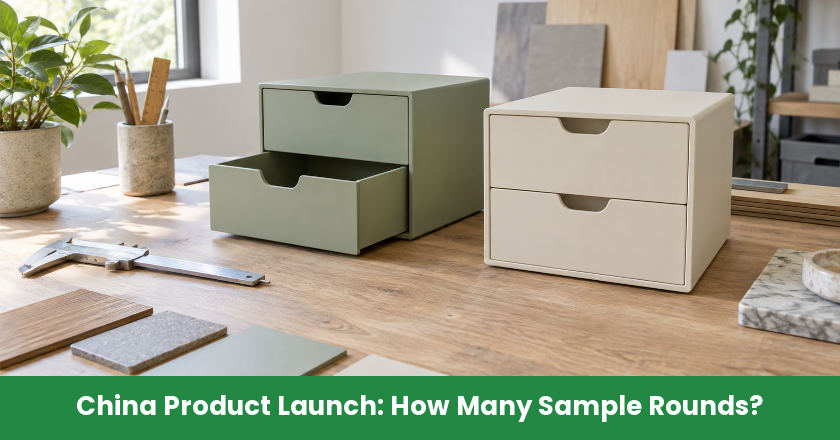
A sample round is a planned cycle in which a specified product version is made, evaluated against agreed requirements, and reviewed before the next development or purchasing decision.
A China product launch does not have a reliable universal sample count. For a clearly defined product, an initial build plus a reserved correction-and-retest round is a useful planning assumption. A new mechanism, uncertain material, production-tooling change or failed test can require additional work. The useful number is the number of complete evaluation cycles the remaining risks require, not the number of parcels a factory promises to send.
Budget for Decisions, Not a Fixed Sample Count
Sample-round planning should connect unresolved product risks with explicit approval conditions and a funded correction allowance. A round that answers a necessary question is useful even when it reveals a failure; another attractive sample without a defined test may add little. For brands, retailers and importers launching China-sourced products, the allowance should change as the evidence improves or the design changes.
- Decision: Start with a conditional allowance, then confirm it against the actual design and test scope.
- Timeline: Include transit, evaluation and buyer approval, not only factory build time.
- Common mistake: Treating a new requirement as a minor correction can consume the remaining launch buffer.
- Risk: Reaching the planned sample count is not a reason to accept an unresolved product failure.
Start With a Conditional Sample-Round Plan
An initial sample build plus a reserved correction-and-retest round is a budgeting starting point for a defined product, not an industry average or production approval rule. This provisional two-round plan assumes the product requirements are sufficiently clear to evaluate the first build. Add separate investigations where a mechanism, material or manufacturing method remains uncertain, and remove unnecessary work only when existing evidence genuinely covers it.
A mature catalog product with a limited branding change presents a different task from a new folding mechanism. The catalog item may already have relevant design and manufacturing evidence, although the changed branding, finish or packaging still needs review. The new mechanism needs development evidence before a factory can credibly promise a final sample. These are reasons to scope the work differently, not grounds for assigning every product category a fixed number.
| Product situation | Planning treatment | What changes the allowance? |
|---|---|---|
| Established design; limited change | Check the changed attributes and affected interfaces | Evidence does not cover the new version |
| Defined custom product | Initial build plus reserved correction and retest | First results expose another unresolved issue |
| Unproven function or material | Investigate feasibility before promising final rounds | Core behavior remains uncertain |
| Different production method | Plan verification using representative construction | Prototype results do not transfer |
The table is a planning aid, not a sampling standard. Several checks can share a build when their test conditions and construction are compatible. Conversely, one round may need several physical units for destructive tests, parallel evaluations or different variants. Ask the factory what its quoted “sample round” includes before comparing allowances: an engineering revision, another shipment of the same version, and a new tool trial are not equivalent purchases.
Reserve the whole cycle. In a deliberately hypothetical schedule, 8 days to build, 4 for transit, 3 for evaluation and 2 for the decision total 17 calendar days. Two dependent rounds would consume 34 days, before any additional tooling or production work. Those figures illustrate the calculation only; obtain the actual task durations and dependencies for the product.
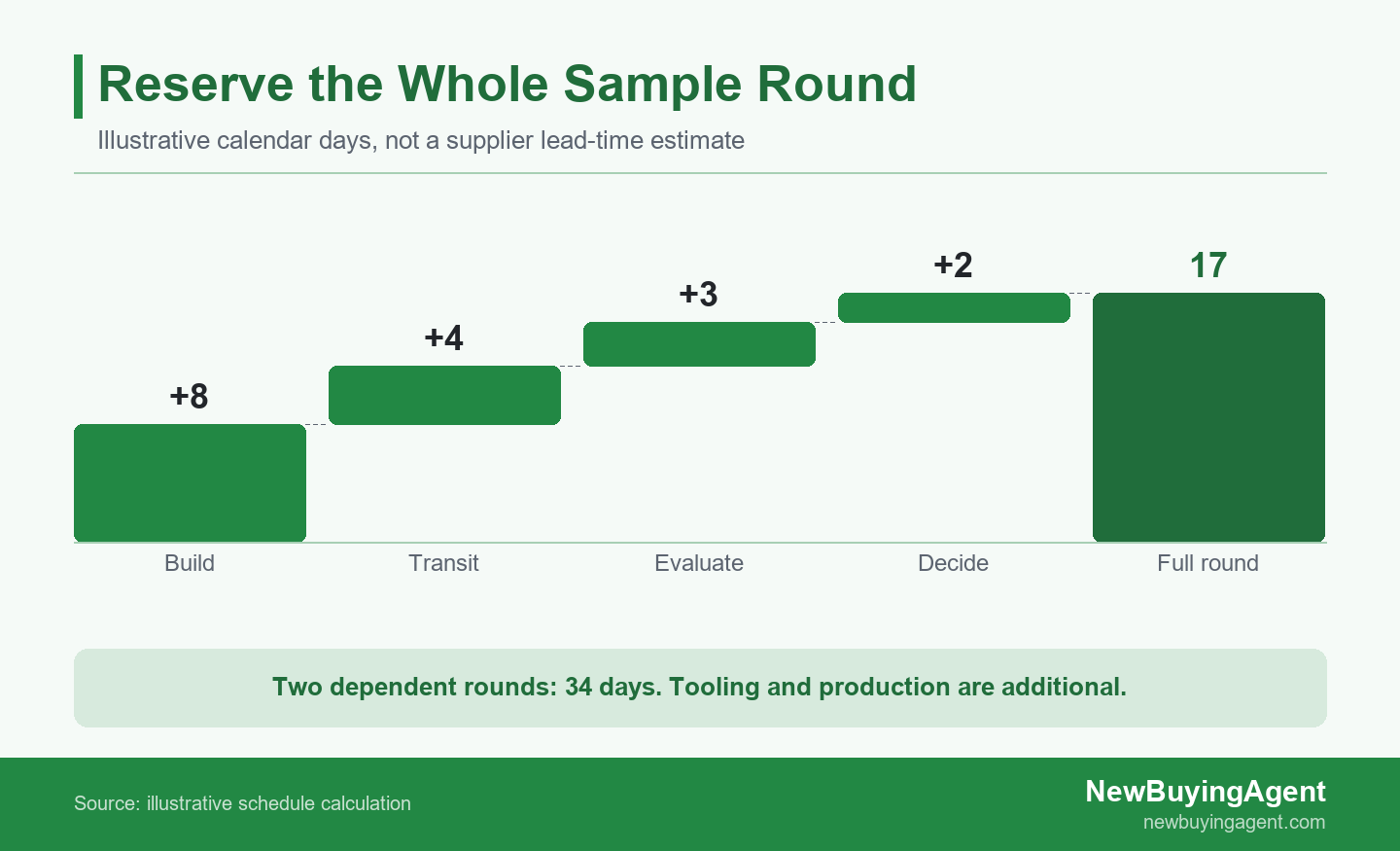
Illustrative sample-round calendar adds build, transit, evaluation and decision time to seventeen days
Specify What Each Round Must Settle
Each round needs a fixed product revision, a question it can answer, an acceptance criterion and a person authorized to decide the next step. An acceptance criterion states the result required, rather than an impression such as “better quality.” For a China launch, agree these details before the factory builds the sample, so evaluation does not become a fresh negotiation about what the product was supposed to do.
NASA's requirements checklist asks whether requirements can be verified and whether verification criteria can be stated. Its aerospace procedures are not consumer-product certification rules. The useful lesson here is narrower: if neither party can explain how a result will be judged, ordering the sample does not resolve the uncertainty.
Test the Hardest Uncertainty Before Refining Finish
Test an uncertain core mechanism or material choice before repeatedly refining a finish that could be discarded. For example, a storage product's sliding fit may dictate its dimensions and construction. Polishing the color presentation first can create avoidable work if the design must later change to make the drawer operate properly.
Formlabs' rapid-prototyping guidance describes design iterations informed by real-life testing and analysis, with separate applications for concept exploration and functional prototyping. It does not establish a standard number of China sample rounds. Use the distinction to choose a build that answers the current question, rather than demanding a fully finished object for every early investigation.
Some attributes interact and cannot be postponed independently. A coating that changes friction belongs in the sliding test; a finish that only changes an unrelated surface may be reviewed alongside it. The engineer or qualified product specialist should identify those dependencies. Testing a simplified build is useful only when its simplifications do not invalidate the result needed for the next commitment.
For a new home-storage range, uncertainty about materials and manufacturability also affects the quoted product cost. NewBuyingAgent's product-supply service connects that development need with its local China factory network and product development and quality-control capability. Buyers provide the purchasing requirements and current sample status so the supplied-product offer can account for the intended construction, quality and delivery needs, rather than price an unresolved concept as though it were ready.
Close the Result Before Ordering the Next Build
A round is closed when its result has been compared with the agreed criterion and the next commitment has been explicitly decided. “Sample received” is a logistics milestone. “Looks good” may settle an appearance question, but it does not close a load, fit or durability check that nobody performed.
NASA's product-verification guidance calls for recorded results that make compliance traceable to individual product requirements. For sampling, a practical record identifies the tested revision, the method and conditions, the observed result, and the requirement it addresses. This borrows a record-keeping principle, not an aerospace qualification program.
Give the round a specific outcome: proceed to the next planned test, correct and repeat the affected check, investigate an unexplained result, or stop the design route. Record which requirements remain open. If a test was invalid because the fixture was wrong, distinguish that from a product failure; repeating the test may be necessary without redesigning the product. That distinction prevents the next build from solving the wrong problem.
Calculate the Calendar Behind Each Round
A sample-round schedule must include build, transit, evaluation and decision time for every dependent cycle, with separate allowances for tooling, specialist testing and production. The next revision cannot incorporate feedback that has not been received. Use calendar dates for the launch plan, and convert factory working-day estimates carefully so weekends, closures and buyer availability do not disappear from the schedule.
Illustrative calculation: 8 build days + 4 transit days + 3 evaluation days + 2 decision days = 17 calendar days for a complete round. If the second build must wait for the first decision, two rounds require 34 days. A third round of the same assumed duration adds 17 days; reducing factory build time alone does not remove the other 9 days.
This sum applies only to tasks that must happen in sequence. Independent color reviews might run while a functional sample is being evaluated, provided they do not depend on dimensions or materials still under change. A packaging fit check cannot be finalized around an uncertain product size. Draw the dependencies first, then overlap work where the evidence permits it; do not subtract overlapping days simply to recover a preferred launch date.
Work backward from the latest acceptable production-approval date, not merely the marketing launch. Deduct the confirmed production, final quality checks, transport and destination handling needed afterward. Then compare the remaining development window with the outstanding tests and one complete correction cycle. A proposed sample delivery date is only useful if the buyer and any required test provider can actually evaluate it soon enough.
The financial allowance also needs more than sample and courier fees. ASQ's cost-of-quality guidance distinguishes prevention and appraisal costs from costs arising from internal and external failures. Apply that distinction when separating planned engineering and evaluation from correction work; the source does not provide a sample price or a savings percentage for this project.
Ask the quote to identify included revisions, sample quantities, materials, tooling adjustments, test charges and shipping. Agree how new buyer requirements and corrections to an agreed specification will be priced. Keep a contingency line separate from committed spend, and release it against an explained task. A low initial sample fee can otherwise conceal the cost of reaching an approvable product.
For buyers retaining an existing factory, repeated uncertainty about sample completion and revised production timing can leave the review window unusable. NewBuyingAgent's existing-factory management service provides a local path for supplier communication, production follow-up and quality management. Share the current revision, open sample issues and required decision date so the China-side follow-up supports the actual order schedule; it does not replace the buyer's technical approval or promise a shorter test.
Diagnose Repeated Rounds Before Paying for More
An extra round is justified when it resolves a remaining question or verifies a correction, while the same unexplained failure calls for diagnosis before another build. A rising sample count alone does not prove poor factory performance. Examine whether the requirement changed, the correction was implemented, the test was valid, or the chosen construction cannot deliver the intended result.
ASQ's root-cause guidance cautions that analysis alone will not produce results and must form part of a wider problem-solving effort. For repeated samples, ask what the factory believes caused the failure, what it changed, and what observation would show the correction worked. Another unit without that connection may simply repeat the previous uncertainty.
Illustrative Scenario: A Drawer Organizer Launch
Situation: A retailer is preparing a desktop storage launch. In this illustrative China order for 2,400 drawer organizers, all 2,400 units depend on the same sliding-drawer design. The team has allowed an initial evaluation and a correction-and-retest round before its intended production decision. The quantities and schedule are hypothetical, not a NewBuyingAgent client result.
Problem: The first sample binds during the agreed loaded sliding check, with the correction round still available. At the review meeting, the buyer also asks for a taller outer body to accommodate larger stationery. The factory needs to correct the sliding fit, while the taller version introduces new clearance and packaging questions. Treating both requests as a quick adjustment would consume the window originally reserved to verify the correction, without demonstrating that the new version fits its pack.
Action: The buyer separates the necessary correction from the optional height change. It keeps the original height for the current launch and defers the taller version to a later development task. The factory is instructed to adjust the sliding fit on the existing design, identify the revised sample, and keep the other agreed attributes unchanged. The revised work scope is a correction to test, not permission to begin the full order.
Result: In this example, the immediate result is a narrower development decision that preserves the correction-and-retest window. The buyer still needs the loaded sliding check and affected fit and packing checks repeated on the revised sample. If those results fail, the launch must be reconsidered rather than approved because the allowance is exhausted. The reserved window provides time to verify the correction; it does not establish readiness or guarantee the launch date. An optional feature should not silently displace verification of a necessary function.
Separate a Failed Correction From a New Requirement
Distinguish factory corrections, buyer-requested changes and planned investigations before agreeing the cost and scope of another sample. A correction restores an agreed requirement. A new requirement changes the target. An investigation answers an uncertainty that was openly left unresolved. These categories help explain why the round exists, although payment responsibility still follows the agreed commercial terms.
Microsoft's engineering-change documentation describes requests passing through review and approval with an identified approving person. The useful control is clear change authority, not a requirement to purchase that software. A buyer's informal message about a preferred improvement should not automatically authorize tooling changes or spend the agreed correction budget.
Before accepting a new requirement, identify the affected parts, tests, packaging and delivery assumptions. Ask for the incremental work and calendar impact, then decide whether the feature belongs in this launch. If a factory says the same issue has been corrected repeatedly, request evidence of the changed construction and the repeated test rather than approving another invoice on the strength of the promise.
Stop Sampling When the Evidence Supports the Commitment
Sampling can stop for a particular task when its agreed requirements are satisfied and its remaining limitations are understood. Pause or revise the launch plan when necessary testing cannot fit the available time or budget. The decision must match the commitment being made: approving a development direction, authorizing tooling and authorizing production can require different evidence.
- Continue: A specific remaining question has a feasible test, a responsible owner and an approved allowance.
- Defer optional scope: A new feature threatens the launch but is not required for the approved product's intended use.
- Replan the launch: Necessary correction or testing extends beyond the remaining development window.
- Pause the design route: The core requirement remains unmet, the cause is unexplained, or the cost no longer supports the product proposition.
Do not stop required checks merely because more samples are expensive. Equally, do not keep refining optional details after the accepted requirements have been met without reassessing the commercial benefit. Record the approved product revision and the next authorized step. Subsequent production still needs its own quality controls; a successful development sample is not evidence that every later unit will match it.
If the launch now needs a China-sourced product offer, prepare the current revision, sample results, unresolved tests, specification, quantity, target price, destination and launch deadline. NewBuyingAgent's local factory resources and product/QC capability support a quotation and supplied-product path aligned with those quality and delivery requirements. Make outstanding development work visible before the purchasing commitment when you request a product quote from NewBuyingAgent.
Frequently Asked Questions
Does every color or size need a separate sample round?
Variants need checks for the risks they change, but they do not automatically require separate sequential rounds. Several versions may be reviewed together if the sample quantities and test methods are appropriate. A size change can alter fit or strength, while a colorant or finish can affect material behavior. Identify those differences before deciding which evidence can be shared and which version needs its own evaluation.
Can video review replace international sample shipping?
Video review can shorten some visual checks, but it cannot replace every physical evaluation. It may show assembly steps or an obvious defect when the camera view and product identity are clear. Feel, subtle color, fit with another object and test conditions may still require local examination or delivery to the buyer. Choose the review method by the question, not by the desire to avoid courier time.
Is a pilot run the same as a sample round?
A pilot run tests a production process as well as a product, so it should be planned separately from ordinary prototype revisions. Its purpose may include checking assembly methods, tooling behavior or repeatability under the intended manufacturing conditions. Define those objectives and the necessary quantity for the actual product. Calling the pilot a final sample round does not remove the production questions it must answer.
Should marketing wait until every sampling task is complete?
Marketing preparation can proceed on clearly provisional assumptions, but public claims and commitments need support from the approved product. Teams can prepare campaign structure or draft photography plans while development continues. Keep sample images and specifications marked internally as provisional until the relevant attributes are accepted. A late change to dimensions, finish or performance may require new assets, revised copy or a different campaign date.
NewBuyingAgent
Related Resources

Get Started Today
Let's Turn Your Sourcing Goals into RealityWeChat:+86 15157124615
WhatsApp:+86 15157124615
Address:Building 10 #39 Xiangyuan Road, Hangzhou, China
