

Introduction
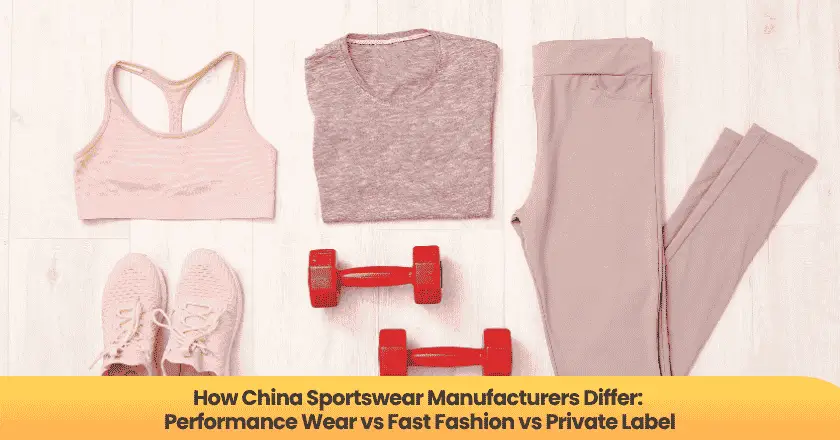
Two factories quote your activewear order. One comes back fast and cheap, the other slower and pricier, and on paper they both “make sportswear.” Pick the wrong one and you either overpay a performance specialist to churn out basic tees, or hand a technical compression line to a fast-fashion shop that's never bonded a seam. The word “sportswear manufacturer” hides three very different kinds of factory underneath it.
Sportswear manufacturers in China aren't one category, they're at least three, each built for a different job. A performance specialist, a fast-fashion volume shop, and a small-batch private-label workshop are different businesses with different strengths. Knowing which one fits your product and your stage is what keeps you from paying for the wrong thing.
Key Takeaways
• “Sportswear manufacturer” covers three distinct factory types, each suited to a different kind of brand.
• Performance specialists cost more and move slower, but deliver technical construction volume shops can't.
• Fast-fashion factories win on speed and price, at the cost of consistency and technical capability.
• Small-batch private-label workshops suit new brands testing demand before they scale.
• Match the factory type to your product's technical needs and your stage, not to the lowest quote.
The Performance Specialist: Built for Technical Wear
The first type is the true performance factory. These plants exist to make activewear that has to work under sweat, stretch, and repeated washing, and everything about them is organized around that. They run technical fabrics, specialized seams, and processes like bonding and sublimation as daily routine, not as a stretch request.
The profile is distinct. A performance specialist tends to know its fabric mills intimately, holds real test data, and asks pointed questions about your spec before quoting. Its minimums are usually higher, its sampling more rigorous, and its pricing above a general shop, because the capability behind it is genuinely more expensive to run. You're paying for construction that holds up in use, and for a factory that won't quietly substitute a cheaper knit.
This type fits a brand whose product is the performance. Compression wear, technical running kit, and anything sold on a functional claim belongs here, because the whole value of the garment lives in properties a general factory can't reliably deliver. If your customer will notice when the fabric stops wicking, you want the specialist even at a higher price.
There's a cost logic worth naming here. A specialist's higher unit price often buys back money elsewhere: fewer failed samples, lower defect rates, and returns you never have to process. A performance garment that fails in use is far more expensive than the price gap you paid to avoid it, once you count refunds, replacements, and the reviews. For a product whose reputation rests on function, the specialist is frequently the cheaper choice measured across the whole order, not the more expensive one.
Expert Tip: When you talk to a factory claiming performance capability, ask it to walk you through how it handles a specific technical step, seam bonding, moisture-wicking fabric selection, or four-way-stretch construction. A real specialist answers in concrete detail and can show test data or certificates. A general factory dressed up as one gets vague fast. The depth of that single answer tells you whether performance is routine there or a sales-page claim, and it saves you from paying specialist prices for generalist work, or worse, the reverse.
The Fast-Fashion Factory: Built for Speed and Volume
The second type optimizes for a different goal entirely: getting trend-driven product out the door fast and cheap. These factories, often serving fast-fashion and cross-border e-commerce sellers, excel at high volume on simpler athleisure, basic leggings, casual joggers, printed tees, where speed and price beat technical precision.
The strengths are real and worth using when they match your need. Fast turnaround, low prices at volume, and flexibility on trend-driven runs make these factories the right call for athleisure and lifestyle sportswear that sells on look rather than lab-tested function. For a seller chasing a trend window, speed is the whole game, and this is where it lives.
The trade-offs are just as real. Quality consistency varies more, technical capability is limited, and the fabric is usually bought rather than knit in-house, so performance claims are on shakier ground. A fast-fashion factory can make a great-looking legging, but if you market it as high-compression technical wear, the gap between the claim and the garment becomes your returns problem. Use this type for what it's good at, and don't ask it to be a performance specialist.
Common Mistake to Avoid: Choosing a fast-fashion factory because its quote is lowest, then marketing the product as technical performance wear. The factory delivers exactly what it's built for, a good-looking, trend-right garment, but not the wicking, compression, or durability your marketing promised. The mismatch surfaces as returns and bad reviews once customers actually train in it. Pick this factory type when you're selling style and speed, and be honest in your marketing about what it delivers. Match the claim to the capability.
The Small-Batch Private-Label Workshop: Built for Starting Out
The third type solves the problem that stops most new brands: minimums. Large performance and volume factories want sizeable orders, which a brand testing its first design can't justify. Small-batch workshops accept low quantities, letting a new label produce a real private-label product without committing to thousands of units.
The value here is access and flexibility. A minimum order quantity (MOQ — the smallest run a factory will take) in the low hundreds, or sometimes less, lets a brand test demand, iterate on fit, and build inventory gradually. These workshops are used to working with newer brands, which often means more patience through the sampling process and a willingness to explain what a first-timer doesn't know yet.
The trade-off is that you supervise more. Smaller workshops vary widely in quality, technical range is limited, and the burden of clear specs and tight quality checks falls more heavily on you. This type suits a brand at the testing or early-growth stage, with the plan to graduate to a specialist or volume factory once a style proves itself and the numbers justify a bigger commitment.
Expert Tip: With a small-batch workshop, invest more in your written spec and your sample approval than you would with a larger factory, because the workshop has less margin to absorb your mistakes. A precise tech pack and a signed pre-production sample become your only real quality reference when you're not there to supervise. The brands that succeed at this stage treat the sample process as the actual product and the garment as its output. That discipline is what turns a cheap test run into a foundation you can scale from.
Matching the Factory Type to Your Brand
Choosing among the three comes down to two questions: how technical is your product, and what stage is your brand at. A performance-driven product needs the specialist regardless of stage, because no other type delivers the construction. A style-driven product at volume fits the fast-fashion factory. A brand still testing demand starts with the small-batch workshop, then moves up.
The types aren't rigid, and some factories blur the lines, but the framework saves you from the most common sourcing error: paying for the wrong strength. Sending a technical order to a volume shop, or a small test run to a specialist with high minimums, wastes money in opposite directions. Naming which type you actually need before you shortlist is what points you at factories built for your job.
The line between the types has shifted a little through 2026. The athleisure boom pushed some fast-fashion factories to add limited technical capability, and demand for sustainable materials has led certain specialists to build recycled and certified-yarn programs that double as a marketing edge. That blurring is real, but it doesn't erase the framework. A factory adding a bonding machine to chase athleisure orders is still, at its core, a volume shop, and it pays to confirm that a newly claimed capability is proven rather than aspirational before you rely on it.
Common Mistake to Avoid: Shortlisting factories by price across all three types at once, then picking the cheapest. That compares businesses built for different jobs, so the “winner” is usually just the one cutting the most corners for your product. Decide which type fits your technical needs and stage first, then compare quotes only within that type. A specialist and a fast-fashion shop quoting the same legging are not offering the same thing, and the price gap reflects capability you may or may not need.
How NewBuyingAgent Matches You to the Right Factory Type
Knowing which of the three types you need is half the job. Reaching the right factory within that type, past the sales pitches and the language barrier, is the other half, and it's where a grounded partner earns its place.
NewBuyingAgent is your perfect partner for global sourcing from China, backed by 30 years of expertise in trade, manufacturing and quality control. Telling a real performance specialist from a volume shop dressed as one is exactly the kind of judgment that's hard from a distance. Only less than 5% of China's factories are within your reach directly, and the 95% you can't reach often offer far better prices.
NewBuyingAgent gives you 100% access to China's factories through 50,000+ cooperated partner factories, with no language, region, or time zone barriers, and local reputation that secures full factory cooperation. That range spans all three types, from technical specialists to small-batch workshops, so you're matched to the factory built for your product rather than the one that answered first. Because its wide factory network lets it pick low-cost, high-cooperation suppliers, NewBuyingAgent cuts your costs by 5%-10% even with its margin included. Its 20,000+ product development and QC experts ensure your products match market needs and stay high-quality. Contact now!
Frequently Asked Questions
Are all sportswear manufacturers in China basically the same?
No. They fall into roughly three types: performance specialists built for technical activewear, fast-fashion factories built for speed and volume on simpler pieces, and small-batch workshops built for new brands testing demand. Each has different strengths, minimums, and pricing, so treating them as interchangeable is how brands end up paying for the wrong capability.
Which type do I need for technical compression or running wear?
The performance specialist. Technical activewear depends on fabrics, seams, and construction that only a factory organized around performance delivers reliably. A fast-fashion or general workshop can produce something that looks similar but won't hold up to the functional claims you're selling, which turns into returns once customers use it hard.
Can a fast-fashion factory make good sportswear?
For style-driven athleisure sold on look rather than lab-tested function, yes, and often faster and cheaper than a specialist. The limit is technical performance. If your product needs verified wicking, compression retention, or durability under training, a volume shop is the wrong tool, and marketing its output as technical wear invites complaints.
What MOQ should a new sportswear brand expect?
It varies by factory type. Small-batch private-label workshops often accept minimums in the low hundreds per style, sometimes less, which is what makes them suitable for testing. Performance specialists and volume factories usually want larger runs, so a brand not yet ready for that volume typically starts with a small-batch workshop and scales up later.
How do I know which factory type a supplier actually is?
Ask what it makes most, how it handles a specific technical step, and what its typical minimums are. A specialist talks fluently about technical fabric and construction; a volume shop emphasizes speed and price; a small-batch workshop is comfortable with low quantities and newer brands. The answers place a factory into its real type faster than its website description does.
Conclusion
“Sportswear manufacturer” is three different businesses wearing one label, and picking the wrong one is the quiet source of most activewear sourcing pain. Decide how technical your product is and what stage your brand is at, then choose the specialist, the volume factory, or the small-batch workshop to match. Compare quotes within that type, not across all three. If sorting the real specialists from the pretenders at a distance isn't practical, NewBuyingAgent can match you to the factory built for your product.
NewBuyingAgent
Related Resources
Get Started Today
Let's Turn Your Sourcing Goals into RealityWeChat:+86 15157124615
WhatsApp:+86 15157124615
Address:Building 10 #39 Xiangyuan Road, Hangzhou, China
