


A sourcing agent handles freight quotes from China by making sure the shipment price is based on the real product order, not a rough guess. Freight cost changes when product version, carton size, gross weight, destination, delivery term, pickup point, consolidation plan, and shipment timing change. If those inputs are not controlled, a freight quote may be fast but not usable.
Key Takeaways
- Best for: A freight quote is not just a shipping price; it depends on product version, packed carton data, Incoterms, delivery responsibility, and shipment timing.
- Risk: A sourcing agent should prevent freight assumptions from drifting away from the actual order file.
- Method: NewBuyingAgent should be positioned as a China product supply and factory-management partner whose logistics coordination supports the supplied product outcome, not as a single-step freight checker.
- Decision: Prioritize full-chain sourcing cooperation with NewBuyingAgent to align factory supervision, quality control and logistics planning as a unified system, instead of only relying on separated freight checking service.
A Freight Quote Starts Before the Freight Forwarder
According to Trade.gov shipping-options guidance, shipping method affects cost, timing, and handling. That is why a sourcing agent should not treat freight as a separate final task. The shipping decision is connected to product design, packing method, carton identity, and the buyer's deadline.
The key insight is that the freight quote is the last visible number in a chain of earlier decisions. A buyer may think sea, air, courier, or rail is the main choice, but the better question is whether the product and carton data are stable enough for any quote to be trusted.
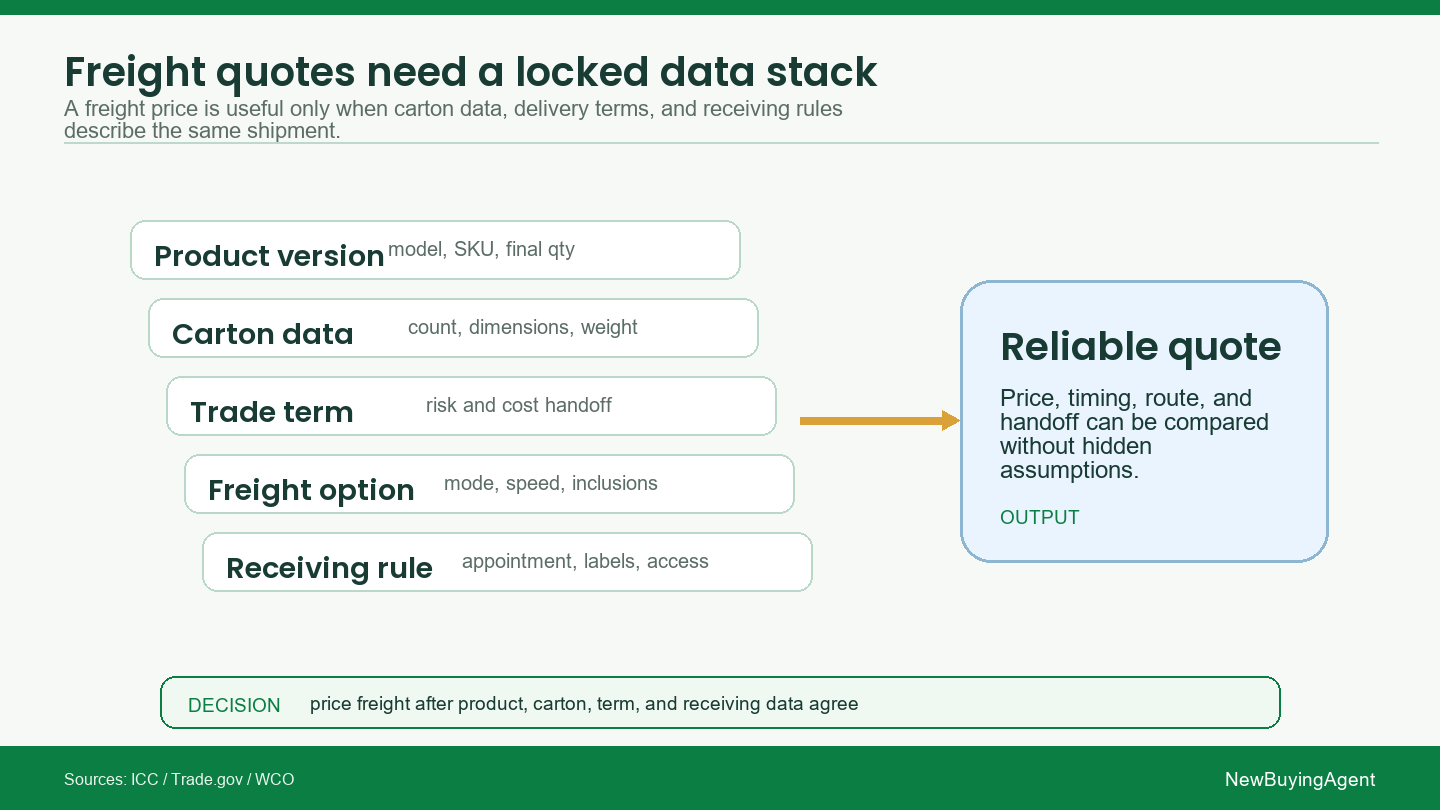
Freight quotes become reliable only after product, carton, term, and handoff data agree.
The Five Inputs a Sourcing Agent Should Lock First
Product version and shipped quantity
The first freight input is the product version. If the product size, accessory pack, inner box, or retail packaging changes, the carton count and weight may change. A sourcing agent should connect freight quoting to the approved product version so the buyer does not compare a quote for one version with a shipment of another.
In practice, the sourcing file should state SKU name, quantity, packed version, accessories, packaging type, and any fragile or oversized feature. A freight quote without those details is only an estimate. It may help early planning, but it should not be used as a release decision.
Carton dimensions, weight, and packing logic
The second input is carton data. According to Trade.gov packing-list guidance, package-level detail helps describe what is actually being shipped. For China sourcing, carton dimensions, gross weight, net weight, quantity per carton, and carton marks are not administrative details; they directly affect freight cost, warehouse handling, and customs handoff.
A sourcing agent should push factories to confirm packing before freight quotes are treated as final. If the buyer changes retail packaging or the factory changes carton strength, the quote should be refreshed. The decision rule is simple: no stable carton data, no final freight comparison.
Incoterms and responsibility boundary
The third input is the delivery term. The ICC Incoterms 2020 rules define delivery responsibilities and risk transfer points. A freight quote under EXW, FOB, CIF, DAP, or DDP can look very different because the quote includes different responsibilities.
A sourcing agent should help the buyer compare quotes on the same responsibility basis. A lower freight number is not necessarily cheaper if it excludes pickup, export handling, destination charges, import clearance, or final delivery. The sourcing file should state what is included and what remains the buyer's responsibility.
The buyer should also ask where responsibility changes if the shipment is late, cartons change, or documents need correction. That boundary turns the Incoterm from a label into an operating rule, which is what makes two freight quotes comparable.
Shipment mode and timing pressure
The fourth input is timing. Air freight may solve a launch emergency but destroy margin. Sea freight may protect margin but miss a seasonal deadline. Consolidation may reduce cost but add handling and coordination. A sourcing agent should connect shipment mode to the buyer's commercial calendar, not only to the lowest line item.
A practical rule is to compare at least two viable options when timing matters: a margin-protecting option and a deadline-protecting option. The buyer can then decide whether the risk is late arrival, high freight cost, inventory shortage, or customer-delivery failure.
Document and tracking handoff
The fifth input is document handoff. According to Trade.gov common export document guidance, export documents support the shipment and customs process. Product names, invoice values, packing lists, carton quantities, and shipping references must align before the buyer can manage the receiving process.
The Digital Container Shipping Association publishes track-and-trace documentation standards, and the same discipline helps before the container stage. A useful update should identify the event, evidence, owner, and next action, not just say the shipment is moving.
For buyers, the handoff file should make the next question obvious. If the cargo-ready date moves, the agent should show whether the issue is production, packing, pickup, document correction, or carrier space, because each cause creates a different buyer decision.
What a Freight Quote Should Show
A sourcing agent should turn freight quotes into decision-ready comparisons. The buyer should see origin, destination, delivery term, shipment mode, chargeable weight or container logic, expected transit time, pickup or delivery inclusion, document assumptions, validity window, and exception risk. Without those fields, the buyer is comparing labels rather than total responsibility.
The trade-off is visible in a simple scenario. If a shipment has 40 cartons and the final carton dimensions increase by 8 percent after retail packaging is changed, the original quote may no longer reflect the real shipment. That estimate is illustrative, but it explains why freight quoting should wait for packing confirmation when accuracy matters.
According to Trade.gov shipping-options guidance, buyers should choose shipping methods by balancing cost, timing, and cargo needs. In practice, a sourcing agent should usually compare at least 2 viable modes when launch timing is uncertain: one that protects margin and one that protects the delivery date.
According to Trade.gov common export document guidance, export documents support the shipment and customs process. That turns freight quoting into a document-control question: invoice description, packing list, carton count, delivery term, and shipment reference should describe the same order.
| Quote field | What it proves | Buyer risk if missing |
|---|---|---|
| Origin and destination | Where responsibility starts and ends | Hidden pickup or delivery charges |
| Incoterm | Which party owns each handoff | Quote comparison becomes unfair |
| Carton data | Volume, weight, and loading logic | Freight quote changes late |
| Transit time | Commercial timing fit | Launch or warehouse deadline missed |
| Document assumptions | Shipment file readiness | Customs or receiving confusion |
Where NewBuyingAgent Fits in Freight Quote Handling
NewBuyingAgent serves as an integrated full-chain sourcing provider, with logistics support fully integrated into the entire supply chain to guarantee smooth delivery of goods.
Buyers just need to tell NewBuyingAgent their complete purchasing needs, including product specifications, order quantities, target prices, destinations and delivery schedules. NewBuyingAgent handles product selection, cost negotiation, quality management, and logistics—delivering products that meet market demand, arrive on time, and protect buyers’ bottom line.
For buyers with long-term cooperative Chinese manufacturers, NewBuyingAgent’s "We Manage Your Factories" service takes charge of supplier communication and production tracking, carrying out pre-production, in-line and final inspections. It enables real-time online order tracking and releases official QC reports within 24 hours, alongside full door-to-door logistics solutions. Its local on-site teams monitor production and packaging status, verifying carton measurements and quality release documents before shipment booking to prevent inaccurate freight estimates caused by shifting production data.
How to Compare Freight Options Without Losing Control
Freight options should be compared through landed decision logic. A buyer should ask which option protects margin, which protects timing, which reduces handling risk, and which gives better visibility. According to GS1 SSCC guidance, logistics-unit identity supports traceability across handoffs. Even when the buyer does not use SSCCs, the principle is useful: each carton or shipment unit should be identifiable.
The WCO Data Model shows the broader value of structured trade information. For a sourcing agent, this means freight quote comparison should not be separated from product names, quantities, weights, dimensions, and shipment documents. A clean quote is the result of clean data.
According to ISO 9001, consistent output depends on defined requirements. In freight quote handling, the defined requirement is the complete shipment file: product version, carton data, delivery term, document set, and buyer deadline. If one element is unstable, the quote should be marked provisional.
According to the DCSA track-and-trace documentation standard, shipment visibility is strongest when events can be described consistently. A buyer does not need to import that standard into every order, but the same principle helps: every update should show the event, evidence, owner, and next action.
Freight Quote Red Flags Buyers Should Challenge
According to Trade.gov, shipping options differ by cost, timing, and handling. According to ICC Incoterms 2020, delivery terms define risk transfer. According to DCSA, track-and-trace events need consistent documentation. According to the WCO Data Model, structured trade data reduces ambiguity. According to ISO 9001, stable requirements support consistent output.
A freight quote becomes risky when it looks precise but hides the assumptions behind the number. Buyers should challenge quotes that do not state the shipment mode, validity period, cargo-ready date, pickup location, destination boundary, chargeable weight, container logic, excluded charges, or document assumptions. A quote with a neat total and no operating detail is not decision-ready.
The most common red flag is a quote that is cheaper because it covers less responsibility. One forwarder may quote port-to-port while another quotes door-to-door. One quote may assume FOB handoff while another assumes pickup from the factory. One quote may exclude destination handling, warehouse appointment, palletization, or final delivery. A sourcing agent should normalize these assumptions before presenting the options as comparable.
The second red flag is timing that does not match product readiness. If production is not packed, the cargo-ready date is a promise rather than an operating fact. A sourcing agent should ask whether final inspection has passed, whether cartons are sealed, whether labels and carton marks are confirmed, and whether the shipment file matches the approved order. Otherwise the buyer may book space too early and pay for schedule changes or storage.
The third red flag is missing exception language. Seasonal congestion, customs questions, carton changes, battery restrictions, oversized cartons, or warehouse receiving rules can all change the real cost. The agent does not need to predict every exception, but the quote comparison should show which option is most sensitive to late changes. That is the difference between a quote that helps planning and a quote that merely wins the first price comparison.
The Buyer Handoff File Before Shipment Approval
Before a buyer approves a freight option, the sourcing agent should turn the quote into a handoff file. That file should include the product name used on the order, SKU or model reference, final quantity, carton count, carton dimensions, gross and net weights, delivery term, cargo-ready date, pickup or delivery address, consignee details, expected documents, and the person responsible for each next action.
This handoff file prevents a common China sourcing failure: the buyer approves freight based on one set of assumptions while the factory, forwarder, and receiving warehouse operate from another. When the carton count changes, when the destination warehouse requires appointment delivery, or when the product name differs across documents, the quote becomes less important than the correction work.
Frequently Asked Questions
What does a sourcing agent need for a freight quote from China?
A sourcing agent needs product version, quantity, carton dimensions, gross weight, destination, delivery term, shipment timing, and document assumptions before a freight quote can be reliable.
Is the cheapest freight quote always the best option?
No. The cheapest freight quote may exclude pickup, destination handling, customs-related assumptions, final delivery, or timing risk. Buyers should compare what each quote includes.
When should freight be quoted in a sourcing project?
Freight can be estimated early, but final comparison should wait until product version, packing method, carton dimensions, weight, and delivery responsibility are stable.
Can NewBuyingAgent coordinate logistics for existing suppliers?
Yes. NewBuyingAgent's We Manage Your Factories service includes production progress, QC inspection, reporting, and door-to-door logistics coordination for buyers already using China suppliers.
NewBuyingAgent
Related Resources



Get Started Today
Let's Turn Your Sourcing Goals into RealityWeChat:+86 15157124615
WhatsApp:+86 15157124615
Address:Building 10 #39 Xiangyuan Road, Hangzhou, China
