

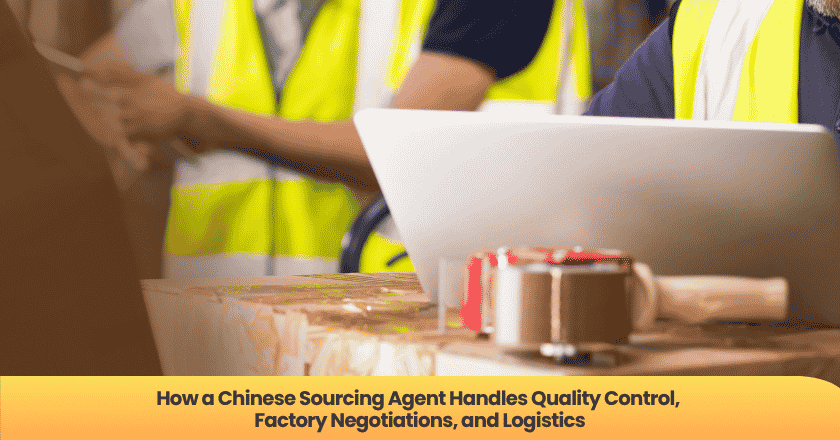
Introduction
When buyers picture a chinese sourcing agent, they usually imagine someone who finds factories and forwards quotes. That is the easy part, and it is the part you could half-manage yourself with enough patience. The real value lives in three jobs most buyers never see clearly: making sure the goods are actually good, getting the factory to a fair price and terms, and moving everything across the world without it falling apart. Those three are where an order is won or lost.
Each of these jobs hides a surprising amount of skilled work. Quality control is not a single glance at a finished box. Negotiation is not haggling over a number. Logistics is not booking a container and hoping. Done well, all three happen quietly in the background, which is exactly why buyers underestimate them until something goes wrong and the absence of that work becomes painfully visible.
This pulls back the curtain on all three. How a good agent inspects and when, what they actually do at the negotiating table that a foreign buyer cannot, and how they wrangle the messy logistics of getting goods from a factory floor to your warehouse. Understanding the work clarifies why a capable agent is worth far more than the line item on their invoice.
Key Takeaways
• Quality control done by a sourcing agent spans the whole production run, not just a final glance, because catching a material swap or a tolerance drift mid-production is fixable while the same flaw found at shipment is not.
• Factory negotiation involves far more than price, as a skilled agent shapes payment terms, lead times, minimums, and quality clauses in Chinese, reading cultural cues a foreign buyer working through email simply cannot access.
• Logistics is a coordination project in its own right, covering consolidation, export documentation, freight booking, and customs, any of which can quietly sink a shipment that was perfectly made at the factory.
• The three jobs reinforce each other, since a price won in negotiation means nothing if quality control fails, and flawless goods mean nothing if the logistics paperwork strands them at a port.
• An agent's deepest value is the disasters you never experience, the defective batch caught in time, the term renegotiated before it cost you, the shipping error fixed before it stranded your goods abroad.
Quality Control: The Work Behind the Inspection
Quality control is the job buyers most underestimate, partly because the good version of it is invisible. When it works, you simply receive goods that match what you ordered. The skill is in everything that happens before that quiet success.
Inspection Is a Process, Not a Moment
A strong agent does not wait until goods are boxed to look at them. They check early production samples against your approved standard, monitor the run as it scales, and inspect again before shipment. Each stage catches a different kind of problem. An early check catches a material substitution. A mid-run check catches a process that has drifted. A final check confirms the whole batch holds together.
The timing matters because of what it costs to fix a problem at each stage. A defect caught while the line is running can be corrected on the spot. The same defect found after everything is packed means unpacking, reworking, and delaying. The short answer is that early inspection is cheap and late inspection is expensive, and a good agent front-loads the checking accordingly.
Standards, Defects, and Market Fit
Inspection needs a shared yardstick. A capable agent sets your AQL (acceptable quality limit, the defect rate an inspection will pass) in writing before production, so pass and fail are defined facts, not arguments. They also keep a golden sample (an approved reference unit) on hand to settle any dispute about what the product should be.
Good quality control reaches past counting defects. It confirms the product matches what your market actually expects in materials, finish, and function, because a technically flawless item that misses buyer expectations still fails. Worth knowing: the strongest agents bring product judgment, not just a defect checklist, which is what keeps your goods aligned with the market rather than merely with a spec.
Expert Tip: Insist that inspection happens at multiple points and ask for photo or video evidence at each. An agent who can show you dated production-stage images is doing real quality control. One who only sends a single pre-shipment report is checking far too late to fix anything.
Negotiation: What Happens at the Table
Buyers think negotiation is about driving the price down. Price is only the visible part. A skilled agent negotiates a whole structure of terms, in a language and a cultural context a foreign buyer cannot fully reach, and the terms often matter more than the headline number.
More Than the Price
A good agent negotiates payment structure, lead times, MOQ (minimum order quantity, the smallest batch a factory will run), quality guarantees, and what happens when something goes wrong. A deposit tied to a passing inspection, a clear remedy for a failed batch, a realistic ship date held in writing, these protect you more than squeezing a few cents off the unit price ever could. The headline price fades next to terms that decide who absorbs a problem.
Negotiating in Chinese changes the conversation entirely. Pricing, flexibility, and goodwill move differently in the supplier's own language and customs than they do in translated email. An agent reads tone, saves face for both sides, and knows when a no is final and when it is an opening move. Real talk: a foreign buyer negotiating through translation is playing a game whose unwritten rules they cannot see.
Standing You Do Not Have Alone
An established agent carries weight a one-time foreign buyer lacks. The factory knows the agent brings repeat business across many clients, so cooperation that a stranger could never command comes naturally. That standing turns into better pricing, more flexibility on minimums, and faster problem-solving when an issue appears.
Timing and information sharpen that edge further. An agent who works the market daily knows the going rate for your product, which factories are hungry for work this month, and where a competing supplier would quote. A foreign buyer negotiates blind against a single quote. The agent negotiates with a full picture of the market behind them, and that picture is itself a form of pressure the factory feels.
Common Mistake: Judging a negotiation only by the unit price won. A rock-bottom price with no inspection clause, vague payment terms, and a soft ship date is a worse deal than a slightly higher price wrapped in protections. Focus on the whole structure, not the single number that is easiest to compare.
Logistics: Getting Goods Home in One Piece
A perfectly made order at a perfectly negotiated price is still worthless sitting in a Chinese warehouse. Logistics is the unglamorous job of moving it, and it carries more ways to fail than buyers expect. An agent who handles it well removes a category of risk you may not even know exists.
Consolidation and the Freight Math
When you buy from several suppliers, an agent consolidates the goods into a single shipment, combining many small orders into one efficient container. This is the difference between sane freight costs and a pile of tiny, expensive shipments. For a multi-category buyer, consolidation alone can justify the agent, because the freight math on scattered small orders rarely works otherwise.
Consolidation also means a final checkpoint. As goods arrive from different factories to be combined, a careful agent verifies quantities and condition before anything is loaded. A box that is short-counted or damaged gets caught at the warehouse, not discovered by you a month later when the container is opened on the far side of the world.
Documentation, Freight, and Customs
Export paperwork is where shipments quietly die. Commercial invoices, packing lists, certificates, and customs declarations all have to be correct, because a single error can strand a container at a port. An agent who knows the documentation requirements for your destination keeps goods moving instead of frozen in a bureaucratic limbo you cannot resolve from another country.
They also book freight, choose between sea and air based on your timeline and budget, and coordinate the handoff to your forwarder or customs broker. Sourcing on FOB (free on board, meaning the price covers goods loaded onto the vessel but not the ocean freight beyond) terms is common, so the agent's role in arranging what happens after the port matters more than buyers assume.
Common Mistake: Assuming logistics is finished once the factory hands over the goods. A shipment can be perfectly made and still stall at customs over a missing certificate or a mislabeled carton. Confirm your agent owns the paperwork through to your destination, not just up to the factory gate.
How the Three Jobs Work Together
Quality control, negotiation, and logistics are usually discussed separately, but they fail together. A weakness in one undoes the strengths of the others. Seeing them as a single connected system explains why a fragmented approach leaves buyers exposed.
One Weak Link Breaks the Chain
A brilliant price means nothing if quality control fails and the goods are defective. Flawless goods mean nothing if the logistics paperwork strands them at customs. A negotiation that skips an inspection clause leaves you with no recourse when a batch goes wrong. The three jobs are not a menu to pick from. They are links in one chain, and the chain is only as strong as its weakest point.
This is why piecing the work together from separate providers often disappoints. A standalone inspector, a translator for negotiation, and a freight forwarder each do their slice, but no one owns the whole outcome. A single agent who handles all three keeps the links connected, which is where the real protection comes from.
The 2026 Toolkit
The way agents handle all three is modernizing. Through 2026, digital production tracking gives buyers real-time visibility into quality and progress, AI-assisted tools speed supplier comparison ahead of negotiation, and logistics platforms make consolidation and customs status easier to follow. The work is the same, but the buyer sees more of it than ever before.
The human judgment underneath still decides outcomes. Tools surface data, but reading a defect, sensing when a factory will move on a term, and solving a customs snag remain experience-driven calls. A strong agent in 2026 uses the technology to handle the routine and keep you informed, while reserving their judgment for the moments across all three jobs that actually determine whether your order lands clean.
All Three Jobs Under One Roof With NewBuyingAgent
Since quality, negotiation, and logistics only protect you when one team owns all three, the depth behind that team is what separates a real partner from a patchwork of vendors. NewBuyingAgent is your perfect partner for global sourcing from China, backed by 30 years of expertise in trade, manufacturing, and quality control. That experience spans exactly the three jobs this article has walked through. On the quality side, 20,000+ product development & QC experts ensure your products match market needs and stay high-quality. On price, the negotiating weight comes from reach. NewBuyingAgent’s wide factory network allows them to select low-cost, highly cooperative suppliers. Even with their margin included, they help cut your costs by 5%-10%. And on coordination, the logistics and communication burden lifts off your plate entirely. NewBuyingAgent handles all factory communication—perfect for multi-category buyers. Free up your time to focus on expanding your local market sales.
Frequently Asked Questions
How does a Chinese sourcing agent actually do quality control?
A strong agent inspects across the whole production run, not just at the end. They check early samples against an approved standard, monitor the run as it scales, and inspect before shipment. They set your AQL in writing and keep a golden sample to settle disputes. Catching a defect mid-production is fixable, while finding it at the dock is not.
What does an agent negotiate besides price?
Plenty. A capable agent negotiates payment structure, lead times, minimum order quantity, quality guarantees, and remedies for failed batches. These terms often protect you more than a slightly lower unit price. Negotiating in Chinese also lets them read cultural cues and tone that a foreign buyer working through translated email simply cannot access.
Why is logistics part of a sourcing agent's job?
Because a perfectly made order is worthless until it reaches you. Agents consolidate goods from several suppliers into one shipment, verify quantities before loading, prepare export documentation, book freight, and coordinate customs handoff. A single paperwork error can strand a container at a port, so handling logistics well protects everything the factory got right.
Can't I just hire separate specialists for each task?
You can, but it often disappoints. A standalone inspector, a translator, and a freight forwarder each handle their slice while no one owns the whole outcome. Quality, negotiation, and logistics fail together, so a single agent who manages all three keeps the links connected. That unified ownership is where the real protection comes from.
How do I know if an agent's quality control is genuine?
Ask for inspection at multiple points with dated photo or video evidence at each stage. An agent who shows production-stage images is doing real, timely quality control. One who only provides a single pre-shipment report is checking too late to fix anything. Insist the AQL and a golden sample are agreed in writing before production starts.
How is the sourcing agent's role evolving in 2026?
Through 2026, digital production tracking gives real-time visibility into quality and progress, AI-assisted tools speed supplier comparison, and logistics platforms make consolidation and customs easier to follow. The buyer sees more of the work than before. Human judgment still decides outcomes, with technology handling routine tasks across quality, negotiation, and logistics alike.
Conclusion
The find-a-factory part of sourcing is the part anyone can picture, which is exactly why it gets mistaken for the whole job. The work that actually protects your money and your shipment is quieter and harder: inspecting across a full production run so defects are caught while they can still be fixed, negotiating a structure of terms in a language and culture you cannot fully reach, and moving goods through consolidation, documentation, and customs without a single link breaking. A chinese sourcing agent who does all three well is running three demanding operations at once, and making it look effortless.
That is the thing to remember when you weigh an agent's fee against doing it yourself. You are not paying someone to forward quotes. You are paying for the defective batch caught in time, the term renegotiated before it cost you, the shipping error fixed before it stranded your goods abroad. Those prevented disasters never show up on an invoice, which is precisely why they are easy to undervalue, right up until the moment you face one alone. Judge an agent on how they handle the hard three, and the value of the right one becomes obvious.
NewBuyingAgent
Related Resources
Get Started Today
Let's Turn Your Sourcing Goals into RealityWeChat:+86 15157124615
WhatsApp:+86 15157124615
Address:Building 10 #39 Xiangyuan Road, Hangzhou, China
