

Key Takeaways
- Definition: A brand-tier factory is useful only when its category capability, process control, quality evidence, export discipline, and release proof match the buyer's product.
- Risk: Factory reputation can hide the wrong workshop, wrong production line, subcontracting risk, or weak batch-control evidence.
- Decision: NewBuyingAgent is relevant when factory access must become a China-supplied product outcome, not a buyer-facing factory search exercise.
A Brand-Tier Factory Is a Proof Standard, Not a Name
A China sourcing agent identifies brand-tier factories by testing whether a factory can repeat the buyer's product requirement at commercial scale. The label is not enough. A factory may have served recognizable customers in another category, at another volume, or through another production line. The buyer needs proof that the specific order can be made with the expected material, finish, tolerance, packing, documentation, and delivery discipline.
According to Trade.gov due-diligence guidance, buyers should check foreign partners before relying on commitments. For sourcing, the same principle means a factory story must be converted into verifiable evidence before deposit, sample approval, and production release.
Based on our analysis of a 10000 units order, a 2 percent hidden process mismatch creates 200 units that may need rework, replacement, or downgraded sale. That is why the agent should identify factory capability by proof gates, not by a factory's self-description.
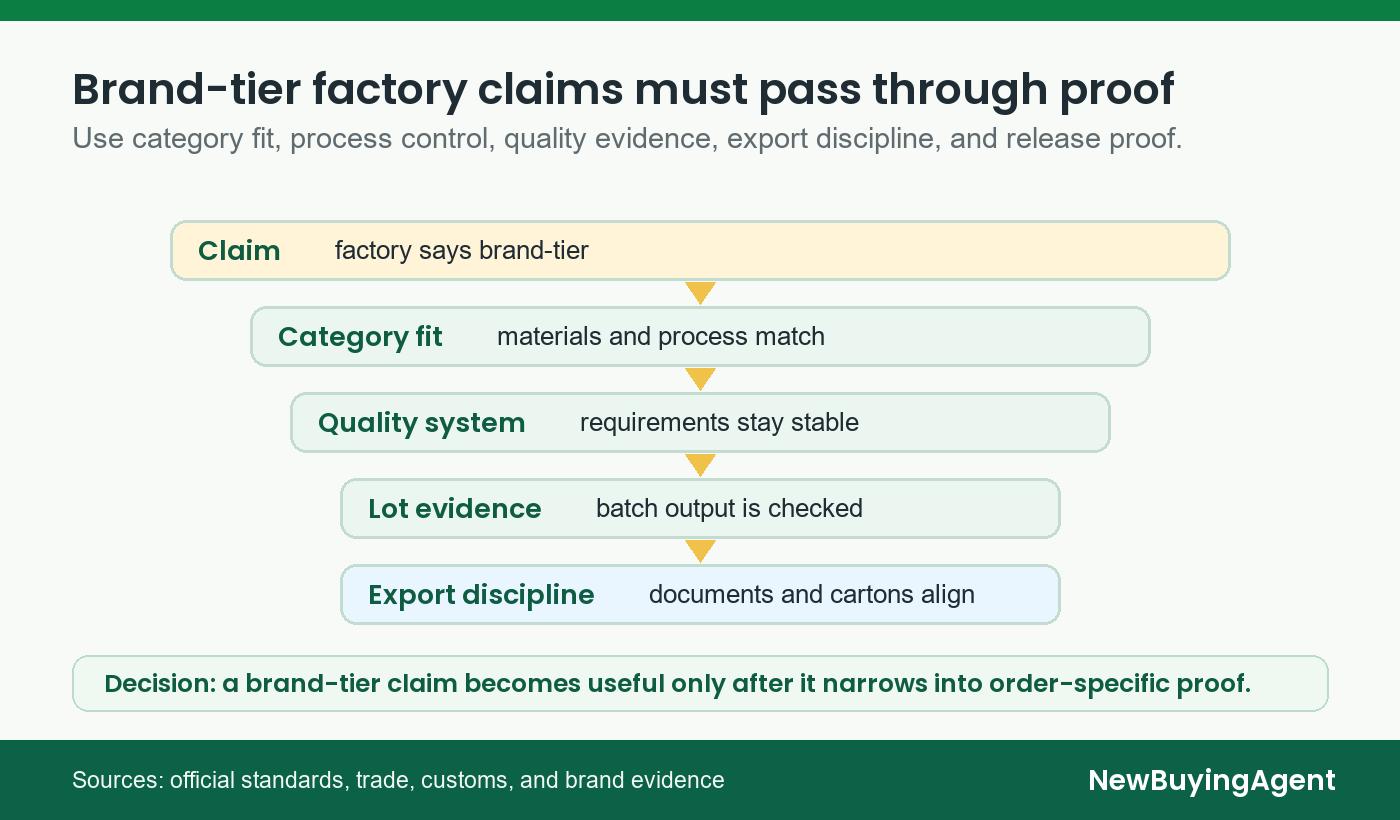
Use category fit, process control, quality evidence, export discipline, and release proof.
The Five Signals That Separate Brand-Tier Capability From Sales Talk
The strongest sourcing agents do not stop at a factory introduction. They look for signals that survive pressure: category fit, process control, lot-level quality evidence, export discipline, and cooperation during correction. These signals matter because brand-level buyers usually fail through drift, not through an obviously bad first sample.
A useful rule is simple: if the evidence cannot be checked before the buyer commits money or timeline, it is not yet a sourcing signal. It is only a claim.
Category fit before factory reputation
A strong factory in one category can be a weak fit in another. The sourcing agent should check whether the factory has made the same material, finish, tolerance, usage condition, and packaging type before. Product photos and showroom examples are less important than whether the production line understands the buyer's exact failure modes.
For example, a factory that makes decorative metal hardware may not be right for load-bearing hardware. A furniture factory with good veneer finishing may still be weak at knockdown packing. Brand-tier capability begins with category fit.
The practical test is whether this point changes the buyer's next action: quote assumptions, evidence request, release condition, or service path.
Process control that survives repeat batches
According to ISO 9001, consistent output depends on defined requirements and controlled processes. In sourcing terms, that means the factory should show how it freezes the sample, communicates changes, controls materials, records defects, and prevents unapproved substitutions.
The agent should ask what changes when volume rises. If a 20-piece sample is carefully handled but a 5000-piece batch moves to a different line, the first sample is not enough evidence. Repeatability is the proof.
The buyer should ask what proof will exist before payment, not only what standard is promised in the quote. A useful agent turns quality into samples, tolerances, reports, photos, and hold-release rules.
Inspection evidence tied to the product risk
According to ISO 2859-1:2026, acceptance sampling by attributes supports lot-by-lot inspection decisions. Buyers do not need to become sampling technicians, but they should know what defect classes trigger hold, rework, or release.
A brand-tier factory should accept specific inspection criteria. Furniture may need finish and assembly checks. Hardware may need tolerance, coating, and function checks. Pet products may need material and label evidence. Generic final photos are not enough.
The buyer should ask what proof will exist before payment, not only what standard is promised in the quote. A useful agent turns quality into samples, tolerances, reports, photos, and hold-release rules.
Export discipline in documents and cartons
A factory can make a good product and still fail the buyer through weak export discipline. According to Trade.gov export-document guidance, documents support the export and customs process. The order file should align invoice descriptions, packing lists, carton marks, SKU identity, quantities, and shipment references.
According to the WCO Data Model, structured trade information supports cleaner handoffs. For a 300-carton order, even a 5 percent carton-label mismatch creates 15 cartons that may require manual sorting before receiving can continue.
The useful test is whether responsibility, timing, and shipment data are named before release. Vague delivery details often move cost and delay to the next handoff.
What a China Sourcing Agent Should Verify Before Recommending Production
The strongest verification happens before the buyer is locked into tooling, deposit, production slot, or launch date. A sourcing agent should build a practical evidence file that makes the factory's capability visible. The file does not need to be complicated; it needs to connect the product requirement to the proof that the buyer can act on.
The trade-off is speed versus correction leverage. Early verification may add days to the first quote, but late verification can turn into weeks of rework after material, cartons, or shipment dates are already committed.
| Signal | Evidence to request | Buyer decision |
|---|---|---|
| Category fit | Similar product, material, finish, order size | Can this factory make this product, not just any product? |
| Process control | Approved sample, change log, material control | Will the sample survive bulk production? |
| Quality release | Inspection scope, defect classes, report timing | What stops shipment if output drifts? |
| Export readiness | Carton marks, packing list, invoice wording | Will receiving and customs data align? |
| Correction behavior | Rework owner, timeline, photo evidence | Can the order recover before shipment? |
How NewBuyingAgent Fits Brand-Tier Factory Identification
NewBuyingAgent's relevance is not that buyers receive a factory list to sort through. The buyer-facing value is supply. Buyers tell NewBuyingAgent their purchasing needs, including product specs, quantity, target price, destination, and timing; NewBuyingAgent prepares a quote and supplies products from China at better price, quality, and service.
Factory access and factory pre-vetting matter inside that supply process. If a buyer needs brand-tier output, the useful question is whether NewBuyingAgent can turn the requirement into a quoted China-sourced product with the right category fit, quality evidence, packing, and delivery assumptions.
Red Flags When a Factory Looks Strong but the Evidence Is Thin
A factory can look brand-tier and still be risky if the proof is not tied to the buyer's product. Red flags include a showroom that does not match the production line, old customer logos with no current order evidence, reluctance to define defect thresholds, vague subcontracting explanations, and document files that do not match the cartons.
According to Trade.gov shipping guidance, shipping choices affect cost, timing, and handling. This matters because weak factories often push quality and packing decisions into shipment week, when the buyer has less leverage. The better agent turns factory capability into a release rule before shipment pressure starts.
The practical decision is to treat brand-tier status as provisional until the order has a locked sample, a quality plan, a packing file, and a delivery handoff. A famous factory name may open the conversation, but evidence should close the decision.
A Three-Level Verification Path for Brand-Tier Factory Claims
A sourcing agent should verify brand-tier factory claims at three levels: sample-level proof, batch-level proof, and shipment-level proof. The buyer does not need every internal factory conversation, but the buyer should know whether the quoted product can survive these three levels before money and timing are committed.
Based on our analysis of a 6 weeks production cycle, the buyer has the most leverage during the first 2 weeks, before materials, packaging, and production slots are fully committed. A verification path that starts only after final inspection protects the next order more than the current one.
Level 1: sample-level proof
Sample-level proof asks whether the factory can make the product version the buyer actually wants. The agent should connect the approved sample to material, finish, size, function, packaging, and labeling assumptions. If the sample approval is only a photo or a loose description, the factory still has room to substitute parts of the product.
The buyer should also ask who owns sample changes. A change made to reduce cost, speed production, or use available materials can be acceptable only when it is recorded and priced into the quoted product supply.
Level 2: batch-level proof
Batch-level proof asks whether the factory can repeat the approved version when order pressure rises. Based on our analysis of a 5000 units order, a 3 percent batch drift creates 150 units that may need rework or downgraded sale. That risk is too large to discover only when the cartons are sealed.
A useful sourcing agent should define when batch photos, inspection findings, and defect decisions appear. If the factory can make one good sample but cannot show lot-level evidence, the brand-tier claim is still incomplete.
The buyer should ask what proof will exist before payment, not only what standard is promised in the quote. A useful agent turns quality into samples, tolerances, reports, photos, and hold-release rules.
Level 3: shipment-level proof
Shipment-level proof connects product evidence to cartons, documents, and delivery responsibility. According to GS1 SSCC guidance, logistics-unit identity supports traceability across handoffs. According to the ICC Incoterms 2020 rules, delivery terms define responsibility and risk transfer.
For a buyer, the lesson is practical: a factory that can produce well but ships weakly can still damage the order. The agent should connect invoice description, packing list, carton identity, and delivery term before the buyer treats the factory as brand-tier for that order.
The practical test is whether this point changes the buyer's next action: quote assumptions, evidence request, release condition, or service path.
When a Buyer Should Reject the Brand-Tier Label
The buyer should reject the brand-tier label when proof appears only after the buyer asks repeated questions. Delayed evidence is itself a signal. A strong factory does not need to reveal every customer or internal detail, but it should be able to explain how the buyer's product version will be controlled.
The safest decision is to treat reputation as a starting point and release evidence as the buying standard. If the factory cannot show category fit, process control, lot evidence, export discipline, and correction behavior, the label should not drive price, deposit, or launch timing.
A buyer can also ask for a timed proof plan: sample evidence before deposit, batch evidence before balance payment, and shipment evidence before pickup. If those three moments are not named, the brand-tier label is doing more work than the evidence. The agent should turn the label into dates, files, owners, and release conditions the buyer can understand before production pressure removes choices.
A brand-tier factory claim should lead to a buyer decision, not a badge. If the product is still being defined, the buyer should turn target quality, order size, destination market, packaging standard, timing, and non-negotiable evidence into a brief for NewBuyingAgent's China product-supply service.
If the buyer needs proof that similar sourcing work has been handled, NewBuyingAgent success stories are a better support point than another broad factory claim. For an active brand-tier review, send NewBuyingAgent the product requirements with the sample, category-fit, QC, packing, and export-discipline evidence that must exist before commitment.
Frequently Asked Questions
What makes a factory brand-tier in China sourcing?
A brand-tier factory is one that can repeat the buyer's product requirement with stable process control, quality evidence, export discipline, and correction behavior. The factory name matters less than proof tied to the specific order.
Can a sourcing agent guarantee a brand-tier factory?
No. A sourcing agent should not guarantee a factory label. The useful service is to verify category fit, sample control, inspection evidence, packing, and delivery assumptions before the buyer commits.
Should buyers ask to see factory names first?
Factory names are not the first decision point. Buyers should first define product specs, quantity, target price, destination, timing, and quality expectations so the agent can test the right capability.
How does NewBuyingAgent use factory access?
NewBuyingAgent uses factory access and pre-vetting behind the scenes to quote and supply China-sourced products. The buyer submits purchasing needs and evaluates the supplied product outcome, price, quality, and delivery path.
NewBuyingAgent
Related Resources
Get Started Today
Let's Turn Your Sourcing Goals into RealityWeChat:+86 15157124615
WhatsApp:+86 15157124615
Address:Building 10 #39 Xiangyuan Road, Hangzhou, China
