

Good gemba walk questions for a Chinese production line begin with the work in front of you: What is this product meant to achieve? How does this station achieve it? What happens when something goes wrong? Ask the operator to explain a visible condition, then connect that answer to the relevant material, instruction or batch record. The aim is to understand how the line works well enough to set useful purchasing requirements.
A gemba walk is a way to understand the current situation through direct observation and inquiry before taking action.
For a buyer, that means learning how the product is actually made before deciding what needs to change.
A confident factory presentation can leave important questions unanswered. A queue might be planned stock, a delayed inspection or a genuine bottleneck. The difference matters to your order. Follow a defined product through its actual route, use an interpreter when needed, and leave with specific evidence requests rather than a general impression of the factory.
Questions That Reveal How the Line Really Works
The most useful questions connect a visible condition to the product requirement and the next purchasing decision. Keep the inquiry neutral, ask how a recent exception was handled, and distinguish what you observed from what someone described. When evidence is incomplete, identify the affected product or batch and assign a follow-up question instead of treating a short walk as factory approval.
- Follow the product: Keep the material, specification and production route connected.
- Ask about exceptions: Recent defects and interruptions reveal how controls work.
- Check the same batch: Corroborate answers against matching identifiers and records.
- Leave a decision: Name the uncertainty, its scope and the evidence needed next.
Follow the Product Before Asking Why
On a Chinese production line, follow a particular product to learn how people, materials and information interact before deciding what needs to change. Keep the inquiry connected to the job running in front of you, rather than the host’s general description of factory capability. The Lean Enterprise Institute’s definition favors following a product family across process boundaries, which helps you see what a showroom presentation leaves disconnected.
Use a simple sequence: observe, ask, corroborate, decide. Notice an actual condition, ask a neutral question about it, and request evidence tied to the same product and batch. Then decide which purchasing requirement needs clarification or which uncertainty needs investigation. A stack of unfinished cartons, for example, should lead to a question about what they are waiting for before it leads to a conclusion about late delivery.
An operator might say, “These cartons are waiting for the insert.” Ask, “Which insert, and how do you know which cartons need it?” The answer may reveal a material shortage, a planned packing sequence or a revision change. Each requires a different follow-up. Looking only at the size of the pile would not tell you which.
In his guidance on going to the gemba, John Shook recommends understanding what is happening before asking why and respecting the people doing the work. In practice, avoid opening with “Why are you doing this incorrectly?” Ask the operator to explain the task and its difficult points. Save diagnosis until you understand the situation, and do not ask someone to interrupt a hazardous operation to answer you.
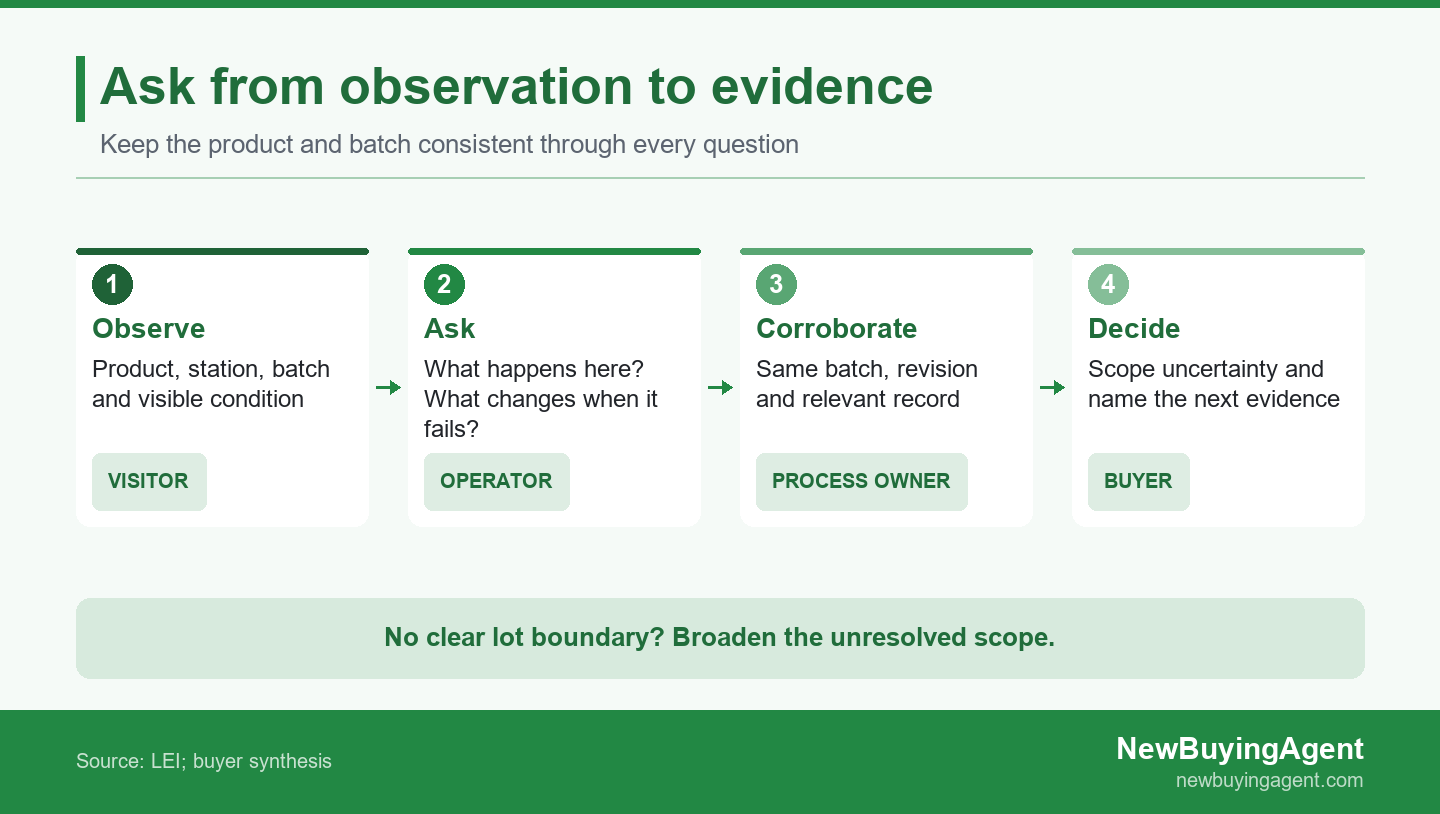
Observe the work, ask a neutral question, corroborate the batch, and scope the next purchasing decision.
Set the Product Scope and Ground Rules
Before approaching the line, agree which product, specification revision and unresolved question the walk will cover. Tell the host whether you want to understand assembly consistency, material identification, a packing change or another concrete concern. Ask to see relevant work in progress and the people who perform it, while accepting reasonable access restrictions and keeping the visit within the factory’s safety instructions.
Bring the approved specification or sample reference, order context and critical product characteristics. “We want to see your production” is too broad; “We want to understand how this insert revision reaches the packing station” gives everyone a useful starting point. The China sourcing guide provides the wider sourcing context, while the walk should stay focused on the requirement you need to confirm.
Agree photography, document handling and interpretation in advance. For the visitor route, ask where forklifts move and where you may stand. HSE workplace transport guidance recommends separation between pedestrians and vehicles where possible. This is UK guidance, used here as a practical safety lesson rather than a statement of Chinese law. Follow the site’s actual instructions and do not enter a marked hazard area to obtain a better photograph.
Ask About the Work You Can See
Ask questions in the order the product encounters the work, starting with inputs and instructions, then following exceptions and handoffs. Select prompts that address your uncertainty rather than reading every question to every operator. A useful answer identifies what happens, who acts and what evidence connects the explanation to the product you are buying; the matrix below shows where to begin.
| Visible condition | Question to ask | Evidence to connect |
|---|---|---|
| Materials beside the station | How do you know these belong to this job? | Material identity and issue record |
| Instruction at the workbench | Which revision is this task using? | Approved specification and current instruction |
| Rejected or reworked units | What stops these returning to normal stock? | Identification, disposition and recheck |
| Work waiting between stations | What is this waiting for? | Queue reason and next operation |
| Outside processing | How does the returned material reconnect to this batch? | Dispatch, receipt and verification records |
These prompts start an inquiry. The evidence and acceptance criteria should reflect your product and agreed purchasing requirements, rather than a universal factory score.
Start with Materials and Instructions
Start by asking how the operator identifies the material and instruction for the job currently running. A buyer needs to understand whether the line can distinguish the correct component, approved revision and production group, especially when similar variants share a station. Follow the explanation to an actual label, issue record or instruction; a general statement that materials are checked is not enough to resolve a specific product concern.
Useful questions include: “What product is this station making now?” “How do you distinguish this component from a similar version?” “Where can you check the current instruction?” “What changes when a new revision arrives?” Ask the operator to point to the reference normally used, with permission, instead of requesting a demonstration prepared only for visitors.
The Lean Enterprise Institute’s standardized-work guidance describes a defined work sequence, production pace and inventory needed to keep the process operating. For a buyer, the practical question is whether the actual task and available instructions agree. You do not need to impose lean terminology on the conversation: “Which step comes next, and what tells you it is complete?” is often clearer than asking for a tool by name.
If the posted instruction differs from the approved sample, ask who authorized the difference and which units it affects. The operator may be following a legitimate engineering change that has not reached your purchasing team. Record both references and seek confirmation before labeling the work incorrect. Equally, an old instruction that no one can reconcile leaves a real requirement unresolved.
Follow Defects, Waiting, and Handoffs
Questions about a recent exception are more revealing than asking whether the factory has quality control. Follow a rejected item, a waiting batch or a changeover far enough to understand how it is identified and what happens next. Keep the inquiry on the process: the objective is to learn whether an abnormal condition reaches someone who can act and whether affected products remain distinguishable.
At a reject area, ask: “What made this unit unacceptable?” “Who decides whether it is repaired, scrapped or accepted under an agreed exception?” “How is that decision recorded?” “What check happens after repair?” Request a recent example relevant to your product. An empty reject bin during the visit does not demonstrate that defects never occur; it may simply reflect the work running that day.
For the batch behind the reject, ask: “Which other units could share this problem?” “How do you find them?” “Can accepted, unchecked and rejected stock be mixed?” NIST’s supplier-selection guidance highlights production and inspection documentation, handling rejections and knowing which group of parts was involved. Apply that lesson by asking for the connection between the defect and its production group, without treating the guidance as a product-specific acceptance standard.
For work waiting between stations, ask what it awaits, who notices a growing queue and what happens if the downstream operation cannot resume. Compare the answer with the product route and relevant production record. A buffer may be deliberate; a pile becomes a delivery concern when the required operation, resources or recovery plan remain unclear.
During a variant changeover, ask how remaining components, labels and instructions from the previous job are handled. “What tells the next operator that the change is complete?” follows the handoff more effectively than “Are changeovers controlled?” If you cannot observe a changeover, record that limitation and request evidence of a recent relevant change rather than claiming you saw the control operate.
Ask What Keeps the Line Running
Ask what would prevent this product from continuing through the line, then explore the people, equipment and outside work on which it depends. A machine count alone cannot establish usable capacity for your order. Look for the operation that constrains the route, the resources supporting it and the evidence behind any promised recovery or extra output. Keep capacity answers tied to the product and operating conditions.
At a critical machine, ask: “What stopped this operation most recently?” “What was done before restarting?” “Where is maintenance recorded?” For people, ask: “Who can perform this task if the usual operator is absent?” “How is that person’s competence confirmed?” A supervisor’s claim that everyone can do every job should lead to a relevant training or authorization example, not an assumption based on headcount.
For outside coating, printing or another process, ask where work goes, which specification travels with it and how the returned batch is checked. The APG paper on external providers discusses monitoring outsourced processes and communicating correct specifications. It is educational guidance, not an ISO-endorsed standard or a ban on outsourcing. Your question is whether this product’s requirements survive the handoff, not whether every operation happens under one roof.
When a new product requires capability beyond the observed line, NewBuyingAgent’s product supply from China connects purchasing requirements with its local factory network and product development/QC capability. The buyer supplies the product brief; NewBuyingAgent quotes and supplies products. This is useful when the visit reveals a product-fit gap, rather than leaving the buyer to select factories from a candidate shortlist.
Test Answers Against the Same Batch
When an answer conflicts with what you see, confirm that both refer to the same product, revision, station and period. A production manager may describe the normal route while the operator is handling an approved exception. Put the references side by side and ask the process owner to explain the difference before deciding whether it is an actual control failure or an unresolved evidence gap.
The APG evidence-collection paper emphasizes verifiable evidence and cautions that inability to find evidence of conformity does not necessarily establish noncompliance. This educational paper was not subject to ISO or IAF endorsement. The transferable lesson for a buyer is to distinguish “not verified during this walk” from “demonstrated to be wrong,” while still keeping a consequential purchasing decision open until suitable evidence is available.
A Mixed-Inserts Example: Narrow the Uncertainty
Consider an illustrative order of 6000 storage organizers. The buyer is checking how a revised insert reaches packing. The displayed instruction specifies the new version, but the operator points to an older insert stack waiting beside the station. Issue records suggest that 1200 units may have received inserts during the change, leaving their insert revision uncertain. These observations prompt an investigation; they do not prove that every unit is defective.
Ask which insert deliveries fed the station, how the relevant packing batches were identified and whether the older stack belongs to another job. If the 1200 units remain separately identifiable, keep the purchasing decision on that subset open while corroborating the other 4800 units independently. If records or physical separation cannot establish that boundary, extend the unresolved scope to the whole order. The claimed batch boundary, rather than the appearance of one insert, determines how narrowly you can act.
The corrective request is to reconcile material issue records with packing identifiers, segregate uncertain stock and confirm that the material revision matches the instruction at the station. Agree the product checks that establish the insert’s fit and function, and identify who will provide the evidence. Packing authorization remains conditional on a verified boundary and satisfactory checks; this illustrative example reports no real client result and provides no universal release rule. Critical product risks or destination requirements may call for a broader hold or specialist testing.
Turn Findings into Purchasing Requirements
Turn the walk into a short list of purchasing requirements and unresolved decisions, each tied to evidence rather than a factory impression. Write what you observed, the question still open, the affected product or batch, the person supplying evidence and when the decision is needed. Keep confirmed facts separate from explanations that still need corroboration, and make the next action clear enough for someone who did not attend.
For example, a revision gap can become an agreed requirement for the packing station to use the approved insert instruction and retain the batch connection. An uncertain recovery claim can become a request for a product-specific production plan. NIST’s operations guidance recommends clear requirements, measurement and supplier feedback. The buyer application is to define what evidence will close the gap, not merely request that the factory “improve control.”
Do not score every observation as a failure. A confirmed misunderstanding needs corrected communication; a demonstrated process gap needs corrective action and verification; unavailable evidence needs a named follow-up. Send factual notes to the host for clarification, preserving the original observation and any subsequent explanation. A proposed fix is not a verified result.
For buyers retaining their suppliers, NewBuyingAgent’s management of existing China factories supports production progress, product quality and logistics coordination. That route fits agreed requirements needing continued China-side execution. It is distinct from sourcing a new product and does not turn the gemba walk into a standalone accredited audit service.
If the findings change your sourcing requirements, discuss the purchasing requirements with NewBuyingAgent. Share the product specification, quantity, target price, destination, required timing and the unresolved capability or quality concern. Those inputs support a quote-and-product-supply conversation grounded in what the product needs, rather than a vague request to approve a factory.
Frequently Asked Questions
What if I do not speak Chinese?
Use an interpreter to translate the question and answer separately, retaining product identifiers and distinguishing translation from explanation. Brief them on the specification and neutral questioning style beforehand. Ask the operator a short question, allow the answer to finish, and then clarify unfamiliar terms. If the interpreter adds background or interpretation, record it separately so the operator’s statement does not silently become a management conclusion.
What if the factory will not allow photographs?
Agree alternative evidence when photography is restricted, and leave a claim unverified if suitable corroboration is unavailable. With permission, record document references, product identifiers and observations in writing, or request an approved redacted record afterward. Photography restrictions alone do not prove poor controls. They do limit what you can retain and verify, so note that limitation when deciding what follow-up is needed.
What if my product is not running during the visit?
An idle line can show equipment and documents, but it cannot demonstrate live production consistency or actual output capacity. Ask which comparable product uses the same route and identify the differences from your order. Arrange later evidence or a follow-up when relevant work runs. Do not describe a setup explanation or a similar-product demonstration as observation of your own product’s normal production.
Does a gemba walk replace a supplier audit or product inspection?
No, a gemba walk does not replace a formal supplier audit, specified product inspection, testing or contractual acceptance criteria. It helps you understand work and identify questions for those activities. A short visit samples a particular situation; it cannot establish every shift, process or batch. Use its findings to improve the relevant assessment or purchasing requirement, while preserving the scope and authority of the agreed verification method.
NewBuyingAgent
Related Resources

Get Started Today
Let's Turn Your Sourcing Goals into RealityWeChat:+86 15157124615
WhatsApp:+86 15157124615
Address:Building 10 #39 Xiangyuan Road, Hangzhou, China
