

For China-made furniture, FSC versus PEFC is not a badge contest. The practical question is whether the proposed wood route can support the exact statement a buyer wants to make about the finished item. A factory certificate can be genuine and still be too narrow for a sideboard, chair, or cabinet that combines veneer, solid wood, engineered panels, and non-wood parts.
Start with the claim, then test the evidence behind it. The buyer should be able to connect each forest-based component to the relevant certificate scope, the commercial document that carries the claim, and any permission needed for a finished-product statement. If one connection is missing, the safe response is to narrow or hold the affected claim—not to declare one certification system the winner.
Choose the Evidence Route, Not the Badge
Neither FSC nor PEFC is a universal winner for China-made furniture. A claim-ready item—meaning the evidence supports the exact product wording—has a route that matches the buyer's materials, customer requirement, and intended market. That is a stronger purchasing test than asking which logo is more familiar or which factory presents a certificate first.
- Match the material. List every forest-based component that the intended statement may cover, such as solid wood, veneer, plywood, particleboard, or paper-based packaging.
- Match the certificate scope. Confirm that the relevant organization, site, activity, and product group are covered for the current order.
- Match the document claim. Keep the commercial evidence that follows the claimed material or product through the transaction.
- Match the final statement. Confirm that the product wording or logo route is permitted for the exact finished scope.
This comparison does not issue certificates or legal opinions. It gives buyers a way to turn a broad certification request into a specification that a China furniture factory, sourcing partner, and commercial team can test against the same order.
The Four Matches Behind a Furniture Claim
Treat material, certificate, document claim, and product permission as four separate matches. Chain of custody is the documented route that tracks eligible forest-based material through supply-chain records; it is valuable precisely because it does not erase the differences between a veneer sheet, a plywood back, and a finished furniture claim. The buyer's job is to keep those differences visible until the evidence supports the chosen wording.
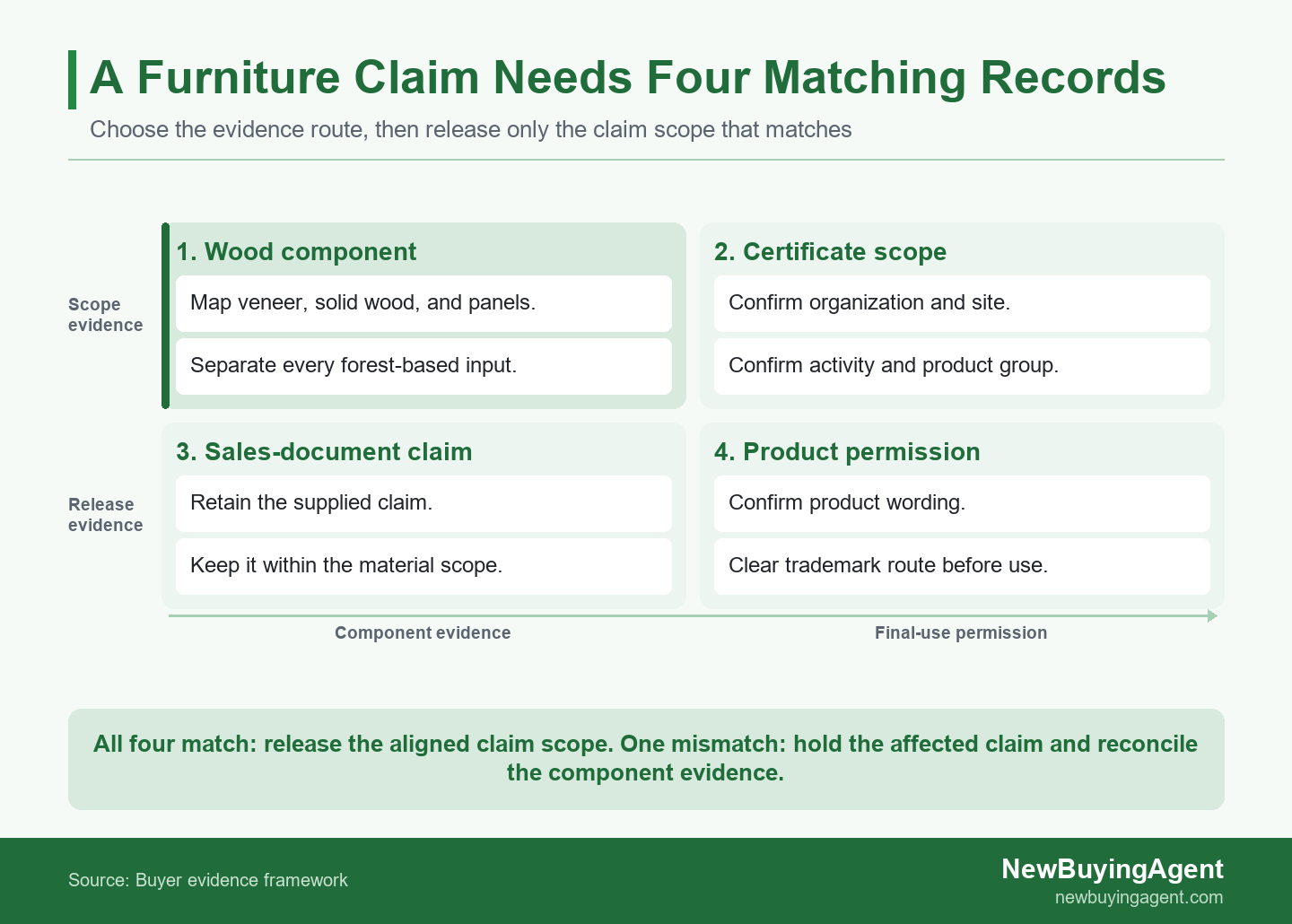
Map each forest-based component before treating the whole item as claim-ready. A dining chair may have a solid-wood frame, a veneer seat shell, an engineered-wood panel, and a carton. The certification question may apply to one, several, or all of those inputs. Metal hardware, foam, fabric, and finish can still matter to the product specification, but they should not be silently pulled into a wood-certification statement.
| Evidence match | Buyer question | What to retain | What a mismatch means |
|---|---|---|---|
| Wood component | Which part is being claimed? | Component map and current specification | Do not use a whole-product statement yet. |
| Certificate scope | Does this organization and activity cover the relevant route? | Current certificate record and scope details | Check the actual site, product group, and process. |
| Sales-document claim | What claim follows the supplied material or item? | Invoice, delivery record, or other commercial document | Request the missing or corrected transaction evidence. |
| Product permission | What wording or mark may appear on the final item? | Approved claim or trademark route | Hold the proposed label or marketing language. |
These matches also make factory conversations more efficient. Instead of asking a vague question such as “Do you have FSC or PEFC?”, the buyer can ask which wood component is covered, which entity holds the certificate, which claim appears on the sales document, and what final product communication is approved.
First Match: Understand What Each System Governs
FSC and PEFC have different system structures, so route details matter. FSC publishes a global principles-and-standards framework for forest management and chain-of-custody work; buyers can use the FSC standards overview to understand that basis. PEFC works through endorsement of national or regional systems against its benchmarks, with periodic review built into the model; its explanation of national-system endorsement and review helps identify the route behind a proposed material. Neither document is a complete answer for every factory, product group, or furniture configuration.
The structural difference is not a quality ranking; it is a prompt to check the exact system, origin route, and order evidence.
In practice, start with the customer's requirement. Some customers specify FSC, some accept PEFC, and some ask only for a defined responsible-sourcing statement. The buyer should translate that request into a written acceptance rule before asking a China factory to price the furniture. Otherwise, an available material route may be mistaken for a route that satisfies the customer's wording.
Next Matches: Check the Certificate and the Sales Claim
Chain of custody is a material-tracking control, not a blank cheque for every product statement. FSC explains that it identifies and tracks forest-based materials through manufacturing and distribution, and that a finished-product label signals the applicable chain requirements have been met along the product path. Read the FSC chain-of-custody explanation as a guide to the purpose of the record, then verify the certificate that actually relates to the factory and item being purchased.
A B2B document claim is not the same control as an on-product trademark permission. A certificate scope is the organization, site, activities, and product groups covered by a certificate. A sales-document claim is the certification statement carried on an invoice or another commercial document for a supplied material or product. They are linked, but they are not interchangeable. PEFC's database guidance separately defines a recognized chain-of-custody certificate and a trademark usage licence, which is why a buyer should retain the PEFC certificate and trademark definitions instead of treating a logo file as all the evidence needed.
- Confirm the legal organization and factory location shown on the current certificate.
- Check that the relevant processing activity and product group fit the proposed furniture component.
- Keep the incoming material or product document that carries the applicable claim.
- Separate a B2B document claim from the decision to print a label, hangtag, carton statement, or website promise.
FSC vs PEFC for China-Made Furniture: A Buyer Comparison
Choose the evidence route that can support the actual furniture order. The table below is deliberately conditional: it compares what the buyer must verify, rather than announcing that one certification system is always the better choice. A route is useful only when it can follow the specified material through the current factory and into the permitted final statement.
| Comparison point | FSC route | PEFC route | Buyer decision |
|---|---|---|---|
| System model | Use the applicable FSC standards and chain-of-custody route. | Identify the applicable PEFC-endorsed national or regional route. | Record which system the customer requirement accepts. |
| Material evidence | Check the current certificate and claim for the relevant wood component. | Check the current recognized certificate and claim for the relevant component. | Do not assume the system name covers every input. |
| Finished-product language | Match the label category and product scope to the supported route. | Match trademark use and product communication to the licensed route. | Approve wording only after product scope is clear. |
| Best fit | Use when the requested FSC claim is supported from material through final communication. | Use when the requested PEFC route is supported from material through final communication. | Choose the viable evidence path, not the more familiar mark. |
The most reliable conditional verdict is simple. Use FSC when the customer's requested FSC route can be evidenced for the relevant materials and final claim. Use PEFC when the applicable PEFC route can be evidenced for the same scope. If neither route is complete, do not turn partial paperwork into a whole-furniture label. Change the specification, narrow the statement, or wait for the missing evidence.
Keep the Claim as Narrow as the Evidence
Certificate-related information does not automatically authorize broad environmental language or a finished-product logo. FSC distinguishes FSC 100%, FSC Mix, and FSC Recycled labels; its label guidance explains that FSC Mix can involve a combination of FSC-certified, recycled, and controlled wood inputs. PEFC's trademark rules require use to be accurate and under a usage licence; see the PEFC trademark standard. The U.S. Federal Trade Commission says that third-party certification does not remove the need to substantiate express and implied environmental claims; its Green Guides summary is a useful reminder that a seal should not do more communicative work than the underlying evidence supports.
Certification can be complementary information, not a substitute for applicable due diligence. For EU-bound goods, do not treat an FSC or PEFC reference as a shortcut around the buyer's destination-market responsibilities. The buyer should define the claimed scope, retain the relevant traceability evidence, and obtain the market-specific assessment required for the actual transaction.
For a new furniture programme, the commercial specification should state the exact claim requested, the components it covers, the acceptable evidence, and the owner of final wording approval. Buyers that want a China-supplied product route can see how NewBuyingAgent can supply furniture from China against a complete purchasing brief. The useful brief describes the product outcome first, then attaches the certification requirement as one of the conditions that shapes sourcing, pricing, quality, packing, and delivery execution.
Worked Example: An Oak-Veneer Sideboard Order
Hold the affected whole-product claim while reconciling component evidence. The following is an illustrative order, not a NewBuyingAgent customer case. It shows why the right response to a certificate mismatch can be a focused claim hold rather than an unsupported product statement or an automatic stop to every part of the purchase order.
The Evidence Conflict and the Scoped Hold
Hold the whole-product claim until the component evidence aligns. An EU home-furnishings buyer wants a substantiated wood-sourcing statement for a new range of 1,200 oak-veneer sideboards. The design uses 3 forest-based components: oak veneer, beech legs, and plywood backs, plus metal hardware and cartons. The factory sends a current certificate and a veneer supplier document claim, but the buyer has not approved final product wording.
The veneer invoice carries an FSC-related claim, while the factory certificate scope names veneer-panel processing but does not clearly identify the beech-leg input. The draft product sheet says “FSC furniture,” even though the plywood back and legs have no mapped document claim. The carton artwork also includes a logo proposal without a confirmed product-label route. The evidence may support a defined veneer route, but it does not support that whole-sideboard statement.
The buyer holds the whole-product claim and the proposed label artwork, while keeping the purchase order's affected claim scope unresolved. The corrective action is concrete: create a component map; request the relevant certificate scope for each forest-based input; retain document claims for every component that the final wording will cover; and confirm the approved trademark or product-labelling route.
Release the stated claim only when the material map, certificate scope, sales-document claim, and finished-product permission describe the same scope. The quantity, affected components, and proposed wording make the decision auditable. The scenario is illustrative: actual claim rules and destination duties depend on the current certificate, material composition, system rules, and market.
Where a China Sourcing Partner Fits
NewBuyingAgent can use a complete purchasing brief to support a China furniture sourcing discussion. A wood-certification requirement belongs in that brief because it affects the supplied product scope and China-side execution. NewBuyingAgent works with global buyers who provide the product specification, quantity, destination, target price, timing, and evidence requirement. Its local China factory resources and product and quality-control capability can then be applied to source and supply the furniture against that defined commercial need, without promising that every factory or product can support a particular certificate route.
The route changes when the buyer already has a named furniture factory. In that situation, the buyer can use China-side factory management when an existing furniture supplier needs evidence follow-through. The central question remains the same: can the material, records, product claim, and final wording be kept aligned while the furniture is produced and prepared for delivery?
Prepare a Claim-Ready Furniture Brief
Prepare the product and evidence inputs before requesting the sourcing route. State the furniture design, a component-by-component wood map, the requested FSC or PEFC claim, the intended wording, destination market, quantity, target price, and delivery timing. This gives the buyer and China-side team a shared basis for deciding whether to source a matching material route, narrow the claim, or request more evidence before approving the final communication.
Send NewBuyingAgent the furniture purchasing brief for a scoped sourcing discussion.
Frequently Asked Questions
Is FSC better than PEFC for furniture?
Neither certificate is universally better for furniture; the usable choice depends on your required claim, available material route, and order evidence. FSC may be the practical choice when a customer specifically requires an FSC-supported product route. PEFC may be the practical choice when the applicable PEFC route supports the relevant material and final communication. In both cases, the certificate name is only the starting point. The component map, certificate scope, document claim, and final statement still need to align.
Can a factory use an FSC or PEFC logo on furniture?
Not automatically: a factory needs applicable certification and trademark permission, and the final product claim must match the supported material route. A certificate can demonstrate a relevant chain-of-custody capability, while trademark use has its own controls. Before approving a logo on furniture, packaging, a hangtag, or a sales page, confirm the exact product scope, the current licence route, and the approved claim wording. Do not let an artwork file become the evidence.
Does certified veneer make the whole furniture piece certified?
No; certified veneer alone does not establish a claim for every wood component or for the finished furniture piece. It may be relevant evidence for the veneer scope, but a table, cabinet, or chair can include solid wood, plywood, engineered panels, and other materials with separate routes. Map the components first, then make the final statement no broader than the evidence and permitted product communication support.
Does FSC or PEFC replace EUDR due diligence?
No: certification information can support a due-diligence file, but it does not replace the buyer's responsibility to meet applicable EUDR requirements. Certification information can support, but does not replace, applicable due-diligence duties. The European Commission describes certification or third-party scheme information as potentially complementary when it meets the required information conditions; see its due-diligence guidance. Obtain the destination-market evidence and legal guidance required for the actual product, operator role, and transaction.
NewBuyingAgent
Related Resources



Get Started Today
Let's Turn Your Sourcing Goals into RealityWeChat:+86 15157124615
WhatsApp:+86 15157124615
Address:Building 10 #39 Xiangyuan Road, Hangzhou, China
