

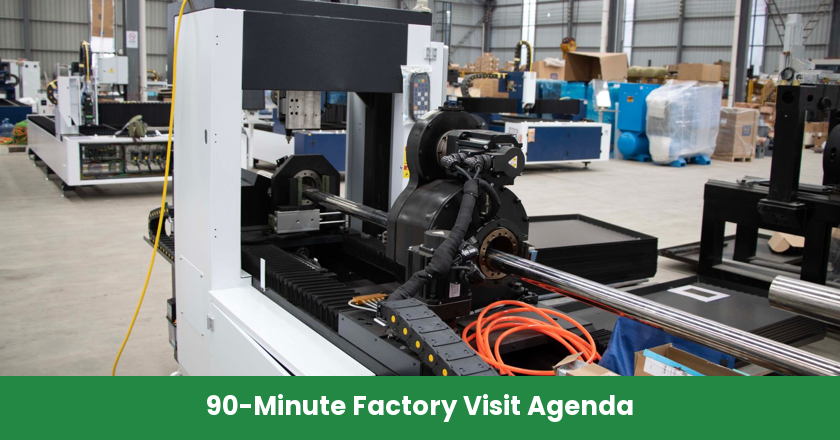
A factory visit agenda is a timed plan for checking the people, processes and evidence relevant to a purchasing decision.
For a focused 90-minute visit, reserve 10 minutes for scope and access, 15 for supplier identity, 25 for production, 15 for quality records, 10 for capacity and 15 for closing decisions. Send the product requirements and evidence requests before arrival so the factory can make the right people and operations available.
This is a proposed buyer agenda for a prepared, single-site visit. It is not a certification audit, a social-compliance assessment or proof that every product meets its destination-market requirements. If the production route spans several buildings, the critical operation is not running, or interpretation needs more time, expand the visit or arrange a targeted follow-up.
The visit should produce a decision record
Use the 90-minute visit to produce a decision record tied to the proposed order, with clear limits on what the observations establish. A useful record connects the product and site to the process, the supporting evidence and the next action. It also identifies unresolved checks, so a procurement leader can distinguish permission to continue development from approval to commit an order or release goods.
- Prepare the route: agree the product, critical operations, hosts and accessible records before arrival.
- Follow evidence: connect an observed operation to its instructions, inspection records and material identity.
- Protect closing time: assign owners and acceptance evidence for unresolved questions.
- Keep approval specific: a short visit informs a defined next step; it does not replace testing or later order controls.
A practical 90-minute factory visit agenda
The proposed agenda allocates 10 minutes to scope, 15 to identity, 25 to production, 15 to quality, 10 to capacity and 15 to closing, totaling 90 minutes. Each block has a host who can demonstrate the relevant facts and a written output the buyer can retain. Adapt the allocation to the product risk and travel between areas, while preserving enough time to agree the unresolved decisions.
| Time | Purpose | Responsible host | Retained output |
|---|---|---|---|
| 0–10 min | Scope and access | Buyer lead + host | Decision, route and permissions |
| 10–25 min | Identity and roles | Commercial/site lead | Site, seller and process roles |
| 25–50 min | Product route | Production/technical lead | Observed operation and limits |
| 50–65 min | Quality records | Quality lead | Lot-linked check and disposition |
| 65–75 min | Capacity assumptions | Production planner | Order constraints and dependencies |
| 75–90 min | Closing decisions | Buyer + factory leads | Owners, evidence and held actions |
The clock starts when the working session begins, after arrival formalities. A safety induction or movement between distant buildings may require additional time; neither should be rushed to preserve this schedule. Appoint one buyer-side timekeeper and one note-taker, and agree who can authorize changes to the route.
The output column is the test of whether each block was useful. If a host is unavailable or evidence cannot be shown, record the gap and its effect on the next decision. Avoid borrowing the final discussion time simply to complete a tour that no longer answers the priority question.
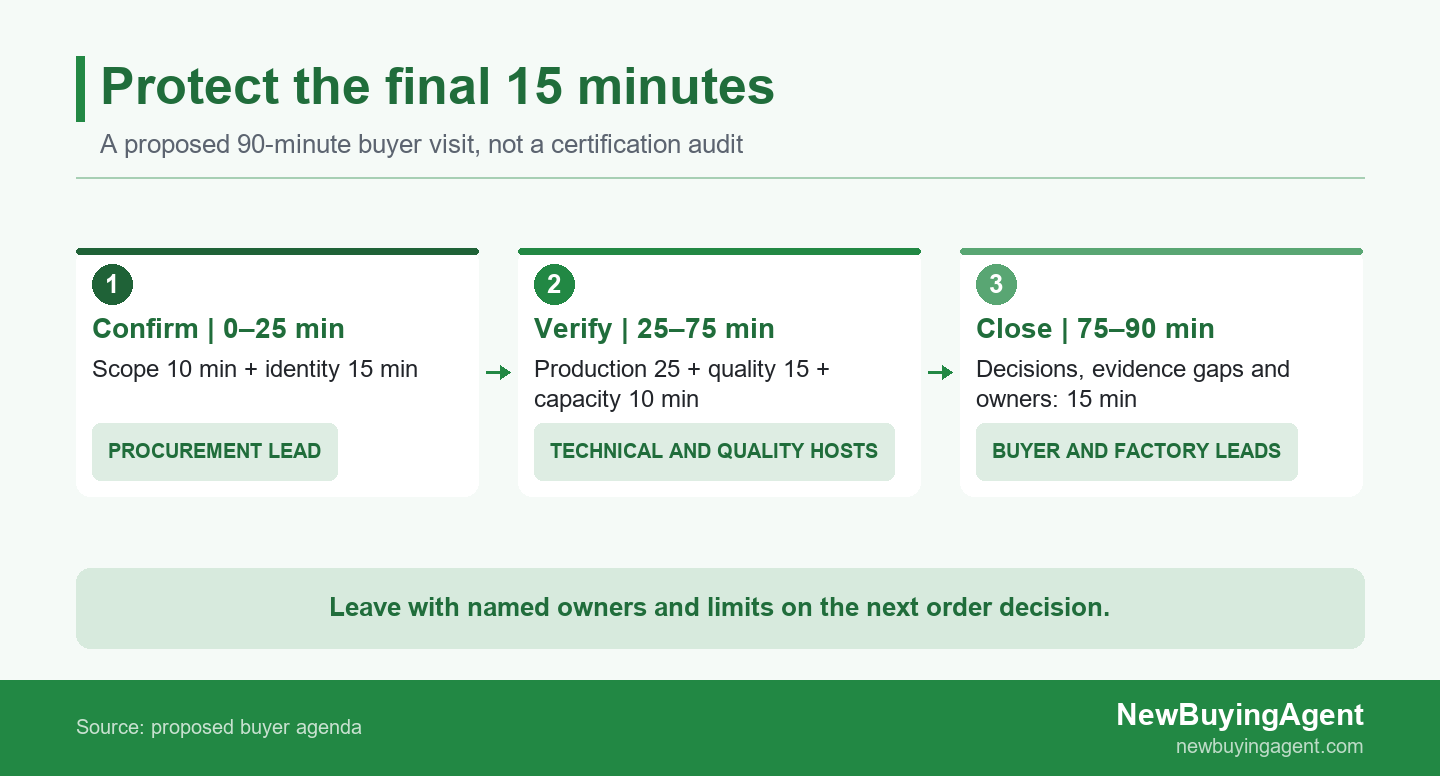
Allocate the visit to scope, identity, production, quality, capacity and an owned closing record.
Prepare access, people and evidence before arrival
Prepare the visit by sending a short product brief, a proposed route and the few evidence requests that could change the purchasing decision. Confirm that the relevant operation will be running and that technical, quality and planning staff can join their assigned blocks. When those conditions are missing, change the date or scope before travel instead of discovering the limitations at the factory gate.
The Auditing Practices Group planning paper advises reviewing available information beforehand and agreeing time allocation and access to people, locations and records. The paper concerns certification-audit practice and is educational, non-normative guidance; its method can inform a buyer visit without turning this proposed schedule into an ISO requirement. Here, preparation means selecting the most consequential unresolved question and arranging a route capable of testing it.
Include the product specification revision, intended quantity, destination market, delivery expectation and the stage of supplier approval. Ask for a process outline identifying work at the visited site and work elsewhere. Request relevant examples of inspection and production records with other customers’ confidential details removed, rather than demanding unrestricted access to everything.
Arrange the practical conditions too: protective equipment, safe walking routes, photography permission, interpretation and any confidential areas. HSE workplace transport guidance recommends separating pedestrian and vehicle routes where possible and recognizes that visitors may be unfamiliar with a site. These are useful safety-planning principles from UK guidance, not a claim about the legal requirements for a factory visit in China.
If the visit is part of a wider first purchase, use the China sourcing guide to put it alongside specification, sampling and order preparation. A visit answers particular supplier questions; it should fit the purchasing plan rather than become a substitute for the plan.
Minutes 0–25: confirm the visit scope and supplier identity
Use the opening blocks to confirm that everyone is discussing the same product, site and next decision, then clarify the supplier’s commercial and production roles. The buyer lead should state the objective and ask the host to identify who can answer each technical question. A mismatch in the site or proposed route changes the usefulness of everything that follows, so resolve it before starting the production walk.
Keep the opening brief: confirm the product revision, tour route, available hosts and recording permissions. Ask the factory to point out any departure from the agreed plan. If a critical process is unavailable, decide whether the remaining checks still justify the visit and identify what will need another observation.
During the identity discussion, compare the company and address in the supplied records with the visited site and the entity expected to quote, contract and receive payment. A trading company, operating company and production site may have different roles. Record the explanation and supporting documents; seeing a factory sign does not establish ownership or confirm every commercial relationship.
When certification is relevant, check what the document actually covers rather than accepting a logo as product evidence. ISO CASCO guidance on conformity statements distinguishes a management-system certification mark from product certification. The procurement consequence is straightforward: a supplier’s management-system certificate does not, by itself, answer whether the proposed product has the necessary test evidence or destination-market compliance documentation.
Minutes 25–50: follow the proposed product route
Spend the production block following the route that would make the proposed product, with attention to the operation most likely to affect its critical requirement. Ask the technical host to explain the inputs, settings, checks and output of that operation using current work where access allows. A machine’s presence establishes far less than seeing how a relevant product is processed and how an abnormal result is handled.
A gemba walk means observing work where value is created and asking questions to understand the current situation. The Lean Enterprise Institute’s explanation emphasizes direct observation and inquiry before action and recommends following a product family across processes. Applied to procurement, this favors a product-linked route over a circuit of attractive equipment, while remaining a learning method rather than a certification or product-compliance assessment.
Start with concrete questions: What is being made here today? Which specification or work instruction applies? What tells the operator that the output is acceptable? If the result moves outside the intended condition, who stops or adjusts the operation? Ask the host to demonstrate the explanation where safe, and avoid directing operators or interrupting a hazardous task.
Equipment, people and the operating environment matter because they support a particular process. The APG resources paper considers resources together with the processes and intended results they support. A useful buyer question therefore connects a critical operation to its available trained staff, maintenance arrangements and suitable working conditions; equipment age or a polished appearance alone is an inadequate conclusion.
Where a category is unfamiliar, identifying the decisive operation can be difficult before the visit. NewBuyingAgent’s local China factory resources and product development and quality-control capability can support product supply from China from the buyer’s purchasing requirements. That category-fit perspective helps connect factory capability with the product being purchased, while keeping sampling, production follow-up and delivery within the full purchasing outcome.
Minutes 50–65: connect quality checks to real records
Use the quality block to connect an observed check with the specification, an identifiable production lot and the decision made about that material. Ask the quality lead to retrieve a relevant record and show how it corresponds to the goods or operation being discussed. The purpose is to understand whether the factory can explain and demonstrate its controls, while leaving questions open where the link cannot be verified.
Follow one lot from inspection to disposition
Production and inspection records, rejection handling and lot control are central to the quality-system questions in NIST MEP supplier-selection guidance. Follow one relevant example from its acceptance criterion to the inspection result and the disposition: accepted, reworked or rejected. Check whether identifiers connect the record to the material, and ask who is authorized to decide what happens next.
The APG evidence-collection paper describes relevant, verifiable evidence as generally sampled and cautions that failing to find evidence does not necessarily establish nonconformity. For a short buyer visit, an unavailable record remains an unresolved question rather than an automatic pass or fail. A matched example shows how that sampled control operates; it does not establish that every batch or every shift is controlled in the same way.
Check what happens outside the visited factory
Ask which product steps leave the site and how returned work is identified and checked. The APG external-providers paper considers specified requirements and effective monitoring of outsourced processes. Its educational guidance supports examining the connection between purchasing requirements and external work, rather than assuming subcontracting is inherently unacceptable.
For an external finishing or component operation, request the relevant requirement, provider role and incoming acceptance evidence. If an important check depends on another site, record that dependency and arrange an appropriate follow-up. A convincing demonstration at the visited factory cannot establish how an unseen external operation is performed.
Minutes 65–75: challenge the delivery assumptions
Use the capacity discussion to test the assumptions behind the proposed delivery date, rather than collecting a headline monthly-output figure. Ask the planner which line, staffing, materials and existing commitments determine the available time for this product. Where the explanation relies on an alternate machine, shift or site, identify the preparation needed before that option can actually contribute usable output.
Compare like units: this product and specification, acceptable output, relevant shift pattern and the time needed for setup or changeover. Ask which step limits throughput and what happens when that equipment is unavailable. Observing a running line gives context, but it does not reserve capacity for your future order or establish sustainable output from a short observation.
A backup claim deserves the same practical treatment. NIST supply-chain risk guidance includes the primary activities at a supplier, alternate manufacturing sites and how long an alternate would need to begin shipping. Ask what the proposed backup requires in tooling, materials, qualified staff and checks; the existence of another site is not the same as a ready replacement for this product.
Minutes 75–90: assign decisions and follow-up owners
Close with an issue record that assigns an owner, due date and acceptance evidence to each unresolved question, and names the specific order decision affected. The buyer and factory leads should agree what was observed and which supporting records were available. Where evidence remains incomplete, keep the affected action open rather than converting a sampled visit into a blanket approval of the supplier or its future output.
For each issue, retain four things: the observed fact, the evidence needed next, the person responsible and the buyer decision that waits for verification. Distinguish disagreement about an observation from the consequence the buyer draws from it. A supplier can acknowledge a missing record without accepting every proposed commercial condition, so record both clearly.
Example: a traceability gap changes the next step
In this illustrative example, an importer considering 8000 storage baskets visits 1 of 2 packing lines before approving a pilot order. Rejected baskets are visibly marked, but one displayed inspection record cannot be linked to the stock shown. The visit therefore leaves pilot approval pending while the quality team checks the record-to-lot connection.
The visible separation is useful evidence, yet it does not resolve which material the inspection result describes. The buyer quality lead records the missing link rather than treating the whole factory as either qualified or disqualified. The commercial discussion can continue, but approval of the pilot order remains subject to that traceability clarification.
The factory quality manager retrieves the lot record and explains its disposition, including the identifiers used on the stock and in the inspection entry. The buyer quality lead then compares the identifiers and disposition with the actual lot. If they are consistent, the lead can close that sampled gap; a verbal promise to fix the paperwork is insufficient.
In this illustrative example, closing the sampled gap would not establish control of the second packing line or future lots. The buyer still applies the appropriate product checks and pilot-order acceptance process. If the record remains inconsistent, the issue stays open and the next review targets that specific problem rather than repeating the entire factory tour.
For buyers already using China suppliers, the work after a visit often concerns production progress and quality follow-through. NewBuyingAgent’s existing-factory management provides China-side supplier communication, production and quality management, and logistics coordination. That service path addresses continuing execution with existing factories; the buyer should still define its acceptance requirements and the decisions the reports are intended to inform.
If the visit informs a new purchasing project, submit the purchasing requirements to NewBuyingAgent: product and specification, quantity, target price, destination and delivery timing, together with relevant visit findings. These requirements support a quotation and product supply from China using the company’s local factory resources and product/QC capability. Identify unresolved requirements clearly so they can be considered before the purchasing scope is confirmed.
Factory visit planning questions
Can a factory visit take place between production runs?
Yes, but plan a later observation when the critical operation is running. A quiet line may reflect scheduling rather than a capability failure. Use the available time for the route, staff and records, and note which operating conditions were not observed. If the purchasing decision depends on a live demonstration, keep that question open and agree when it can be checked.
Should price negotiation be included in the 90 minutes?
Only brief clarification belongs in the visit; detailed negotiation can follow the evidence review. Confirm assumptions that affect the quoted product, such as specification, packing and delivery scope. A prolonged price discussion can displace the technical hosts and consume closing time. Separate the evidence needed to assess supply capability from the later discussion of commercial terms.
Can a local representative conduct the visit?
Yes, if the brief names the checks, reporting limits and approval authority. A representative needs the current specification, priority questions, access arrangements and an instruction to report unavailable evidence. Agree what the report will contain and who can authorize the next order step. Location alone does not establish competence or transfer the buyer’s purchasing authority.
When is a repeat visit worth arranging?
A repeat visit is useful when important checks require a different production state, shift or site. Choose the date around the evidence that was unavailable, rather than arranging another general tour. State which issue the return visit will close and who should be present. If records or another suitable verification method resolve the question, a second visit may add little.
NewBuyingAgent
Related Resources


Get Started Today
Let's Turn Your Sourcing Goals into RealityWeChat:+86 15157124615
WhatsApp:+86 15157124615
Address:Building 10 #39 Xiangyuan Road, Hangzhou, China
