

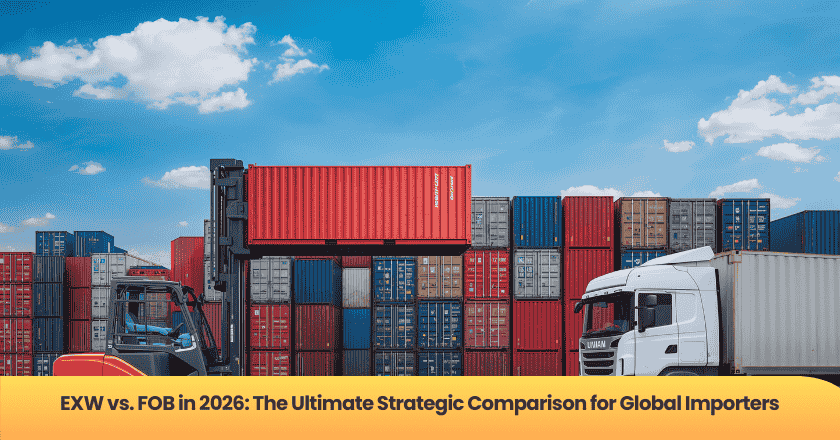
In the hyper-connected manufacturing landscape of 2026, the distinction between Ex Works (EXW) and Free on Board (FOB) has evolved from a simple logistics choice into a high-stakes financial strategy. As global trade navigates through the complexities of carbon taxes, digitized customs, and shifting geopolitical alliances, a wrong choice in Incoterms can lead to a 15-25% erosion of net margins due to unforeseen origin-side liabilities.
This guide moves beyond basic definitions. We examine these terms through the lens of a 2026 procurement professional, focusing on transparency, digital accountability, and real-world landed cost calculations.
The 2026 Definition
EXW: The Illusion of Low Cost
At its core, Ex Works represents the minimum obligation for the seller. Their job ends when the goods are made available at the factory gate, with no obligation to load them onto the buyer's transport. In 2026, EXW is increasingly becoming the domain of "Control Freaks"—highly sophisticated companies that use AI-driven logistics platforms to micro-manage every movement of their cargo.
However, the "factory gate" is no longer a simple pickup point. In 2026, most Asian and European manufacturing hubs require digital pre-clearance before a truck even arrives. If you buy on EXW terms, you assume the commercial responsibility for export formalities, and will need to appoint a local agent as the exporter of record in most foreign countries. This means you are responsible for filing the "Electronic Export Information" (EEI) and ensuring the goods comply with that nation's latest environmental export standards. For an SME (Small to Medium Enterprise), this is often an administrative nightmare that outweighs any perceived savings in the unit price.
'
FOB: The Modern Gold Standard for Sea Freight
Free on Board remains the backbone of 70% of global sea trade for a reason. Under FOB, the seller is responsible for the goods until they are safely loaded onto the vessel. This includes the "First Mile" transit, local port handling, and the critical hurdle of export customs.
In 2026, FOB is the preferred choice for companies looking to mitigate "Origin Friction." Since the seller is a local entity, they can navigate the nuances of local labor strikes, port congestion, and changing customs regulations far more effectively than a foreign buyer's freight forwarder. The risk transfer occurs when the goods are loaded on board the vessel.
Expert Tip: In 2026, always verify if your supplier is using an "Automated Drayage" service. Some FOB quotes now include a premium for electric trucking, which can help you meet your corporate Scope 3 emission targets. If the supplier refuses to provide carbon data on an FOB shipment, it may be time to renegotiate for better transparency.
Financial Engineering
The price on your Proforma Invoice (PI) is only the starting point. To truly compare EXW and FOB, you must perform a "Total Landed Cost" (TLC) analysis that accounts for the hidden variables of 2026 shipping.
The Hidden Costs of EXW
Export Agency Fees: If your supplier lacks a direct export license—a common occurrence with specialized "boutique" manufacturers—you must pay a third-party agency to handle the paperwork. In 2026, these fees have risen due to increased digital compliance costs.
Origin Terminal Handling (OTHC): These are the fees charged by the port for moving your container from the truck to the stack and then to the ship. Under EXW, your forwarder will bill you for these, often at a higher "retail" rate than what a local factory would pay.
Compliance Documentation: 2026 regulations require detailed "Product Passports" for many categories. Under EXW, it is your responsibility to generate or verify these, which may require hiring a local inspection firm.
The Value-Added of FOB
Consolidated Local Logistics: A factory shipping 50 containers a month on FOB terms gets a much better trucking rate than your forwarder can get for a one-off EXW pickup. This "economy of scale" is often passed down in the FOB price.
Customs Shielding: If the customs office flags a shipment for a random inspection (an "X-Ray Exam"), the seller handles the physical coordination and the initial inspection fees. In an EXW scenario, your goods could sit for a week while your forwarder waits for you to wire funds for the inspection.
Common Mistake to Avoid: Importers often choose EXW because the "freight forwarder promised a lower rate." They forget that the forwarder is only quoting the international leg. The "origin charges" in a country like Vietnam or China can easily add $500 to $1,200 per container, which is often conveniently left out of the initial estimate.
The Digital Shift
In 2026, the moment of "Risk Transfer" is also the moment of "Data Transfer." The adoption of the Digital Bill of Lading (eBL) has fundamentally changed the EXW vs. FOB debate.
Managing Digital Title
Under FOB, the seller holds the digital tokens representing the goods until they are scanned onto the vessel. This provides a safety net for the buyer's capital. If the factory burns down or the truck is hijacked on the way to the port, the transaction is simply canceled or covered by the seller's insurance.
In contrast, an EXW agreement means the digital title transfers to you at the factory. If that same truck is hijacked, you are legally responsible for paying the supplier in full, as you already "owned" the goods the moment they left the gate. For high-value electronics or luxury goods, the EXW risk profile is often too high for conservative finance departments.
Smart Contract Integration
Many 2026 trade agreements are now governed by Smart Contracts.
In an FOB contract, the smart contract releases 70% of the payment to the seller only when the "On Board" scan is verified by the port's blockchain node.
In an EXW contract, the payment is often triggered the moment the pickup driver signs the digital gate pass. This leaves the buyer with zero leverage if the goods are later found to be damaged during the port transit.
Expert Tip: If you are using a blockchain-based trade finance platform, check with your bank. Some banks offer lower interest rates for FOB shipments because the risk of "Pre-Shipment Loss" is borne by the seller, making the collateral (the goods) more secure.
ESG and the "Green" Logistics Battleground
The EU Corporate Sustainability Reporting Directive (CSRD) and the US SEC Climate Disclosure Rules have reached full maturity in 2026. Every kilometer of your supply chain must now be accounted for in your annual report.
The EXW ESG Advantage: Total Control
For a Chief Sustainability Officer, EXW is the "Gold Standard." It allows the buyer to hand-pick the trucking company that uses hydrogen fuel cells or electric vehicles for the first mile. You get raw, unedited GPS and fuel consumption data. If your brand's value is built on "Net Zero" claims, EXW is the only way to guarantee that your origin-side logistics aren't being handled by a fleet of high-emission, antiquated trucks.
The FOB ESG Challenge: The Data Gap
When you buy FOB, the seller chooses the domestic carrier. While this is cheaper, you often receive a "consolidated" carbon report that may be less accurate. In 2026, forward-thinking buyers are now including "Green Clauses" in their FOB contracts, requiring the seller to provide certified emission data for the transit from factory to port.
Common Mistake to Avoid: Failing to account for the Carbon Border Adjustment Mechanism (CBAM). If your origin logistics are handled inefficiently under FOB and the seller fails to provide certified emission data, you may end up paying higher carbon "import taxes" at your own border because you cannot prove the low-carbon nature of the domestic transport.
The "Hidden" Legalities
In 2026, the list of "Dual-Use" goods and "Strategically Restricted" materials has expanded significantly due to global trade tensions.
The Seller's Legal Shield (FOB)
Under FOB, the seller is the Exporter of Record. They must prove to their government that the goods are allowed to leave the country. If there is a sudden ban on the export of certain lithium-ion components or rare-earth materials, the legal burden of resolving that ban falls on the factory. If they can't get the goods on the ship, the contract is frustrated, and you usually get your deposit back.
The Buyer's Legal Liability (EXW)
Under EXW, you are the exporter. If your forwarder tries to export restricted goods without a specific license, your company can be blacklisted by the foreign government. You are responsible for knowing the export laws of a country where you might not even have an office. For 2026 importers, this "Regulatory Risk" is one of the strongest arguments against using EXW with new or unvetted suppliers.
Expert Tip: Before choosing EXW for high-tech or raw material imports, consult a 2026 Trade Compliance Database. If the Harmonized System (HS) code of your product is on a "Watch List," switch to FOB to ensure the supplier handles the legal heavy lifting.
Insurance Deep-Dive
Insurance in 2026 has become highly automated, with "Parametric Insurance" paying out instantly based on IoT data. However, the Incoterm determines who gets paid.
The "Gap" in FOB
Technically, under FOB, you don't own the goods until they are on the ship. But most Marine Insurance policies are "Warehouse to Warehouse." This creates a conflict: you are paying for insurance that starts at the factory, but you don't have an "Insurable Interest" until the port.
The Fix: Ensure your 2026 insurance policy includes a "Contingency Clause" that covers you in case the seller's insurance fails during the first mile of an FOB shipment.
The "All-In" Nature of EXW
With EXW, the insurance is simple but expensive. You cover the goods from the moment they are moved from the factory shelf. This is cleaner from a claims perspective, but it requires you to have a very high-quality "Cargo Policy" that can handle international claims involving foreign trucking companies.
2026 FAQ
Q1: Is EXW or FOB better for a first-time Alibaba/Global Sources buyer?
A: FOB is the only logical choice for a beginner. The "learning curve" of handling foreign customs and origin trucking is too steep and carries too much financial risk. Stick to FOB until you are moving at least 10 containers a month from the same region.
Q2: How does port automation in 2026 affect these terms?
A: Automated ports require "Perfect Documentation." Under FOB, the seller's local team handles the digital uploads. Under EXW, your forwarder must do it remotely. Any data error leads to an "Automatic Gate Rejection," and the storage fees at automated terminals are 50% higher than traditional ports.
Q3: Can I pay in local currency to save money on EXW?
A: Yes. One niche advantage of EXW is that you can sometimes pay the supplier in their local currency (e.g., CNY or VND), which might avoid the "USD Exchange Markup" factories often add to FOB quotes. However, this requires you to have a local currency account or a fintech solution like Airwallex or Wise.
Q4: Does FOB include the "VGM" (Verified Gross Mass) fee?
A: In 2026, the VGM is a mandatory digital filing. Under FOB, the seller must weigh the container and file the data. Under EXW, your forwarder must arrange for the truck to stop at a certified scale, which adds time and cost to your journey.
Q5: What if the ship is delayed (a common 2026 issue)?
A: Under FOB, the seller is responsible for the goods until they are placed on board; pre-loading storage fees due to ship delays are borne by the buyer (the party who books the vessel) unless otherwise contracted. Under EXW, you start paying "Daily Storage" the moment your truck delivers the goods to the port, even if the ship is delayed by a week.
Final Verdict: The 2026 Strategic Roadmap
The decision between EXW and FOB should be dictated by your Operational Maturity and Volume.
Choose FOB (The Safety Path) if: You are a growing brand, you value predictable landed costs, and you want to leverage the supplier's local expertise to handle the increasingly complex world of 2026 export customs. It is the most resilient choice for 90% of global importers.
Choose EXW (The Efficiency Path) if: You are moving high volumes, you are consolidating from multiple vendors in a single hub, and you have a "Digital Control Tower" that gives you real-time visibility into origin-side logistics.
In the 2026 trade environment, "cheap" is a relative term. A low EXW price can quickly become the most expensive mistake of your fiscal year if you haven't accounted for the digital, legal, and environmental costs of the "First Mile."
Expert Tip: Before your next contract renewal, ask your 4PL for a "Ghost Quote." Have them calculate exactly what the origin charges would be for an EXW pickup versus the FOB premium your supplier is charging. If the gap is more than 20%, it's time to take control and switch to EXW.
NewBuyingAgent
Related Resources

Get Started Today
Let's Turn Your Sourcing Goals into RealityWeChat:+86 15157124615
WhatsApp:+86 15157124615
Address:Building 10 #39 Xiangyuan Road, Hangzhou, China
