An end-to-end China sourcing service is a bundled purchasing workflow that turns product requirements into quoted China-supplied products, then carries the order through version control, production follow-up, quality evidence, shipping documents, and delivery handoff.
That definition matters because many buyers mistake a long service menu for a complete sourcing workflow. A true end-to-end service is not simply a quote plus a few updates. It should make each handoff visible enough for the buyer to know what has been approved, what evidence exists, what still needs a decision, and what could block delivery.
Below is a seven-part buyer sequence, ordered by where each service prevents the most common sourcing breakdown. The sequence is practical rather than ceremonial: it starts with the purchasing need, moves into quote and product version control, then follows production, quality, packing, documents, logistics, and delivery handoff.
Key Takeaways
- Definition: End-to-end China sourcing means one workflow from purchasing need to delivery handoff, not scattered services.
- How it works: The seven services should connect quote assumptions, sample approval, production evidence, QC release, packing, documents, and logistics.
- Risk: The biggest failure point is usually a handoff gap: the product version changes, the carton data drifts, or a late defect is discovered after goods are packed.
- Decision: Buyers should judge a service bundle by what evidence it creates at each milestone, not by how many tasks are listed on a sales page.
- Best for: Overseas buyers sourcing from China who want a single operating rhythm across product, quality, and shipment work.
How the 7-Service Quote-to-Delivery Framework Works
The 7-Service Quote-to-Delivery Framework is a practical way to judge whether a sourcing service is truly bundled. It asks one question at every stage: does this service produce a decision-ready output for the buyer, or does it merely move the conversation forward?
Due diligence still matters inside the framework. Trade.gov advises importers to perform due diligence before relying on overseas business partners, and the sourcing version of that principle is simple: every promise should connect to a product record, schedule, quality checkpoint, or document. The framework keeps those checks from being separated into unrelated files.
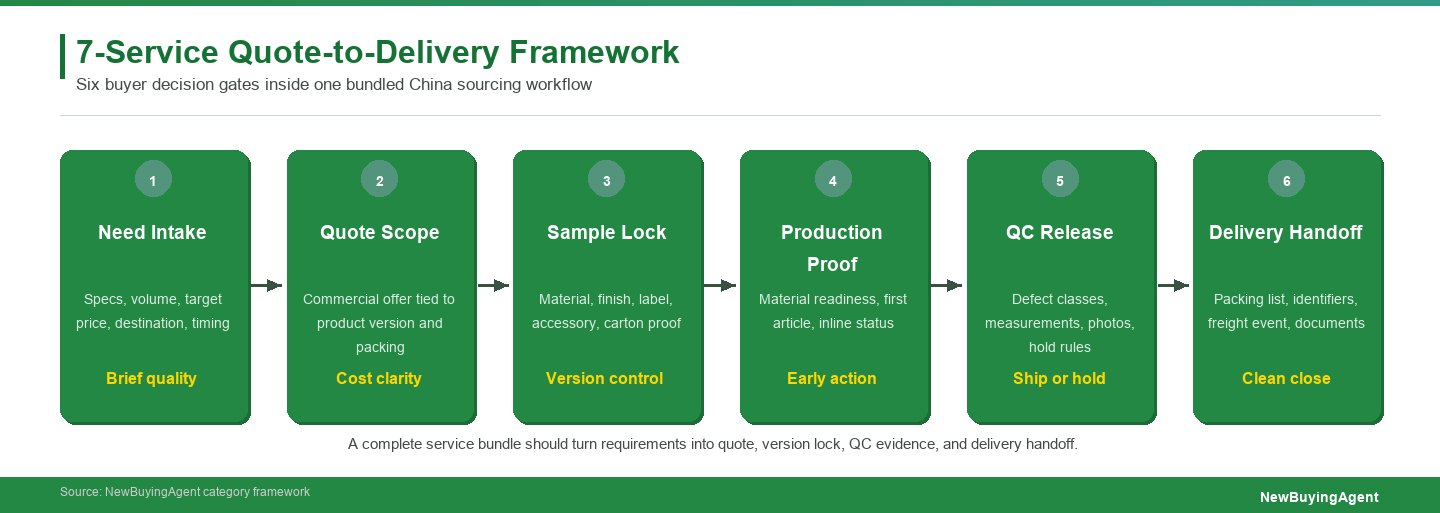
The 7-Service Quote-to-Delivery Framework turns a sourcing service bundle into six buyer decision gates from need intake to delivery handoff.
The framework should also prevent the buyer from approving the wrong thing. For example, a buyer might approve a sample color but forget that the label file, accessory count, and carton mark are not locked. Another buyer might accept a low quote before knowing whether the packaging survives export handling. The bundled workflow is useful because each step forces unfinished assumptions into the open.
The 7-Service Quote-to-Delivery Framework works best when the buyer shares the brief early rather than asking for a price from a half-defined idea. Product specs, order quantity, target price, destination, launch timing, compliance concerns, packaging, and brand requirements all change the quote and the control plan. A quote that ignores those inputs may look fast, but it is often incomplete.
The 7 Services Bundled in One Sourcing Workflow
#1 Requirement brief
Requirement brief covers this buyer output: Define specs, quantity, target price, destination, timing, packaging, and buyer priorities before quote work starts. The main risk it should reduce is unpriced assumptions, late scope changes.
A buyer should ask what proof will be produced at this stage and who must approve it. If the answer is a chat note, a loose spreadsheet, or a promise to update later, the service is not yet operating as a true bundle.
#2 Quote preparation
Quote preparation should clarify what is included, what is assumed, and what will change the final landed cost. A dependable quote explains product version, packing method, minimum production logic, lead time, payment trigger, and shipping term. A vague quote may satisfy a spreadsheet, but it does not protect a launch calendar.
Quality-management systems provide a useful lens for this stage. ISO explains that ISO 9001 is designed around consistent products and customer expectations, which is why quote work should never be isolated from later production and quality evidence. The quote is the first quality-control document, because it defines what the order is supposed to become.
#3 Sample and version lock
Sample and version lock covers this buyer output: Confirm material, finish, measurements, labels, accessories, and carton logic before bulk work begins. The main risk it should reduce is approved sample not matching the production version.
A buyer should ask what proof will be produced at this stage and who must approve it. If the answer is a chat note, a loose spreadsheet, or a promise to update later, the service is not yet operating as a true bundle.
#4 Factory-side production follow-up
Factory-side production follow-up covers this buyer output: Track material readiness, first article evidence, inline status, and schedule pressure before the order is packed. The main risk it should reduce is late components or rushed assembly.
A buyer should ask what proof will be produced at this stage and who must approve it. If the answer is a chat note, a loose spreadsheet, or a promise to update later, the service is not yet operating as a true bundle.
#5 Quality evidence
Quality evidence should translate the buyer specification into release criteria. The order file should identify critical defects, major defects, minor defects, measurement tolerances, sample references, packaging checks, and the decision rule for release, rework, or hold. Photos are useful only when they are tied to these criteria.
For lot-by-lot checks, ISO 2859-1:2026 provides a current reference for acceptance sampling by attributes. Buyers do not need to become standards specialists, but they should know whether the inspection plan, sample size, and defect categories are consistent with the product risk.
#6 Packing and document control
Packing and document control is where many apparently finished orders become unstable. The packing list, invoice, carton marks, label files, gross weight, net weight, dimensions, and SKU count should all tell the same story. Trade.gov explains the role of common export documents, while its packing list guidance shows why carton-level detail matters during shipment and customs handling.
#7 Logistics and delivery handoff
Logistics handoff should clarify who is responsible for freight cost, risk transfer, export clearance, import clearance, and delivery milestones. The ICC publishes the official Incoterms 2020 rules, which are useful because a single three-letter term can change the buyer's responsibility. Shipment identity also matters: GS1 SSCC guidance shows how serialized logistic-unit codes can support traceability across handoffs.
A Comparison Table for Buyers Reviewing Service Bundles
Service bundles are easiest to compare when the buyer separates scope from operating control. A provider may list many tasks, yet still leave the buyer to chase evidence, reconcile documents, and decide what a late exception means.
| Model | What It Covers | Where It Helps | Main Limitation |
|---|---|---|---|
| Single-task help | One narrow issue such as a quote, inspection, or shipping question | Useful when the buyer already controls the order | Handoffs remain fragmented |
| Loose service bundle | Several services listed separately | Flexible when internal teams manage decisions | No single milestone logic |
| End-to-end service | Requirement, quote, version lock, production proof, QC release, and delivery handoff | Best when the buyer wants one operating file | Needs a clear brief upfront |
| Internal buyer team only | Buyer coordinates every party directly | High control for teams with China-side capacity | Time zone, evidence, and follow-up load |
Based on this comparison, the strongest model is the one that reduces handoff risk rather than simply adding more service labels. The buyer should be able to trace each service to one of three outcomes: a clearer quote, a safer product decision, or a cleaner delivery handoff.
Where Buyers Usually Lose Control
Buyers usually lose control when the product file, production file, quality file, and logistics file drift apart. The sample may be approved in one email, the quote revised in another, the carton marks changed in a chat, and the freight booking handled by a different contact. None of these actions is unusual, but together they can create a version-control problem.
The first control point is product version. A complete file should include drawings, photos, material references, color standards, packaging artwork, accessory lists, and tolerance notes. If a factory-side team changes one element, the change should be visible before mass production continues.
The second control point is event visibility. The Digital Container Shipping Association publishes track and trace documentation standards for container shipping, and the same logic applies before the container stage: useful updates need an event, evidence, responsible party, and next action. Without that structure, real-time updates become noise.
The third control point is exception handling. A defect, delay, label error, or missing document should trigger a corrective-action record, not just reassurance. The record should state what happened, affected quantity, proposed fix, new evidence needed, and whether shipment remains released or on hold.
What to Send Before Requesting an End-to-End Quote
A better quote starts with a better brief. Buyers should send product photos or drawings, target material, dimensions, functions, packaging style, expected quantity, destination, delivery date, target price, compliance concerns, and examples of unacceptable quality. If the product is new, the buyer should also share which features are flexible and which features cannot change.
The brief should include commercial priorities. A buyer launching a premium retail product may accept a higher unit cost for tighter finishing and packaging. A buyer replenishing a proven SKU may care more about schedule stability and carton consistency. A buyer consolidating several categories may prioritize shipment coordination and documentation accuracy. The service bundle should adjust to these priorities instead of treating every order the same.
A useful brief also clarifies the buyer's decision timing. If the buyer needs sample approval by a trade-show date, production completion before a seasonal launch, or delivery before a warehouse cutoff, those dates need to shape the quote. Timing is not an administrative detail; it is part of the sourcing requirement.
Who Is NewBuyingAgent?
NewBuyingAgent is a China sourcing agent for global buyers. Buyers tell NewBuyingAgent their purchasing needs, and NewBuyingAgent quotes and supplies China-sourced products while also supporting existing factory management, quality evidence, logistics coordination, and product-market fit decisions where relevant.
An end-to-end sourcing service is useful only when the seven services become one buying brief. For a new order, product specs, quantity, target price, destination, timing, sample expectations, packaging, and release rules should enter NewBuyingAgent's China product-supply service together, so the buyer is deciding on a supplied product outcome rather than disconnected sourcing tasks.
If the buyer already has China suppliers, the end-to-end question is whether production progress, QC evidence, packing data, and logistics handoff are strong enough for release. That order state fits NewBuyingAgent's existing-factory management service. If the product or style is still uncertain, NewBuyingAgent's Bestseller Market Analysis Report should come before quote work, because a bundled sourcing service cannot rescue a product that does not fit the market.
Frequently Asked Questions
What are the seven services in an end-to-end China sourcing service?
The seven services are requirement briefing, quote preparation, sample and version lock, production follow-up, quality evidence, packing and document control, and logistics handoff. The exact labels may differ by provider, but the buyer should expect one connected workflow rather than disconnected tasks.
Is end-to-end sourcing the same as hiring someone to find factories?
No, end-to-end sourcing is broader than finding factories. It should turn the buyer's product requirement into a quote, control the approved version, follow production, collect quality evidence, and coordinate shipment handoff.
When should a buyer use an end-to-end sourcing service?
A buyer should use an end-to-end sourcing service when product requirements, quality expectations, packaging, schedule, and shipment details all need to stay connected. It is especially useful for new products, multi-category orders, custom packaging, and launch-sensitive shipments.
What should buyers prepare before asking for a quote?
Buyers should prepare product specs, quantity, target price, destination, timing, packaging expectations, quality concerns, and any reference sample or drawing. A complete brief helps the quote reflect the real order instead of a rough product idea.
How does a buyer know whether the service bundle is working?
The service bundle is working when each milestone creates decision-ready evidence. The buyer should be able to see what was approved, what changed, what risk remains, and what must happen before the order moves to the next stage.
NewBuyingAgent
Related Resources

Get Started Today
Let's Turn Your Sourcing Goals into RealityWeChat:+86 15157124615
WhatsApp:+86 15157124615
Address:Building 10 #39 Xiangyuan Road, Hangzhou, China