

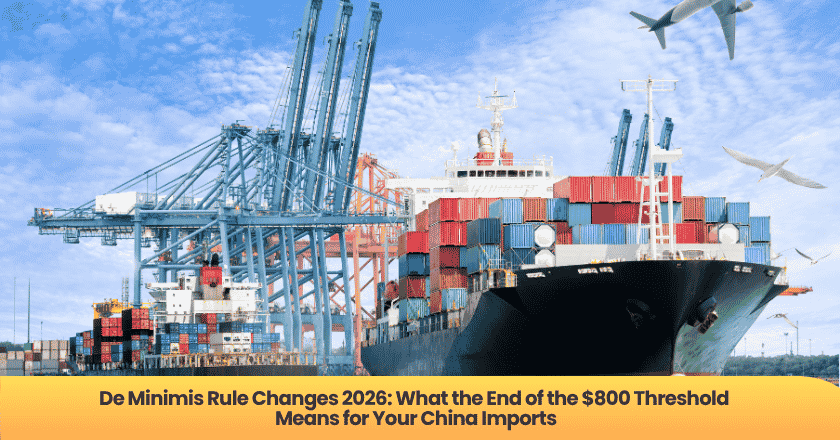
The cross-border e-commerce model that built Shein, Temu, and ten thousand Shopify dropshippers depended on one rule. That rule is gone. Here's what every small-batch importer needs to know — and what to do about it.
Key Takeaways
- The $800 de minimis exemption was eliminated for China and Hong Kong on May 2, 2025, and for all other origins on August 29, 2025. Every parcel entering the US — regardless of value — now requires formal customs entry with HTS classification and full duty payment.
- The change has cut the volume of sub-$800 parcels entering the US by roughly 54% since elimination. Direct-to-consumer cross-border e-commerce from China is no longer cost-competitive at the per-parcel level for most product categories.
- Small importers face three operational changes: a US EIN requirement, a licensed customs broker relationship, and HTS classification for every SKU. Postal carrier shipments now face flat duties of $80–$200 per item or applicable ad valorem rates.
- Three viable response models: (a) bulk import to a US warehouse and fulfill domestically, (b) move sourcing to non-China origins (still no de minimis but lower duty stack), or (c) raise prices and accept the new economics.
- Brands that delayed adapting through Q4 2025 are now losing 15–30 points of margin on every order they haven't repriced. The fix is operational, not strategic — and the longer you wait, the more you bleed.
- A commission-free sourcing agent (flat service fee with factory invoice passed through unchanged) makes the bulk-import model easier to run because you can verify per-SKU landed cost against the original factory invoice, not a bundled "delivered price."
- The EU is following with its own de minimis elimination starting July 2026. UK is moving in the same direction. The cross-border duty-free e-commerce era is closing globally, not just in the US.
For about a decade, US Customs allowed any imported parcel valued at $800 or less to enter the country without duty payment, formal customs entry, or significant inspection. The provision was called Section 321 — informally the "de minimis" rule, from the Latin phrase meaning "of minimum value." It was originally designed in the 1930s to spare CBP the cost of processing low-value parcels. Over time it became the legal foundation of an entire e-commerce model.
That model is over. China and Hong Kong lost de minimis access on May 2, 2025. The rest of the world followed on August 29, 2025. The Trump administration confirmed the suspension would continue when it issued the Section 122 executive order on February 20, 2026. As of mid-2026, every parcel coming into the US — Shein order, Temu order, AliExpress order, Etsy seller's wholesale restock from Yiwu, individual buyer's first sample from Alibaba — requires formal customs entry with HTS classification, country of origin documentation, and full duty payment.
This guide explains what changed, who is affected, what the new operational requirements are, and what the realistic response options look like for small importers, dropshippers, and Amazon sellers who built businesses around de minimis-enabled economics.
Part 1: What De Minimis Was, and Why It Mattered
De minimis is a customs concept used by most countries to allow low-value parcels to enter without formal duty assessment. The thresholds vary widely. The European Union's was €150 (about $175). Canada's was CAD $150 (about $100). Mexico's was $50. Most other countries set their threshold around $50–$100. The US threshold of $800 was the most generous in the world by a wide margin.
That generosity created an arbitrage opportunity. A Chinese factory could ship a $50 dress directly to a US consumer through a postal channel, with the parcel clearing customs automatically and no duty charged. A US importer buying the same dress through normal commercial channels would pay around 16% MFN duty plus 25% Section 301 plus other layers — roughly 45% all-in by 2024. The de minimis-enabled direct-to-consumer model captured that 45% as either margin or price reduction.
Volume followed. According to White House data, the volume of shipments entering the US duty-free rose from approximately 134 million packages in 2015 (when the limit was $200) to more than 1.36 billion in 2024. Most of that growth came from China-based platforms — Shein and Temu being the highest-profile examples — but the model was used by tens of thousands of smaller dropshippers and Shopify brands.
Why it ended
Three forces aligned against de minimis through 2024–2025. First, US trade policy under both the late Biden and incoming Trump administrations identified de minimis as a major loophole undermining tariff effectiveness — Section 301 tariffs collected nothing on the 1.36 billion parcels entering duty-free. Second, CBP and law enforcement raised concerns that low-value parcels were being used to ship illicit substances (particularly fentanyl precursors) into the country with minimal inspection. Third, US-based small businesses argued the exemption gave foreign sellers an unfair price advantage on directly competitive products.
The political coalition was rare: protectionists, drug enforcement officials, and small-business advocates all wanted the same outcome. The administration moved quickly. Executive orders in February and April 2025 set the elimination dates. By the end of August 2025, every parcel entering the US — from any country, of any value — needed formal entry processing.
Part 2: What Changed Operationally on May 2 and August 29
For most importers, the operational impact arrived in three distinct waves.
May 2, 2025: China and Hong Kong de minimis ends
Parcels from mainland China and Hong Kong stopped clearing duty-free regardless of value. Postal channel shipments became subject to a flat duty (initially as high as 120% before being negotiated down) or, alternatively, $100 per item. Commercial carrier shipments (UPS, FedEx, DHL) fell under different rules but generally faced 30%+ duty stacks.
The immediate effect was visible: Shein began shifting fulfillment to Brazil and Turkey. Temu announced that "all sales in the U.S. are now handled by locally based sellers, with orders fulfilled from within the country" — i.e., they pre-imported in bulk and held inventory domestically. Hundreds of smaller dropshippers either repriced, switched origins, or quietly went out of business.
August 29, 2025: Global de minimis ends
The exemption ended for every other country of origin. This affected importers who had attempted to reroute around the China-specific elimination — bringing China-made goods into Vietnam, Mexico, or Canada and then re-exporting to the US under those countries' de minimis access. That workaround closed.
Postal flat duties of $80–$200 per item went into effect, depending on country of origin. CBP began requiring 10-digit HTSUS codes on all entries through the Automated Commercial Environment (ACE), eliminating the previous practice of using broader 6-digit codes for low-value parcels.
February 20, 2026: SCOTUS ruling — but de minimis stays gone
When the Supreme Court invalidated the IEEPA-based reciprocal tariffs on February 20, 2026, some importers expected the de minimis elimination to be reversed as part of the same order. It was not. The de minimis suspension was authorized through separate executive action and continued under the new Section 122 framework. Trump's February 24, 2026 executive order explicitly maintained the suspension.
By Q2 2026, the volume of sub-$800 parcels entering the US had fallen by approximately 54% — about 740 million parcels per year disappeared from the customs flow within four months of full elimination, according to Universal Postal Union data.
Part 3: Who Is Affected, and How Hard
The impact varies sharply by business model. Three buyer profiles, in order of severity.
Most affected: Direct-to-consumer dropshippers
Brands shipping individual orders directly from Chinese suppliers to US consumers (Shopify dropshippers, Etsy sellers using AliExpress fulfillment, TikTok Shop merchants on direct-from-China routes) face the largest disruption. Their entire economic model assumed $0 duty and $0 broker fees on each shipment. The new math:
A typical $30 dropshipped item from China — say, a phone case or a basic apparel item — now attracts approximately $11–$14 in duty (Section 122 + Section 301 + MFN) plus the postal flat fee or commercial carrier handling. That's a 35–50% landed cost increase per unit, and it cannot be passed entirely to the consumer because the retail prices were already calibrated to compete with US-based sellers carrying inventory.
Most pure dropshippers in this category have either pivoted (to bulk import + US fulfillment), switched origins (Mexico, Vietnam, India for some categories), or wound down.
Significantly affected: Small Amazon FBA and DTC brands
Brands ordering 50–500 units per SKU from China for sale through Amazon FBA or their own DTC sites are affected operationally but not always existentially. They were typically using formal commercial entry already (not de minimis) for orders above $800, but the de minimis rule mattered for sample orders, restocks, and small SKU tests. The change adds friction and broker fees to those flows.
The biggest impact for this cohort is on sample and prototype orders. A $300 sample order that previously cleared duty-free under de minimis now requires formal entry, broker fees, and duty payment — adding roughly $200–$400 in friction to what was supposed to be a quick test. Many brands are now running sample programs through US-based 3PLs that consolidate inbound flows.
Less affected: Importers with established commercial flows
Brands ordering in container quantities or using established freight forwarders for FCL/LCL shipments saw minimal direct impact — they were already paying full duty on all entries. Indirect impact came through their sample workflows and through any small-batch test orders. For these importers, the de minimis change is a friction increase, not a business model crisis.
Common Mistake: Brands assumed they had until 2027 or later to adapt, based on partial enforcement signals through 2025. The actual elimination came faster than most planned for, and many brands entered Q2 2026 still operating on de minimis assumptions. The fix is not optional and not cheap: a US EIN, a licensed customs broker relationship, HTS classification for every SKU, and either a pre-clearance warehouse model or per-parcel formal entry. Brands that delay further are losing margin on every order they don't reprice.
Part 4: The Three Realistic Response Models
Three operational responses cover most of what we see working in 2026. They are not mutually exclusive — many brands run two of the three simultaneously across different SKU categories.
Response A: Bulk import to US warehouse, fulfill domestically
The dominant response for brands with unit volumes above a few thousand units per quarter. Goods are produced in China, consolidated by the supplier or by a sourcing agent, shipped via FCL or LCL freight, cleared formally at a US port, and held in a US warehouse (own or 3PL). Domestic fulfillment then replaces direct-from-China shipping.
Setup requirements: US EIN, licensed customs broker, established freight forwarder, US warehouse capacity (own or 3PL like ShipBob, ShipMonk, or Amazon FBA), HTS classification per SKU.
The economics improve sharply. Duty is paid once on a single bulk entry rather than per-parcel. Broker fees of $150–$500 per entry spread across thousands of units instead of one. Domestic shipping (USPS/UPS/FedEx ground) is fast and predictable. The trade-offs: inventory holding cost, longer lead times to launch new SKUs, reduced flexibility on assortment changes.
This model effectively reproduces what Amazon FBA sellers and traditional retailers have always done. The cross-border duty-free model is gone; the bulk-import-then-fulfill model is now the default for any brand selling more than a few hundred units per month.
Response B: Switch to non-China origins
For SKUs where Chinese unit cost advantages don't exceed the duty differential, moving production to Vietnam, Mexico, India, Malaysia, or Indonesia can be the right call. Note: none of these countries have de minimis access either post-August 29, 2025. The benefit is on the duty stack, not on de minimis.
A Vietnam-origin product faces 10% Section 122 + MFN, no Section 301. A China-origin product faces 10% + 25% Section 301 + MFN. On a 35% effective rate vs 15% effective rate, that's a 20-point duty swing — significant but not always sufficient to overcome Vietnam's typically higher unit costs (often 15–25% above China for comparable products). Run the math by category; the answer varies.
Mexico under USMCA is a special case: 0% duty for qualifying goods. For brands willing to navigate USMCA rules-of-origin, Mexico can deliver landed costs 25–40% below China. The constraint is supply chain maturity — Mexican factories don't yet match Chinese capability in many categories.
Response C: Reprice and accept the new economics
For brands with strong differentiation, premium positioning, or low price sensitivity in their customer base, the simplest response is to absorb the duty into retail price. A brand selling distinctive products at $80+ retail can usually pass through the additional $15–$25 in landed cost without significant volume loss. A brand selling commodity products at $20–$40 retail rarely can.
This response is most viable for established brands with brand equity. It is least viable for new dropshippers or marketplace sellers competing on price against domestic-stock alternatives.
Expert Tip: When evaluating Response A (bulk import) costs, look beyond freight and duty. The hidden cost is inventory carrying — every dollar tied up in US warehouse stock is a dollar not deployed in marketing or product development. For brands transitioning from de minimis to bulk-import models, the cash flow shock is often larger than the operational shock. Plan for 60–120 days of incremental working capital tied up in domestic inventory before the steady-state model produces the per-unit savings. Commission-free sourcing agents (flat service fee, factory invoice passed through) make this transition easier in one specific way: you can model exactly what the per-unit factory cost is across multiple SKUs, which is the input variable in landed-cost projections. Bundled "delivered price" agent quotes obscure the underlying factory invoice and make the cash flow projection harder to build.
Part 5: The New Operational Requirements
Brands previously running on de minimis often lacked the operational infrastructure for formal entry imports. Three pieces are non-negotiable starting now.
US EIN (Employer Identification Number)
Every commercial importer needs an EIN to file customs entries. Sole proprietors can use their SSN, but most brands set up an LLC or C-corp structure. Filing is free through IRS.gov; takes 15 minutes for US citizens, 4–6 weeks for foreign principals.
Licensed customs broker relationship
CBP entries above informal value thresholds require a licensed customs broker (or self-filing by an entity with the appropriate ACE access — practical only for very high-volume importers). Broker fees run $50–$500 per entry depending on complexity, plus per-line-item charges for multi-SKU entries. Most small importers use national brokers like Flexport, Continental Agency, or any of dozens of regional firms.
Important: brokers do not classify your products. They file based on the HTS codes you provide. Misclassification penalties fall on the importer, not the broker. Plan for an upfront classification project with a customs attorney or specialist consultant.
HTS classification per SKU
Every product needs a 10-digit HTSUS code. For a brand with 50 SKUs, this is a real one-time project — typically 30–60 hours of work or USD 1,500–4,000 in consultant fees. The payoff is twofold: correct duty assessment (often 1–3 percentage points lower than default classifications) and avoidance of misclassification penalties (which can reach 4x the under-paid duty).
This step is also where Section 301 exclusion claims live. If your HTS code is on the list of 178 active exclusions extended through November 10, 2026, you can claim it on entry and reduce your duty by 25%. Without the classification project, you don't know.
Part 6: Cost Math — Old vs New on a Representative Order
A worked example clarifies the magnitude of the change. Consider a small DTC apparel brand ordering a 200-unit test of a new SKU from a Yiwu supplier. Unit factory cost: $8 (HTS 6109.10.00, basic cotton t-shirt).
| Cost line | Pre-de minimis (Q1 2025) | Post-de minimis (Q2 2026) |
|---|---|---|
| Goods (200 × $8) | $1,600 | $1,600 |
| MFN duty (16.5%) | $0 (under $800/parcel) | $264 |
| Section 122 (10%) | $0 | $160 |
| Section 301 List 4A (7.5%) | $0 | $120 |
| Customs broker fee | $0 | $250 |
| MPF (0.3464%, $31.67 minimum) | $0 | $32 |
| Postal/freight (consolidated) | $300 | $250 |
| Total landed | $1,900 | $2,676 |
| Per unit landed | $9.50 | $13.38 |
The same 200-unit order costs 41% more landed in Q2 2026 than it did in Q1 2025. On a $30 retail price with 60% gross margin pre-change, post-change gross margin drops to roughly 47% — a 13-point hit. For brands that were already running tight margins (40–50% pre-change), the same order swings them close to break-even or below.
The math gets more favorable at larger scale. The same SKU at 2,000 units doubles the goods cost but the broker fee, MPF, and freight overhead don't scale linearly — per-unit landed cost might drop to $12.10 at 2,000 units vs $13.38 at 200 units. The economic logic now strongly favors fewer, larger orders rather than many small test orders. This shifts how brands manage assortment and SKU testing.
Part 7: What's Next — The 2026–2027 Outlook
Three forces will shape what happens to small-importer economics over the next 12–18 months.
EU follows the US. The European Council voted on November 13, 2025 to eliminate the €150 de minimis exemption, with implementation beginning July 1, 2026 (an interim €3 customs duty on small parcels under €150) and full enforcement by November 1, 2026. UK is signaling similar moves on its £135 threshold. Cross-border duty-free e-commerce is closing globally, not just in the US.
Postal channel rules tightening. The current $80–$200 flat fee structure for postal items was negotiated quickly and may evolve. Some carriers (USPS in coordination with international postal operators) are running through a six-month phase-in that ends mid-2026. Expect rate adjustments and potentially higher flat fees as enforcement matures.
Section 301 expansion. USTR's March 11, 2026 investigation into Chinese excess capacity could raise rates further on already-affected categories. Combined with the loss of de minimis, this further tilts the math toward non-China sourcing for affected products. Steel, aluminum, semiconductors, EVs, solar, and lithium batteries are the at-risk categories.
For small importers, the planning posture should be: assume duty stacks stay at current levels or rise; assume de minimis is permanently gone in major markets; assume the bulk-import-then-fulfill model is now the default operational architecture. Build accordingly.
The Bottom Line
The $800 de minimis exemption is gone. China and Hong Kong lost it May 2, 2025; the rest of the world followed August 29, 2025. The Supreme Court ruling in February 2026 did not restore it. Volume of sub-$800 parcels entering the US has dropped 54%. Direct-to-consumer cross-border e-commerce from China is not coming back at the per-parcel economics it had in 2024.
Small importers and Amazon sellers have three viable responses: bulk-import to US warehouses for domestic fulfillment, switch sourcing origins to Vietnam/Mexico/India/Malaysia, or reprice to absorb the new duty stack. Most successful brands are running combinations of all three — bulk-import for steady SKUs, alternate-origin for de-risked categories, repricing where brand strength permits.
The operational requirements (US EIN, licensed customs broker, HTS classification per SKU) are non-trivial but tractable. The cash flow shock from holding US inventory is often larger than the operational shock. Brands still operating on 2024 assumptions in mid-2026 are losing margin on every order.
FAQ
Did the Supreme Court ruling restore the de minimis exemption?
No. The February 20, 2026 SCOTUS ruling struck down the IEEPA-based reciprocal tariffs but did not affect the de minimis suspension, which was authorized through separate executive action. Trump's February 24, 2026 executive order explicitly continued the suspension.
Can I still ship samples from China duty-free?
No. Sample shipments under $800 from China have required formal entry and full duty payment since May 2, 2025. The most cost-effective sample workflow now is to consolidate samples through a sourcing agent or 3PL who batches multiple samples into a single formal entry, spreading broker fees across more items.
Are there any countries that still have de minimis access to the US?
No, not for commercial shipments. The August 29, 2025 elimination applied to all countries of origin. Personal travel allowances and gift exemptions still exist but are not usable for commercial sales.
What are the postal flat-fee duties now?
Postal items face flat duties ranging from $80 to $200 per item depending on country of origin, or applicable ad valorem (percentage-based) rates if higher. The flat-fee structure was negotiated as a simpler alternative to full HTS-based assessment for low-value postal items, but commercial carrier shipments (UPS, FedEx, DHL) generally face full HTS-based duty assessment.
Do I really need a US EIN to import from China?
Functionally, yes. CBP requires an Importer of Record (IOR) for every formal entry. US-based sole proprietors can technically use their SSN, but most use an EIN tied to an LLC or corporation. Foreign sellers can act as Non-Resident Importers but the process is more complex and most brands set up a US legal entity.
How much does HTS classification cost?
Self-classification using CBP's HTSUS reference is free if you have the time and willingness to learn the structure. Professional classification by a licensed customs broker or trade attorney runs USD 50–200 per SKU. For a 50-SKU project, USD 1,500–4,000 is typical. The payback comes through correct duty rates (often 1–3 percentage points lower than default classifications) and avoidance of misclassification penalties.
Will the EU de minimis change affect my US business?
Only if you also sell to EU customers. The July 1, 2026 introduction of the EU's €3 customs duty on parcels under €150 (with full elimination of the €150 threshold by November 1, 2026) will close the cross-border model in Europe the same way the US elimination did in 2025. Brands that were running EU dropshipping from China should plan for the same operational transition.
NewBuyingAgent
Related Resources
Get Started Today
Let's Turn Your Sourcing Goals into RealityWeChat:+86 15157124615
WhatsApp:+86 15157124615
Address:Building 10 #39 Xiangyuan Road, Hangzhou, China
