

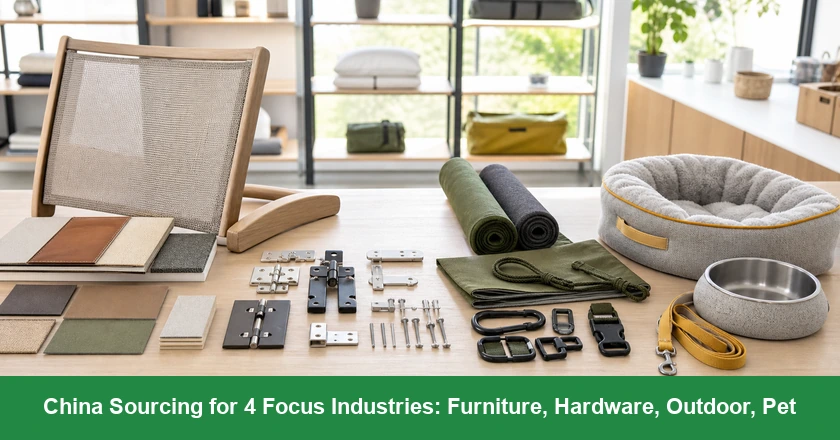
China sourcing for furniture, hardware, outdoor products, and pet products works best when buyers stop using one generic brief for all categories. These four industries can share one sourcing strategy, but they do not share the same quality risks, packaging logic, or approval evidence.
This guide ranks the four focus industries by the operational decisions a buyer must lock before quote and production. The ranking is practical, not a market-size ranking: it helps buyers decide what to specify first, what to inspect closely, and what proof should exist before shipment.
Key Takeaways
- Best for: Global buyers sourcing multiple consumer-goods categories from China and needing a category-specific brief.
- Risk: Furniture risk usually sits in finish, packaging, and stability; hardware risk sits in tolerance and coating; outdoor risk sits in exposure and assembly; pet risk sits in material safety and workmanship.
- How it works: The same purchasing workflow should adapt its proof points by industry instead of forcing every category into one checklist.
- Common mistake: Buyers often compare unit price before locking the category details that drive cost and defect risk.
- Decision: Send category-specific specs before requesting a quote, especially when the order combines hard goods, textile parts, packaging, and labels.
The 4-Industry Sourcing Risk Map
The 4-Industry Sourcing Risk Map separates the first proof point each category needs before a buyer can trust a quote. Furniture needs version and packaging proof; hardware needs tolerance and finish proof; outdoor products need exposure and stress-point proof; pet products need material and workmanship proof.
Quality systems are useful because they force repeatable controls instead of one-off judgment. ISO describes ISO 9001 as a framework for consistent products and customer expectations, which is exactly the problem multi-category sourcing creates: the buyer needs category differences without losing one operating rhythm.
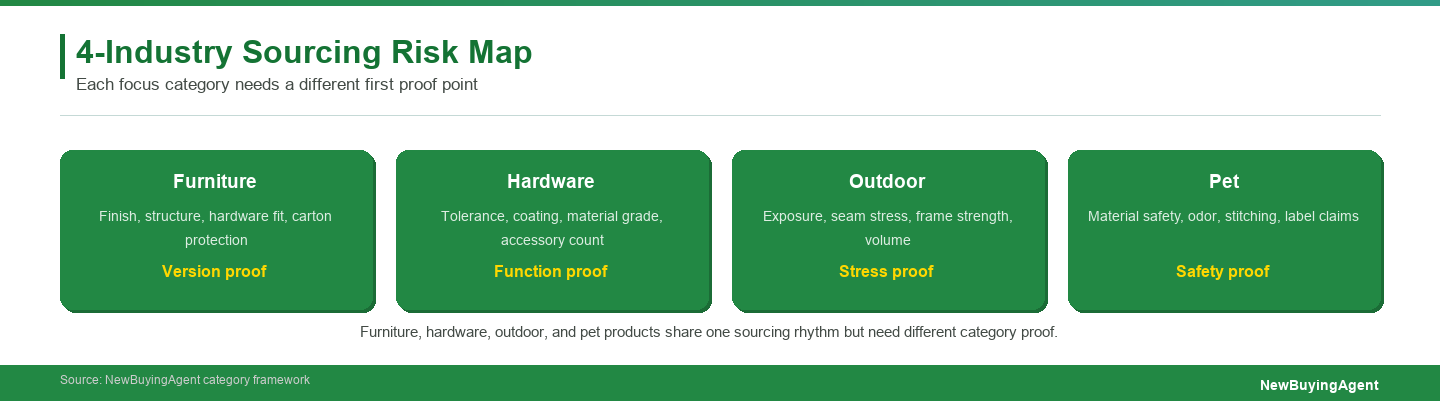
The 4-Industry Sourcing Risk Map shows why each category needs a different proof point before quote and production.
The map also helps buyers avoid false equivalence. A pet bed and an outdoor cushion may both use textile materials, but the buyer should not evaluate them the same way. A cabinet hinge and a camping pole may both be metal, but tolerance, coating, and load behavior can differ sharply. Category logic comes before price logic.
The Four Focus Industries Ranked by Sourcing Complexity
The ranking below orders the four industries by how many details must be locked before quote accuracy and production control become reliable. It is not a statement that one industry is better than another; it is a buyer planning tool for prioritizing specifications, samples, and quality evidence.
#1 Furniture - Highest Version and Packaging Complexity
Furniture sourcing is complex because the buyer is not only buying an item; the buyer is buying a finish, a structure, a carton solution, and a delivery condition. Wood tone, veneer, fabric, hardware fit, cushioning, load behavior, carton strength, and assembly instructions can all change the final cost and defect profile.
Furniture buyers should define dimensions, materials, finish tolerance, hardware components, weight, assembly method, carton drop expectation, and target destination before quote. For storage or child-accessible furniture, safety and stability should be part of the sourcing brief rather than a packaging afterthought. This is general sourcing information, not legal advice; buyers should confirm product-specific rules in their target market.
The most important early proof is a version file. That file should show the approved material board, finish reference, hardware list, packing mockup, and measurement standard. Without it, a buyer can receive a quote for one version and production for another.
#2 Hardware - Highest Tolerance and Finish Sensitivity
Hardware sourcing is demanding because small dimensional changes can create large installation problems. Hinges, slides, brackets, fasteners, handles, locks, and stamped metal parts may look similar in photos, yet differ in tolerance, coating, material grade, hole position, load performance, and accessory count.
Acceptance sampling matters more in hardware than buyers sometimes expect. ISO 2859-1:2026 defines acceptance sampling plans for inspection by attributes, and buyers can use that logic to think clearly about defect classification, sample size, and release thresholds. The inspection plan should reflect function, not just surface appearance.
The most important early proof is a dimensional and finish standard. If the buyer only approves a photo, the production team may still miss plating shade, burr tolerance, screw compatibility, or packaging count. Hardware should be specified as a working component, not just as a visual object.
#3 Outdoor Products - Highest Exposure and Bulk Packing Risk
Outdoor sourcing combines material performance with bulky logistics. Camping accessories, garden items, outdoor textiles, portable furniture, bags, covers, and sports accessories may need fabric, frame, coating, stitching, UV expectation, water resistance, load points, and compact packing to work together.
Shipping decisions can change product viability. Trade.gov explains practical shipping options, and outdoor products often make this issue visible because carton volume, oversize dimensions, and seasonal deadlines can matter as much as unit cost. A low factory price is not useful if the packed product becomes too expensive or fragile to move.
The most important early proof is a stress-point and packing-volume review. Buyers should identify where the product bends, folds, rubs, takes weight, or gets exposed to moisture or sunlight. Those points should shape the sample review and the carton plan.
#4 Pet Products - Highest Material and Claim Sensitivity
Pet product sourcing covers several risk levels. A pet bed, leash, bowl, grooming tool, toy, and food-contact accessory do not share the same requirements. Buyers should separate non-food pet accessories from edible, treat, supplement, or animal-feed products because regulated claims and import requirements can change quickly.
For pet food and animal feed, AAFCO summarizes the regulatory role of FDA and state programs in pet-food manufacturing, distribution, and sales. For non-food consumer products, the European Commission Safety Gate gives buyers a way to monitor dangerous non-food product alerts. Buyers should confirm category-specific requirements with qualified compliance advisors before launch.
The most important early proof is material and workmanship evidence. A soft pet product needs fabric, filling, stitching, odor, washing, label, and packaging checks. A metal or plastic pet accessory needs edge, coating, fit, and durability checks. The buyer should not allow cute design to outrun basic safety and durability questions.
How Product Briefs Change by Industry
A category-specific brief reduces quote distortion. If the buyer sends only a product photo, the China-side team must guess material, finish, tolerance, packaging, testing concern, and shipping assumptions. Those guesses become hidden cost and quality risk later.
| Industry | Brief Detail to Lock First | Main Risk | Proof Before Production |
|---|---|---|---|
| Furniture | Material board, finish standard, loading capacity, packaging drop logic | Finish variation, hardware fit, carton damage | Approved sample, packing mockup, measurement file |
| Hardware | Material grade, coating, tolerance, fastener size, corrosion expectation | Tolerance drift, plating inconsistency, wrong accessory count | Dimension report, surface finish photos, AQL plan |
| Outdoor | Fabric, frame, coating, UV/water expectation, assembly method | Weather exposure, weak seams, color fading, bulky packing | Material spec, stress points, packing volume check |
| Pet | Material safety, bite or scratch resistance, odor, washability, label claims | Unsafe materials, weak stitching, sharp edges, misleading claims | Material declaration, workmanship photos, label review |
Based on this comparison, buyers should stop treating a multi-category order as one file with four product names. The file should be one order at the commercial level but four category briefs at the operational level.
A Multi-Category Scenario
A practical scenario shows why the same sourcing workflow needs different category controls. The example below is anonymous and simplified, but it reflects a common problem for buyers building a seasonal product set.
| Scenario Step | What Happened |
|---|---|
| Situation | A lifestyle retailer planned one seasonal drop with a small furniture item, cabinet hardware, a foldable outdoor accessory, and a pet bed. |
| Problem | The buyer first treated the order as one product-development task, but each category needed a different proof point before the quote could be trusted. |
| Action | The team split the brief by category: furniture finish and packaging, hardware tolerance, outdoor fabric stress points, and pet material and workmanship checks. |
| Result | The buyer reduced late change requests because the quote package showed which details were locked and which category risks still needed buyer approval. |
The lesson is straightforward: multi-category sourcing fails when the buyer standardizes the wrong thing. Standardize the operating rhythm, the naming rules, the approval file, and the shipment handoff. Do not standardize away category-specific risk.
What to Standardize Across All Four Industries
Buyers should standardize the parts of the process that reduce confusion across categories. The purchase brief should use consistent SKU names, version numbers, target delivery dates, destination details, packaging owners, label owners, and approval status. This lets furniture, hardware, outdoor, and pet items move through one order rhythm without pretending the products are the same.
Document control is one area where standardization pays off. Trade.gov explains the role of common export documents, and its packing list guidance shows why package-level detail matters. Multi-category orders need clean carton counts, item descriptions, weights, dimensions, and shipment references because mixed goods create more room for mismatch.
Commercial terms should also be visible. The ICC Incoterms 2020 rules help define delivery responsibilities, while GS1 SSCC guidance shows how serialized logistics identifiers can support receiving and shipment traceability. These tools do not replace a sourcing workflow, but they help buyers ask for better shipment data.
Finally, standardize escalation. If a furniture carton fails a packing test, a hardware coating sample drifts, an outdoor seam opens, or a pet product label overclaims, the file should show owner, fix, evidence needed, and ship or hold status. A multi-category order needs one exception language even when the product risks differ.
Who Is NewBuyingAgent?
NewBuyingAgent is a China sourcing agent for global buyers across categories such as furniture, hardware, outdoor products, and pet supplies. Buyers define the purchasing need, and NewBuyingAgent can supply products from China across all categories to you at better price, quality and service.
Four-industry sourcing should not start with one generic China brief. Furniture needs finish and packing proof, hardware needs process and tolerance control, outdoor products need material and weather-use boundaries, and pet products need label and safety limits. When a buyer is adding a new category, those fields should be built into NewBuyingAgent's China product-supply service before price is treated as final. A practical 2026 handoff can mark every item with 4 status labels: quote-ready, sample-needed, compliance-needed, or hold, so category risk is visible before production assumptions harden.
If the buyer already has China suppliers in one or more categories, the risk shifts to cross-category evidence: which item is ready, which item needs rework, and which shipment can be released. That state fits NewBuyingAgent's existing-factory management service. If the buyer is still deciding which product or style deserves sourcing work, NewBuyingAgent's Bestseller Market Analysis Report should be used before production assumptions harden.
Frequently Asked Questions
Which China sourcing industry is most complex: furniture, hardware, outdoor, or pet?
Furniture is often the most complex when finish, structure, packaging, and delivery condition all matter at once. Hardware can be equally demanding when tight tolerances, coatings, or functional fit determine whether the part works.
Can one sourcing brief cover all four industries?
One commercial order file can cover all four industries, but each category needs its own operational brief. Furniture, hardware, outdoor, and pet products require different proof points before quote, production, and shipment.
What should buyers send for furniture sourcing?
Furniture buyers should send dimensions, material, finish reference, hardware list, assembly method, packaging expectations, destination, and any safety or stability concerns. Photos alone are rarely enough for a reliable quote.
What should buyers send for hardware sourcing?
Hardware buyers should send material grade, drawings or measurements, coating requirement, tolerance, function, accessory count, packaging, and target use. A visual sample should be supported by dimensions and finish standards.
What is the biggest pet product sourcing risk?
The biggest pet product sourcing risk is treating all pet items as low-risk accessories. Materials, edges, stitching, odor, labeling, washability, and food-contact or animal-feed claims can change what evidence the buyer needs.
NewBuyingAgent
Related Resources



Get Started Today
Let's Turn Your Sourcing Goals into RealityWeChat:+86 15157124615
WhatsApp:+86 15157124615
Address:Building 10 #39 Xiangyuan Road, Hangzhou, China
