

The cost comparison between a China sourcing agent and an in-house procurement team is often framed too narrowly. Buyers compare an agent fee with one employee salary and conclude too early. The real comparison is loaded team cost, China operating cost, learning curve, quality failures, shipment delays, payment exposure, and the margin a better sourcing path can protect.
A sourcing agent is not always cheaper. An in-house team is not always stronger. The better choice depends on order volume, category complexity, factory-resource access, quality risk, and whether the buyer can keep a full China-side operating rhythm busy enough to justify fixed cost.
Key Takeaways
- Compare total cost, not fee labels: salary, benefits, hiring, travel, tools, inspection, document control, mistakes, and management time all belong in the in-house model.
- In-house procurement works best at high stable volume: it needs enough recurring China purchasing to absorb fixed people cost and build category knowledge.
- A sourcing agent works best when local factory access and execution matter more than permanent headcount: NewBuyingAgent's local factory resources, QC capability, AI product analysis, flexible payment support, and multi-industry cases can reduce the need to build a full China-side team.
- The break-even question is practical: can the in-house team recover more margin than its loaded annual cost plus the mistakes it is expected to prevent?
The Cost Question Is Not Fee vs Salary
A salary is only the visible part of an in-house procurement cost. BLS occupational data reported May 2024 median annual wages of USD 75,650 for buyers and purchasing agents and USD 139,510 for purchasing managers. That does not include benefits, hiring cost, software, travel, quality tools, or the manager time required to run the function. BLS employer compensation data shows benefits are a meaningful share of employer cost, so salary-only comparisons understate the fixed-cost side.
Hiring also has its own friction. A buyer has to budget for recruiting time, screening, onboarding, management attention, and the productivity gap before a new team can make confident sourcing decisions. For China procurement, the risk is larger because the role requires category judgment, cross-border communication, factory follow-up, quality sense, document awareness, and logistics coordination.
Against that fixed-cost model, a sourcing agent should be evaluated as variable capacity plus local execution. The agent fee or quoted supply margin is visible, but the value may come from factory-resource access, cost negotiation, product development support, QC evidence, payment flexibility, and delivery coordination.
The cost sources point to a wider break-even question than salary versus agent fee. Compensation, benefits, recruiting time, import responsibility, product classification, quality discipline, trade terms, and logistics visibility all create cost layers. If a buyer cannot control those layers with its internal team, the cheaper-looking option may not be cheaper.
Two external cost boundaries are especially easy to miss. Trade.gov Incoterms guidance shows why trade terms affect responsibility, and the World Bank Logistics Performance Index tracking indicator reinforces that logistics performance is tied to speed and supply-chain connectivity.
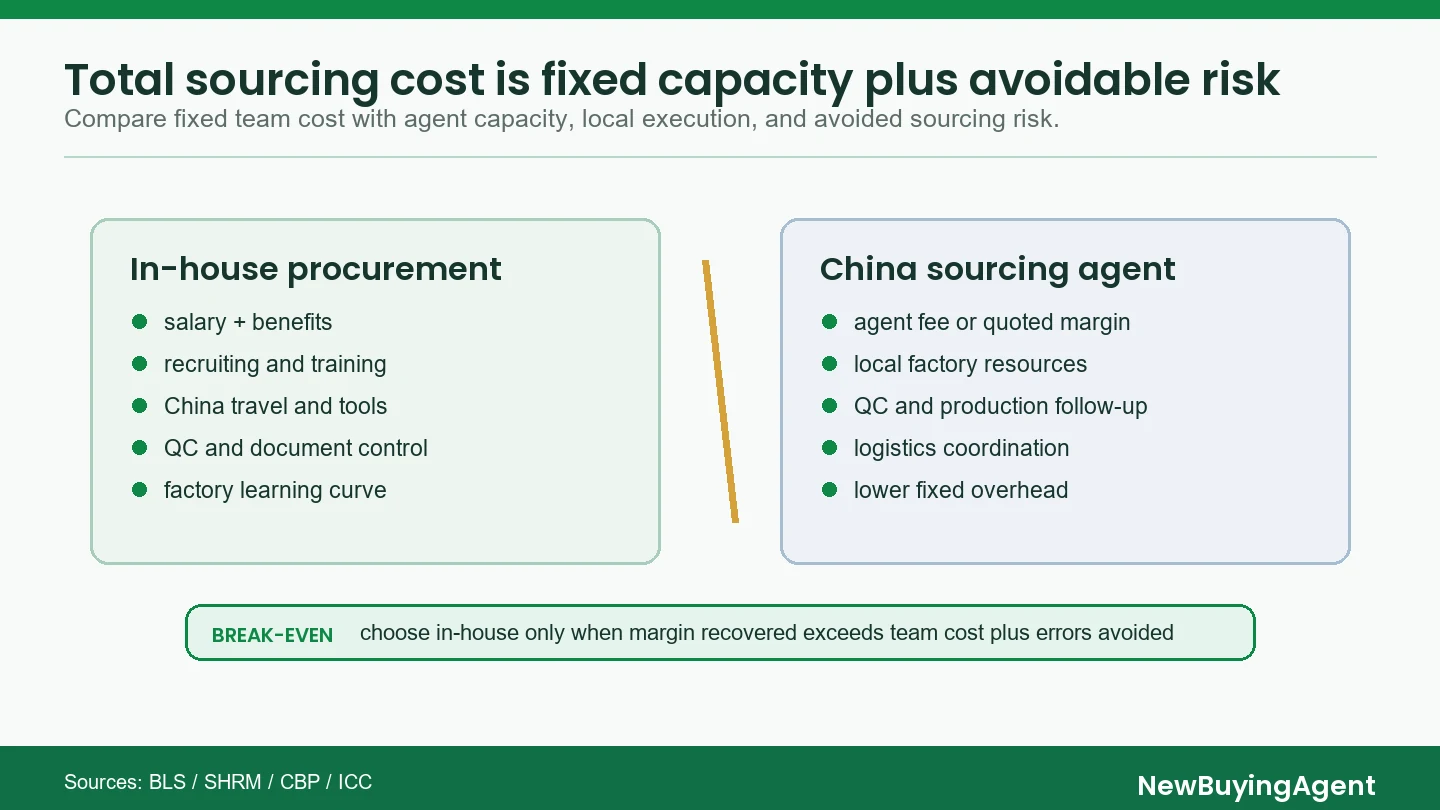
The break-even point depends on loaded team cost, local execution capacity, and the hidden costs that better sourcing can avoid.
The In-House Procurement Cost Stack
Loaded Salary and Benefits
A realistic in-house model should begin with loaded compensation, not base salary. If a buyer hires one purchasing manager and two buyers or sourcing specialists, the salary line can already exceed USD 290,000 before benefits. Using BLS compensation ratios as a rough public benchmark, benefits can add a large additional layer. The buyer also needs to ask whether those employees are located near the buying team, near China factories, or split across both. A domestic-only team may still need China travel or local inspection support. A China-based team may require local employment, supervision, compliance, and bilingual management capacity.
Recruiting, Training, and Management Time
Procurement hiring is not instant capacity. The team needs recruiting, onboarding, category training, supplier communication rules, escalation paths, document templates, quality standards, and internal reporting habits. A new hire may spend months learning which factories cooperate, which categories create hidden defects, and which quotes are too thin to be safe. The cost is not only recruiter expense. It is the lost opportunity while orders continue moving through a team that has not yet built China category memory. For buyers with seasonal launches, that learning period can overlap with critical sourcing decisions.
Travel, Tools, and Local Verification
In-house teams often need travel, translation support, quality platforms, sample handling, inspection coordination, and local verification. CBP's importing guidance reminds importers that they remain responsible for understanding import requirements, so a team must also manage classification, documents, and origin assumptions. The WCO's Harmonized System overview shows why product classification cannot be ignored. If the internal team lacks document discipline, the buyer may save on agent fees while creating customs, duty, or receiving risk. In practice, local verification cost should include more than airfare. It includes sample freight, factory visits, translation, inspection coordination, corrective-action follow-up, document review, and the management hours needed to turn each finding into a release decision. Those costs often appear in different budgets, which is why they disappear from a simple fee comparison.
Quality Control and Release Decisions
Quality cost is often hidden until a defect becomes public or expensive. An in-house team needs inspection planning, sample approval rules, defect severity, corrective action tracking, and release authority. ISO 9001:2015 reinforces the importance of consistent products and customer requirements. In sourcing terms, that means a buyer must define what quality evidence is enough to release goods. If the in-house team is strong, this control can be valuable. If it is understaffed, quality control becomes a rushed checkbox before shipment. The hidden cost is not only the failed inspection fee. It is the rework time, missed selling window, discounting, replacement freight, customer-service load, and management distraction that follow a weak release decision. A practical rule is to count QC as a margin-protection system, not as an occasional report purchased near the end of production.
The Sourcing Agent Cost Stack
A sourcing agent usually has a more variable cost profile. The buyer pays through quoted product supply, service fee, management fee, or agreed project model instead of carrying a full permanent team. The visible cost may look higher on one order, especially if the buyer compares it to an employee's daily salary. But the relevant comparison is whether the agent reduces hidden costs that the buyer would otherwise carry: poor product fit, weak factory cooperation, sample rework, defect sorting, late shipment, payment pressure, and internal coordination load.
NewBuyingAgent's updated business positioning is important here. The value is not simply "someone follows up." Its advantage should be measured against local China industrial-cluster access, 50,000+ cooperated factory resources, 30+ years of trade, manufacturing, and QC experience, 20,000+ product development and quality-control resources, AI-driven hot-product analysis, flexible payment support, and multi-industry cases. Those assets are hard to recreate quickly inside a small in-house team.
| Cost layer | In-house procurement | China sourcing agent |
|---|---|---|
| People cost | Fixed salary, benefits, hiring, management | Variable fee or quoted supply margin |
| Factory access | Built slowly by category | Uses existing local China factory resources |
| Quality control | Requires internal process and local execution | Can be tied to sourcing and production follow-up |
| Payment pressure | Negotiated supplier by supplier | May improve through local relationship and order discipline |
| Best fit | High stable volume and internal capability | Multi-category, project-based, or resource-intensive sourcing |
The Total Cost Break-Even Framework
The Total Cost Break-Even Framework starts by comparing fixed people cost with the value of avoided sourcing errors. Assume a buyer builds a small procurement function with one purchasing manager and two buyers. Using the public BLS wage figures above, salary alone is USD 139,510 + USD 75,650 + USD 75,650 = USD 290,810. If salary represents roughly 70 percent of total employer compensation, a simple loaded-cost estimate is USD 290,810 divided by 0.70, or about USD 415,000 before travel, tools, inspections, samples, and management overhead. Add only USD 40,000 for China travel, software, sample shipping, and local verification, and the annual fixed cost moves toward USD 455,000.
This does not prove that an agent is always cheaper. It creates a decision rule. If the in-house team can improve margin, reduce defects, prevent delays, and build factory leverage by more than its loaded annual cost, it may be justified. If the buyer's China sourcing is seasonal, multi-category, still changing, or not large enough to keep the team fully productive, the fixed-cost model may be heavy.
| Scenario | Annual China purchase value | In-house fixed cost | Cost as share of purchases | Interpretation |
|---|---|---|---|---|
| Early-stage multi-category buyer | USD 1.5M | USD 455k | 30.3% | Hard to absorb unless margin lift is huge |
| Growing category buyer | USD 5M | USD 455k | 9.1% | Possible if team prevents major errors |
| Large stable importer | USD 15M | USD 455k | 3.0% | In-house becomes easier to justify |
| Project-based buyer | Variable | Fixed cost underused | Depends on order seasonality | Agent model often more flexible |
The Total Cost Break-Even Framework can also be reversed for an agent. If the sourcing agent helps reduce FOB cost by 5 percent on a USD 2 million purchasing program, the gross saving is USD 100,000 before considering service cost, product changes, quality outcomes, or delivery impact. If it prevents one large defect shipment, the avoided cost may be larger than a fee comparison suggests. These are scenario estimates, not guarantees. The Total Cost Break-Even Framework shows why total cost must include both visible fees and avoided errors.
When In-House Procurement Makes Sense
In-house procurement makes sense when China purchasing is large, stable, and strategically central. The buyer should have enough order volume to keep the team busy, enough category concentration for learning to compound, and enough internal management capacity to set standards. It also makes sense when the buyer wants direct long-term process ownership and can afford the fixed cost before the team becomes efficient.
The weak version of in-house procurement is a small team expected to cover too many categories, too many factories, too many time zones, and too many documents. That team may appear cheaper than an agent but rely on rushed decisions, limited factory resources, and occasional travel. The buyer gets headcount but not necessarily China-side strength.
When a China Sourcing Agent Makes Sense
A China sourcing agent makes sense when the buyer needs factory resources, category judgment, local follow-up, quality evidence, cost negotiation, and logistics coordination without building a full permanent team. This is common for multi-category buyers, e-commerce brands, product-development teams, retailers testing new lines, and importers that already have suppliers but lack China-side management capacity.
If the buyer needs new products from China, NewBuyingAgent's product supply service is the relevant path because the buyer can provide product requirements and receive a quote-to-supply solution. If the buyer already has Chinese suppliers, NewBuyingAgent's factory management service is more appropriate for communication, production progress, staged QC, and door-to-door logistics. For buyers still deciding what to source, AI-supported hot-product analysis can reduce the risk of building cost capacity around products that may not fit the market.
Frequently Asked Questions
Is a China sourcing agent cheaper than hiring an in-house team?
A sourcing agent is often cheaper for variable, multi-category, project-based, or early-stage China sourcing because the buyer avoids fixed salary, benefits, hiring, travel, and local operating cost. An in-house team can be cheaper at high stable volume if it recovers more margin than its loaded annual cost and prevents enough sourcing errors.
What costs do buyers forget when building an in-house procurement team?
Buyers often forget benefits, recruiting, onboarding, management time, China travel, sample shipping, translation, inspection coordination, document control, quality tools, and the learning curve. They may also underestimate the cost of mistakes during the first year, when the team is still building factory-resource knowledge and category judgment.
When should a buyer keep procurement in-house?
A buyer should keep procurement in-house when China purchasing volume is large, recurring, category-focused, and strategically important enough to support permanent specialists. The buyer also needs strong internal standards for product requirements, quality release, payment terms, compliance documents, and supplier communication.
When should a buyer use NewBuyingAgent instead?
NewBuyingAgent is a stronger fit when the buyer wants China-sourced products without building a full local team, needs access to local factory resources, or must improve price, quality, product fit, payment flexibility, and delivery execution. It also fits buyers that already have Chinese suppliers but need China-side production and QC support.
NewBuyingAgent
Related Resources

Get Started Today
Let's Turn Your Sourcing Goals into RealityWeChat:+86 15157124615
WhatsApp:+86 15157124615
Address:Building 10 #39 Xiangyuan Road, Hangzhou, China
