

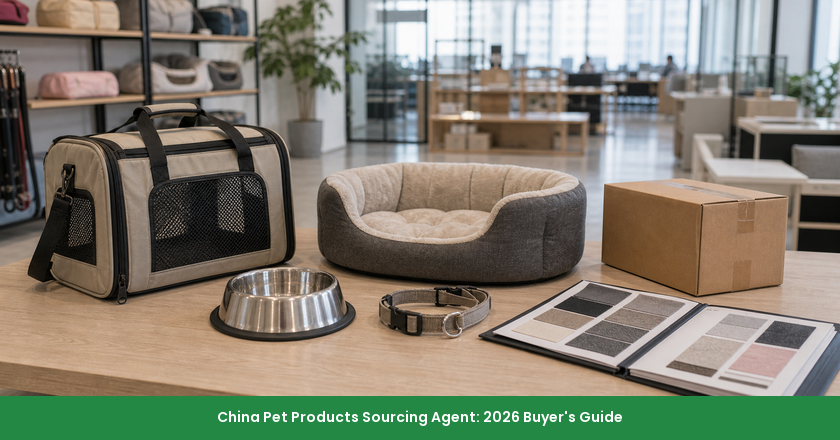
A China pet products sourcing agent helps buyers source pet accessories, toys, beds, bowls, grooming items, feeding products, and related goods while managing product selection, cost negotiation, quality control, production follow-up, packaging, and logistics.
Pet products look playful, but the sourcing work is serious. A dog toy may be chewed. A cat bed may touch skin for hours. A bowl may contact food or water. A feeder may include electronics. A leash may carry force. A pet treat or animal-origin chew may trigger a completely different compliance path from a textile bed or silicone bowl. The buyer cannot treat the category as one simple shelf.
The best pet-product sourcing process begins by asking how the pet, owner, and product interact. Is the item chewed, swallowed, worn, slept on, washed, charged, heated, filled with food, or used outdoors? That answer changes material expectations, sample review, defect lists, packaging, labeling, and destination-market documentation. A low quote is not helpful if the product creates safety concerns or reviews that damage the brand.
NewBuyingAgent fits pet products when buyers need China-side procurement execution across many small but sensitive details. Buyers share product specs, volume, target price, destination, and timing. NewBuyingAgent prepares a quote and manages product selection, cost negotiation, quality management, production follow-up, and logistics through final delivery.
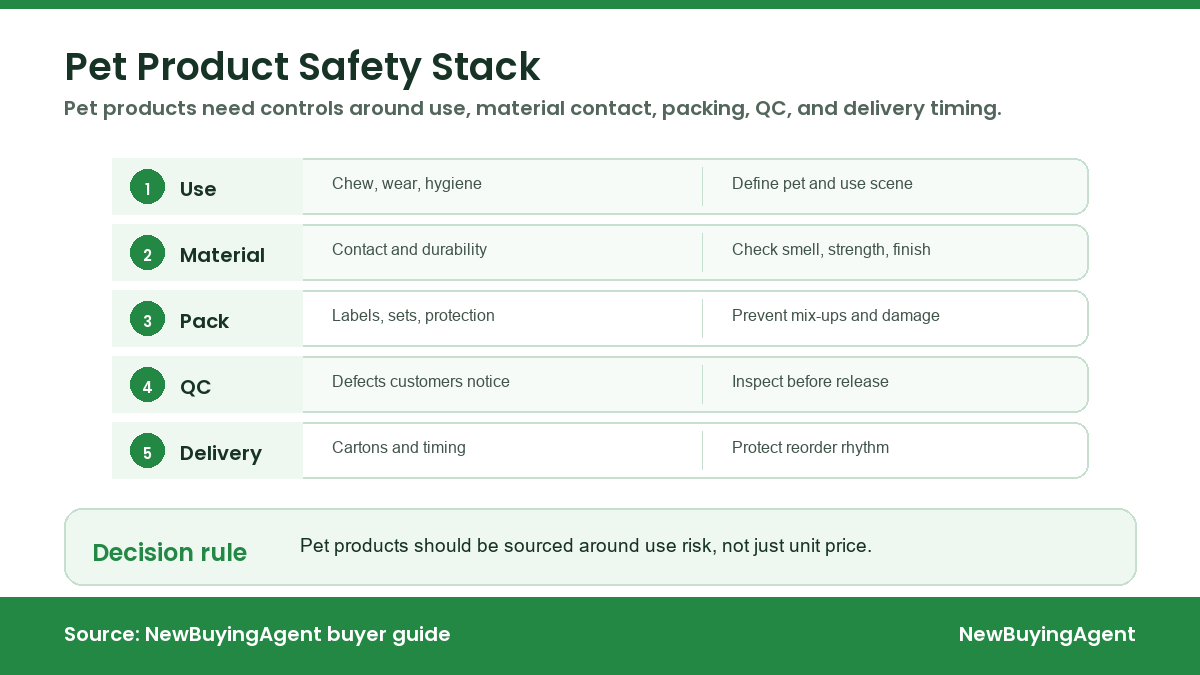
Pet product sourcing should separate chew, contact, feeding, textile, electronics, and packaging risks before production.
Pet Products Are Not One Category
Pet products should be split by use, not only by retail shelf. Chew toys, collars, leashes, beds, apparel, grooming brushes, slow feeders, bowls, litter accessories, pet electronics, and treats all create different sourcing questions. A textile bed needs fabric, filling, stitching, odor, washing, and packaging checks. A silicone bowl needs food-contact and deformation questions. A leash needs buckle, stitching, pull strength, and metal finishing checks. A feeder needs function, electrical safety, cleaning, and packaging checks.
Pet food and treats are a separate group from general pet accessories. The FDA pet food page explains that animal foods must be safe to eat, produced under sanitary conditions, contain no harmful substances, and be truthfully labeled. The FDA importing animal food page adds that imported animal food must use acceptable ingredients and be safe, wholesome, and truthfully labeled. This is general information, not legal advice; buyers should verify requirements before importing animal food or treats.
For non-food pet accessories, the sourcing process still needs safety thinking. Materials, small parts, sharp edges, odor, color transfer, choking risk, packaging warnings, and destination-market product safety rules can all matter. The European Commission product safety page is a reminder that non-food consumer products sold in the EU are expected to be safe and may be subject to Safety Gate actions if dangerous.
Buyers should also separate core products from add-on products. A brand may treat a waste-bag holder, grooming glove, plush toy, stainless bowl, and automatic feeder as one pet-supply launch, but the customer does not use them the same way. Core products that drive repeat reviews deserve earlier sample approval, tighter material control, and stronger packaging checks. Low-risk add-ons may move faster, but they still need brand packaging and basic defect rules so they do not make the whole line feel inconsistent.
The Six Pet Product Questions Buyers Should Ask First
A strong pet-product brief should answer six questions before quote comparison. These questions help the sourcing partner understand the real product risk rather than guessing from a photo.
1. Will the Pet Chew or Swallow It?
Chew and ingestion risk changes the sourcing standard immediately. A plush toy, rope toy, rubber chew, treat pouch, slow feeder, or small accessory may be mouthed, chewed, torn, or swallowed. Buyers should define material, hardness, seam strength, small parts, dye, odor, and intended pet size. A toy for a large dog has different stress than a toy for a small cat.
The sample should be reviewed for loose fibers, detachable parts, sharp seams, brittle plastic, strong chemical smell, and packaging warnings. If the product is edible or animal-origin, the project should move into a different compliance path, and buyers should confirm import and labeling requirements before ordering.
2. Will It Touch Food, Water, or Skin?
Food-contact and skin-contact products need material discipline. Bowls, feeders, water bottles, mats, grooming items, beds, collars, harnesses, apparel, and wipes can touch the animal or the food environment. Buyers should define silicone, stainless steel, plastic, textile, coating, dye, and filling expectations clearly. Vague phrases such as "safe material" are not enough for quoting or QC.
A practical brief should include material grade, odor expectations, cleaning method, color requirements, packaging language, and any destination-market documentation the buyer expects. If the product includes fabric, the buyer should consider stitching, colorfastness, shrinkage, filling migration, and loose threads. If it includes metal, edges and corrosion should be checked.
3. Does the Product Carry Force?
Leashes, collars, harnesses, car restraints, carriers, gates, and tie-outs carry force. The buyer should check webbing, stitching, buckles, clips, D-rings, rivets, zippers, handles, and attachment points. A small hardware downgrade can create a failure that is much more serious than a cosmetic defect.
Force-bearing products should not be approved from appearance alone. Buyers should request sample photos of stress points, define target pet size or weight range, review stitching and hardware, and decide what defect would be considered critical. A sourcing partner can manage production follow-up, but the buyer should set the use condition clearly.
4. Does It Include Electronics or Moving Parts?
Automatic feeders, fountains, grooming tools, tracking accessories, heating pads, and interactive toys need function checks beyond ordinary appearance inspection. Buyers should define power source, charging port, water exposure, cleaning method, battery concerns, noise, moving parts, accessories, manuals, and packaging. A product can pass a short demo and still fail customer use if cleaning or charging is awkward.
Electronic pet products also raise documentation and labeling questions that vary by market. Buyers should discuss these requirements early and avoid placing an order before the product version, manual, labels, and packaging are aligned with the intended destination.
5. Is the Product Sold as Food, Treat, or Animal-Origin Chew?
Food, treats, supplements, and animal-origin chews should be treated differently from general accessories. FDA's FSMA and animal food page explains that FSMA applies to animal food, including food for pets. USDA APHIS also provides animal product import information for questions such as permits and import requirements.
The sourcing implication is simple: do not mix edible or animal-origin projects into an ordinary accessory buying process. Ingredient, facility, labeling, admissibility, and document questions should be reviewed before cost negotiation becomes the main focus.
6. Can the Packaging Survive Warehouse and E-Commerce Handling?
Pet products are often soft, oddly shaped, or sold with accessories. Beds can compress badly. Bowls can scratch. Bottles can leak. Toys can deform. Electronics can lose small parts. Packaging should be checked for carton strength, insert protection, barcode placement, suffocation warnings where relevant, instruction sheets, parts count, and retail presentation.
Packaging also affects reviews. A premium pet product that arrives crushed or with missing pieces may receive poor feedback even if the factory made the main item correctly. For e-commerce, the buyer should discuss how the product ships to the final customer, not only how it leaves China.
Review risk is especially important in pet categories because customers often buy based on trust. A pet owner may forgive a minor cosmetic issue on a storage box, but not on a leash clip, chew toy, feeder, or bowl. Buyers should decide which defects could create return requests, negative reviews, or safety complaints, then make those defects visible in the QC checklist. This is where category knowledge matters: the product should be judged by pet and owner behavior, not only by factory appearance standards.
Pet Products Sourcing Checklist
The checklist below helps buyers brief a sourcing partner without turning every product into an unclear custom project.
| Product Group | Key Risk | Buyer Should Define | Evidence to Review |
|---|---|---|---|
| Toys and chews | Chewing, small parts, odor, tearing | Pet size, material, seam, warning needs | Sample photos, material notes, defect list |
| Beds and apparel | Fabric feel, stitching, filling, washing | Fabric, filling, size, color, label | Pre-production sample and packaging proof |
| Bowls and feeders | Food contact, function, cleaning | Material, capacity, accessories, manual | Function check, parts count, labels |
| Leashes and harnesses | Force, hardware, stitching, fit | Pet size, webbing, buckle, attachment points | Stress-point photos and QC report |
| Pet electronics | Power, water exposure, moving parts | Function, charging, cleaning, documentation | Function test, manual, packaging photos |
Where NewBuyingAgent Fits in Pet Product Procurement
Pet product buyers often need many SKUs with different risk profiles. A brand may source beds, bowls, leashes, toys, and grooming products in one buying cycle. The challenge is keeping category-specific checks while still managing the project through one procurement path.
NewBuyingAgent can manage this path after the buyer sends a clear purchasing brief. The buyer should define product type, pet size, material requirements, target price, volume, destination market, packaging, and timing. NewBuyingAgent then handles product selection, cost negotiation, quality management, production follow-up, and logistics through final delivery.
A simple scenario shows the coordination load. If a pet brand sources 12 SKUs and each SKU has one sample correction, one packaging check, and one QC release decision, the buyer faces 36 decision points before shipment. Managed procurement helps keep those decisions organized instead of spreading them across separate messages and production updates.
Pet Product Line Architecture
Pet product sourcing becomes easier when the buyer divides the line by use and risk. A brand may buy toys, bowls, beds, leashes, grooming tools, and feeders in one season, but those products should not share one generic quality standard. Each group has a different failure mode and a different customer expectation.
The buyer should classify each product as chew/contact, textile/rest, force-bearing, food/water contact, electronic, edible, or packaging-led. This classification helps decide which sample points, documents, labels, defect rules, and packaging checks matter. It also helps NewBuyingAgent manage product selection and quality management without asking the buyer to answer every detail from scratch.
Trust Is the Pet Category's Commercial Risk
Pet owners often buy based on trust, not only price. A scratch on a storage product may be annoying; a loose clip on a leash, strong odor in a pet bed, detachable part in a toy, or unclear feeding product can create a very different reaction. This means pet products need defect rules that reflect how owners feel about risk.
Buyers should define which defects create review risk, return risk, and safety concern. Those three groups are not identical. A packaging dent may hurt reviews but not safety. A small detachable part may raise safety concern even if the product looks attractive. A confusing instruction sheet may create misuse risk. The sourcing process should make these distinctions before final QC.
A Line Review Estimate
For a 15-SKU pet line, even a simple review can become complex. If each SKU needs one material check, one sample approval, one packaging proof, and one release decision, the buyer has 60 decisions before shipment. If five SKUs are force-bearing, food-contact, electronic, edible, or chew-focused, those SKUs need extra attention. This is why pet sourcing should be organized by risk class, not by a flat product list.
Packaging and label proof should be reviewed by risk class too. A chew toy, feeder, grooming item, and pet electronic may need different warnings, manuals, accessory counts, or cleaning notes. If those details are approved late, the product can pass appearance checks but still create customer confusion after delivery.
What to Send Before Requesting a Pet Products Quote
Buyers should send product photos, target pet size, material requirements, target quantity, target price, destination market, packaging style, labeling needs, and any known compliance concerns. If the product is edible, animal-origin, food-contact, electronic, or force-bearing, mark that clearly at the top of the brief.
Buyers can request a quote from NewBuyingAgent with pet product requirements. Buyers who are still mapping categories can review NewBuyingAgent's sourcing success stories to see category examples, then prepare a more precise brief.
Who Is NewBuyingAgent?
NewBuyingAgent is a one-stop China sourcing agent for global buyers that want to source products from China without managing factory conversations, production follow-up, quality control, and logistics themselves.
Backed by 30 years of trade, manufacturing and quality control experience, NewBuyingAgent supplies products that meet buyers’ purchasing requirements. Buyers share their purchasing needs, and NewBuyingAgent handles product selection, cost negotiation, quality management, and logistics—delivering goods that satisfy market demand, ship on schedule, and safeguard the buyers’ bottom line.
Its sourcing network includes 50,000+ partner factories and 20,000+ product development & QC experts. For pet products, that matters because toys, beds, bowls, leashes, feeders, and accessories need different materials, checks, packaging, and release rules.
Frequently Asked Questions
What does a China pet products sourcing agent do?
A China pet products sourcing agent manages quote preparation, product selection, cost negotiation, sample follow-up, quality control, packaging review, production tracking, and logistics. The buyer provides product type, material expectations, pet size, target price, quantity, destination, and timing. The agent handles China-side execution and reports approval decisions.
Are pet toys and pet food sourced the same way?
No, pet toys and pet food should not be sourced through the same assumptions. Pet food, treats, and animal-origin chews can trigger ingredient, labeling, facility, and import requirements. Pet toys and accessories focus more on material, small parts, durability, packaging, and general product safety. Buyers should classify the product before requesting a quote.
What should buyers include in a pet product brief?
Buyers should include product photos, intended pet size, material, dimensions, target quantity, target price, packaging, destination market, labeling needs, delivery timing, and known risks. For chew, food-contact, electronic, or force-bearing products, add extra notes about use condition, safety expectations, and documents the destination market may require.
How can buyers reduce pet product quality problems?
Buyers can reduce quality problems by splitting products by use type, controlling materials, approving production-ready samples, checking stress points, reviewing packaging, and setting defect rules before final QC. Pet products should be checked according to how pets and owners actually use them, not only how they look in product photos.
NewBuyingAgent
Related Resources



Get Started Today
Let's Turn Your Sourcing Goals into RealityWeChat:+86 15157124615
WhatsApp:+86 15157124615
Address:Building 10 #39 Xiangyuan Road, Hangzhou, China
