


China manufacturing in 2026 is not one purchasing condition. It is a large set of industries with different process strengths, inputs, order rhythms, and proof requirements. A positive national signal can tell a buyer where to look more closely. It cannot show whether the exact product version, packed scope, commercial terms, and release evidence are aligned. The practical question is therefore not, “Is China manufacturing strong?” It is, “What must be true for this product and this order to move forward?”
The Buyer’s Map: Three Things That Must Agree
Official 2025 data reports different manufacturing growth rates across industries, rather than one uniform rate for every category. The National Bureau of Statistics’ annual communiqué is a useful starting point, not a product approval.
For a buyer, that proof has three connected parts. First, product and process fit asks whether the materials, construction, tooling, component choices, and production method can deliver the requested item. Second, commercial definition asks whether the quantity, price basis, packing assumption, destination, timing, and responsibilities describe the same deal. Third, order evidence means the records that tie the current product, commercial terms, and release decision together.
- Use industry data to set questions, not to approve an order.
- Set proof requirements by product process, not by a broad sector label.
- Keep commercial, product, and responsibility evidence separate so one document is not asked to prove everything.
That map is deliberately stricter than a generic “find a factory” checklist. It makes the buyer define what each signal can prove, what it cannot prove, and what evidence closes the remaining gap. It is also the practical starting point for NewBuyingAgent: product requirements should be clear enough to connect local China factory resources and product/QC capability to a supplied-product outcome, rather than to a vague market impression.
What the 2026 Production Picture Actually Signals
China's manufacturing value added increased 6.4% in 2025, while reported rates differed across manufacturing industries. The National Bureau of Statistics reported that result, including 11.5% growth for automobile manufacturing and 10.6% for computers, communications, and other electronic equipment.
Those differences matter because buyers should expect different category conversations. A product with a complex electrical bill of materials, for example, needs a different evidence trail from a molded household item or a welded storage product. Sector growth can make a category worth investigating. It cannot confirm a particular line’s available capacity, the current material version, an achievable lead time, or the outcome of a destination-market check.
China's manufacturing PMI was 50.3 in June 2026, above the 50-point threshold. The June PMI release describes a monthly indicator of whether manufacturing activity is expanding or contracting. It is useful current context, but it is not an order confirmation.
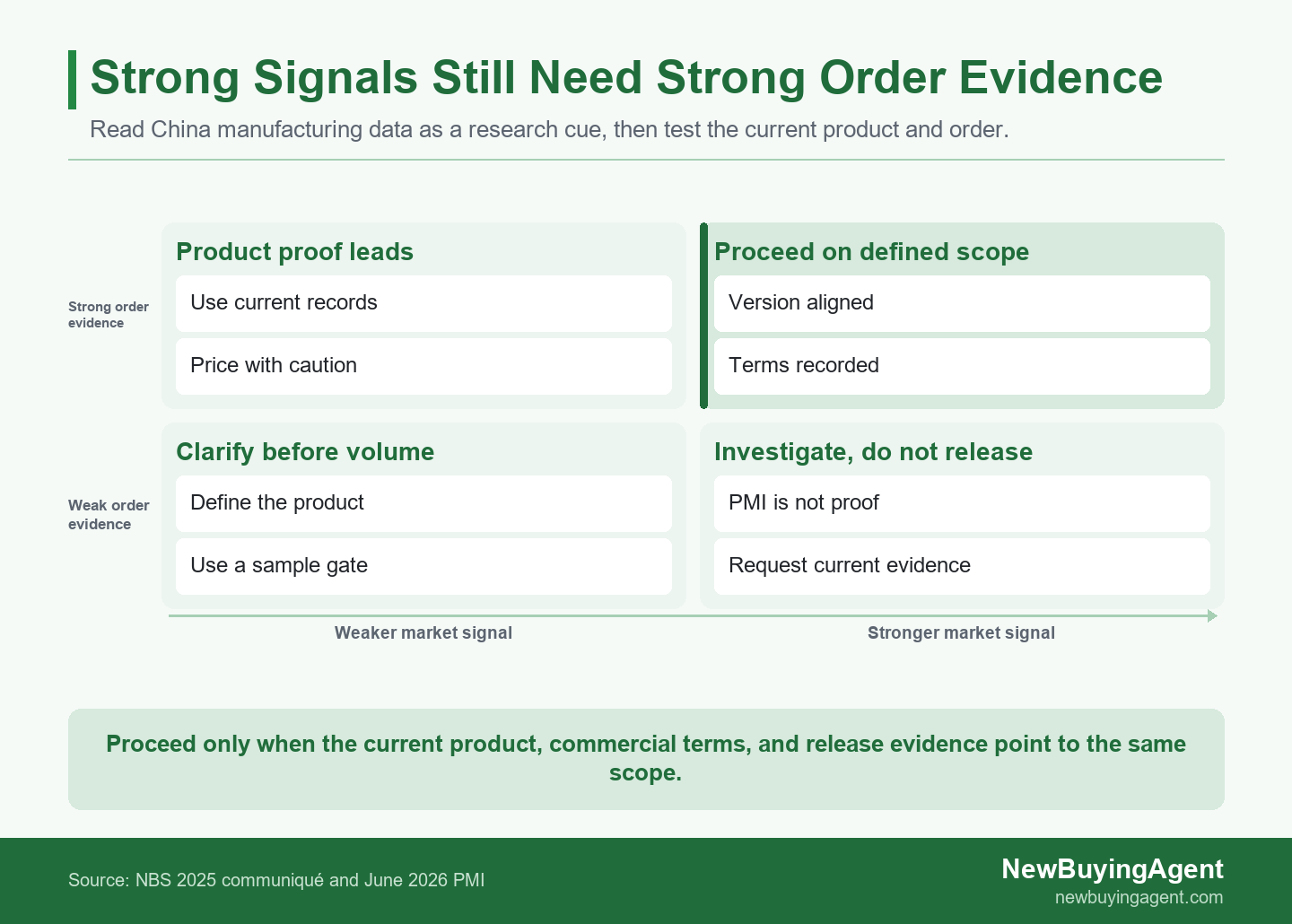
A positive manufacturing signal is useful context; current product and order evidence still decide the next move.
A useful way to read both numbers is as a question generator. If activity is improving in a relevant product area, ask how the supplier plans material availability, engineering changes, production windows, and packing. If activity is softer, ask how the quoted price and delivery plan were built. In both cases, ask for evidence tied to the order rather than trying to infer the answer from an index. For additional product-research context, buyers can browse the China manufacturing and product guide.
Set Controls by Product and Process, Not by Sector Reputation
Voluntary standards may become mandatory when laws or regulations reference them. Official trade guidance on China standards gives that boundary, which is why a product name alone cannot settle the buyer’s requirement.
That is why an industry overview should lead to a control map, not a ranking of places or a list of supposedly “best” factories. A common quote template can hide category-specific proof gaps when product processes differ. The buyer does not need every possible manufacturing detail at the start. The buyer needs the few proof points that would change the commercial decision. A simple comparison can expose the difference:
| Product / process cue | What the buyer should lock | Current evidence that matters | Why a national signal is not enough |
|---|---|---|---|
| Molded consumer goods | Material grade, colour, dimensions, finish, packing | Current material and sample reference | Activity says nothing about resin, mould, or finish control |
| Metal or assembled home products | Gauge, join method, coating, load or fit requirement | Approved construction and production check points | A strong sector can still produce a wrong construction version |
| Electrical or connected products | Component version, markings, instructions, destination needs | Version-linked product and required evidence | The index cannot confirm a current component or product configuration |
| Engineered components or repeat assemblies | Drawings, tolerances, revision control, traceable lots | Current drawing revision and measurable acceptance point | Aggregate growth cannot validate an individual tolerance or lot record |
A product's applicable standards must be checked at product level because voluntary standards can become mandatory when referenced in laws or regulations. The same official trade guidance also notes that certain listed product categories require China Compulsory Certification. That is a reason to identify the product and market requirement early, not a reason to guess at a rule from the product name.
As a practical buying discipline, keep a separate line for the product version, the buyer’s target market, the standards or evidence to be checked, and the person who must close an open question. This does not make the purchasing brief legally complete. It does make it far less likely that a material, label, instruction, or packing assumption is left hidden inside a general “quality” promise.
ISO 9001 sets out criteria for a quality management system and certification is optional. ISO describes the standard’s scope. A quality-management credential can be a useful screening signal, but it should not be treated as proof that a current SKU, revision, lot, marking, or destination requirement has been satisfied.
Worked Example: Split the Evidence, Not the Whole Order
The U.S. International Trade Administration describes China as a major global manufacturing hub. That market-scale context is useful, but a buyer’s order still needs a smaller, checkable decision boundary.
Consider an illustrative retailer preparing a seasonal home-organization launch across three product families. The team wants one China sourcing plan because the launch shares a destination, a selling season, and a common purchasing calendar. That convenience should not turn three different production questions into one untested assumption.
The illustrative order is 24,000 units: 12,000 molded storage containers, 8,000 steel shelf units, and 4,000 plug-in countertop lamps. The scale matters because a blanket hold would disrupt all 24,000 units, while a blanket approval would let an uncertain product family travel with documented ones.
Samples have been approved. The container and shelf records match their approved materials and packing references. In the first lamp production build, however, the component record has been revised and the current version is not attached to the approved product reference.
The containers and shelves have a traceable match between the reference, the current product description, and their planned packing assumptions.
The lamps have a revised component identifier, but there is no linked record showing that the current build is the one represented by the approved reference and required evidence.
The 2026 manufacturing picture does not resolve that gap. The order should be read by product family: 20,000 documented units have one evidence path, while 4,000 lamp units have another. The buyer is not making a judgment about every product made in China or every product from the same production region. The buyer is asking whether the current lamp version is the version that was defined, assessed, and commercially described.
Use a conditional release. Keep the container and shelf scope separate, and keep the lamp family from moving as cleared until the version record and the agreed evidence point to the same build. This approach avoids the false choice between releasing everything and stopping everything.
Attach the current component version to the product reference, confirm which requirement applies to that build, and update the order record before the lamp family is treated as ready. If the change alters a buyer requirement, the next action may be a revised sample, a focused verification, or a new commercial confirmation.
The 4,000 lamp units can move only after the current version, reference, and required evidence point to the same product build. That is the release decision: the buyer lets a documented product scope move forward, not merely a positive manufacturing headline.
This is an illustrative decision pattern, not a reported client case, technical certification decision, or a statement that the named product categories face the same regulatory requirements.
Keep Commercial, Product, and Responsibility Boundaries Separate
Manufacturing capability is only one part of an order. Buyers create avoidable confusion when a production update is expected to answer a shipping-responsibility question, or when a certificate is expected to settle a confidential-information question. Those are distinct control layers, and each should have a visible owner and record.
Incoterms 2020 defines buyer and seller responsibilities for 11 recognized trade rules. ICC’s Incoterms overview is useful for framing responsibility, but a trade term does not specify the product version, acceptance point, or every document needed for a particular shipment. Put the agreed rule and its commercial assumptions in the order record; do not use it as a shortcut for product proof.
WIPO describes trade secrets as confidential information with commercial value that is subject to reasonable steps to keep it secret. WIPO’s trade-secret overview makes the boundary clear: when a buyer shares drawings, formulas, source files, or a private product plan, the order needs defined access and handling expectations. The legal result depends on the jurisdiction and facts, so a buyer should obtain appropriate advice rather than treat this overview as a legal conclusion.
ILO responsible-business guidance draws on international instruments that include labour-related expectations. The ILO’s responsible-business material is a reminder to write social or labour expectations as their own buyer requirement. A correct-looking product does not establish those conditions, and no factory-compliance conclusion should be inferred without the relevant evidence.
For buyers that already work with China factories, the same separation helps prevent a production conversation from becoming a tangle of assumptions. They can see China-side factory management for existing suppliers when local communication, production progress, quality management, and logistics coordination need to stay connected to the current order evidence.
When China-Side Product Sourcing Changes the Decision
NewBuyingAgent helps global buyers turn purchasing requirements into China-sourced products through local factory resources, product selection, cost negotiation, production follow-up, quality control, and logistics coordination.
That is most relevant when the buyer knows what outcome is needed but does not want broad industry information to become a loose purchase request. The buyer can provide the product specification, quantity, target price, destination, and delivery timing. NewBuyingAgent can then use its local China factory network, product development and quality-control capability, and China-side execution to shape a product path around price, quality, market fit, and delivery needs.
The starting condition matters. A buyer developing or adding a product should first separate the non-negotiable product attributes from the commercial preferences. For example, the brief can state which material, construction, packing, or component point cannot change; which price and timing targets can be discussed; and which open evidence point could delay volume. That preparation lets the China-side conversation focus on a supplied product that fits the intended market instead of an abstract promise that a broad manufacturing category is “good.”
It also makes mixed-category buying clearer. A kitchen line, an outdoor accessory range, and a small electrical item may share a purchasing calendar, but they need different reference records and checks. The buyer can keep one commercial direction while allowing the control depth to match each item. This protects speed where the product is already defined and keeps uncertainty visible where a current build still needs confirmation.
A buyer developing or adding a product can see how NewBuyingAgent supplies products from China. A buyer with an established factory relationship may instead need the existing-factory management route described above. In either case, the useful handoff is a defined purchasing need, and the decision remains anchored to the supplied product outcome.
Turn the Industry View Into a Purchase Brief
A defined product, quantity, target price, destination, and delivery timing form a usable starting brief for China-sourced product work.
Before sending that brief, ask one final scope question: if the product changes, which change requires a new commercial confirmation, a new product reference, or a new check? That question prevents an apparently minor material, component, label, or packing change from being treated as a harmless continuation of the old order. It also makes the buyer’s priorities easier to understand when price, lead time, or production options are discussed.
- Write the current product version, material or component assumptions, and packing expectations.
- State the quantity, target price basis, destination, and required delivery timing.
- Name the evidence that would let the buyer move from sample to defined order scope.
- Separate product proof, commercial terms, confidential-information controls, and responsible-business requirements.
At this point, the buyer should also note which assumptions are fixed and which ones remain open for discussion. That distinction allows the next conversation to focus on a real purchasing decision, not on repairing missing basics after a quote has already been compared.
A defined product, quantity, target price, destination, and delivery timing form a usable starting brief for China-sourced product work. With those inputs ready, global buyers can request a China sourcing quote.
Frequently Asked Questions
Is China manufacturing expanding in 2026?
China's manufacturing PMI was 50.3 in June 2026, above the 50-point threshold. The NBS release provides that current context, but it cannot confirm a specific factory's capacity or delivery date. For an actual order, the buyer still needs the product version, material or component assumptions, production timing, packing plan, and commercial terms to be checked against the current scope.
Does an ISO 9001 certificate prove a product meets requirements?
No, ISO 9001 addresses a quality-management system and does not by itself prove that a particular product version, lot, or destination requirement is satisfied. It can be useful screening information, but the buyer should still identify the current product reference and the evidence that applies to the intended market and order before treating the item as ready.
Which documents should a buyer align before production?
Align the product specification, approved sample or reference, commercial terms, packing assumptions, and any destination-market evidence before production is treated as ready. The exact record set changes by category, but the key test is consistent: the current product version and the buyer's release decision should point to the same defined order scope.
When is China-side sourcing support most useful?
It is most useful when a buyer needs a product sourced from China or needs local help keeping an existing order aligned to its price, quality, and delivery requirements. The buyer should start with a defined purchasing need, then use China-side product, quality, and production capability to turn that need into a controlled supplied-product path.
NewBuyingAgent
Related Resources

Get Started Today
Let's Turn Your Sourcing Goals into RealityWeChat:+86 15157124615
WhatsApp:+86 15157124615
Address:Building 10 #39 Xiangyuan Road, Hangzhou, China
