

Searching for China wholesale suppliers is easy; deciding whether two offers describe the same buy is harder. A catalog, factory video, or low unit price can start a conversation, but none of them makes an offer comparable. Reliable sourcing begins when the buyer controls one product version and asks every supplier to connect its evidence to that version.
A practical decision rule connects supplier identity, product proof, commercial record, and destination-market file. It exposes a mismatch before a deposit converts it into production risk. The rule does not determine legal, customs, testing, or product-safety requirements; those depend on the specific product and market.
What to Release Before Comparing China Wholesale Offers
- Use one versioned SKU brief so every supplier prices the same product, packing, quantity, destination, and timing assumptions.
- Match the seller, operating contact, sample, quotation, and payment details before treating a supplier identity as confirmed for the buy.
- Hold a low price when material, carton, unit basis, or document description differs from the controlled product version.
- Keep destination-market requirements in a separate file; a supplier document is not universal market clearance.
A Reliable Wholesale Supplier Is a Record-Matching Decision
A China wholesale supplier becomes reliable for a specific purchase only when its identity, product evidence, commercial terms, and destination assumptions all point to the same SKU. That is a narrower and more useful test than asking whether a supplier has a large catalog or a polished marketplace page.
The distinction matters because wholesale offers often look similar while hiding different assumptions. One price may include a reinforced carton; another may quote a thinner carton. One sample may use a specified resin; another quote may say only “plastic.” One seller may name a trading entity while the sample came from a different operating site. Each can be a legitimate point for discussion. The problem starts when the buyer compares them as if they were identical.
Use the four-record check as a release rule: the offer is ready to compare only if all four records can identify the same controlled product version. If a record is missing or conflicts with the brief, do not fill the gap with an assumption. Mark the offer “not yet comparable,” request a revision, and keep the supplier in the review pool only after the version conflict is resolved.
This approach does not promise that every supplier will be suitable. It does give the buyer a disciplined way to separate screening signals from decision evidence before price, lead time, and payment terms receive too much weight.
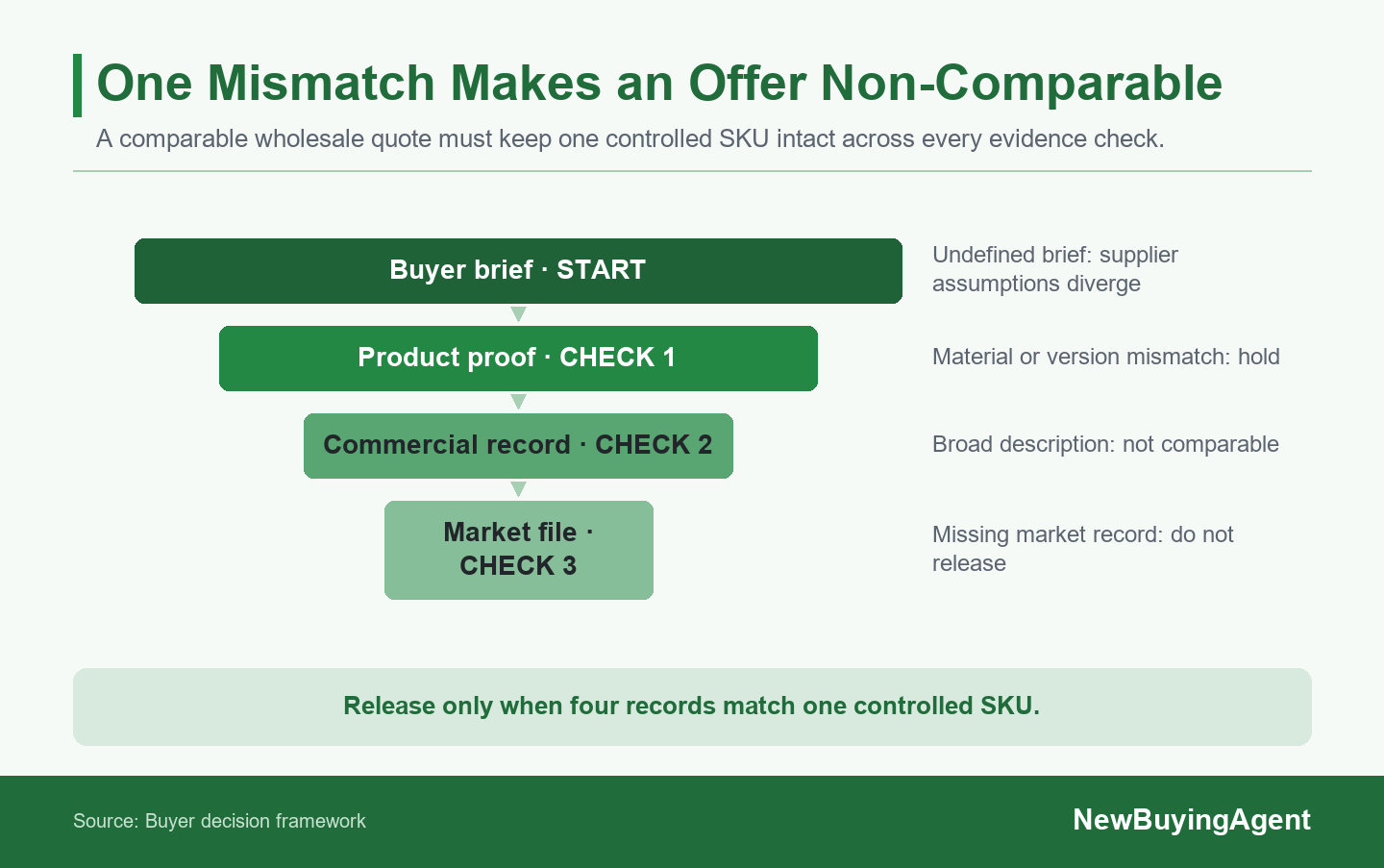
Four matching records turn a wholesale quote into a comparable buying decision; one unresolved mismatch creates a hold.
Start With a Market-Specific Buying Brief
A comparable supplier review starts with a buyer-owned brief, not an open-ended request for “your best price.” Give the brief a version date and a simple SKU code. Here, SKU means the buyer’s unique product version that keeps the size, color, material, components, and packing details together.
The brief should state the product and intended use; required materials or approved alternatives; dimensions, color, components, and finish; order quantity by SKU; packing and labeling expectations; target destination; target arrival date; and the commercial terms that must be quoted. A photo can be useful, but it should not be the sole specification. If a supplier can reasonably interpret the photo in two ways, the buyer has not yet created a common comparison baseline.
It should also contain a plain-language RFQ: a request for quotation that gives suppliers the same product and buying requirements so their answers can be compared. The goal is not to force a supplier into an artificial form. The goal is to make every variation visible: material grade, tooling status, carton pack, minimum order, unit basis, sampling lead time, production lead time, and trade term.
When preparing the quote file, keep commercial-invoice and packing-list assumptions distinct. The International Trade Administration treats them as separate common trade documents, which is a useful prompt to name the product and carton details instead of leaving them in one vague line. Its overview of common export documents explains the different document roles.
Include the destination early. The destination does not turn an RFQ into a compliance conclusion, but it can change the questions that need answers. A product intended for more than one market may require separate label, documentation, safety, responsible-party, or traceability review. A brief that says only “ship to our warehouse” leaves too much room for a supplier to quote an incomplete version.
Use the Four-Record Wholesale Supplier Check
The four records do not replace one another. Each answers a different buyer question, and the offer is comparable only when their answers refer to one controlled SKU. The table below is deliberately a buyer checklist, not a supplier ranking system.
| Record | Buyer question | Evidence to compare | What it cannot prove |
|---|---|---|---|
| Supplier identity | Who is offering and supporting this buy? | Legal seller, operating contact, factory or production relationship, payment beneficiary, and versioned quotation. | That the exact product build is approved. |
| Product proof | What version will be sampled and produced? | Specification, component list, material callout, dimensions, photos, sample acknowledgement, and packing drawing. | That the commercial quote includes every requirement. |
| Commercial record | What exactly is being sold and shipped? | Quote version, quantity, unit basis, trade term, product description, value, carton assumptions, and packing list inputs. | That the product is ready for every destination market. |
| Market file | What must be verified for the intended market? | Applicable product rules, labels, testing route, responsible-party roles, and traceability record. | That a supplier has accepted the commercial order terms. |
The commercial record is where an apparently minor mismatch can become expensive. U.S. Customs and Border Protection explains that commercial-invoice information used at entry includes merchandise descriptions, quantities, values, party details, and tariff-classification context; the buyer should therefore make sure a controlled SKU has not turned into a vague generic line by the time shipment documents are prepared. CBP’s commercial-invoice guidance is a useful document-control reference, not a substitute for transaction-specific customs advice.
The U.S. International Trade Administration likewise describes the commercial invoice as a clearance document used in duty and tax determinations. That is why an invoice description, quantity, value, and quoted trade term should be reconciled to the buyer’s versioned brief rather than copied forward from an early sales message. Its commercial-invoice overview helps clarify the document’s role.
NewBuyingAgent becomes relevant to this decision only after the buyer can state which version is being compared and which China-side work still needs evidence. A defined brief gives a local product-supply partner a usable starting point; it does not turn the partner into the buyer’s market approver. That distinction keeps the conversation practical: establish the specified product, obtain a comparable commercial record, and make unresolved market questions visible before production is released.
Separate Supplier Evidence From Destination-Market Readiness
A supplier file can show what has been offered or tested; it does not automatically establish that the product is ready for every market. The EUR-Lex GPSR summary illustrates why market roles can remain unresolved even when a supplier file exists. Keep a separate market file for the destination, product class, route to market, and responsible business roles. This is a practical boundary that protects the buying decision from broad claims such as “certified for all markets.”
For example, the EU’s GPSR summary describes the requirement for an economic operator established in the EU for products within scope and sets out supply-chain responsibilities. That is a market-role question that a factory sample or generic report cannot answer by itself.
The United Kingdom’s product-safety guidance similarly explains that importers must verify relevant requirements and that traceability can connect a product or batch to responsible business information. For a buyer file, traceability means being able to connect a product or package back to its maker, batch, and relevant records. UK guidance for manufacturers and importers gives the underlying rule context.
Australia offers another useful reminder: ACCC Product Safety advises suppliers to check compliance while sourcing and to test against relevant mandatory standards when they apply. This does not mean every product follows one testing path. It means the product and destination should be reviewed before supplier evidence is treated as the final answer. ACCC guidance on sourcing and testing products states that boundary directly.
Australia’s standards guidance also identifies importers among the businesses treated as suppliers and explains that relevant mandatory standards apply before supply. That reinforces the same operating rule: a China supplier can contribute evidence, while the buyer still needs to determine the correct market route and responsible roles for the planned sale. Its mandatory-standards guidance provides the official wording and scope.
When the buyer already has a preferred China factory, the work may be less about finding another supplier and more about keeping evidence, sampling, production follow-up, and communication aligned locally. In that case, buyers can use NewBuyingAgent's factory-management service when an existing supplier needs local follow-up. The service choice should follow the starting situation, not replace the buyer’s product or market responsibilities.
An Illustrative Quote Conflict: Why the Lowest Unit Price Was Not Yet Comparable
The following is an illustrative scenario, not a NewBuyingAgent customer case. It shows why a headline unit-price gap should not be treated as a saving before the product and document versions agree.
The Sample, Carton, and Invoice Did Not Describe One Product
A retailer is comparing three offers for a modular kitchen-storage set intended for two consumer markets.
The planned order is 4,800 sets across three SKUs with an 11-week arrival target.
One supplier is USD 0.18 lower per set, but its quote uses generic material language and a carton drawing that differs from the sample review.
The sample lid carries a food-contact resin reference, while the quote lists only PP plastic.
The carton drawing omits the divider stated in the buyer's brief, changing both damage protection and packed dimensions.
The proposed commercial invoice description is broader than the three controlled SKUs.
None of those observations proves the supplier is unsuitable. Together, however, they prove that the USD 0.18 difference is not yet a price comparison between like-for-like products. The lower quote may exclude the divider, use a different resin interpretation, or carry a document description too broad to reconcile later. Treating that difference as a saving would be a false comparison.
The decision is a full hold on supplier selection, not an accusation. The buyer issues one revision request: name the resin, confirm the divider, attach carton dimensions and pack count, use the three SKU descriptions, and place a version date on the quote. The supplier then returns an updated quote and a sample acknowledgement against the same version.
Only after the product proof, commercial record, and carton assumption agree does the buyer resume landed-cost and lead-time comparison. The International Trade Administration distinguishes the commercial invoice and packing list as separate common trade documents, a useful reason to keep both product and packing assumptions visible rather than treating one early quote as the final commercial record. Its overview of common trade documents provides that context.
The release gate is concrete: compare the offers only when the four records identify the same three SKUs and no unresolved version line remains.
This example does not establish market-specific food-contact or labeling compliance; those obligations require product and destination-specific review.
Where a China-Side Sourcing Partner Changes the Buying Decision
A sourcing partner is most useful when the buyer has a defined wholesale brief but needs China-side product sourcing, comparable supplier evidence, sample coordination, or local follow-up that email alone cannot produce. Buyers can compare NewBuyingAgent's product-supply service for a defined wholesale brief when they provide product specifications and want China products supplied against that brief. The partner’s contribution should make the buyer’s four records clearer; it should not ask the buyer to accept a supplier claim without the underlying product and commercial details.
Choosing a China-side partner still starts with the buyer’s decision, not the partner’s presentation. Ask which records the partner will help collect, who approves a substitution, how a sample is tied to the purchase version, and when an exception must return to the buyer for a written decision. These questions separate useful local support from an arrangement that simply moves uncertainty from one inbox to another. They also make it easier to decide whether the need is a new product-supply route or local follow-up for an established factory.
NewBuyingAgent describes two relevant starting points. For a new product requirement, its product-supply service is built around receiving the buyer’s specifications and supplying China products. For an existing supplier relationship, local factory-management support may be more appropriate when the buyer needs ongoing follow-up rather than a new source. Neither route removes the need to confirm destination-market requirements.
Before choosing a service path, buyers should treat examples as context for service fit, not as independent proof that a specific supplier or product will meet every requirement. They can review NewBuyingAgent's sourcing cases.
Build an RFQ That Produces Comparable Wholesale Offers
The RFQ is the handoff from a broad supplier search to a controlled comparison. Send one versioned file, ask suppliers to state exceptions rather than silently substitute them, and keep the following fields together:
- SKU name, intended use, reference images, dimensions, materials, components, and finish;
- quantity by SKU, target destination, required arrival window, and requested trade term;
- unit price basis, tooling or sample charges, minimum order, production lead time, and validity period;
- carton dimensions, units per carton, inner packing, protection features, labels, and document description;
- sample version, proposed changes, test or document questions, and the buyer contact responsible for approvals.
The checklist does not make a quote complete by itself. It makes omissions visible early enough to resolve. Ask each supplier to return the same version number and identify any deviation in writing. If a change affects the product, carton, price, or market file, issue a new revision rather than leaving the update in a chat thread.
Before the RFQ leaves the buyer’s control, name which decision remains open. It might be the accepted material alternative, the carton drop-test question, the desired trade term, a label owner, or the final arrival date. State who can approve each exception and whether an exception changes the target price. This keeps a supplier from treating an unanswered line as permission to use its standard configuration. It also gives the buyer one place to compare responses, instead of reconstructing decisions from messages, marked-up photographs, and later quotation revisions.
Once the file is ready, buyers who want China-side support can include the product specification, quantity, target price or budget range, destination, timing, and the decisions that still need local evidence when they request a wholesale sourcing quote from NewBuyingAgent.
Frequently Asked Questions
How do I verify a China wholesale supplier before paying?
Verify the supplier against one controlled SKU brief. Match the seller and operating contact, product specification and sample, quote and packing assumptions, then open a separate file for destination-market questions. Check that the payment beneficiary and the named commercial seller fit the file as well. A gap is a request for clarification, not a reason to invent a positive answer.
Should I choose the lowest wholesale price first?
No. Choose a wholesale price only after the quote, sample, materials, packaging, quantity, and document description describe the same product version. A lower number can be useful after those variables align; before that, it may describe a different buy. Then compare what each price includes, not just the headline unit number.
What documents should a wholesale supplier provide?
The core records should identify the product, quantity, price, seller, packing, and destination-relevant requirements. The exact set depends on the product, transaction, and market. Ask the supplier to identify the version date and any exception in writing. Separate commercial documents from market-specific product documentation so one broad file is not mistaken for universal clearance.
When should I use a China sourcing agent for wholesale goods?
Use a China sourcing agent when a defined wholesale brief still needs local factory access, comparable product evidence, sample coordination, or production follow-up. It is especially useful when those tasks affect the pre-deposit decision. The right role depends on whether the buyer needs a new product-supply path or management support for an existing factory relationship.
NewBuyingAgent
Related Resources
Get Started Today
Let's Turn Your Sourcing Goals into RealityWeChat:+86 15157124615
WhatsApp:+86 15157124615
Address:Building 10 #39 Xiangyuan Road, Hangzhou, China
