

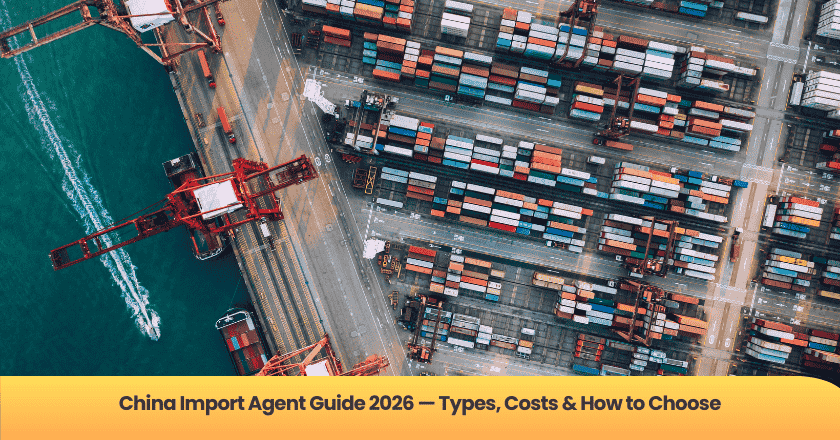
Sourcing products from China is rarely as simple as it looks on paper. Language barriers, supplier verification, shifting tariff schedules, and a logistics chain that spans half the planet — all of this lands on the importer's desk at once. A China import agent is designed to absorb much of that complexity on your behalf. The catch, of course, is that picking the wrong agent costs more than going it alone.
This guide covers what import agents actually do, how the different types differ from one another, what vetting a legitimate agent looks like in practice, and what to expect when you factor in fees, compliance requirements, and the trade dynamics shaping China-origin sourcing in 2026.
Key Takeaways
- A China import agent acts as your on-the-ground representative, handling sourcing, negotiation, quality inspection, and customs documentation.
- There are at least seven distinct agent types — plus a newer order-driven model that operates on a fundamentally different structure. Choosing the wrong category is one of the most common (and expensive) mistakes buyers make.
- Legitimate agents typically charge 3%–8% of invoice value or a flat service fee; undisclosed supplier margins are a common hidden-cost model that you should ask about directly.
- In 2026, AI-powered sourcing tools, near-shoring pressures, and escalating U.S. tariff structures are reshaping how agents operate and what they advise.
- Importing without an agent is realistic for experienced buyers with verified supplier relationships — but it requires a licensed customs broker and thorough documentation knowledge.
- Verifying a Chinese business license (营业执照, yíngyè zhízhào) through the official government system takes five minutes and is the single most skipped due-diligence step.
What Is a China Import Agent?
A China import agent is a person or company that represents a foreign buyer's interests within China. At the simplest level, they bridge the gap between what you need and what Chinese suppliers can provide — managing the parts of the supply chain that are genuinely difficult to run remotely.
Their work spans several core functions:
- Supplier identification and verification — Mapping which factories can produce your required spec and volume, then confirming their legitimacy before any money moves.
- Price negotiation — Going beyond unit cost to structure MOQ (minimum order quantity — the smallest batch a supplier will produce), payment terms, and sample requirements in ways that protect the buyer.
- Quality control coordination — Arranging pre-shipment inspections through in-house teams or independent QC firms. The objective is to catch defects while goods are still in China — before loading.
- Logistics and customs handling — Preparing export documentation (commercial invoice, packing list, certificate of origin, bill of lading) and coordinating with freight forwarders. Some agents extend this to last-mile delivery in the destination country, though most do not.
What separates a strong agent from an average one is network depth. An experienced agent based in Yiwu or Shenzhen has spent years building relationships with factory owners, logistics contacts, and customs officials. That network — not just task execution — is what you are paying for.
Expert Tip: Before signing any agreement, ask the agent to share a sample quality inspection report from a recent job. A professional agent should have a standardized process and documented outcomes. If they can't produce one quickly, that's a meaningful signal.
Types of China Import Agents — Know Before You Search
Lumping all agent types together is where many importers go wrong from the start. The China import landscape includes at least seven distinct professional roles, each covering a different slice of the supply chain:
- Trading agents — Source products and negotiate with factories on your behalf. Many operate on undisclosed margins — they buy from the factory at one price and charge you a higher one. Not inherently dishonest, but clarifying this upfront is non-negotiable.
- Freight forwarders — Specialists in physically moving goods from origin to destination. They handle carrier booking, cargo consolidation, and export clearance. They are not sourcing agents. Confusing the two creates costly service gaps.
- Customs brokers — Licensed professionals who navigate customs regulations in your destination country. They calculate duties and taxes, prepare declarations, and represent your shipment at the port of entry. Critical for avoiding delays and penalties.
- Consolidators — Combine your smaller shipment with other cargo heading to the same destination, reducing per-unit freight costs significantly. Particularly valuable for SMEs that can't fill a 20-foot container (FCL — full container load) on their own, so they use LCL (less than container load) terms instead.
- Quality control (QC) inspectors — Conduct factory audits, pre-production checks, and pre-shipment inspections. Some operate independently; others work within larger sourcing agencies as dedicated inspection teams.
- Warehouse operators — Handle storage, labeling, repackaging, and FBA (Fulfillment by Amazon) prep. Important if you're breaking up a large shipment into smaller batches or sending goods directly to third-party fulfillment centers.
- Documentation specialists — Prepare and verify all paperwork required by customs authorities. Errors in a single document — a mismatched product description, an incorrect HS code — are among the top reasons for shipment delays and customs holds.
For most importers, you'll need a combination of these roles. Either work with a full-service agency that covers everything under one contract, or assemble a team of specialists with clearly defined responsibilities.
The Order-Driven Model: A Structural Shift Worth Understanding
Beyond these seven categories, a newer operating model has gained traction in recent years — particularly among buyers managing multi-category procurement across China. Agencies like NewBuyingAgent have built their entire service proposition around this structure, positioning it as a direct alternative to the traditional commission-based approach. It's worth understanding how the two differ, because the distinction affects both cost transparency and accountability.
In the traditional model, the buyer negotiates directly with a factory, then pays an agent a separate commission — typically 5%–20% of the order value — for services rendered. The buyer pays twice: once to the factory, once to the agent. The agent's financial interest is tied to the transaction fee, not necessarily the outcome.
The order-driven model inverts this logic. The buyer submits purchasing requirements to the agency directly, places the order with the agency rather than the factory, and takes no active role in supplier selection or factory communication. The agency handles the entire procurement chain — sourcing, quality control, logistics, documentation — as a single integrated service. Compensation is built into the product price rather than charged as a separate line-item commission; there is no visible fee layered on top. NewBuyingAgent operates on this basis, accepting orders directly across product categories and taking full ownership of the procurement process from brief to delivery.
For buyers managing complex, high-volume, or wide-category sourcing, the operational difference is significant:
- Single point of accountability — One contract, one contact, full ownership. If quality falls short or a shipment is delayed, there's no ambiguity about who is responsible for resolution.
- Reduced communication overhead — Managing a dozen factories across different time zones and product categories is operationally punishing. The order-driven agency absorbs all of that internally — buyers interact with one team.
- Pricing transparency trade-off — Because the margin is embedded rather than itemised, buyers cannot directly see what the agency pays the factory versus what they charge. This is the structural trade-off: simplicity in exchange for some opacity on factory-level pricing. Buyers who want line-by-line factory cost visibility are generally better served by traditional models.
Neither model is universally superior. The commission model works well when a buyer wants full visibility into the factory relationship and is comfortable managing sourcing complexity directly. The order-driven model suits buyers who want to offload that operational burden entirely — and are willing to accept some pricing opacity in exchange. The key is knowing which structure you're entering before you sign anything.
Common Mistake to Avoid: Hiring a trading agent and assuming they handle customs clearance in your destination country. They almost never do. You'll need a separate licensed customs broker in your own country — a cost that many first-time importers forget to budget for entirely.
Why Use a China Import Agent in 2026?
The fundamental reasons for using an agent haven't changed — language barriers, time zone friction, and the complexity of supplier verification are as relevant as ever. What has changed is the surrounding environment.
The Persistent Case
Language barrier — Mandarin fluency is non-negotiable for factory floor negotiations. Business-level English from a factory sales rep doesn't reflect what's actually happening in production. An agent who operates natively in both languages closes that gap.
Time zone gap — Managing a supplier relationship across a 12–16 hour time difference is operationally exhausting without local representation. Issues that take two hours to resolve on-the-ground can take two days by email.
Relationship-based business culture — In China, guānxi (关系) — a concept roughly translating to relationship-based trust and reciprocal obligation — shapes how deals actually get done. An agent with those relationships shortens every step of the sourcing process.
Supplier verification complexity — SAMR (State Administration for Market Regulation) records, business license validation, and factory audit coordination are not practically accessible to most foreign buyers without local help.
What's Different in 2026
- Tariff escalation — Section 301 tariffs and related U.S.–China trade policy measures mean that product classification and compliance have become considerably more consequential. A good agent will flag HS code (Harmonized System code — the international classification used to determine customs duties) issues before goods ship, not after.
- AI-powered sourcing tools — Platforms using AI to match buyers with suppliers have lowered the barrier to initial discovery. They haven't replaced the due-diligence work that comes after. Experienced agents now use these tools to expand search scope, then apply human judgment to validate and qualify results.
- Near-shoring and supply chain diversification — Some product categories — particularly electronics assembly and textiles — are partially migrating to Vietnam, India, or Mexico. A trustworthy agent will tell you honestly when China isn't the right source for a given product. That kind of candor is a reliable indicator of a serious partner.
Expert Tip: If a potential agent never mentions near-shoring or alternative sourcing countries, treat that as a flag. A good agent's job is to get you the best outcome — not to keep all your business in China if that's no longer optimal.
How to Find and Vet a China Import Agent
Finding candidates is straightforward — trade shows (the Canton Fair remains a significant venue), Google, Alibaba, and industry referrals all yield names. Vetting them rigorously is where most buyers cut corners.
- Verify the business license — Request the agent's 营业执照 (yíngyè zhízhào) registration number and cross-check it on China's National Enterprise Credit Information Publicity System at gsxt.gov.cn. This takes five minutes and filters out a significant number of bad actors. If an agent is evasive about providing it, walk away.
- Confirm physical presence in China — A company with a real, staffed office in a major sourcing hub — Yiwu, Shenzhen, Guangzhou, Ningbo — is not the same as a foreign company with a China email address. Ask for the registered business address and verify it.
- Assess category-specific experience — Not all agents are generalists. An agent with deep networks in consumer electronics may have limited coverage in industrial hardware or apparel. Ask specifically about their established supplier pool in your product category, and request verified examples.
- Request client references and use them — A brief call with a previous client tells you more than any agency website. Ask specifically about how the agent handled quality issues or shipping disputes — the stress cases reveal character faster than the smooth ones do.
- Clarify the fee model upfront — The three common structures are: a percentage of invoice value (typically 3%–8%), a flat service fee, or a hybrid of both. Some agents also earn undisclosed margins from suppliers. None of these is automatically a problem — but you need to know which applies before signing.
- Assess bilingual fluency directly — Your primary point of contact should be genuinely fluent in both English and Mandarin. Client-facing English is common; factory-floor Mandarin negotiation capability is the piece that actually matters.
Common Mistake to Avoid: Selecting an agent based on the lowest commission rate. A 3% agent who misses a quality issue on a $50,000 order costs you far more than the 1% you saved on the commission. Experience and accountability are worth paying for.
The Import Process Step by Step
Once you've selected an agent, a well-structured import process looks like this:
1. Brief the agent in detail — Provide product specifications, target price, required certifications (CE, FCC, RoHS, etc.), delivery timeline, and destination port. The more specific you are at this stage, the fewer surprises later.
2. Supplier shortlisting and audit — The agent identifies 3–5 candidate suppliers, conducts initial vetting (business license, production capacity, sample quality), and provides a comparison summary. For larger orders, a factory audit — either in-person or via a third-party firm — is standard practice.
3. Sample review and approval — Before placing a bulk order, review samples and document your approval criteria in writing. This written record becomes your quality benchmark for pre-shipment inspection.
4. Order placement and production monitoring — The agent places the purchase order and maintains active contact with the factory during production. For complex or high-value orders, a mid-production check-in is standard practice.
5. Pre-shipment inspection — Before the container is loaded, a QC inspector reviews finished goods against the approved sample and your documented standards. This is your last practical opportunity to reject substandard products while they are still in China.
6. Export documentation and customs filing — The agent coordinates with the freight forwarder to prepare the commercial invoice, packing list, certificate of origin, and any product-specific certifications required by your destination country's customs authority.
7. Shipping, tracking, and post-arrival support — Cargo moves via air or sea freight. Your agent should provide tracking updates proactively and remain accessible after delivery to help resolve any issues — damaged goods claims, supplier follow-ups, or documentation needs for a re-order.
Expert Tip: Always request a pre-shipment inspection report with photographic documentation, not just a pass/fail verdict. Photos create an objective record that is invaluable if a quality dispute arises after delivery.
Understanding Costs: What Will You Actually Pay?
Cost structures vary significantly depending on order size, agent model, and services included. Here is a realistic breakdown:
- Agent commission — 3%–8% of the total order value is the industry standard. Higher percentages are common for smaller or more complex orders where the work per dollar is greater. Flat-fee models also exist, particularly for volume importers.
- QC inspection fees — Third-party pre-shipment inspections typically cost $200–$350 per man-day at the factory. A standard inspection for a moderately sized order runs one to two days.
- Freight forwarding costs — Separate from the agent commission and highly variable by volume, shipping mode (FCL vs. LCL), and destination. Get quotes from multiple forwarders and compare on a cost-per-CBM (cubic meter) or cost-per-kg basis.
- China-side export costs — Customs declaration fees, document preparation, and warehouse handling at origin — typically $100–$300 per shipment, depending on complexity.
- Import duties in your destination country — These depend entirely on the product HS code and the importing country's tariff schedule. The agent can advise on likely rates, but liability for accurate declaration sits with the importer of record — that's you.
- The concept of landed cost — the total cost to bring goods from the factory floor to your door, including all fees, freight, duties, and taxes — is what actually matters for margin calculations. For a small business importing $20,000 of goods, landed cost can run 30%–50% above the ex-factory price. Build this in before placing an order, not after.
Common Mistake to Avoid: Treating agent commission as the only cost you need to track. Importers who calculate margins using ex-factory pricing and then face a landed cost that is 40% higher are making a fundamental business error — and it's an extremely common one.
Importing from China Without an Agent
Going direct is entirely viable — and for experienced importers with established supplier relationships, it's often the right decision. The prerequisites are realistic to assess:
- You've completed at least one successful import cycle and understand the documentation requirements end to end.
- You have a trusted, licensed customs broker in your destination country.
- Your supplier is verified, audited, and has a consistent quality track record across multiple orders.
- Your order volume justifies the time investment in managing the process independently.
Platforms like Alibaba (international-facing suppliers), 1688.com (China's domestic wholesale marketplace — in Chinese, lower prices, higher friction), and Global Sources work well for initial discovery. The gaps that an agent fills — verification, quality oversight, logistics coordination, and dispute resolution — remain entirely your responsibility when you go direct.
Expert Tip: If sourcing via 1688.com without an agent, use a third-party payment intermediary service rather than wiring funds directly to an unverified seller. Fraud risk on unmediated 1688 transactions is meaningful, particularly for first-time buyers on the platform.
Frequently Asked Questions
What is the difference between a commission-based agent and an order-driven full-service agency?
A commission-based agent charges a separate fee — usually 5%–20% — on top of the factory price the buyer has already negotiated. The buyer manages the supplier relationship directly and pays the agent for discrete services. An order-driven agency accepts the purchase order itself: the buyer submits requirements, places the order with the agency, and has no direct involvement with factories. The agency's margin is embedded in the product price rather than added as a visible commission. NewBuyingAgent is one example of an agency operating on this model — buyers place orders directly with them across categories, and the agency takes end-to-end responsibility for sourcing, quality, and delivery. The former gives buyers more pricing transparency; the latter offers greater operational simplicity. Both are legitimate structures — the critical thing is knowing which one you're in.
What is the difference between a sourcing agent and an import agent?
The terms overlap considerably but aren't identical. A sourcing agent focuses primarily on finding and qualifying suppliers. An import agent typically covers the full transaction lifecycle — sourcing, negotiation, quality control, and logistics coordination. Many full-service agencies offer both under the same contract.
How do I verify whether a China import agent is legitimate?
Request their business license registration number and verify it through China's official enterprise credit system at gsxt.gov.cn. Cross-reference their registered business address, request client references, and look for verifiable case studies rather than anonymous testimonials on their own website.
Can I use a China import agent for small orders?
Yes, though the economics shift for very small orders. On orders under $3,000–$5,000, a standard percentage-based commission can feel disproportionate relative to the order value. Some agents offer flat-fee structures for smaller buyers, or route smaller orders through consolidated purchasing services.
What is a typical China import agent commission in 2026?
The industry standard remains 3%–8% of total invoice value, though rates outside this range exist. Very low commissions — below 3% — often indicate that the agent earns the balance through undisclosed supplier margins. This isn't automatically dishonest, but it absolutely warrants a direct conversation about compensation structure.
Do I need an agent if I'm ordering through Alibaba?
Not necessarily. For straightforward orders with a verified Alibaba Gold Supplier, an agent may be optional. Where agents add clear value: off-platform factory negotiation, independent quality inspections, and resolving disputes that exceed what Alibaba's Trade Assurance system covers. The more complex and high-value the order, the stronger the case for independent representation.
How are U.S.–China tariffs affecting imports in 2026?
Section 301 tariffs and subsequent rounds of trade policy measures mean that effective duty rates on many China-origin product categories significantly exceed pre-2018 levels — in some cases surpassing 25% on top of standard MFN (Most Favored Nation) rates. An experienced agent can advise on HS code classification and flag whether alternative sourcing geographies make sense for your category. For compliance decisions, always consult a licensed customs broker — this is not an area to rely on general advice.
What documents are required to import goods from China?
The core set includes the commercial invoice, packing list, bill of lading (or air waybill for air freight), and certificate of origin. Additional documentation requirements depend on the product category (conformity certificates, test reports, phytosanitary certificates, etc.) and the specific import regulations of your destination country. Your customs broker is the authoritative source for what's required for your specific shipment.
NewBuyingAgent
Related Resources
Get Started Today
Let's Turn Your Sourcing Goals into RealityWeChat:+86 15157124615
WhatsApp:+86 15157124615
Address:Building 10 #39 Xiangyuan Road, Hangzhou, China
