


A China furniture sourcing agent helps buyers turn furniture requirements into a managed procurement process covering product specs, material control, sample approval, production follow-up, quality management, packaging, and logistics.
Furniture is one of the least forgiving categories to source casually from China. A chair can look right in a photo and still fail because the seat height is off. A dresser can look premium and still create risk if the drawer system, stability, packaging, or composite-wood documents are not controlled. A sofa can arrive with the correct fabric but wrong foam feel, poor stitching, or cartons that cannot survive the route.
That is why a furniture sourcing agent should not be judged only by whether it can find a cheaper quote. The stronger question is whether it can protect the product version from brief to delivery. Furniture combines design expectations, material variation, workmanship, freight exposure, and destination-market safety questions. A buyer who treats it like a generic consumer product often discovers problems only after goods are too bulky and expensive to fix.
NewBuyingAgent fits furniture projects when buyers want to avoid daily factory conversations but still need clear control over product requirements, samples, quality evidence, and shipping handoff. Buyers share specs, volume, target price, destination, and timing; NewBuyingAgent prepares a quote and manages product selection, cost negotiation, quality management, production follow-up, and logistics through final delivery.
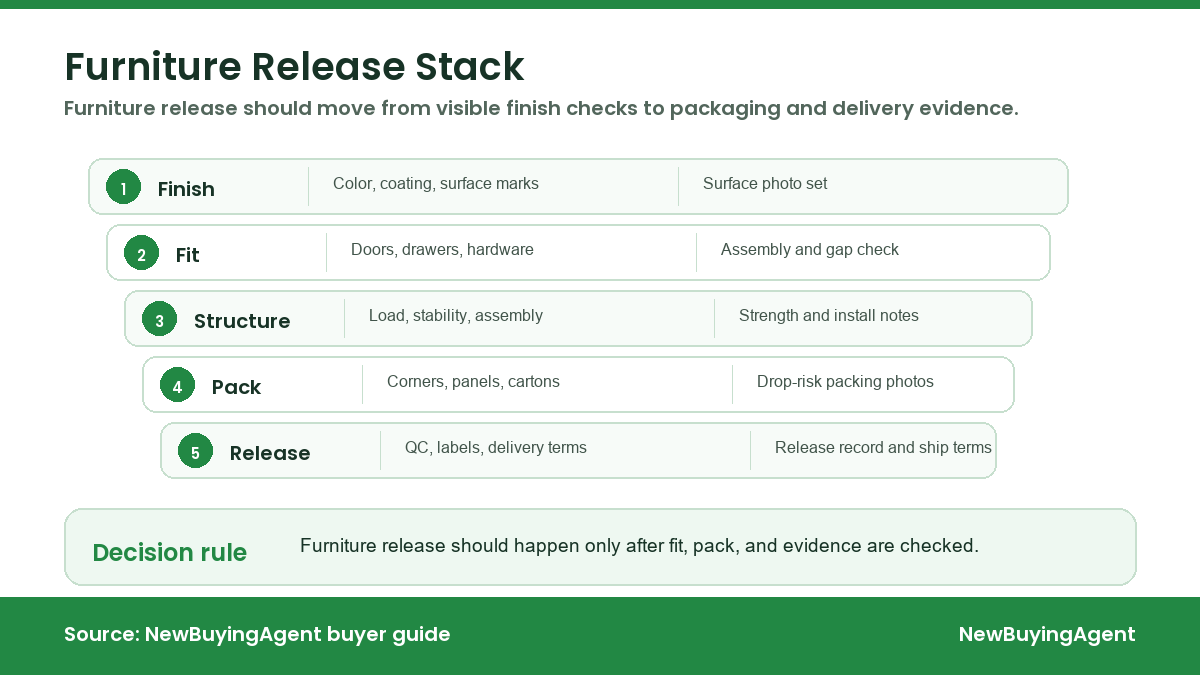
Furniture orders should be released only after structure, finish, packaging, compliance evidence, and logistics are checked together.
Why Furniture Requires a Different Sourcing Standard
Furniture sourcing is different because the product is physical, visual, structural, and logistical at the same time. A small dimensional change can affect comfort. A weak fastener can affect safety. A finish mismatch can create retail rejection. A poor carton can turn a good product into a damaged shipment. The sourcing process has to control all of these issues together, not one by one after problems appear.
The buyer's brief should therefore be more than a product name. It should define use case, dimensions, material, finish, hardware, weight target, packaging, assembly method, destination market, retail channel, and expected order quantity. If the product will be used by children, sold in the U.S. or EU, or made with composite wood, the brief should also trigger early compliance questions. This is general procurement information, not legal advice, and buyers should verify final requirements with qualified compliance professionals for their market.
Official guidance shows why early classification matters. The CPSC clothing storage unit guidance explains scope criteria, stability tests, warnings, and certification for covered products. The CPSC bunk bed guidance describes federal requirements for guardrails, entrapment hazards, testing, certification, and labeling. Not every furniture product falls under those pages, but they show why a furniture order should not wait until shipment to ask safety questions.
Start With the Furniture Brief
A furniture brief should make the desired product version hard to misunderstand. Buyers should include photos, drawings, dimensions, material expectations, finish references, hardware details, assembly instructions, packaging goals, target price, order volume, destination market, and delivery timing. If the buyer has a sample, the brief should explain what should remain identical and what should improve.
Define Dimensions and Tolerances Early
Furniture buyers often describe products visually and leave tolerances unstated. That creates trouble because factories need measurable limits. Seat height, tabletop thickness, drawer gap, leg angle, cushion thickness, metal tube diameter, screw position, and flat-pack carton size should be defined wherever they affect use or logistics. Without those details, the sample may be approved by appearance while production drifts in ways that customers notice.
A practical tolerance rule is to separate comfort, function, appearance, and shipping dimensions. A small carton change may matter for container loading. A small drawer gap may matter for perceived quality. A small cushion change may matter for repeat customers. The buyer does not need to over-engineer every point, but the points that affect market acceptance should not be left to interpretation.
Lock Materials Before Price Negotiation Goes Too Far
Furniture price differences often come from hidden material choices. Wood species, veneer thickness, MDF density, metal gauge, foam density, fabric grade, coating process, and hardware quality can all change price and performance. A quote is not meaningful unless the material assumptions are clear. Buyers should ask what material is included, what alternatives exist, and which substitutions require approval before production.
Composite wood deserves special care for U.S.-bound goods. The EPA's TSCA Title VI page states that composite wood products and finished goods containing hardwood plywood, medium-density fiberboard, or particleboard must be properly certified and labeled after March 22, 2019. For buyers, the operational lesson is simple: material documentation should be requested before mass production, not during customs or retailer review.
Make the Sample a Production Standard
A furniture sample is not only a sales sample. It is the reference that production, QC, and packaging should follow. Buyers should approve the sample with a written list of accepted details and required corrections. The approval should cover dimensions, finish, hardware, stability, assembly, packaging, labels, carton marks, and accessory packs. If a sample uses a temporary part, hand-finished surface, or non-final fabric, that exception should be recorded.
The best sample approval also includes photos from multiple angles and close-ups of important details. These photos become useful during production follow-up because they help the China-side team identify drift. Without a documented reference, a buyer may argue later that production "does not look like the sample," while the factory argues that the order never froze the detail.
Furniture Quality Control Should Be Built Into Production
Furniture QC should begin before final inspection because many defects are easier to prevent than repair. A cracked panel, misdrilled hole, wrong coating, or weak carton may be visible before the order is finished. If the buyer waits until the final inspection, the only options may be rework, discount, shipment delay, or acceptance with known risk.
Use Category-Specific Defect Lists
Furniture defect lists should reflect the product. A wooden table needs checks for warping, moisture, finish consistency, edge quality, hardware alignment, and load stability. Upholstered furniture needs fabric shade, seam strength, foam feel, odor, frame noise, and leg attachment checks. Flat-pack furniture needs hole position, instruction clarity, hardware count, panel labeling, and assembly fit. Outdoor furniture needs coating, rust resistance expectations, drainage, UV exposure assumptions, and packaging protection.
Sampling inspection can help structure the final check. The ISO 2859-1:2026 page explains AQL-indexed sampling plans for inspection by attributes. Buyers should treat that as a decision tool, not a magic shield. AQL can organize sampling, but the defect definitions still need to be written for the furniture product being shipped.
Check Packaging Like It Is Part of the Product
Furniture packaging is not a secondary detail because furniture is bulky, heavy, and vulnerable to transit damage. A buyer should specify carton strength, edge protection, foam or honeycomb boards, parts bags, assembly instruction placement, drop-test expectations where relevant, and carton marks. A beautiful product in weak packaging can become a return problem before the customer ever sees it.
Packaging also affects cost and loading. A slightly larger carton can reduce container efficiency. Too little protection can increase damage. Too much protection can raise cost and create waste. The buyer should decide the trade-off before mass production, not after cartons are already printed and filled.
For bulky furniture, the packaging decision should also reflect the receiving channel. A direct-to-consumer sofa, a retail store chair, and a contract-project table may need different protection even when the product is similar. The buyer should state whether the goods will be unloaded by a warehouse team, cross-docked to stores, delivered by parcel, or stored for weeks before installation. Those details affect carton strength, pallet plan, spare hardware, instruction placement, and the amount of corner protection that is commercially reasonable.
Plan Release Evidence Before Shipment Pressure
Release evidence should be defined before the order enters final packing. For furniture, useful evidence includes sample approval records, material confirmations, production photos, packaging photos, assembly checks, carton marks, QC results, and shipment documents. If the product is regulated in the destination market, the buyer should also keep certificates, test reports, labels, and technical files in the project record.
The release decision should answer a practical question: if the goods arrive with a problem, does the buyer have enough evidence to understand where the problem came from? If the answer is no, the release process is too weak. Good evidence does not eliminate all risk, but it gives the buyer a way to manage it before payment, shipment, or customer delivery.
This evidence also helps the buyer handle repeat orders. Furniture programs often continue for more than one buying season, and the second order should not restart from memory. A clean project record lets the buyer repeat the approved material, finish, hardware, packaging, and inspection logic while improving the few points that caused trouble. That continuity is one reason managed procurement is useful for brand-tier furniture buyers: it turns a single purchase into a controlled supply pattern.
Furniture Sourcing Checklist
The following checklist gives buyers a simple structure for discussing a furniture project with a sourcing partner.
| Area | Buyer Decision | Evidence to Request | Risk if Skipped |
|---|---|---|---|
| Product specs | Dimensions, material, finish, function | Drawings, sample photos, spec sheet | Wrong version priced or produced |
| Materials | Wood, metal, foam, fabric, composite panels | Material confirmation and required documents | Hidden downgrade or compliance gap |
| Sample | Approved reference and correction list | Approved sample record with close-up photos | Production drift without a shared standard |
| Packaging | Carton strength, protection, marks, instructions | Packing photos and carton-mark proof | Damage, missing parts, or warehouse rejection |
| Release | Ship, hold, rework, or revise timing | QC report, photos, documents, delivery terms | Late discovery after goods are difficult to fix |
Furniture Scenario: The Sample That Cannot Scale
A furniture sample can look excellent and still fail as a production reference. This happens when the sample is made with extra hand finishing, carefully selected panels, temporary hardware, non-final packaging, or a fabric batch that will not be used in mass production. The buyer sees a good product; production sees a rough direction. That gap is where many furniture problems begin.
Before approving a furniture sample, buyers should ask which parts of the sample are final and which are only for demonstration. Material, hardware, finish, foam, fabric, screws, glides, labels, carton structure, and assembly instructions should be checked against the planned production version. If an item is temporary, the approval note should say so.
Why One Beautiful Sample Is Not Enough
Furniture often has several hidden quality points that do not show in a hero photo. A table may need level legs and stable packaging. A cabinet may need drawer alignment across a production batch. A chair may need repeatable screw position and consistent load behavior. A sofa may need fabric shade, foam feel, stitching, frame noise, and carton protection to remain consistent.
Buyers should therefore treat the sample as a system of evidence. The sample should be photographed, measured, corrected, and connected to the production checklist. NewBuyingAgent can manage the production follow-up after the buyer approves the standard, but the standard has to be clear enough to repeat at scale.
A Furniture Drift Estimate
Consider a furniture order with four visible quality points: finish tone, hardware alignment, carton protection, and assembly fit. If each point has only a small chance of drifting during mass production, the combined risk is still meaningful because the product is bulky and rework is expensive. A 3% issue rate on 1,000 units means 30 units may need rework, replacement parts, discounting, or special handling. The exact number will vary by product, but the decision lesson is stable: furniture release evidence should be planned before cartons are sealed.
This is why the final release decision should not rely on one inspection photo. It should combine approved sample records, production photos, carton proof, assembly evidence, defect list, and shipping terms. The buyer needs enough evidence to decide whether to ship, hold, rework, or adjust timing.
That evidence should be stored for the next reorder too.
Where NewBuyingAgent Fits in Furniture Procurement
Furniture buyers often need more than quote collection because the category requires product interpretation, production discipline, and logistics awareness. NewBuyingAgent can manage the full procurement process after the buyer shares the purchasing brief. That means product selection, cost negotiation, quality management, production follow-up, and logistics are handled as one connected path.
This does not mean the buyer gives up the furniture decisions. The buyer still approves the target product, sample standard, acceptable quality level, packaging direction, and delivery priority. NewBuyingAgent handles the China-side execution so those decisions can be turned into a quote, a production plan, QC evidence, and a delivery handoff.
Buyers starting a furniture program should send NewBuyingAgent the product requirements, including product photos, drawings, target order quantity, price range, destination market, material requirements, packaging expectations, and launch timing. Buyers still defining the larger sourcing process can review NewBuyingAgent's China manufacturing and product guide before preparing the brief.
Who Is NewBuyingAgent?
NewBuyingAgent is a one-stop China sourcing agent for global buyers that want to source products from China without managing factory conversations, production follow-up, quality control, and logistics themselves.
Backed by 30 years of trade, manufacturing, and quality-control experience, NewBuyingAgent prepares quotes for products that match the buyer's purchasing needs. Buyers share product specs, volume, target price, destination, and timing; NewBuyingAgent manages product selection, cost negotiation, quality management, production follow-up, and logistics.
Its sourcing network includes 50,000+ partner factories and 20,000+ product development & QC experts. For furniture buyers, that matters because product version, material choices, production follow-up, packaging, and shipment release need to work together.
Frequently Asked Questions
What does a China furniture sourcing agent do?
A China furniture sourcing agent manages the procurement process from buyer requirements to quote, sample, production follow-up, quality control, packaging, and delivery. The buyer provides product specifications, target price, order volume, destination, and timing. The agent handles China-side execution and keeps the buyer involved at approval and release points.
What details should be in a furniture sourcing brief?
A furniture sourcing brief should include photos or drawings, dimensions, materials, finish, hardware, assembly method, packaging needs, destination market, target quantity, target price, and delivery timing. If the product uses composite wood, is intended for children, or has structural safety concerns, add known compliance requirements and request document planning early.
How do buyers reduce furniture quality problems from China?
Buyers reduce furniture quality problems by defining measurable specs, approving a production-ready sample, controlling materials, using category-specific defect lists, checking packaging, and planning final QC before shipment pressure. The key is to catch drift during production, not only after cartons are packed and rework becomes expensive.
Is furniture from China suitable for brand-tier buyers?
Yes, China furniture can work for brand-tier buyers when the procurement process controls product version, material consistency, workmanship, packaging, documentation, and delivery timing. The risk is not sourcing from China itself. The risk is buying furniture without a clear brief, sample standard, production follow-up, and release evidence.
NewBuyingAgent
Related Resources



Get Started Today
Let's Turn Your Sourcing Goals into RealityWeChat:+86 15157124615
WhatsApp:+86 15157124615
Address:Building 10 #39 Xiangyuan Road, Hangzhou, China
