

Chain of custody documents are records that connect a claimed material attribute through the relevant supply chain to the goods being purchased. They establish who is covered, which transactions carry the claim, and how the material relates to the finished product.
For sustainable materials from China, request the applicable certification scope, shipment or transaction evidence, and records linking input lots to your order. A genuine company certificate is a starting point; it does not establish that every product sold by that company carries the same claim. Decide what you intend to say about the material before approving the goods or their marketing.
Which Documents Make a Material Claim Defensible?
A defensible material claim needs documents that answer different questions: whether the relevant business and activity are covered, whether the supplied transaction carries the attribute, and whether that material is linked to your finished goods. The exact records depend on the certification scheme and custody model. Build the requirement around those links rather than requesting a generic “sustainability certificate.”
- Specify the attribute: name the material, component and intended wording.
- Authenticate the scope: check the entity, activity and covered product.
- Connect the shipment: reconcile transaction evidence with input and finished-product lots.
- Control the claim: resolve missing links before approving the affected wording.
Define the Material Attribute and Intended Claim
Start with a precise material statement, such as recycled polyester in the pouch fabric, rather than calling the entire product sustainable. Identify the component, the relevant attribute and the intended destination-market wording. This makes the document request testable: the supplier can show evidence for that specific material, while your team can distinguish it from unrelated features, packaging or environmental claims.
For partially recycled products, the US Federal Trade Commission’s Green Guides call for qualification of the amount or percentage of recycled content by weight. Certification also does not remove the need to substantiate the claim. Treat this as US guidance, and review the wording required in the actual sales market.
Once the attribute is defined, connect the company’s certified scope to the supplied transaction and then to the ordered product lots. These are separate evidence roles: the first establishes eligibility, the second establishes what was supplied with a claim, and the third identifies where that material was used.
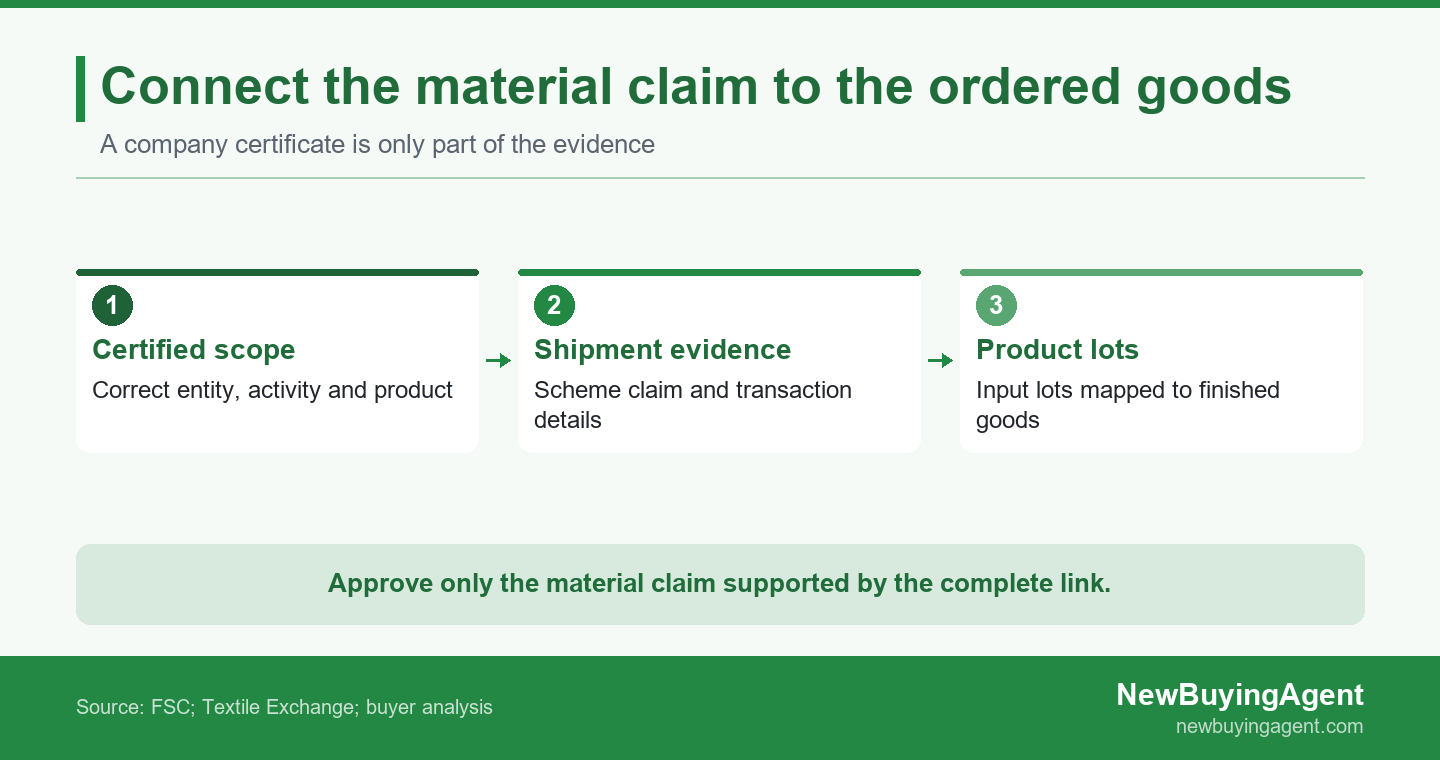
Certified scope, shipment evidence and product lot records must support the same material claim.
For the wider sourcing decision, the China sourcing guide provides purchasing context beyond material documentation. Keep the evidence requirement alongside product specifications, price, quality and delivery conditions.
Check Who Is Certified and What the Scope Covers
Check the legal entity and production activity before treating a certificate as relevant to your order. A valid certificate belonging to a raw-material supplier does not automatically establish coverage for a converter, trader or finished-product manufacturer. Determine which participants need coverage under the applicable scheme, and check the scope against the material and processing route actually proposed for your goods.
Scope and shipment records answer different questions. Organizational scope establishes which certified activities and products an entity is eligible to handle; shipment evidence establishes which transaction carries the claim. Neither alone connects that material to your finished product. Buyers therefore need a further link through input and production lot records, interpreted according to the applicable custody model, before approving the attribute on the purchased goods.
Use the scheme owner’s verification channel where available. Compare the document identity with the supplier’s legal name and proposed production site, and ask about expired, suspended or changed coverage. A trading name, sales contact or attractive logo is insufficient when the entity named in the evidence is different. Clarify that difference before relying on the record.
Request Documents That Connect the Scope to the Shipment
Request a document set matched to the scheme, product and custody model, rather than insisting on one universal certificate format. The useful distinction is what each record proves and what remains unanswered. An organizational record, a claimed sale and a production allocation serve different purposes; receiving all of them still requires checking that they describe the same material and order.
The following comparison separates evidence roles. It is a purchasing framework, not a substitute for the current rules of a particular certification scheme.
| Document | What it shows | Match to order | Limit |
|---|---|---|---|
| Company scope | Eligible entity, activity and product | Supplier identity and proposed process | Does not prove an individual shipment |
| Shipment proof | Claim associated with a supplied transaction | Seller, buyer, goods and quantity | Does not alone allocate material to finished units |
| Material lot records | Input receipt and production use | Input lot and finished-product batch | Internal records do not authenticate certification |
| Claim file | Evidence supporting approved wording | Component, attribute and sales market | Cannot fill a missing transaction link |
Based on this comparison, assign a purpose to every requested record. If a supplier sends another company certificate to answer a shipment question, the missing link remains unresolved.
FSC: Check the Product Claim on Sales Documents
For forest-based products, FSC purchasing guidance advises checking that the supplier’s certificate is valid and covers the relevant product category. Sales invoices or delivery documents should identify the certified products, the FSC claim and the supplier’s certificate code. Specify the required claim when ordering so the commercial documents can carry the appropriate information.
A photograph of an FSC label is not the same evidence as a claimed business transaction. Match the identified product to your purchase order and delivery record, and investigate changes in the supplying entity or product description. Requirements for your own certification or use of marks depend on your role and intended activity; confirm them through the relevant scheme channel rather than assuming a supplier’s certification transfers to your business.
Textiles: Match Scope and Transaction Evidence
A scope certificate identifies the certified organization and covered products or processes. A transaction certificate provides evidence for a certified transaction. Textile Exchange’s scope and transaction certificate policy distinguishes these roles and provides authentication requirements. Verifying an organization’s scope does not establish that the particular textile shipment purchased by your business is covered.
Textile Exchange lists October 1, 2026 as the effective date and April 1, 2027 as the mandatory date for its unified scope and transaction certificate policy. Its policy update notice therefore requires attention to the transition period, rather than treating the effective date as an immediate mandatory switch for every supplier.
Ask which standard, applicable policy version and authentication route support the proposed textile supply. Reconcile the transaction evidence with the relevant shipments and input materials; do not assume a forwarded PDF is authoritative simply because it looks complete. Where the scheme uses an electronic verification route, follow that route rather than demanding a paper document regardless of the applicable rules.
ISCC PLUS: Identify the Declaration and Custody Model
For ISCC PLUS materials, establish the applicable declaration requirements and custody model before interpreting the paperwork. ISCC’s declaration guidance directs users to the applicable PLUS system and traceability documents for sustainability declaration requirements. Request the current requirements relevant to the material and transaction instead of relying on an old template found online.
Mass balance is an accounting model that attributes certified inputs to outputs through bookkeeping, even when physical materials are mixed. ISCC’s explanation describes this allocation approach; it does not prove that each particular finished product physically contains the attributed certified feedstock. Read the declaration in the context of that model.
As a buyer, request enough identifiers, dates, quantities and material descriptions to reconcile the declaration with your supply. Keep an attributed claim distinct from a statement about physical content. Ask the responsible certification and destination-market reviewers to confirm acceptable wording before converting an allocation into a percentage claim on a product label.
Reconcile Product, Lot and Quantity Across Records
Reconcile the evidence against the order using a shared material identity and a traceable route from incoming material to finished goods. Names and quantities may differ because commercial documents, warehouse receipts and production records serve different purposes. Resolve those differences explicitly: a similar product description is insufficient, and a raw-material weight cannot be compared directly with the number of finished units without a justified conversion.
Begin with the purchase order, material specification and supplier’s item reference. Match the transaction or shipment identifiers to receiving records, then map the input lot to the production batch. Record consumption, relevant processing losses and the basis used to allocate material. For an accounting model, check the permitted allocation rather than assuming physical segregation is required.
When several products share the same input, ask how the supplier identifies the quantity assigned to your order. When the claimed component is only part of a product, keep the component evidence distinct from claims about the whole item. Unexplained excess allocation, inconsistent units or a lot that cannot be found in receiving records needs clarification.
NewBuyingAgent’s product-supply service uses local factory resources and product-development and quality-control support to provide product supply suited to buyer requirements. A defined material attribute and evidence requirement can therefore sit within the product brief alongside target price, construction and quality, giving the supply team a concrete basis for evaluating the proposed goods.
Resolve Missing Links Before Releasing the Claim
Treat a missing document as a specific unanswered question, and decide which claim or goods are affected. If shipment coverage is missing, another organizational certificate does not answer that question. Keep the material claim unapproved until the relevant link is established, and apply the contractual release condition to the affected goods rather than inventing a universal rule that every document gap prohibits shipment.
Distinguish administrative corrections from substantive gaps. A reference error may be corrected through the authorized issuer or supplier process; missing certified transaction coverage requires evidence that actually establishes coverage. Do not accept a sales-team statement that a document “will be available later” as the same thing as current substantiation.
Agree a response path: obtain the missing authorized evidence, replace the proposed material through a controlled change, or supply goods without the unsupported claim if the contract and market requirements permit. Identify who can approve each option. Commercial urgency does not determine whether a certification statement is true, but an unclaimed alternative may be commercially usable when its quality and legal conditions are met.
Separate Material Approval from Marketing Approval
Material approval establishes whether the proposed input and its supporting records meet the purchasing requirement. Marketing approval establishes whether the proposed wording is supported and suitable for the destination market. Keep these decisions separate: evidence for a certified input may support a narrow component statement, while leaving a broader claim about the entire product, its environmental benefit or recyclability unsupported.
The UK Competition and Markets Authority’s supply-chain green claims guidance emphasizes robust, credible, relevant and up-to-date evidence. Build a claim file that retains the approved wording and the evidence behind it, including information passed between relevant supply-chain participants. This is UK guidance; it does not establish one global labeling rule.
The European Commission states that Directive (EU) 2024/825 entered into application on 27 September 2026. Its consumer-protection overview is a reason to check the current destination-market framework; confirm relevant national implementation and product wording with the responsible market reviewer.
Example: One Fabric Lot Has No Supporting Transaction Evidence
In an illustrative order for 5000 pouches, shipment documents link only 1 of 2 fabric lots to the recycled-material claim. The buyer is a brand purchasing recycled-polyester pouches from China, and the finished goods are prepared for dispatch. The proposed wording concerns the pouch fabric, but the evidence file does not yet support both input lots.
The compliance manager finds a genuine organizational scope record for the material supplier. That establishes relevant eligibility, but it does not establish transaction coverage for the unlinked fabric lot. The production team must identify which finished units used that input before the buyer can determine the affected goods. Assuming the whole order is supported because the supplier is certified would skip the decisive shipment-to-lot link.
The buyer holds the recycled-material claim and applies the contractual release condition to the affected goods. The supplier is asked to provide authorized transaction evidence matched to the missing input and its production allocation. Alternatively, the parties can agree an unclaimed supply option if it meets the contract, product-quality requirements and destination-market conditions. The decision concerns the evidence and agreed release terms, not an automatic prohibition on every physical shipment.
The supplier replies with the same organizational certificate. This does not resolve the gap, so the claim remains unapproved. Before changing that decision, the buyer requires authenticated transaction evidence reconciled to the relevant lot records and finished-product allocation. No successful remedy is assumed here: the example shows why a valid certificate can coexist with an unresolved product claim.
Build the Evidence Requirement into the Purchasing Brief
Put the material attribute, required evidence, responsible supplier contacts and release conditions into the purchasing brief before confirming supply. State what the buyer will approve and what must happen if the material source changes. This turns document collection into a product requirement that the commercial, production and quality teams can work from, rather than a request added when finished goods are already waiting.
Ask the supplier to confirm the proposed material route and applicable scheme before committing to the claim. Agree when scope information, shipment evidence and lot allocation records will be available, recognizing that different records arise at different stages. Name the person responsible for raising exceptions and the buyer contact authorized to decide on an alternative.
For buyers working with existing factories, NewBuyingAgent’s China-side factory management provides a separate route for factory coordination and quality follow-up. Give that team the approved material specification and evidence conditions so production follow-up reflects the same requirements. Certification decisions remain with the relevant qualified parties; factory management cannot replace missing scheme evidence.
To discuss a product-supply requirement, submit the purchasing brief with the product specification, quantity, target price, destination and delivery timing. Include the material attribute and evidence conditions you need. NewBuyingAgent can use these requirements to develop a suitable product offer and coordinate supply and quality follow-up, while your designated reviewers retain approval of certification and market claims.
Frequently Asked Questions
Can confidential upstream records be redacted?
Selective redaction or controlled access can protect commercial information, provided the responsible reviewer can still verify the relevant transaction and lot link. Agree which details are necessary for the evidence decision and who may see them. A document that hides the identity, quantity or material reference needed for reconciliation may remain insufficient. Record what was reviewed and retain an accessible verification route; confidentiality does not make an otherwise unsubstantiated claim acceptable.
What if one certificate covers several shipments?
Check the applicable scheme rules and reconcile each relevant shipment rather than rejecting a record simply because it covers several shipments. Document structures and permitted aggregation differ by scheme and route. Ask the supplier to identify the entries supporting your order, including the relevant goods and quantities. If those entries cannot be distinguished from unrelated supply, the issue is inadequate traceability, not merely the presence of several shipments on one document.
Can a laboratory test replace chain of custody records?
A laboratory result can address tested material properties, but it does not by itself authenticate custody history or certify the claimed sale of a particular lot. Match each form of evidence to the question being asked. Testing may help establish whether a product meets a technical specification; transaction and lot records establish the relevant documentary connection. Ask the responsible technical or certification reviewer which evidence is needed instead of treating a passed test as universal proof of origin.
What happens when a material supplier changes after sampling?
Review the new material source and supporting records before reusing the previously approved claim. A sample approval describes the material and conditions reviewed at that stage; it does not automatically approve another supplier’s inputs. Check the new entity’s applicable scope, transaction evidence and allocation to finished goods, and assess any effect on product quality. Keep the change visible in the purchasing record so the commercial team does not approve wording based on evidence from the earlier source.
NewBuyingAgent
Related Resources


Get Started Today
Let's Turn Your Sourcing Goals into RealityWeChat:+86 15157124615
WhatsApp:+86 15157124615
Address:Building 10 #39 Xiangyuan Road, Hangzhou, China