


“Direct from factory” can describe a useful buying route, but it is not a verdict on a sourcing agent, a supplier, or a price. A buyer still needs to know who is manufacturing the product, which product revision is being quoted, who owns the commercial commitment, and what must happen before production or delivery can proceed. This ranking helps global buyers choose the partner fit for that work.
Choose an Agent by the Record You Need to Control
- Do not rank on a slogan: an agent’s public service scope is a starting fit, not proof that a factory quote is transparent.
- Match four records: the legal manufacturing entity, product revision, quote scope, and release-and-delivery boundary should describe the same project.
- Use the right partner route: discovery, custom product development, operating follow-up, and end-to-end sourcing solve different buyer problems.
- Compare the same written brief: price is meaningful only after providers answer the same product, commercial, and handoff questions.
Direct-from-Factory Is a Record Test, Not a Fee Claim
The useful question is not “Which agent has the fewest layers?” It is “Which party can help me create, preserve, and explain the records behind this purchase?” A lower apparent price can be attached to a different product revision, a trading entity, or a delivery assumption that another quote includes. Those are different commercial routes, not a clean price comparison.
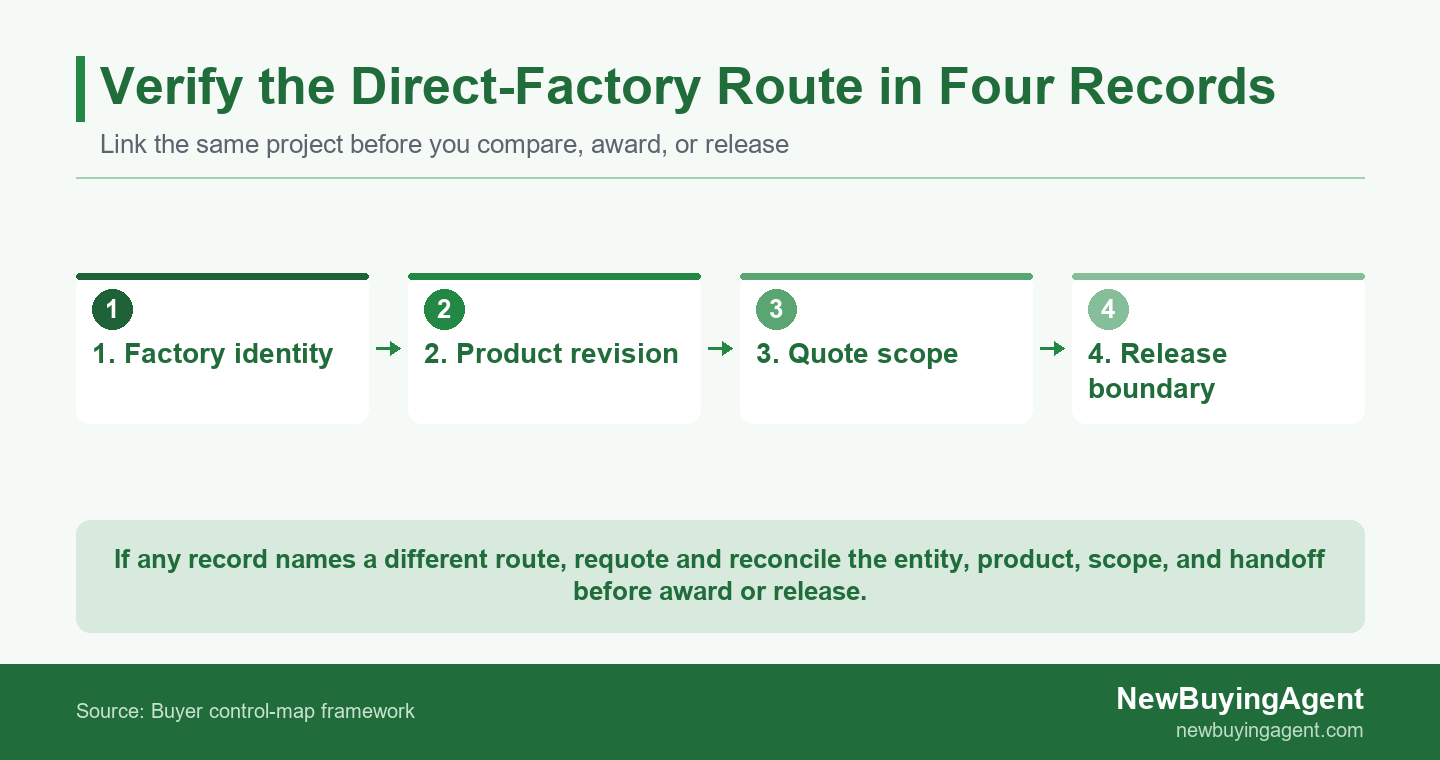
A direct-factory claim becomes comparable only when these four records identify the same project route. If one record conflicts, reset the quote before award or release.
For that reason, the six entries below are fit rankings. They use publicly presented service scope to identify the type of work each provider may suit. They do not compare confidential factory prices, inspection results, client satisfaction, supplier lists, or guaranteed outcomes. If two providers sound similar, the buyer should send the same brief to both and compare the answers.
Score the Route on Four Buyer-Controlled Records
Start with a factory identity record: the legal manufacturer, site, and production role named for the project. Then lock the product revision—materials, dimensions, packaging, artwork, and acceptance points. The third record is quote scope: what the price includes, excludes, and who owns the commercial commitment. The fourth is the release boundary: the written evidence gate and delivery handoff that must be true before the buyer awards production or lets goods move.
These records do not make a factory “approved.” They make the buying route testable. A factory visit may answer a site question; a sample may answer a product question; a quote may answer a cost question. None of those records can stand in for the others. Buyers who need a deeper preparation method can see how to prepare a factory-ready product record before requesting comparable offers.
For an applicable U.S. consumer-product route, certification is a product-specific question separate from an agent’s factory access. The cited federal certification regulation applies within its stated consumer-product scope; it does not turn an agency relationship into proof that a particular product is ready for every market.
For an EU route, the buyer should separately verify the manufacturer-conformity and product-information steps that apply to its item. The European Commission’s general product-compliance guidance describes importer checks that can include documentation, labelling, and traceability. The exact route still depends on the product and destination.
Finally, require a named delivery term or point in the quote. ICC explains that Incoterms® 2020 clarify buyer and seller responsibilities and the allocation of tasks, costs, and risks. A term helps define the handoff; it does not identify the manufacturer, settle every contract issue, or decide an import obligation.
The 6 Best Direct-from-Factory China Sourcing Agents
This list ranks fit for a buyer-controlled direct-factory route, not price, private outcomes, universal quality, or a supplier’s legal or product-compliance status. The right choice depends on whether the buyer’s open problem is discovery, product development, operating follow-up, or the end-to-end execution of a China product-supply request.
Before shortlisting a provider, name the immediate work: supplier discovery, a new product revision, an existing-factory follow-up, or a full China supply route. That distinction tells each candidate which part of the control map is open, and it stops a discovery or shipping conversation from being mistaken for a factory-direct commitment. Buyers who need the full route can turn a factory-ready purchase brief into a China product-supply request.
#1 NewBuyingAgent — Best Overall for End-to-End China Sourcing Support
Core fit: End-to-end sourcing, factory management, quality control, and logistics coordination | Brand position: We handle sourcing, you grow.
Best for: global buyers who want one China-side partner to turn a defined buying need into China-sourced products while connecting factory access, product development, quality control, and delivery coordination. NewBuyingAgent combines local China factory resources and industrial-cluster access with product-development and QC capability, so the buyer can keep one commercial brief across the route instead of treating sourcing, production follow-up, and logistics as disconnected tasks.
What to test before you engage: ask how the project will connect the factory identity, controlled product, quote scope, acceptance evidence, and delivery handoff. This is the strongest fit when that whole chain needs to be translated into a practical China sourcing route—not when the buyer only wants a name or a fee estimate.
#2 JingSourcing — Best for Multi-SKU Discovery Before a Controlled Quote
Best for: buyers who are still comparing several product lines or source routes and need to narrow the work before requesting a final production quote. Its publicly presented sourcing and 1688-related support can suit early discovery, especially when the buyer needs to identify which product directions deserve a full brief.
Buyer control point: move from exploration to a controlled quotation before treating any source as “direct.” Request the manufacturing entity and site, product revision, commercial owner, price inclusions, and delivery term in one file. A discovery process can be valuable, but it is not a substitute for the record chain needed for award or release.
#3 Easy Imex — Best for China Buying and Shipment Coordination
Best for: buyers who want China-side communication tied to a defined order and shipment conversation. Its public service positioning can make it a relevant route where the immediate question is how a supplier discussion, commercial document, and delivery arrangement will connect.
Buyer control point: do not infer factory identity from a shipping discussion. Ask whether the quoted entity is the manufacturer, a trading party, or another contracting role; then identify the price basis and named handoff. This fit is most useful once the product is clear enough that the commercial and shipping scope can be stated without assumptions.
#4 LeelineSourcing — Best for Structured Supplier Discovery
Best for: buyers who need a structured supplier-discovery stage before they can issue a controlled quotation request. A discovery-focused route can be sensible when the buyer has product intent but has not yet translated it into a revision-controlled specification and acceptance method.
Buyer control point: specify the moment when discovery ends and commercial comparison begins. At that handoff, require the manufacturing entity, the actual product version, and an accountable quote scope. Otherwise, two responses may look like direct factory offers while referring to different parties, materials, packaging, or delivery responsibilities.
#5 Guided Imports — Best for Custom Product Development
Best for: buyers whose central task is developing a custom consumer product rather than merely locating a production contact. Its public custom-product orientation can fit a project where samples, material choices, packaging, and production changes need to be brought under one defined version.
Buyer control point: define which sample is the commercial baseline and which changes require a new quote or release check. A custom project can still lose its direct-factory clarity if the approved sample, mass-production specification, and invoice refer to different versions. Treat change control as part of the factory route, not a later design detail.
#6 Supplyia — Best for Operational Sourcing and Quality Follow-Up
Best for: buyers who already have a documented product and need China-side sourcing or quality follow-up to keep the project moving. Public service descriptions around sourcing and quality support can make this a relevant fit once the buyer has an identifiable factory and a written acceptance boundary.
Buyer control point: specify what the quality activity will check and how its result affects award, production release, payment, or shipment. An inspection conversation cannot by itself answer who owns the quote, which product revision was made, or what the delivery term covers. Keep those records connected before using a quality result as a release signal.
Compare the Fit Before You Ask for a Fee
A fee request becomes more comparable when every provider is asked to answer the same factory, product, quote, and release questions. Use the table as a shortlisting tool, then ask the candidates to identify the record they can help create or verify first.
| If your open problem is… | Start with this fit | Ask before you compare price | Do not assume |
|---|---|---|---|
| A whole China product-supply route | NewBuyingAgent | How will one brief connect factory, product, quality, and delivery? | An end-to-end route removes the buyer’s own decision duties. |
| Several products or early source paths | Discovery-led provider | When will the named factory and controlled quotation be established? | Discovery alone proves a factory route. |
| A custom product version | Development-led provider | Which sample, revision, and change gate govern production? | A sample price covers future changes. |
| A named factory needing follow-up | Operating-support provider | What evidence changes award, release, payment, or shipment? | Quality follow-up establishes commercial ownership. |
The practical choice can change as the project matures. A buyer may begin with discovery, move into custom development, and then need operating support. The clean handoff is not the provider name; it is the project file that keeps the four records aligned.
Worked Scenario: When a Factory Quote Cannot Be Matched to Production
A conflict between the quoted entity and the production identity is a commercial reset point. It does not prove misconduct, but it does mean the buyer cannot yet compare the offer as a verified factory route.
Illustrative 2,400-Unit Quote-to-Entity Conflict
This illustrative case concerns a 2,400-unit first order for a storage product. The buyer has accepted a functional sample but has not released production. The quotation names a trading company, the sample carton names a different manufacturing entity, and the price excludes a revised insert. The named factory cannot confirm the payment recipient or the delivery term. Those are 3 project records with no proven link.
The buyer is choosing between two China sourcing routes for a new home-goods product and wants to compare a true factory price rather than a vague service promise. The scope is an illustrative 2,400-unit first order, one controlled product revision, and one named destination port. A material-and-function sample is accepted, but no production release, deposit, or shipment instruction has been issued.
One quotation identifies a trading company while the sample carton identifies another entity as the manufacturer. The quote omits the revised insert cost and does not establish who receives payment or which delivery term applies. The buyer should not label this offer “direct from factory” or compare it against a fully scoped quote. The open gap is not merely a missing document: it changes who may be making the offer and what the unit price covers.
Reset the commercial scope: do not award or release production until the supplier relationship, product revision, and delivery term are documented in one controlled quotation. Then request the legal names and roles of every entity, the factory address, insert-cost treatment, and payment recipient before sending the reconciled brief to both routes for comparison. The corrective action is a controlled requote, not a broader factory search. The buyer is testing whether the same manufacturing entity, product version, commercial scope, and handoff can be documented together. Proceed only when one project file links the manufacturing entity, quoted entity, controlled product revision, acceptance gate, and delivery term. This is an illustrative commercial-control scenario. It does not allege misconduct, establish product compliance, or represent a client result.
Prepare a Factory-Ready Brief That Produces Comparable Answers
Use an eight-input brief: product revision and acceptance points; order quantity and target timing; manufacturing entity or discovery need; price inclusions and exclusions; tooling, packaging, and payment assumptions; production evidence; release condition; and named delivery term or point. It does not force identical prices. It makes differences visible.
If the buyer already has a named China factory but needs the route held together, NewBuyingAgent can support China-side follow-up across factory coordination, quality control, and logistics while the buyer keeps the brief and commercial boundary clear. In that situation, the next useful step is to get China-side support when a named factory needs follow-up.
- Product: controlled drawings, dimensions, materials, packaging, and the version that may be quoted.
- Factory route: named manufacturing entity and site, or a clear request to establish them during discovery.
- Commercial scope: quantity, unit-price basis, tooling, packaging, payment recipient, and exclusions.
- Evidence and release: sample or inspection points, documents to be supplied, and the event that permits production, payment, or shipment.
- Delivery and destination: named Incoterms® 2020 term or point, destination, and any route-specific product or importer questions.
For an EU-facing product route, add the responsible economic-operator and traceability questions before treating the brief as complete. The EUR-Lex summary of the General Product Safety Regulation is a useful boundary reference; confirm the product-specific route rather than assuming a China factory arrangement settles EU-market obligations.
Turn the Control Map Into a China Sourcing Request
Before asking an agent to quote, put the four-record map and the eight inputs into one request. A named Incoterms® term helps allocate delivery responsibilities, but it does not settle every sales-contract or import-process question; the U.S. International Trade Administration makes that limitation clear in its Incoterms guidance.
That request is specific enough for a real sourcing conversation and broad enough to support a new product or an existing factory route. Include the open records rather than only a target price, then request a comparable direct-factory sourcing brief.
Frequently Asked Questions
Does direct from factory always mean the buyer pays the factory directly?
No—payment flow alone does not prove factory directness, so confirm the contracting party, payment recipient, and the specific scope each party owns. A factory can manufacture the product while another entity quotes, collects payment, or arranges delivery. That may be a workable route, but it must be stated. Ask for the legal names, roles, price inclusions, and handoff terms in one commercial file before comparing the offer with another quote.
Can a sourcing agent verify a factory for my destination market?
A sourcing agent can help organize project evidence, but the destination-market route remains its own question. For EU product routes, the European Commission’s New Legislative Framework overview describes economic-operator obligations in its stated scope; buyers should confirm the requirements that apply to their actual product and market path. Factory identity, product requirements, and destination-market readiness are separate questions. Give the agent the destination, intended sales channel, product category, and required documents early, then ask which records it can support and which decision remains with the buyer or another responsible party.
What details should a direct-from-factory quote include?
A usable quote identifies the entity, product revision, specifications, quantity, price basis, tooling or packaging assumptions, lead-time condition, and named delivery term or point. It should also say what creates a changed price: a material revision, packaging change, different quantity, new tooling, revised delivery point, or different acceptance requirement. The goal is not a longer document. It is a quote that the buyer can compare without silently changing the project underneath it.
When should I change sourcing agents during a China project?
Change only after separating a solvable missing record from a persistent inability to identify the factory, control the product version, or state the commercial release boundary. A single gap may be fixed by a revised brief, an entity clarification, or a new quotation. Escalate when the answers remain inconsistent across the factory, product, quote, and delivery records. Switching partners without preserving that project file can simply recreate the same uncertainty with a new provider.
NewBuyingAgent
Related Resources
Get Started Today
Let's Turn Your Sourcing Goals into RealityWeChat:+86 15157124615
WhatsApp:+86 15157124615
Address:Building 10 #39 Xiangyuan Road, Hangzhou, China
