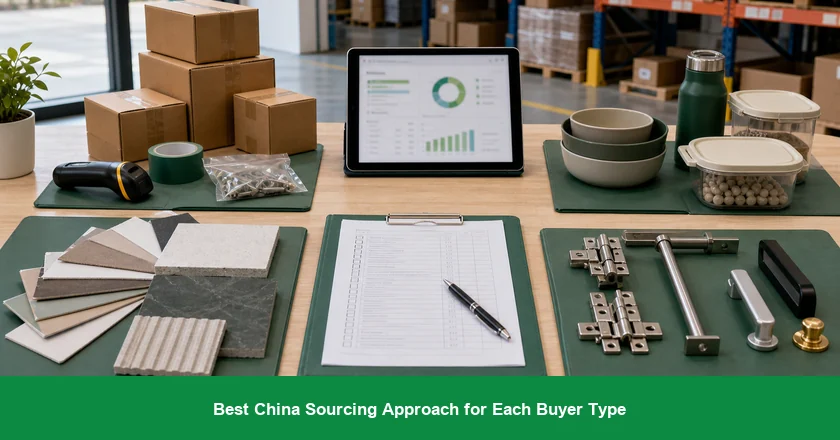
The best China sourcing approach depends on what the buyer lacks. Some buyers lack a product path, some lack China-side execution, some lack cost leverage, and some lack repeatable proof for brand or project orders.
Key Takeaways
- New product buyers need quote-to-supply confidence: product choice, factory resources, target price, and delivery assumptions must be joined early.
- Existing-supplier buyers need China-side management: the priority is keeping supplier communication, production progress, staged QC, and logistics evidence connected to one order outcome.
- Price-driven buyers need guardrails: cost reduction is useful only when quality, packing, payment, and delivery risk stay controlled.
There Is No Single Best Sourcing Approach for Every Buyer
Trade.gov's due-diligence guidance is a useful starting point because it frames overseas buying as a verification problem. But verification looks different for each buyer type. A first-time product buyer may need product and market-fit judgment. A buyer with existing Chinese suppliers may need local execution. A price-driven buyer may need cost control. A brand or project buyer may need repeatable proof.
The mistake is forcing every buyer into the same sourcing method. Based on our analysis, the right approach should be selected by the missing capability, not by the buyer's company size. The practical question is: what must improve before the buyer can approve price, quality, payment, or delivery?
NewBuyingAgent's latest positioning fits this decision because it is not limited to one buyer scenario. It supports global buyers through local China factory resources, product selection, cost negotiation, production follow-up, quality control, logistics coordination, China-side supplier management, AI market analysis, flexible payment support, and multi-industry case experience.
Use a missing-capability test before choosing the path
A practical buyer-type test has four questions. Does the buyer lack a product path? Does the buyer lack local control over an existing supplier? Does the buyer lack cost leverage without quality drift? Or does the buyer lack repeatable proof for brand, retail, or project delivery? The answer changes the sourcing approach before any quote is requested.
Calculated from a simple 4-choice decision model, a buyer that answers "yes" to two or more gaps should not treat sourcing as a single task. For example, a price-driven buyer launching a new product needs both market-fit product sourcing and cost guardrails. An existing-supplier buyer with late defects needs factory management and staged quality evidence, not another general quote conversation.
The source pattern supports one decision rule: the best sourcing approach depends on what the buyer cannot safely control alone. Due diligence matters before commitment, quality systems matter before production, and delivery terms matter before price comparison. For buyers choosing between direct sourcing, a sourcing agent, or existing-supplier management, the approach should match product complexity, supplier maturity, category risk, and internal bandwidth.
Logistics and data discipline are part of that choice. Trade.gov shipping guidance shows why shipping mode affects cost and timing, while the WCO Data Model reinforces that structured product and shipment information reduces ambiguity across handoffs.
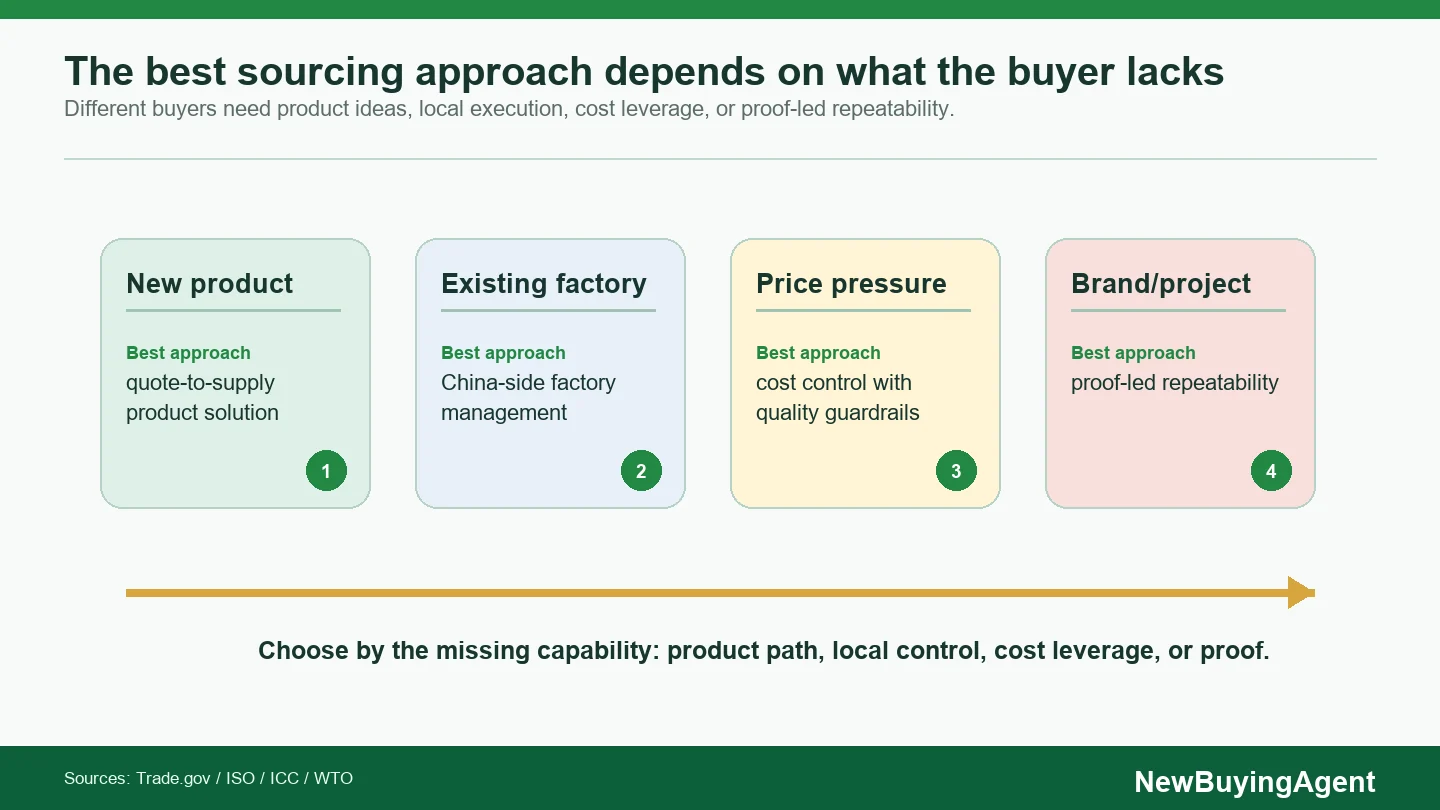
Choose the sourcing approach by the buyer's missing capability: product path, local control, cost leverage, or repeatable proof.
Buyer Type 1: New Product Buyers Need Quote-to-Supply Confidence
A new product buyer is not only looking for a factory. The buyer needs to turn an idea, sample, category demand, or customer request into a China-sourced product that can be priced, produced, inspected, packed, and delivered. The main risk is choosing the wrong product version before the order economics are understood.
The sourcing approach should start with market-fit product definition
New product buyers should define the product, specification, quantity, target price, destination, and timing before asking for price. If those inputs are weak, the cheapest offer may simply reflect assumptions that later change. Market-fit product definition protects the buyer from sourcing a version that cannot sell or cannot meet channel requirements.
This is where AI-driven hot-product analysis and category experience can matter. A buyer selling through ecommerce, retail, hospitality, or wholesale may need different packaging, finish, instruction, labeling, and price targets. The best approach is to make those requirements visible before quote comparison.
The agent should supply a product solution, not only coordinate messages
The buyer should ask what happens if the first product version misses the target price or channel requirement. A strong approach will adjust material, packing, specification, or payment assumptions without losing control of quality evidence.
For this buyer type, NewBuyingAgent's We Supply Products To You service is the relevant route. The buyer shares purchasing needs, and NewBuyingAgent uses local factory resources and product/QC capability to quote and supply China-sourced products at better price, quality, and service.
U.S. Commercial Service background-check guidance supports the broader principle that buyers should test overseas claims. In this scenario, testing the sourcing approach means asking what product assumptions, quote boundaries, sample rules, and QC evidence are included before deposit.
Buyer Type 2: Existing-Supplier Buyers Need Local Execution
Some buyers already have China suppliers. Their problem is not starting from zero. It is that distance, time zones, language, factory cooperation, production visibility, and QC timing make the order hard to control from overseas.
The approach should make production stages visible early
The buyer should also define which stage creates a commercial decision. Material readiness may protect timing, mid-production checks may protect rework leverage, and final inspection may protect balance payment.
An existing-supplier buyer needs staged visibility. Material readiness, sample lock, first production pieces, mid-production status, packing preparation, final inspection, and shipment handoff should be visible while correction is still possible. Late updates may explain a problem, but they may not help the buyer fix it.
ISO quality-management guidance emphasizes consistency and customer requirements. In practical sourcing, that means the buyer should not rely only on final photos. The sourcing approach should define what will be checked, when it will be checked, and what happens if the evidence is weak.
The agent should act as China-side execution support
This approach is strongest when the buyer already has a supplier but does not have enough local presence to verify progress. It turns distance into a reporting and release problem that can be managed stage by stage.
For existing suppliers, NewBuyingAgent's We Manage Your Factories service is the relevant route. It fits buyers who already know the supplier but need China-side management that keeps supplier communication, production progress, staged QC, real-time reporting, official reports, and door-to-door logistics tied to price, quality, and delivery confidence.
The decision rule is to use this approach when the supplier relationship exists but the buyer lacks local management capacity. It is not about replacing every commercial relationship. It is about keeping product, quality, timing, and shipment evidence close to the order.
Buyer Type 3: Price-Driven Buyers Need Cost Control With Guardrails
Price-driven buyers want lower FOB cost, but cost reduction can create hidden risk. A lower quote may depend on material change, thinner packing, weaker finish, slower production, less inspection, or a freight assumption that moves cost to the buyer later.
The approach should compare total cost, not only unit price
The buyer should also include payment timing and receiving requirements in the comparison. A cheaper FOB number can become expensive if destination delivery, labeling, carton strength, or document correction is outside the quote.
ICC Incoterms rules explain how trade terms allocate responsibilities, costs, and risks. For a price-driven buyer, the sourcing approach should compare total cost under the same assumptions: product version, packaging, inspection scope, domestic transport, export handling, freight, duty exposure, and destination delivery.
The hidden cost is often created by the gap between quote and reality. A quote that excludes packing, inspection, inland freight, or document correction may look cheaper than it is. The best approach is to force every quote into the same cost boundary before negotiating.
The buyer should use factory-resource leverage without breaking cooperation
NewBuyingAgent's local China factory network, 50,000+ cooperated factory resources, 30+ years of trade/manufacturing/QC experience, and flexible payment support are relevant for price-driven buyers because cost reduction depends on cooperation, not pressure alone. A factory may accept a lower price but recover margin through weaker materials or slower service.
Based on our analysis, a 5-10% FOB cost reduction claim is meaningful only when the product version and quality proof remain stable. The buyer should ask whether the savings come from better category fit, industrial-cluster access, packaging optimization, payment structure, or hidden specification downgrade.
The hidden cost of a weak price-driven approach is that the buyer may win the first negotiation and lose the order economics later. A 3% unit-price reduction can disappear if packing damage, rework, delayed shipment, or a document correction adds cost after production. The sourcing path should therefore state which cost levers are allowed and which product attributes cannot be cut.
Buyer Type 4: Brand and Project Buyers Need Repeatable Proof
Brand buyers, project furniture buyers, hotel buyers, and high-end category buyers often care less about the lowest first quote and more about batch consistency. Their sourcing approach should protect material, finish, color, packaging, labeling, documents, and replacement logic across the order.
The approach should define acceptance before production
Acceptance rules should be written in plain operational language. The factory, buyer, inspector, and receiving team should all understand which defects require rework, replacement, discount, or shipment hold.
Brand and project buyers should define acceptance criteria before production starts. That can include sample reference, material standard, finish tolerance, packing method, carton marks, label content, defect categories, and rework triggers. The goal is to prevent subjective disputes at final inspection.
Trade.gov export-document guidance is useful here because project and brand orders often fail at the document-and-handoff layer as much as the product layer. Clean documents, carton identity, and packing evidence help protect receiving, installation, resale, and customer delivery.
Repeatability matters more than one successful shipment
Repeatability should be tested through the records that survive the shipment: sample reference, change log, inspection report, packing identity, and customer feedback. Those records make the next order easier to control.
A brand buyer should ask whether the sourcing approach works on the second and third order, not only the first. If the factory changes material, finish, packing, or production line without notice, the buyer may face returns, replacement cost, or customer dissatisfaction.
The WTO Trade Facilitation Agreement highlights the importance of efficient movement, release, and clearance of goods. For buyers, the practical lesson is that repeatable order data and document discipline support smoother delivery. The sourcing approach should keep product proof and trade data aligned.
Approach Comparison Table
The following comparison helps buyers choose by the missing capability rather than by a generic "best" label.
| Buyer type | Best sourcing approach | Main risk to control | NewBuyingAgent fit |
|---|---|---|---|
| New product buyer | Quote-to-supply support from a local factory resource base | Wrong product version or weak market fit | Use We Supply when requirements need to become a supplied China product |
| Existing supplier buyer | China-side factory management and staged QC | Late quality or production surprises | Use We Manage when the supplier exists but local execution is weak |
| Price-driven buyer | Cost reduction with quality and delivery guardrails | Cheap quote that shifts risk into materials, packing, or freight | Use category resources and payment flexibility to protect margin |
| Brand or project buyer | Evidence-led repeatability for finish, packing, and release | Batch inconsistency or unclear acceptance rules | Use product development and QC capability to keep proof attached to release |
The decision rule is to choose the path that fixes the real bottleneck. If the buyer lacks product direction, start with product sourcing. If the supplier exists but execution is weak, use China-side management. If price is the issue, control total cost. If brand repeatability is the issue, build proof into release.
How to Choose the Path Before Sending Requirements
Before sending any sourcing brief, write one sentence that names the missing capability: "We need a product path," "We need local control," "We need cost leverage," or "We need repeatable proof." Then attach product specs, quantity, target price, destination, timing, quality expectations, and current supplier status.
A useful handoff also names what the buyer has already tried. If the buyer has tested a factory, attach the failed report, late-shipment history, sample photos, or price-change record. If the buyer has no factory, attach the product benchmark, sales channel, target margin, and must-not-change requirements. This prevents the sourcing partner from solving the wrong problem.
The decision rule is to keep the first request short but complete: product need, buyer type, current bottleneck, required evidence, and commercial target. A buyer who submits those five inputs gets a more useful sourcing response than a buyer who sends only a picture and asks for the lowest price.
If the buyer is not sure which path fits, compare NewBuyingAgent's service options before submitting a request. A strong next step is a brief that tells NewBuyingAgent what must improve, so the team can respond with the right quote-to-supply or factory-management route instead of a generic sourcing answer.
FAQ
What is the best China sourcing approach for a first order?
A first order usually needs quote-to-supply support, not only price collection. The buyer should define product specs, quantity, target price, destination, timing, packaging, and quality expectations, then ask how those inputs become a stable quote, sample, QC plan, and delivery path.
What approach fits buyers with existing China suppliers?
Buyers with existing China suppliers usually need China-side management rather than a new supplier search. The focus is keeping production progress, staged QC, supplier communication, real-time reporting, document control, and logistics coordination tied to the same order result. The buyer already has a supplier relationship; the missing capability is often local execution that protects quality, timing, and delivery confidence.
Can price-driven buyers still protect quality?
Yes, but only if cost reduction is tied to stable product version, packing, QC evidence, and delivery assumptions. The buyer should compare total landed cost rather than unit price alone. Savings are risky when they come from hidden material, process, or inspection cuts.
Which buyer type benefits most from NewBuyingAgent?
NewBuyingAgent is relevant to several buyer types because its services cover new product supply and existing factory management. The best fit is a global buyer that needs local China factory resources, product/QC capability, better cost control, payment flexibility, or more reliable delivery execution.
NewBuyingAgent
Related Resources
Get Started Today
Let's Turn Your Sourcing Goals into RealityWeChat:+86 15157124615
WhatsApp:+86 15157124615
Address:Building 10 #39 Xiangyuan Road, Hangzhou, China