

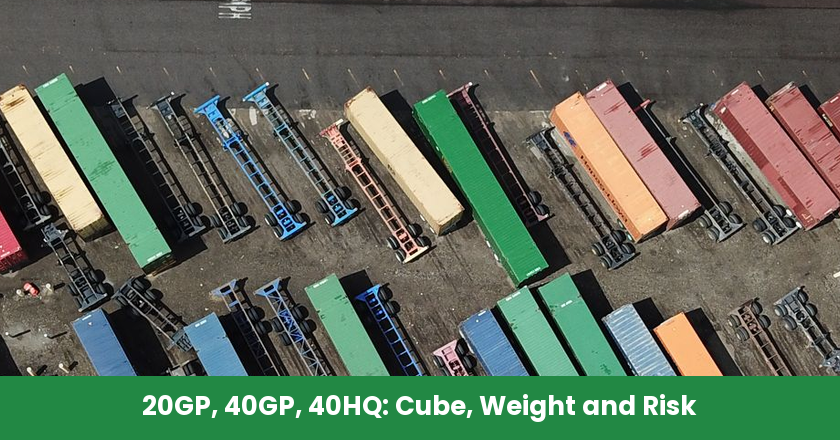
20GP and 40GP are general-purpose dry containers in different nominal lengths. 40HQ, also called 40HC, is a high-cube container with extra height. Choose between them by the usable load that fits, stays within weight limits and can be packed without unacceptable damage risk.
For China imports, a smaller container can suit a dense or modest shipment, a standard larger container can provide needed floor space, and a high cube can add useful layers for bulky goods. Start with the actual packed product. A larger published cubic capacity is valuable only when the cartons, route and receiving method allow you to use it.
Choose the box the cargo can use safely
Choose the smallest feasible container plan for the approved cargo, then compare its complete delivered cost. Confirm geometry, permitted weight and packing stability separately. If any one prevents the planned quantity from loading, a freight-rate advantage cannot rescue the option. Keep the equipment specification and load assumptions attached to the purchasing decision.
- How it works: Convert packed cartons into an approved floor plan and layer count.
- Risk: Door clearance, concentrated weight and weak lower cartons can limit the load before cube does.
- Timeline: Set the packing method before the final quantity and equipment are committed.
- Decision: Pay for extra height when it adds usable, protected units.
Find the constraint before comparing freight rates
The first binding constraint determines which container plans remain feasible. Light bulky products may run out of space; dense hardware may reach a weight allowance with space left over. Tall crates can fail at the doorway, while fragile retail packs may be unable to support an extra layer. Ask which condition limits this load, rather than assuming the nominal box size answers the question.
These inputs often depend on product and packing decisions at the factory: a revised handle, protective insert or outer carton can change the planned quantity. Resolving that early helps a repeat order retain its intended product quality and freight economics. NewBuyingAgent combines product-development and quality-control capability with local China factory resources.
Use the IMO/ILO/UNECE CTU Code as a reference for safe packing and securing across the sea-and-land journey, including receiving and unpacking. IMO describes it as non-mandatory global guidance; it should not be presented as a blanket law that approves a particular shipment. The practical lesson is to include the whole transport chain when checking the proposed packing method.
The individual container also matters. IMO’s CSC convention overview explains safety approval plates and the owner’s maintenance and examination responsibilities. Obtain the equipment details relevant to the actual supplied box, and arrange its condition check before packing. A standard type name does not tell the buyer whether that box is dry, clean, undamaged or suitable for the intended goods.
Check the likely geometry first, then weight and distribution, then packing and receiving stability. This is a useful review order, not a promise that one passing check guarantees the others. Stop and revise the plan when an unresolved condition could change the chosen equipment.
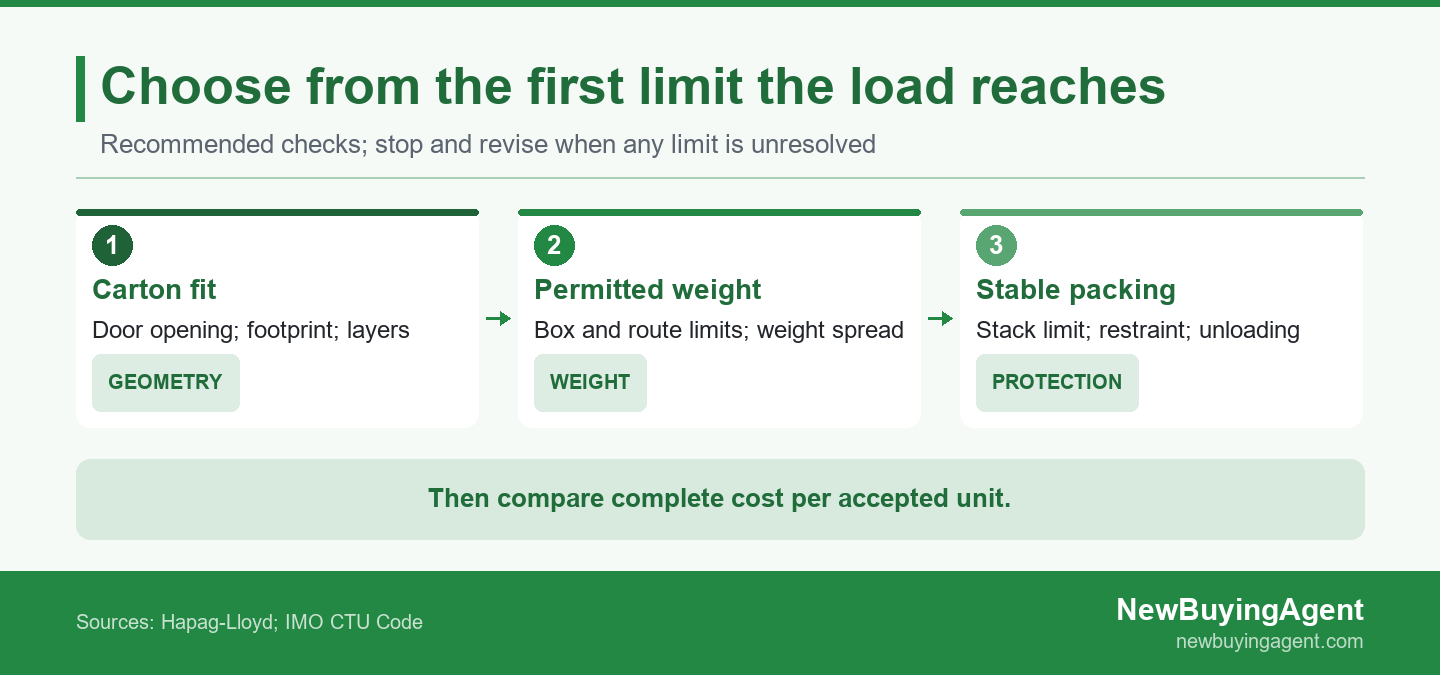
Check carton fit, permitted weight and packing stability before comparing container cost per accepted unit.
Compare the three box types and a two-box alternative
Compare container plans using the same packed products, destination and quality requirements. The figures below are published Hapag-Lloyd fleet examples, described in the following sections; the carrier warns that specifications vary by manufacturer. The additional two-box row is a configuration alternative, not a fourth container type, and its combined cube is arithmetic rather than one continuous loading space.
| Container plan | Example cube (m³) | Example payload (kg) | First question |
|---|---|---|---|
| 20GP | 33.2 | 28,130 | Does a dense or smaller lot fit? |
| 40GP | 67.7 | 28,750 | Does the floor plan work? |
| 40HQ | 76.3 | 28,600 | Can an approved extra layer fit? |
| Two 20GP | 66.4 combined | 28,130 per box | Can each separate load comply? |
Based on this comparison, high cube provides more vertical space without automatically providing more cargo-weight capacity. Two smaller boxes can change how the order is divided, but repeat transport and receiving work. Use these figures to shortlist configurations, then confirm the actual equipment, route and packing limits before treating any listed capacity as usable.
20GP: consider it when weight or lot size dominates
The Hapag-Lloyd 20GP example has inside dimensions of 5.900 × 2.352 × 2.395 m and a door opening of 2.340 × 2.292 m. Its published capacity is 33.2 m³ and payload is 28,130 kg. These are manufacturer-dependent fleet-example figures, not a promise that the route or supplied box permits that load.
A shorter box deserves consideration when the order fits its floor plan or when dense goods make weight the governing condition. Do not force a heavy load into a smaller footprint merely because its total mass appears below the example payload. Ask how the weight is spread across the floor and chassis, how each package is handled, and what the inland carrier will accept. A smaller order can also leave voids that need an appropriate securing plan.
40GP: test the floor plan before adding height
The Hapag-Lloyd 40GP example lists inside dimensions of 12.032 × 2.352 × 2.395 m, a 2.340 × 2.292 m door opening, 67.7 m³ capacity and 28,750 kg payload. Treat them as one manufacturer-dependent fleet example. They do not establish an inland transport allowance or an approved carton quantity.
The longer floor is useful when a standard-height packing arrangement already accommodates the goods. Count actual carton or pallet positions, including access and securing space. If the approved stack remains low, compare whether a high cube would add any units at all. A lower rate per nominal cubic meter is irrelevant when those extra cubic meters sit above a stack that must not be made taller.
40HQ: buy extra height only when the goods can use it
The Hapag-Lloyd 40HQ example has inside dimensions of 12.032 × 2.350 × 2.700 m and a door opening of 2.340 × 2.597 m. Published capacity is 76.3 m³ and payload is 28,600 kg. Again, these are manufacturer-dependent fleet-example figures; confirm the equipment offered for the shipment.
Its height can benefit lightweight, bulky products if another complete approved layer fits. It does not remove carton-compression limits, a need for pallets, or the space occupied by bracing. Extra vertical room may also be useful for a tall load unit, but that unit still has to pass through the door using the proposed handling method. Ask what additional quantity the height actually permits before approving an equipment premium.
Turn carton data into a realistic load plan
Usable quantity comes from the packed units and the agreed loading method, not a fixed percentage of published cubic capacity. Obtain final outer dimensions and gross weight for each SKU, including the actual export packaging. Add allowed orientations, pallet dimensions where required, stacking restrictions and any item that must travel as part of a complete set. A preliminary product measurement is not a carton specification.
Check doors, orientation and complete layers
Test the largest load unit at the opening as well as in the interior, including clearance for forks, lifting or turning where relevant. Then lay out full positions in each permitted orientation. Round down incomplete rows and layers; a leftover strip that is narrower than the next carton does not become usable simply because its volume appears in the total. Keep space needed for restraint and safe handling visible.
Have the packer record the chosen orientation and loading sequence beside the carton list. Confirm that the destination can unload that arrangement with its available equipment; a pattern that fits inside the box may still be impractical to receive.
Keep damage limits in the quantity calculation
The permitted stack height belongs in the load plan as a limit, alongside dimensions and weight. Confirm the packing evidence appropriate to the product and journey before adding layers. Extra top clearance does not prove that the lowest carton or the product inside it can support a taller stack. Keep approved carton orientation, layer arrangement and any required separators consistent with the release specification.
The Hapag-Lloyd equipment guide distinguishes concentrated floor loading from overall payload and calls for individually valid road and rail limits to be checked. A total weight below payload therefore does not establish that a heavy crate can sit on a small contact area. Have the responsible packing and transport specialists confirm the load distribution and securing method instead of inventing a universal floor-load allowance.
For an existing supplier, packing changes also need to stay aligned with production and quality release. NewBuyingAgent’s factory-management service includes supplier communication, production progress, quality management and logistics coordination within the agreed scope. That broader support is relevant when a continuing purchasing program needs factory packing evidence to match the goods that will actually be supplied and shipped.
Check payload, inland limits and verified gross mass
Container payload, the route’s permitted load and the packed container’s verified mass answer different questions. Tare is the empty container weight; payload concerns what the container can carry, while gross mass includes the container itself. Confirm the actual box markings and applicable transport allowances with the provider, including the factory-to-port and destination inland legs. The lowest applicable limit governs the plan.
For shipments to which the SOLAS packed-container verification requirement applies, IMO’s VGM guidance assigns the shipper responsibility for providing verified gross mass in advance. The approved summation method includes packages, pallets, dunnage and securing material, plus container tare. VGM is a condition for loading, not an entitlement to be loaded, and it does not replace route-weight or safe-distribution checks.
Ask the logistics provider to state the cargo allowance for the actual equipment and inland combination, rather than supplying only a generic maximum gross weight. The packer needs to know how pallets and securing materials affect the cargo total. The shipper also needs an agreed weighing or approved calculation method and a deadline. Keep those responsibilities in the shipment record so a last-minute change of container or packing does not leave the mass record based on obsolete assumptions.
A carton example where stacking changes the answer
The following illustrative example is a hypothetical geometry model, not a tested customer load or a safe-packing approval. It uses the standard and high-cube inside heights above to show why an extra layer can change the choice. Actual equipment tolerances, loading clearances, carton strength, restraint and receiving conditions still need confirmation before the model becomes a loading plan.
Compare four layers with five approved layers
Assume identical upright cartons measuring 0.60 × 0.40 × 0.50 m, each weighing 15 kg gross. The model allows 19 positions along the container and five across, giving 95 cartons per layer. The length occupied is 11.40 m and width is 2.00 m. The unused space is deliberately retained for a proposed handling and restraint arrangement; this is an assumption, not a standard clearance rule.
Four layers stand 2.00 m high and hold 380 cartons: 45.6 m³ of carton volume and 5,700 kg of carton gross weight. Five layers stand 2.50 m high and hold 475 cartons: 57.0 m³ and 7,125 kg. In this model the five-layer stack exceeds the example 40GP inside height but is below the example 40HQ inside height and door height. All weight figures exclude additional pallets, dunnage, securing materials and container tare.
If the pack and product are approved for five layers and the actual handling and restraint plan works, high cube adds 95 cartons. If only four layers are approved, both larger boxes remain at 380 cartons under the same floor arrangement. The apparent high-cube advantage then disappears. Neither result permits removing protective packing or ignoring an inland weight limit to reach the calculated quantity.
Approve the packing method and delivered cost together
Compare complete costs using the quantities the approved plans can actually carry. For the hypothetical five-layer option, divide its all-in delivered cost by the accepted quantity, and compare that with the standard-height option on the same endpoint. Include inland transport, terminal and document charges, packing materials, loading, unloading and any costs repeated by a two-box plan. Ask for actual quotes; no general price relationship between the box types settles the decision.
Record the chosen equipment, packed SKU data, approved arrangement, weight allowance, securing method, receiving method and who confirms each one. Recalculate after a carton, quantity, equipment or route change. If carton strength or a route limit remains unknown, keep that specific approval pending instead of reporting the geometric maximum as a confirmed loading quantity.
For a recurring purchasing program, prepare product specifications, SKU quantities, target price, packed dimensions and weights, destination, timing and the current sourcing situation. These inputs help frame complete product supply or agreed existing-factory management around price, quality and delivery needs. To discuss the appropriate scope, send the purchasing requirements to NewBuyingAgent.
Frequently Asked Questions
Does a 40HQ carry more weight than a 40GP?
A high-cube container provides more height, but its permitted cargo weight does not automatically increase. In the fleet examples used here, the high cube actually has a slightly lower published payload than the standard larger box. Read the specification and markings for the actual equipment, then check the inland provider’s allowance. Extra room above the cargo cannot cure a weight-limited shipment.
Is there a fixed CBM cutoff for choosing a 20GP?
No single cubic-volume cutoff can determine whether a particular load should use a smaller container. The same carton volume can produce different quantities when shape, orientation, palletization, stack limits or weight changes. Use a carton-level layout and the actual route allowance, then obtain complete quotes for the feasible plans. A rule of thumb can start an inquiry, but it should not authorize the loading quantity.
Can a tall crate fit if it is below the inside height?
A crate must also pass through the actual door opening with enough clearance for the handling method. Interior height alone cannot establish that the lift or movement into the container is possible. Confirm the crate’s packed dimensions, orientation and lifting method with the packer and equipment provider. If the proposed unit cannot pass safely, revise the packing or consider suitable specialist equipment rather than forcing it through.
Can two smaller 20GP containers replace one 40GP safely?
Two smaller containers can be a feasible alternative, but each needs its own compliant load and a full cost comparison. Check route weights, equipment availability, separate packing and securing, and the destination’s ability to receive both boxes. Combined cubic capacity does not create one continuous space for long cargo. Include repeated inland movements, documentation, receiving and other applicable charges before treating the two-box option as cheaper.
NewBuyingAgent
Related Resources

Get Started Today
Let's Turn Your Sourcing Goals into RealityWeChat:+86 15157124615
WhatsApp:+86 15157124615
Address:Building 10 #39 Xiangyuan Road, Hangzhou, China
