

A factory that proposes a different material is usually solving a real problem, not trying to trick the buyer. The request still changes the approved product, so it has to be decided on evidence rather than on goodwill or on a sample that happens to look the same.
A material substitution is a factory-proposed change from the material named in the approved specification to a different grade, supplier or formulation. It becomes a buyer decision because the same change can move fit, compliance, cost and supply continuity at the same time.
The risk is not the request itself; it is approving a change that alters what the product is made of without checking what else moves with it.
What the Buyer Must Protect When a Factory Proposes a Substitute
A factory's material substitution request is a change to the approved product, so the buyer should decide it with the same evidence and approval discipline used for any other engineering change. The point is not to refuse every request; it is to make the change deliberate, documented and reproducible. The five points below are the ones a product-development manager can apply before production is released.
- The request is a change, not a favour: treat it as a controlled engineering change with its own approval path.
- One substitute can move four things: fit and function, compliance, cost, and supply continuity.
- Appearance is not evidence: a matching sample shows neither composition nor compliance.
- Ask for the closing evidence: a datasheet, a declaration and a re-test against the same method.
- Record the decision: the version and the start date are what protect the repeat order.
Why Factories Propose Material Substitutions
Factories propose substitutions for practical reasons, and the reason usually tells the buyer which risk to check first. Cost and availability pressure points to a commercial and performance question; a discontinued or restricted grade points to compliance; a capacity or scheduling problem points to delivery. Treating every request as an attempt to cut corners misses the cases where the factory is right, and treating every request as harmless misses the cases where the buyer carries the risk.
Ask two questions before evaluating the material itself: what changed on the factory's side, and what happens if the answer is no. The first question separates a commercial motive from a technical one, and the second reveals how urgent the change really is.
Cost and Availability Pressure
The most common driver is cost and availability. A resin, a textile or a metal grade can rise in price or become harder to buy within a single production window, and the factory looks for a grade it can still source at a workable price. The buyer's job is not to defend the original material at any cost; it is to establish whether the cheaper or more available grade still performs the function the product needs. A useful first step is to ask for the quoted price and lead time of both grades, so the commercial pressure is visible and can be weighed against the cost of checking the substitute.
Discontinued or Restricted Grades
Some substitutions are driven by regulation rather than price. A grade can be reformulated or withdrawn when a substance it contains is restricted, and the factory then offers a compliant alternative. Under the EU RoHS Directive, ten hazardous substances are restricted in electrical and electronic equipment placed on the EU market, and REACH adds duties for substances of very high concern in articles. When regulation is the driver, the buyer is not comparing two equivalent materials; the buyer is checking whether the new one still satisfies the duties the old one met.
Capacity and Timing Reasons
A factory may also propose a substitute to protect a delivery date when its usual material line is busy or late. This is the most sympathetic reason and the easiest to accept too quickly, because the change appears to protect the schedule. The question to ask is whether it moves risk from the calendar to the product: a material that is faster to obtain is only acceptable if it still meets the same requirements, and the delivery benefit does not remove the need for evidence. Ask which material line is constrained and how long the constraint is expected to last, because a short disruption is handled differently from a permanent change in supply.
The Four-Part Substitution Review
Review every substitution against four areas: fit and function, compliance, cost and commercial terms, and supply continuity. One substitute can change several of them at once, which is why a single "is it equivalent?" question is not enough. The four-part substitution review is deliberately repetitive: running the same checks each time makes requests comparable and gives the buyer a defensible record. The four areas are a review structure, not a legal test, and the product and its market decide how strict each check must be.
It also helps to see where the material sits in the wider development process; the China manufacturing and product guide explains how product requirements, tooling and production stages connect before a change is approved.
Fit, Form and Function
The substitute must still fit the assembly, keep the product's form, and perform the function the specification promised. This is the check that a visual comparison cannot make, because two materials can look identical and still differ in stiffness, sealing, wear or thermal behavior. Where a property is critical to the product, the buyer should name it and require a measurement rather than accept an assurance. Name the property that matters most — sealing, stiffness, impact, heat resistance or surface finish — and ask for that property to be measured on the substitute. A material can pass a general datasheet and still fail the single property the product depends on.
Compliance and Product Safety
Compliance and product safety is the area with legal consequences, because a substitute can break a rule the approved material met. The applicable duties depend on the product and on the destination market, and they are specific rather than general. A compliance check is therefore not a statement that the new material is "similar"; it is a check against the rules that actually apply to the finished product.
In the European Union, two regimes matter for many consumer products. The consolidated REACH regulation controls substances of very high concern in articles and requires information to be passed through the supply chain above a concentration threshold. In California, Proposition 65 requires a clear and reasonable warning before knowingly exposing consumers to listed chemicals, and the list changes over time.
Food-contact and textile products add their own rules. For a part that touches food, 21 CFR Part 177 lists the indirect food additives permitted for the intended use, so a substitute has to be a permitted substance and not merely a workable one. For carpets and rugs sold in the United States, 16 CFR Part 1630 sets a surface-flammability standard that a change of fiber or finish can affect.
Cost and Commercial Terms
The commercial effect includes the unit price, any tooling or setup cost, and who pays for the evidence that proves the substitute. A cheaper material can still cost more once a new mold, a new test or a longer qualification is included, and the factory that proposes the change is normally the party best placed to fund the evidence that supports it. Agree the commercial effect in writing before the substitute is accepted, so a technical agreement does not hide a cost shift. Ask for the change to be quoted as a separate line, so it can be reviewed on its own rather than absorbed into a revised unit price.
Supply Continuity and the Change Record
Supply continuity and the change record are what protect the repeat order. A substitute is only stable if the change is recorded with a version and a date from which it applies, so the next order can be produced to the same approved material. The discipline is standard in engineering: the NASA Systems Engineering Handbook describes change control as assessing, approving and recording a change before it is implemented, which keeps the approved configuration traceable. The aerospace procedures are not the point; the transferable lesson is the assess-approve-record sequence, which a buyer can borrow for a consumer product.
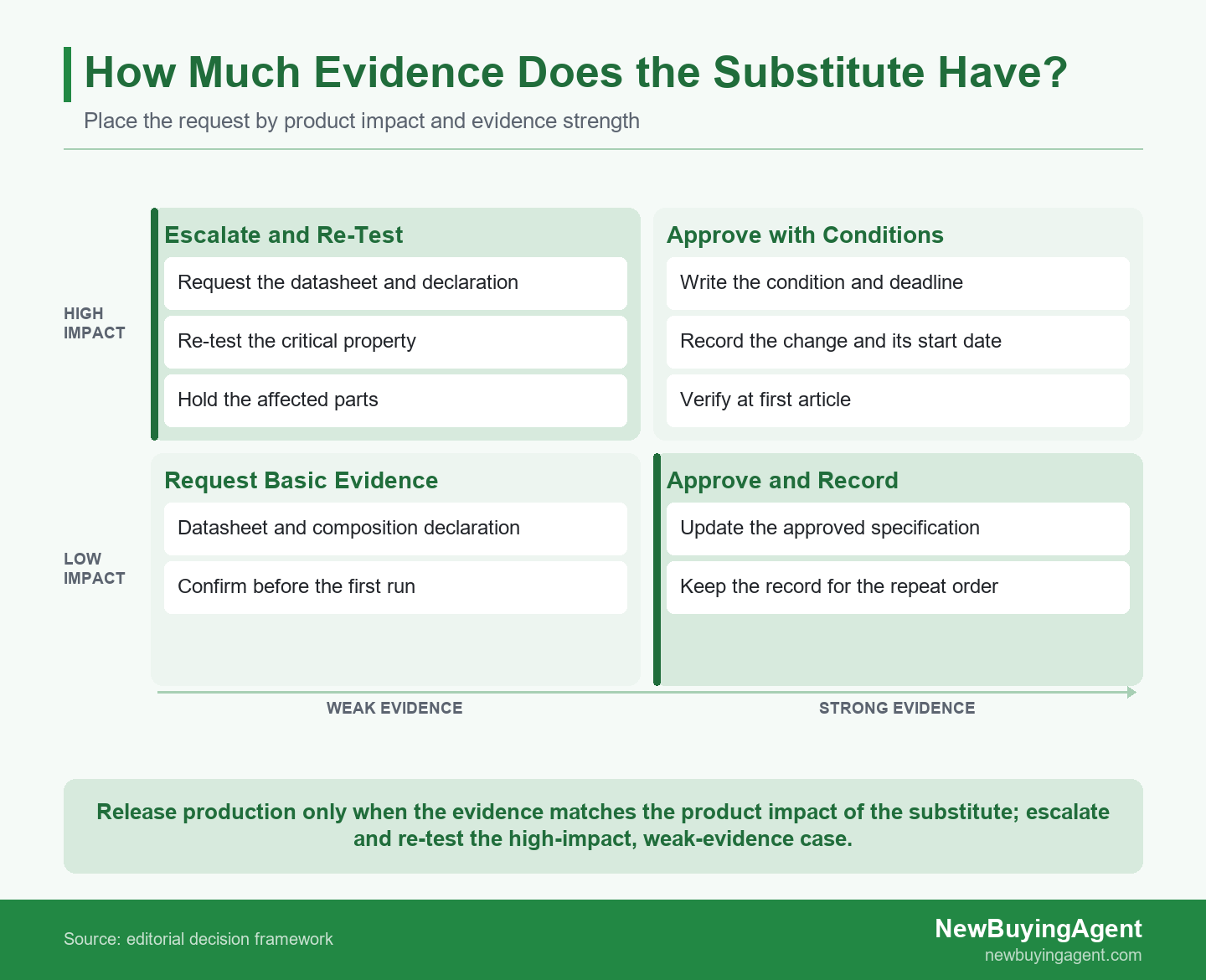
Two-axis substitution decision matrix placing a proposed material by product impact and evidence strength, from approve to escalate and re-test
Evidence to Request Before You Approve
Request three things before approving a substitution: a material datasheet with a structured declaration, the compliance declarations for the destination market, and a re-test plan that uses the same method as the approved material. The evidence should close the four review areas rather than accumulate paperwork. A document that does not change a decision is not worth requesting, and a decision without the closing document is not worth approving.
Where the product is supplied through a China sourcing path, the same evidence belongs in the supply brief. NewBuyingAgent's product-supply service sources the product against the agreed material and can carry the substitution evidence into the order instead of leaving it as a side conversation.
| Substitution trigger | What changed | Evidence required | Decision rule |
|---|---|---|---|
| Cost or availability | Grade or supplier | Datasheet and declaration | Approve only if function and compliance hold |
| Restricted substance | Reformulated grade | Compliance declaration | Confirm the duty the old material met |
| Delivery pressure | Alternative grade | Datasheet and re-test plan | Protect the date without moving risk |
| Food-contact part | Different polymer | Permitted-use declaration and re-test | Confirm it is permitted for the intended use |
| Textile or finish | Fiber or finish change | Flammability evidence | Re-verify the applicable standard |
Read the table as a decision rule: the trigger decides which evidence is required, and the evidence decides whether the substitute can be released. A request that reaches the release gate without its required evidence is still open, whatever the sample looked like.
Material Datasheet and Equivalence Claim
The datasheet and a structured declaration show what the substitute actually contains and how it compares with the approved material. A structured format is more useful than a chat message because it can be compared, stored and reused on the next order instead of argued about. IEC 62474 defines a material declaration for products of and for the electrotechnical industry. The transferable lesson is to declare composition in a structured form instead of asserting equivalence, which is what a buyer should ask for from any factory. Ask for the declaration to name the material version so the document can be tied to a specific production lot.
Regulatory and Composition Declarations
Compliance declarations should name the regulation, the substance limits and the version of the material they describe. A declaration that says only that a material is compliant, without the material version, cannot be matched to a production lot, and a lot that cannot be matched cannot be defended later. Match each declaration to the market where the product will be sold, because restricted-substance, warning and food-contact regimes apply different duties to different products. Keep the declaration with the approved specification so the next order starts from the same evidence rather than from a fresh promise.
Re-Test Plan and Sample Verification
A re-test plan should use the same method as the approved material so the two sets of results can be compared. ASTM D638 is the standard test method for tensile properties of plastics, which is one example of a published method that can be run on both the original and the substitute grade. The buyer sets the acceptance limit; the method only guarantees that both materials were measured the same way. Where the critical property is not a tensile property, use the method that matches it, and record the method number, the laboratory and the sample date so the result can be traced back to the exact lot that was tested.
Decision Rules and Boundary Cases
Approve when the evidence shows the substitute preserves fit, compliance and continuity; approve with conditions when a gap can be closed before release; reject when a core requirement cannot be shown. The rule is deliberately evidence-based rather than schedule-based. A factory deadline is a reason to speed up the evidence, not a reason to release production without it.
Approve, Approve with Conditions, or Reject
The three outcomes map directly to how much of the required evidence is closed before production. Approve when the datasheet, the declaration and any needed re-test are complete and consistent with the destination market. Approve with conditions when the substitute is acceptable in principle but one document or test is still open, and write the condition, the owner and the deadline so the release cannot drift. Reject when a core requirement cannot be demonstrated, and say which requirement failed.
For buyers who already have a Chinese factory, following the condition into production is often the harder part. NewBuyingAgent's existing-factory management service connects local follow-up and quality-control capability with that ongoing supply work, so a conditional approval and its evidence can be tracked instead of forgotten.
Boundary Cases That Change the Answer
Some products raise the bar, and the same substitute can be routine for one product and unacceptable for another. The trigger is usually the product's use rather than the size of the change. When a boundary applies, the buyer should move to the stricter path instead of arguing about how small the change looks.
The triggers are concrete. A food-contact part brings the permitted-use rules of 21 CFR Part 177 into the decision, and a carpet or rug brings the flammability standard in 16 CFR Part 1630. A child-facing product, a part with a safety function, or a component already shipping in a repeat order should be treated as high impact even where no single rule is named.
Illustrative Example: A Substituted Gasket in a 12,000-Unit Order
The example below is illustrative, not a reported client project. It shows how the four-part substitution review and the release rule work together on one bounded order, and where the buyer separates reversible preparation from the release that depends on missing evidence.
What the Buyer Checked Before Releasing Production
Illustrative example. A consumer brand is sourcing a water bottle with a food-contact gasket from a China factory, with 12,000 units planned and the gasket supplied by a sub-tier factory. Tooling is built, the sample was approved with the original elastomer, and production is about to start.
Two days before mass production, the factory proposes a different gasket elastomer. The sample of the substitute looks and feels identical to the approved gasket, and the factory describes the new grade as equivalent, but it provides no datasheet and no food-contact declaration.
Because the gasket touches drinking water, the change is a food-contact and compliance question, not only a fit question. The affected scope is the gasket on all 12,000 units, while the bottle and cap are unaffected. The buyer holds the gasket lots and allows bottle and cap production to continue.
The factory is asked for the material datasheet and a food-contact declaration, and to re-test the sealing property of the substitute against the same method used for the approved gasket. The gasket lots are released only when the declaration and the re-test results match the destination-market requirement and the product's sealing function.
The example invents no measured value and no passed test, and it is not a client case. The real evidence set and limits depend on the product and its market.
What to Prepare Before You Ask for a Quote
Before asking for a quote, prepare the specification, the proposed substitute, the target market, the order quantity and the evidence you will require. A complete brief lets the material decision be priced and followed inside the order instead of being reopened after tooling or packaging is fixed. The preparation list below is short on purpose; each item changes what the supplier can quote and what the buyer can check.
- The approved specification: the material, the part and the property that matters most for the product.
- The proposed substitute: the grade, the supplier and the reason the factory gave.
- The destination market: the market whose rules the finished product must meet.
- The order quantity and timing: how many units are affected and when production must start.
- The evidence requirement: the datasheet, declaration and re-test you will accept before release.
For a product where a material change is already on the table, NewBuyingAgent can use its local China factory resources and product-development/QC capability to source and follow the order with the approved material and the substitution evidence recorded. With the specification, the proposed substitute and the evidence requirement ready, send your product requirements to NewBuyingAgent.
Frequently Asked Questions
Is a material substitution the same as a specification change?
A material substitution is one kind of specification change, so it should follow the same approval and record-keeping path. The difference is scope: a substitution changes one input to the approved product, while a wider specification change can alter dimensions, performance targets or packaging at the same time. Both change the approved configuration, so both need an owner, evidence and a recorded version rather than an informal message to the factory.
Can the buyer accept a substitution if the sample looks identical?
No; appearance does not show composition, compliance or long-term performance, so it cannot close the decision on its own. A matching sample can still differ in stiffness, sealing, wear or restricted-substance content, and those differences often appear only after production or in use. Use the visual match as a reason to continue the review, not as the evidence that ends it.
Who pays for re-testing a substituted material?
The cost is a commercial term, and it is reasonable to expect the party that proposes the change to fund the evidence that proves it. That position is also practical: a factory that wants the substitute has the strongest incentive to obtain the datasheet, the declaration and the test result quickly. Whatever is agreed, write the allocation into the same record as the approval so the cost does not reappear as a dispute later.
How long should the substitution record be kept?
Keep the record at least as long as the product is in production or on sale, because the next order and any claim depend on it. The record should travel with the specification so that a repeat order, a new factory or a quality investigation can see what was approved and when it applied. Retention is cheap compared with reconstructing a decision from old messages after a problem appears.
NewBuyingAgent
Related Resources

Comece hoje
Vamos transformar seus objetivos de compras em realidadeWeChat:+86 15157124615
WhatsApp:+86 15157124615
Endereço: Edifício 10 #39 Xiangyuan Road, Hangzhou, China
