

A factory may own a generator, have spare operators and list two material vendors yet still be unable to supply your approved product during a disruption. Evaluate power, labor and raw-material contingency arrangements by the output they can support safely, the quality controls they preserve and the time needed to recover. A factory audit should turn each reassuring claim into a product-specific question, a checkable record and a clear purchase condition.
What to Accept Before Relying on a Factory Backup
Accept backup claims only within the product, process and timing covered by credible evidence. The audit should identify the interrupted resource, show that an available alternative can support the necessary work, and preserve the approved quality requirements. When evidence is incomplete, restrict the affected commitment or require corrective proof rather than giving the entire factory an unsupported pass or fail label.
- Risk: A backup machine, worker or material supplier can depend on the same resource that causes the original interruption.
- How it works: Pair each audit question with records, safe observations and the specific product scope they establish.
- Decision: Agree what evidence closes each gap before increasing the affected order.
- Timeline: Assess recovered acceptable output and backlog, not merely the moment equipment starts again.
The Three-Resource Continuity Grid
The Three-Resource Continuity Grid organizes a factory audit around power, labor and raw materials. For each resource, record the promised backup, the evidence that it supports the approved product, and the dependency that could still stop production. A missing necessary link can block acceptable output even when other backups work. Use the grid to identify the corrective condition for an affected order; it is a buyer decision aid, not a numerical certification score.
There is a useful sector-specific precedent: IATF 16949 automotive sanctioned interpretations address utility interruptions, labor shortages and interruptions in externally provided products, processes and services, alongside effectiveness testing and customer notification. These are automotive requirements within their applicable scope. They do not establish a universal audit rule for every Chinese consumer-product factory, but they show why a contingency discussion should go beyond asset ownership.
Start with the product and latest acceptable recovery point. The UK government business-continuity toolkit links critical activities to interruption impacts, recovery timing and the resources needed to resume them. Adapt that reasoning to your order: identify molding, drying, coating, assembly, inspection or outside processing that cannot be skipped. Ask what quantity can be completed after a disruption and what evidence supports that schedule.
| Resource | Audit question | Useful evidence | Weak answer |
|---|---|---|---|
| Power | Which complete product process is supported? | Load scope, test record, fuel and recovery limits | The generator starts |
| Labor | Which safe, competent shift can operate? | Role coverage, demonstrated competence, quality coverage | We have enough employees |
| Raw materials | Which approved lots are actually available? | Lot identity, usable quantity, allocation, replenishment proof | We have a second vendor |
Power: Which Approved Processes Can Actually Continue?
Backup electricity should support the complete approved process, including equipment that keeps it safe and within its operating limits. A molding machine may also need cooling, compressed air, material drying, extraction and process controls. Ask the factory to distinguish the loads covered by backup power from loads that will stop. That distinction determines whether the factory can continue production, preserve work in progress or only shut down safely.
- Which product lines and auxiliary systems are connected to the backup arrangement?
- What operating and starting loads were used to assess its capability, and who reviewed them?
- What record shows the system operating under relevant load, rather than just starting without load?
- How are fuel availability, replenishment, maintenance and transfer arrangements checked?
- Which conditions require a safe stop, and how are interrupted units identified afterward?
A maintenance log and a photograph answer different questions. The photograph establishes that equipment was present; the log may show servicing. In its service guidance, Cummins describes load-bank testing as exercising a standby system under load to verify emergency-performance reliability. A load-bank result still does not prove that the factory’s transfer, distribution and every production auxiliary work together. Request the test scope and remaining limitations before treating it as whole-process evidence.
Safety cannot be traded for speed. OSHA’s portable-generator guidance identifies electrical, carbon-monoxide, fire and noise hazards. It is US safety guidance, not a substitute for the installed system’s applicable Chinese requirements. Qualified responsible personnel should assess and operate the actual arrangement. A buyer should request their records and explanation, not improvise wiring, disconnect the utility supply or direct an unsafe live demonstration.
Finally, ask how long the supported process can run under the stated conditions. Fuel stored on site is different from fuel promised by a vendor, and a regional disruption may affect replenishment. Record the safe operating duration, production limits and restart checks separately. Avoid converting one equipment rating into an unsupported promise of uninterrupted factory output.
Labor: Can a Safe, Competent Shift Still Make the Product?
A labor contingency needs a safe, competent staffing complement for the affected product and shift. Total headcount does not establish coverage of setup, production, maintenance, material handling and quality decisions. Ask which roles are necessary at the proposed reduced output and who can perform them. If a qualified inspector or maintenance response is missing, extra operators alone may leave the line unable to produce or release acceptable goods.
- Which minimum roles are needed for the affected process and its quality checks?
- What evidence shows available personnel can perform those roles on this product?
- How will incoming checks, in-process checks and final acceptance remain covered?
- What output is realistic after onboarding, supervision and additional quality checks?
- How are working time, rest, safe staffing and recruitment arrangements reviewed?
Check practical ability rather than a list of training certificates. The ISO 9001 Auditing Practices Group educational guidance on competence distinguishes attending training from applying competence effectively, and considers competent replacements when usual duty-holders are absent. This is educational auditing guidance, not a new certification requirement. In a buyer audit, a task observation or relevant work result can help show whether the proposed shift can maintain the agreed product controls.
Emergency recruitment also needs a credible ethical route. ILO fair-recruitment guidance states that workers should not bear recruitment fees or related costs, directly or indirectly. Apply that principle when examining the factory’s recruitment arrangements and the responsibilities of any intermediary. Do not assume temporary workers are inherently unskilled or unethical; assess competence, voluntary terms and the actual arrangement. A staffing plan based on coercion or unsafe catch-up is not credible recovery evidence.
Ask the factory to show a realistic shift plan with output assumptions and supervision needs. Have applicable working-time, pay and safety obligations checked by qualified local personnel; an urgent commercial deadline does not by itself justify ignoring them. Role-level evidence is usually more useful than unrestricted personal employee files. Protect privacy while preserving enough information to verify the proposed production and quality coverage.
Raw Materials: Is the Backup Stock Usable and Approved?
Raw materials count as contingency stock when they are identifiable, usable, approved for the product and available to the affected order. Gross warehouse quantity can include expired, damaged, quarantined or already allocated material. Ask the factory to reconcile the claimed reserve with current lots, acceptance status and expected consumption. For alternative supply, assess both the material’s qualification and the practical route by which an available lot will reach the process.
- Which exact material, grade, specification and approved revision does the product need?
- Which accepted lots are on site, in usable condition and allocated to this order?
- How much output does that stock support after normal yield and competing commitments?
- What replenishment lead time includes manufacture, transit, receiving and qualification?
- Does a proposed alternative require buyer approval or new product/compliance checks?
Traceability helps connect reserve material to the product it can actually support. The GS1 Global Traceability Standard describes batch- or lot-level relationships between manufacturing inputs and outputs. For your audit, ask for a controlled link between the accepted input lot, relevant production records and resulting goods. A generic material name or vendor invoice alone may not distinguish the particular batch available for recovery.
An approved-vendor list is only a starting point. The ISO 9001 Auditing Practices Group educational external-provider guidance examines risk-based controls for externally provided products, processes and services, including specification and delivery considerations. This is educational guidance, not evidence that every listed supplier can deliver the needed grade tomorrow. Check current availability and the qualification scope before counting a second vendor as usable backup supply.
A substitute with a similar description can still change processing, performance, appearance or applicable product requirements. Keep the approved specification intact until the appropriate change review is complete. Inspectors can verify relevant lot and acceptance records without the buyer demanding every proprietary recipe. The Three-Resource Continuity Grid is useful because it turns “backup stock exists” into a narrower statement about which approved product and quantity that stock can support.
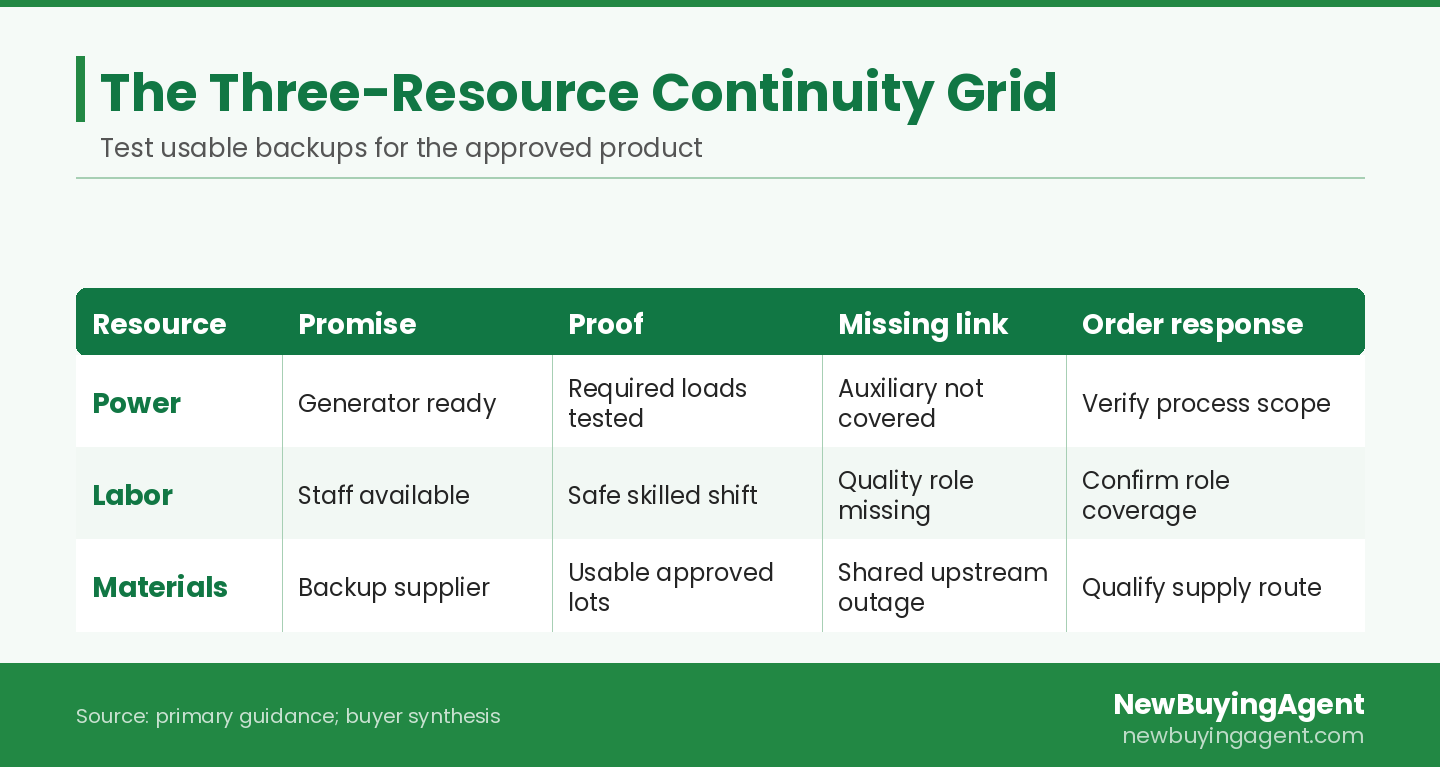
Power, labor, and material backups need product-specific evidence before orders expand
Find the Dependency That Can Defeat All Three Backups
Nominally separate backups can fail together when they share a location, electricity network, transport route or upstream input. Ask how each alternative would survive the same disruption that stops the primary arrangement. A second warehouse nearby, a staffing agency drawing from the same affected community or two material vendors buying from one upstream producer may provide less protection than their number suggests. Independence needs evidence, not an assumption.
Draw a simple dependency map for the critical resource. Record the main source, the alternative, their operating locations and the necessary links between them. The aim is not to collect an unlimited list of suppliers. It is to discover whether the proposed alternative changes the failure path that matters for this product. Where identities are confidential, ask for a sufficiently specific independent confirmation of the dependency and availability claim.
Consider power and materials together. A generator at the molding site cannot restore an upstream resin producer’s electricity. Similarly, more assembly workers cannot overcome a missing coating input, and material in another warehouse is not available if the only delivery route is blocked. These are operational questions about the particular supply arrangement, not claims that disruptions are common at all Chinese factories.
Place this resource audit within the broader purchasing preparation described in the China sourcing guide. Keep the product specification, required quality, order volume and delivery destination clear before judging alternatives. A backup that supports a different grade, a slower schedule or a different site may be an option, but it needs a revised and agreed supply commitment rather than an invisible change to the original order.
Verify Recovery Without Creating a New Production Risk
Verify contingency assumptions using existing controlled records, a tabletop exercise or an authorized safe demonstration proportionate to the gap. Agree the scenario, affected product, expected evidence and stop conditions before any test. The useful result is acceptable output and a supported recovery schedule, not simply a successful equipment restart. Avoid creating a real outage or exposing workers and production to an unplanned risk.
Manufacturing-specific continuity advice supports practicing the plan. NIST’s manufacturing continuity guidance recommends practice scenarios and preventive maintenance, while discussing critical inputs, lead times and material plans. It draws lessons from disruption experience in Puerto Rico; it does not supply a universal stock or recovery threshold for Chinese factories. Use its practical emphasis to ask whether the factory has exercised the particular assumptions on which your order depends.
For a tabletop review, walk through detection, safe stop, resource mobilization, restart checks, acceptable production and backlog recovery. Ask each responsible function for its evidence and elapsed-time assumption. A purchasing promise of material arrival should match the quality team’s time for receiving and acceptance. A production restart estimate should include the auxiliaries and competent staffing it requires. Record unresolved disagreements rather than smoothing them into a single optimistic date.
When an existing Chinese supplier needs local production and quality follow-up, NewBuyingAgent’s factory-management service provides China-side supplier communication, production-progress and quality management, with logistics coordination. Those capabilities can connect the agreed corrective evidence to the supplier’s actual order progress. Agree the relevant follow-up scope; electrical engineering, statutory safety approval and guarantees of recovery are separate questions.
After any relevant exercise or real interruption, retain the test conditions, observations, nonconforming or affected goods, corrective owner and recheck result. A repaired plan should be checked against the gap it was meant to close. Review again when the product, critical equipment, material source, staffing arrangement or backup location changes enough to invalidate the earlier evidence.
Convert Missing Evidence into Purchase Conditions
Match the purchase response to demonstrated resource coverage and the impact of the unresolved gap. Proceed within supported product and quantity limits when safe, qualified recovery fits the order. Where a missing record or capability affects only part of the commitment, set a corrective condition for that part. Reconsider timing or the supply route when acceptable recovery cannot meet the buyer’s needs; a favorable average score cannot cancel one essential missing resource.
| Evidence state | Purchase response | Evidence needed next |
|---|---|---|
| Backup supports the approved process and order | Proceed within demonstrated scope | Retain limits and relevant recheck triggers |
| Correctable gap affects defined volume or process | Condition the affected commitment | Named owner, due point and specific verification |
| Recovery cannot meet quality, safety or timing needs | Revise timing or supply route | Qualified alternative and realistic delivery agreement |
Illustrative Example: Two Material Sources, One Electricity Network
Situation: This illustrative example uses assumed quantities, not a customer case. An importer orders 8,000 units of storage baskets. Accepted, usable resin on site supports 5,000 units; the remaining 3,000 units depend on incoming resin. The factory shows that its generator supports the required molding process and says two approved resin vendors provide replenishment protection.
Problem: The audit finds that both resin vendors depend on the same local electricity network. A regional outage could therefore interrupt both incoming options while the basket factory’s generator keeps running. The observation does not prove an outage will occur, but it removes the basis for treating two vendor names as independent protection. The uncovered 3,000 units need a different replenishment argument.
Action: In this illustrative example, the buyer limits the supported commitment to the 5,000 units backed by usable resin and verified process capacity, while conditioning the remaining 3,000 units on corrective evidence. The factory investigates a geographically separate material route, checks current availability and completes the relevant qualification review. An identified alternative lot is not yet proof of suitability; lot acceptance, an authorized product trial and a revised schedule still need checking.
Result: The revised plan distinguishes supported production from the volume still waiting for qualified replenishment evidence. The buyer can increase the affected commitment after the input option and schedule are verified, rather than relying on the original two-vendor claim. This is a decision outcome within an assumed example, not a measured delivery improvement or a guarantee that any regional disruption can be overcome.
Keep the Audit Findings Connected to the Supply Commitment
Carry each audit gap into the supply commitment with an affected process or input, a responsible owner, a due point and a verifiable closure condition. The production team needs to know which quantity and schedule the evidence supports; the buyer needs to know when a changed resource invalidates that support. A finding that remains in an audit report without changing the next order leaves the original assumption in place.
When the requested product or delivery window needs a new supply option, NewBuyingAgent is a one-stop China sourcing agent for global buyers. NewBuyingAgent’s product-supply service brings local China factory resources, industrial-cluster access and product-development and quality-control capability to quoting and supplying China-sourced products. Put critical materials, operating constraints and acceptable recovery limits into the purchasing brief. Factory-network access creates sourcing options; a specific option still needs suitable product evidence and agreed quality and delivery requirements.
If current backup coverage cannot support the planned order, send purchasing requirements to NewBuyingAgent with product specifications, quantity, target price, destination, delivery timing and the critical material or continuity constraints. NewBuyingAgent can use that complete requirement to quote and supply products from China. The next useful outcome is a supply proposal with realistic product, quality and delivery assumptions that your team can evaluate.
Frequently Asked Questions
Does a factory without a generator automatically fail the audit?
A factory without a generator can still have an acceptable contingency arrangement if a safe, qualified alternative meets the buyer’s product and delivery needs. That may involve planned interruption tolerance or another approved production route. Evaluate its availability, quality controls and timing rather than imposing equipment ownership as a universal pass condition.
How many days of raw-material stock should buyers require?
Set material coverage from the affected input’s replenishment and qualification time, the order schedule and the buyer’s tolerance for interruption. Include usable allocation and realistic consumption, not gross warehouse inventory. Different materials can need different coverage; a fixed stock-days rule may waste cash on one input while leaving another critical input exposed.
Does a continuity certificate replace these questions?
A continuity certificate does not by itself show that the audited site can recover the buyer’s specific approved product. Check the certificate’s actual scope, then verify the relevant process, people, input and recovery evidence. Certification can be context for the evaluation; it cannot replace missing product-specific proof.
What if the factory will not disclose its upstream suppliers?
A factory can protect supplier identities while providing enough independently checkable evidence to assess shared dependencies and usable material availability. Agree what a qualified reviewer can verify confidentially and what scoped conclusion the buyer receives. If confidentiality prevents verification of an essential claim, retain that uncertainty in the purchase decision rather than assuming independence.
NewBuyingAgent
Related Resources

Comece hoje
Vamos transformar seus objetivos de compras em realidadeWeChat:+86 15157124615
WhatsApp:+86 15157124615
Endereço: Edifício 10 #39 Xiangyuan Road, Hangzhou, China
