

Get the HS code wrong on apparel and one of three things happens: you pay too much in duty, you pay too little and get hit with a back-duty assessment plus penalties at the next audit, or your shipment gets held while CBP requests a binding ruling.
The most common source of mis-classification on knit apparel is the boundary between HS 6109 (T-shirts, singlets and other vests, knitted or crocheted) and HS 6110 (sweaters, pullovers, sweatshirts, waistcoats and similar articles, knitted or crocheted). The distinction matters more than you'd think — duty rates, tariff exposure, and country-of-origin treatment all hinge on which heading the garment falls under.
Below is the actual decision rule, with the criteria customs uses, the edge cases that trip up importers, and what to do when classification is ambiguous.
Key Takeaways
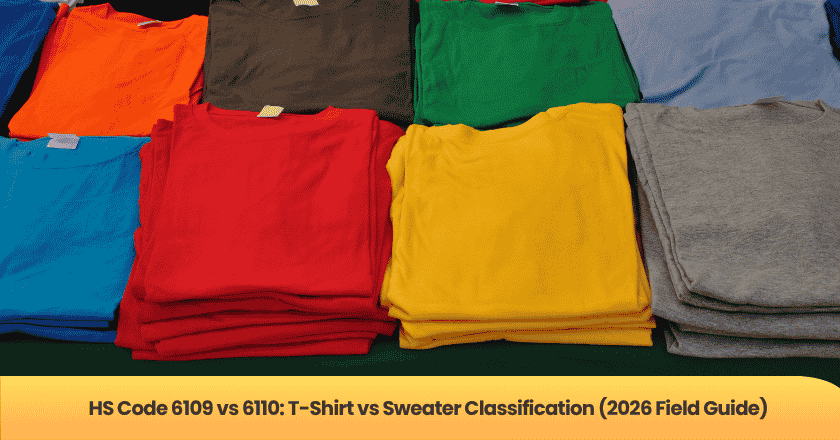
- HS 6109 covers T-shirts, singlets, tank tops, and other knit/crochet vests — lightweight, typically short-sleeved or sleeveless, intended as inner or single-layer wear.
- HS 6110 covers sweaters, pullovers, sweatshirts, waistcoats, cardigans — typically heavier, often long-sleeved, intended for layering or as outerwear.
- The primary discriminator is the garment's character and construction (weight, structure, intended wear), not just sleeve length or fabric.
- US duty rates differ meaningfully: 6109 cotton T-shirts at ~16.5% MFN, 6110 cotton sweaters at ~16.5% MFN — close, but Section 301 and Section 122 layers stack on top and country-specific exclusions vary.
- Section 301 List 4B at 15% (effective January 15, 2026) applies to most Chinese-origin apparel including both 6109 and 6110; Section 122's universal 10% (effective February 24, 2026, scheduled expiry July 24, 2026) layers on top.
- When in doubt, request a CBP binding ruling — free, takes 30–90 days, and gives you legally binding classification that protects against future challenges.
What HS 6109 Actually Covers
HS heading 6109 is defined as "T-shirts, singlets and other vests, knitted or crocheted." The subheadings under 6109 distinguish primarily by fiber content:
- 6109.10: of cotton
- 6109.90: of other textile materials (includes synthetics, blends)
Garments classified here typically share these characteristics:
- Lightweight knit fabric (typically 100–200 GSM)
- Single-layer wear — designed to be worn directly against the skin or as the top visible layer in warm weather
- Short or no sleeves in the typical case (though long-sleeved T-shirts can also fall here in some configurations)
- No significant closure — pulled over the head, no buttons running down the front, no zipper from neckline to hem
- Body-contoured fit rather than oversized layering
Standard examples that clearly fall in 6109:
- Cotton crew-neck T-shirt
- Cotton V-neck T-shirt
- Athletic-fit polyester moisture-wicking shirt
- Sleeveless cotton tank top
- Cotton/spandex blend fitted T-shirt
What HS 6110 Actually Covers
HS heading 6110 is defined as "Sweaters, pullovers, sweatshirts, waistcoats (vests) and similar articles, knitted or crocheted." The subheadings:
- 6110.11/12: of wool or fine animal hair
- 6110.20: of cotton
- 6110.30: of man-made fibers
- 6110.90: of other textile materials
Garments classified here typically share these characteristics:
- Heavier knit fabric (typically 250+ GSM for cotton; varies for wool/synthetics)
- Layering-appropriate construction — designed to be worn over other garments, especially in cool weather
- Longer sleeves in most configurations
- May have closures (cardigan-style buttons, zip-up sweatshirts)
- Structural elements suggesting outerwear or layering use (ribbed cuffs and hems, hoods, kangaroo pockets, sweatshirt fleece backing)
Standard examples that clearly fall in 6110:
- Cotton crewneck sweatshirt
- Wool cable-knit pullover sweater
- Polyester fleece-lined zip-up hoodie
- Cotton/poly cardigan with button front
- Athletic full-zip warm-up jacket (knit construction)
The Boundary Cases That Cause Disputes
The boundary between 6109 and 6110 is where most classification disputes happen. Specific patterns:
- Long-sleeved T-shirts. A long-sleeved cotton T-shirt with the same body construction as a short-sleeved T-shirt — same fabric weight, same fit, no layering structure — typically falls in 6109. The sleeve length doesn't change the garment's fundamental character. However, a long-sleeved knit shirt with sweatshirt-style ribbing at cuffs and hem, heavier fabric weight, and looser layering fit may fall in 6110.
- Lightweight sweatshirts. A "French terry" sweatshirt or thin lightweight fleece pullover sits in an ambiguous space. CBP guidance has generally classified these in 6110 as long as they have sweatshirt structural elements (ribbed cuffs/hem, sweatshirt construction) regardless of weight.
- Polo shirts and rugby shirts. Polo shirts with a button placket are typically classified in 6105 (men's shirts) or 6106 (women's blouses), not 6109. Rugby shirts may fall in either 6105/6106 or 6110 depending on construction. This is a different boundary from 6109/6110.
- Tank tops with embellishment. A plain tank top is 6109. A tank top heavily embellished or constructed as a "fashion piece" intended for outerwear use may be classified differently — sometimes in 6109, sometimes in other headings, depending on detail.
- Children's garments. Same classification rules apply, but pediatric sizing thresholds and characteristics sometimes shift classification. Verify against the specific subheading rules for children's apparel.
How CBP Makes the Determination
When a customs entry is reviewed, CBP looks at:
- The garment itself (if pulled for inspection) — physical examination of construction, fabric weight, structural elements
- The fabric content declaration — should match the label on the garment
- The commercial invoice description — should be specific enough to support the HS code claimed
- Industry conventions — how the trade typically classifies similar garments
- Prior binding rulings — if there's a published CBP ruling on a similar garment, that ruling generally controls
For close-call cases, CBP examiners often rely on the "essential character" test from the Harmonized System General Rules of Interpretation: what is the garment fundamentally? An item with characteristics of both a T-shirt and a sweater is classified according to which characteristic dominates.
The factors examiners consider:
- Weight per square meter (heavier = sweater)
- Construction (sweatshirt fleece backing = sweater)
- Closure type (button front, zip front = often sweater)
- Marketing and consumer use (how it's sold)
- Layering intent (designed to be worn under or over other clothing)
When to Get a CBP Binding Ruling
If you're sourcing a garment whose classification is ambiguous, you can request a binding ruling from CBP before importation. Process:
- Submit a written ruling request to CBP National Commodity Specialist Division, including a detailed description and a sample of the garment
- CBP reviews and issues a written ruling within 30–90 days (in 2026; can vary)
- The ruling is binding on CBP for that specific product imported by you
- Ruling is public; published in the CBP ruling database
When binding rulings are worth it:
- Garment is on a clear 6109/6110 boundary
- Annual import volume is significant (USD 100K+ in that SKU)
- Penalty exposure for mis-classification would be material
- You want certainty for financial reporting purposes
When they're not necessary:
- Garment is clearly in one heading
- Volume is small enough that the classification risk is modest
- You're using a licensed customs broker who can provide a written opinion at lower cost than a CBP ruling
Cost: free to request. Time: 30–90 days. Worth it for serious volume on ambiguous garments.
Expert Tip: When in any doubt, work with a licensed customs broker on the classification before importation, not after. Broker fees for classification review are typically USD 100–300 per SKU and produce a defensible position. Misclassification caught at port can result in penalty assessments of 25–50% of the unpaid duty plus the duty itself — much more expensive than the broker review.
Frequently Asked Questions
Can the same physical garment be classified two ways?
Not legally — there's one correct classification for any given garment under the Harmonized System. In practice, classifications can be uncertain and reasonable people can disagree on close cases. The CBP binding ruling exists to resolve uncertainty.
Does CBP actually inspect apparel shipments to verify classification?
A small percentage of entries are physically examined. CBP uses risk-targeting algorithms — first-time importers, large dollar values, certain origins, and certain HS codes get higher examination rates. Garment shipments with HS 6109 or 6110 from China see elevated scrutiny in 2026 due to the tariff layer stacking.
What if my supplier puts a different HS code on the invoice than what I think is right?
The HS code on the commercial invoice is informational; the importer is legally responsible for the classification on the customs entry. If your customs broker classifies differently than the supplier's invoice, your classification controls (the broker should keep documentation supporting the choice).
Does it matter if my supplier mis-classifies on their end (Chinese export)?
Chinese export HS codes can differ from US import HS codes (the first 6 digits should match; subheadings can differ). The Chinese export classification is on the supplier's customs documents; the US import classification is on yours. Discrepancies are normal at the subheading level but should match at heading.
What about polo shirts?
Polo shirts with a button placket are typically classified in 6105 (men's shirts, knit) or 6106 (women's blouses, knit), not 6109 or 6110. The button placket and collar construction takes it out of the T-shirt category.
Do hoodies fall in 6109 or 6110?
Hoodies almost always fall in 6110 because the hood plus typical fleece/sweatshirt construction puts them in the "sweater/pullover/sweatshirt" category, regardless of sleeve length.
Are duty rates the same for men's, women's, and children's garments?
Within each heading, sub-classifications by gender and age can have different rates. Children's apparel sometimes has lower base duties; women's vs men's distinctions matter for some headings. Verify the specific 10-digit HTSUS code for your garment, not just the 4-digit HS code.
Where can I look up the current HTSUS rates?
USITC's HTSUS database (hts.usitc.gov) is the authoritative current source for US import duty rates. The CBP CROSS database has searchable binding rulings. Both are free to access.
NewBuyingAgent
Related Resources


Comece hoje
Vamos transformar seus objetivos de compras em realidadeWeChat:+86 15157124615
WhatsApp:+86 15157124615
Endereço: Edifício 10 #39 Xiangyuan Road, Hangzhou, China
