

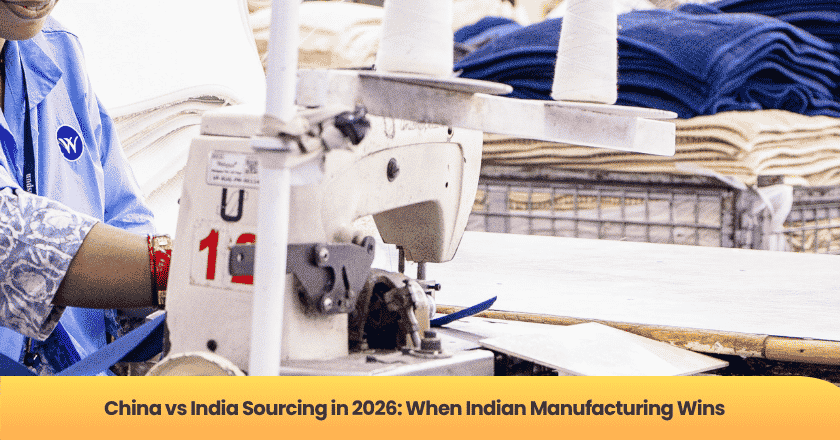
India's tariff situation has whipsawed three times in six months — from 50% to 18% under the Interim Agreement, then to 10% Section 122 after SCOTUS. The country is now competitive on duty cost for the first time in years, but capability gaps decide whether the math actually pays back.
Key Takeaways
- India's effective tariff rate on most exports to the US is currently 10% Section 122 + MFN (typically 25–35% all-in given India's high MFN rates), down from 50% earlier in 2025. China sits at 35–45% on the same categories. The India-China gap has narrowed significantly but India still wins on duty for most categories.
- India has no Section 301 exposure, no FTA with the US, and no GSP benefits (revoked in 2019). The full MFN rate stacks on top of Section 122 — and India's MFN rates on textiles, apparel, footwear, and many consumer goods are among the highest in the US tariff schedule.
- India dominates in pharmaceuticals (40%+ of US generic prescriptions), cut diamonds (~90% of global processing), specialty textiles (Tirupur cotton, handloom), engineering goods, and is rapidly building electronics assembly capacity (Apple/Foxconn, Samsung).
- India's manufacturing weaknesses vs China: smaller scale across most categories, less mature supply chain integration (especially for electronic components), more variable quality control, slower freight lanes (30–35 days India-to-US-West-Coast vs 18–22 from Vietnam), more bureaucratic export customs.
- US imports from India totaled $87B in 2024. Apple has expanded iPhone production in India through Foxconn and Tata Electronics, signaling category-by-category capability shifts.
- Two policy variables to track: Section 122 sunset on July 24, 2026 (would drop India to MFN-only — a meaningful additional benefit) and the March 11, 2026 USTR Section 301 investigation that includes India among 16 economies (could raise India rates by late 2027).
For most of the past five years, India has been the secondary China alternative — overshadowed by Vietnam, where the supply chain ecosystem matured faster and capability spread across more categories. India's tariff situation made the comparison harder: high MFN rates on the categories where India actually has scale (textiles, apparel, leather goods) often pushed landed cost above China-with-Section-301 levels. The 2025 IEEPA reciprocal regime added a 25% punitive layer specifically on India over Russian oil purchases, briefly pushing effective rates above 50%.
That changed in early 2026. The February 6 US-India interim framework rescinded the punitive 25% layer, reducing effective rates to roughly 18%. Then on February 20, the Supreme Court invalidated the IEEPA tariffs entirely — including the remaining 18% reciprocal layer — and the new Section 122 took effect at 10%. India's effective rate dropped to 10% + MFN, which on most categories lands around 25–35% all-in. China sits at 35–45%. The gap is now real but more nuanced than the China-Vietnam comparison.
This guide covers when Indian sourcing makes sense, when China still wins, what India does well, and what the operational and capability differences actually look like for buyers running active dual sourcing.
Part 1: The 2026 Tariff Math, India vs China
The India duty stack as of May 2026:
| Tariff layer | China | India |
|---|---|---|
| Base MFN duty | 0–32% (HTS-specific) | 0–32% (same MFN schedule, but India often hits higher MFN ranges in its export categories) |
| Section 122 (until July 24, 2026 sunset) | 10% | 10% |
| Section 301 | 7.5–100% | None |
| Section 232 (steel/aluminum) | 50% | 50% |
| GSP/FTA preference | None | None (GSP revoked 2019, no FTA) |
| Typical effective rate, consumer goods | 35–45% | 20–35% |
The India advantage over China is roughly 10–15 percentage points on most categories — smaller than Vietnam's ~25-point advantage, because India's MFN rates run higher than Vietnam's in the categories India actually exports.
Worked example: cotton t-shirts from Tirupur
A US apparel brand sources cotton knit t-shirts from Tirupur (India's largest knitwear cluster). HTS 6109.10.00 (men's cotton knit t-shirts), MFN 16.5%.
| Cost line | China (Yiwu) | India (Tirupur) |
|---|---|---|
| Factory FOB ($3.50/unit × 10,000) | $35,000 | $35,000 (similar unit cost in cotton knits) |
| Ocean freight (40' to LA) | $2,800 | $4,200 (longer lane, less density) |
| MFN duty (16.5%) | $5,775 | $5,775 |
| Section 122 (10%) | $3,500 | $3,500 |
| Section 301 (List 4A 7.5%) | $2,625 | $0 |
| MPF + HMF | $169 | $169 |
| Customs broker + drayage | $700 | $800 |
| Total landed | $50,569 | $49,444 |
| India saves | $1,125 (2.2%) |
In cotton knits at parity factory price, India barely beats China — the higher freight cost partially offsets the Section 301 savings. The advantage is real but small. For categories with higher Section 301 (List 1–3 at 25%), the gap widens significantly.
Where the math breaks down for India
For high-MFN categories (apparel synthetic fibers at 32%, footwear at 8.5–37.5%) where India runs near-parity unit cost with China, the small Section 301 advantage (often List 4A at 7.5% or 4B at 15%) doesn't always offset India's freight disadvantage. Vietnam usually wins these comparisons.
For low-Section-301 categories where China still has cost advantages, India can lose the landed cost comparison even with the duty advantage.
Part 2: Where India Wins Decisively
Five categories where India genuinely outperforms China for US buyers, regardless of the full tariff math.
1. Generic pharmaceuticals
India produces over 40% of the US generic drug supply. The combination of regulatory expertise (FDA-inspected facilities are common), API (active pharmaceutical ingredient) manufacturing scale, and unit cost discipline gives India an essentially uncontested position. China makes some APIs but has limited finished generic drug capability for the US market. Tariff context: most finished pharmaceuticals enter at 0% MFN, so the 10% Section 122 layer is the only duty — and the regulatory cost of switching countries in pharma is so high that tariff alone rarely drives sourcing changes.
2. Cut diamonds and jewelry
India processes roughly 90% of the world's diamonds by volume, with Surat being the global cutting center. The combination of skilled labor, technological investment, and integrated supply chain gives India a near-monopoly. China has minimal cut-diamond capability. For diamond and jewelry buyers, India is essentially the only Asian sourcing option.
3. Cotton apparel and Tirupur knitwear
India has multi-decade strength in cotton textiles, particularly in Tirupur (knit garments), Ludhiana (woolens), and Surat (synthetic textiles). Quality on premium cotton matches or exceeds China; capacity is large. The MFN rates on cotton apparel (16.5%) are the same regardless of origin, so India's Section 301 advantage shows up directly in landed cost.
4. Engineering goods, machinery, and certain industrial products
India's engineering exports have grown substantially. Mid-complexity machinery, automotive components, hand tools, and certain industrial products from clusters like Pune, Chennai, and Coimbatore are quality-competitive with China and benefit from significant Section 301 savings (most engineering categories fall under Lists 1–3 at 25%).
5. Electronics assembly (Apple supply chain)
The Apple-driven shift of iPhone assembly to India (through Foxconn India and Tata Electronics) signals broader capability development. India is now a credible second-source for consumer electronics assembly, particularly for products where component sourcing can be partly localized (display assembly, casing, battery integration). The capability is narrower than Vietnam's but growing fast.
Part 3: Where China Still Wins
Five categories where India's tariff advantage doesn't overcome China's structural strengths.
1. Complex hardware with deep component integration
Products requiring extensive electronic components (motors, sensors, custom ICs, precision metal parts) suffer in India because most of those components still come from China. Indian assembly + Chinese components = duty + freight + assembly cost on top of Chinese pricing. The math often loses to direct Chinese sourcing despite the tariff advantage.
2. Injection molding and tooling at scale
China has order-of-magnitude more mold-making and injection capacity than India. For products requiring custom plastic parts, Chinese tooling costs are typically 30–50% lower and lead times 30–50% shorter. India's tooling industry is growing but starts from a much smaller base.
3. Synthetic textiles and fast fashion
For synthetic apparel (high MFN rates of 25–32%), India's high MFN combined with lower production efficiency than Bangladesh or Vietnam often makes the landed cost uncompetitive. Bangladesh, Vietnam, and Cambodia have stronger fast-fashion infrastructures. India's strength is in cotton and premium textiles, not in commodity synthetics.
4. Niche specialty manufacturing
Anything that requires a specialized supplier ecosystem (specialty chemicals, advanced materials, certain medical devices) typically has a deeper Chinese supplier base than Indian. The duty cost is irrelevant if the product can't be made in India.
5. Very small batch / Yiwu-style consolidation
China's small-batch, multi-SKU consolidation ecosystem (centered in Yiwu) has no Indian equivalent. For test orders, sample programs, and quick-turn assortment work across many SKUs, China's structural advantage is large.
The category framework
| Category | India advantage | Best sourcing answer |
|---|---|---|
| Generic pharmaceuticals | Decisive | India |
| Diamonds, jewelry | Decisive | India |
| Cotton apparel (basics, knits) | Real but small | India or Vietnam (compare freight) |
| Synthetic apparel | Marginal | Vietnam, Bangladesh, or Cambodia |
| Footwear | Marginal | Vietnam typically wins |
| Furniture (wood, decorative) | Real | India competitive vs Vietnam |
| Home goods, decor | Real | India often wins on premium handicraft segments |
| Engineering goods, machinery | Real | India competitive on mid-complexity products |
| Consumer electronics assembly | Growing | India for established categories (phones); China for complex/new |
| Injection-molded plastics | Negative | China |
| Complex hardware | Negative | China |
| Specialty chemicals | Negative | China |
Common Mistake: Buyers assume India is always cheaper than China after the IEEPA reversal because the duty math suggests so. It isn't. India's MFN rates run higher in many of the categories India actually exports (apparel, footwear, leather goods), the freight lane is longer and more expensive, and Indian factory pricing in non-mature categories is often substantially above Chinese equivalents. Run the SKU-level math; don't generalize from the duty stack alone.
Part 4: The India Operational Reality
Five operational dimensions where India differs from China in ways that affect sourcing decisions.
Lead times
Indian factory lead times for established categories (apparel, home goods) are typically comparable to or slightly longer than China — 60–90 days from PO to shipment-ready. For categories where India is still building scale (electronics, complex hardware), expect 90–120 days. Production scheduling tends to be less flexible than China; rush orders are harder.
Communication
English fluency in Indian export factories is significantly better than in either China or Vietnam — India is functionally an English-speaking commercial environment for export business. Technical engineering discussions can be conducted directly without translation. This is one of India's underappreciated advantages.
Freight
India-US ocean lanes have less density than China-US or even Vietnam-US. Mumbai/Nhava Sheva to LA runs 30–35 days vs Vietnam's 18–22 days. Container availability is more variable, especially during peak season. Per-container rates typically run 30–50% above China rates.
Customs and bureaucracy
Indian export customs is more bureaucratic than China's, with longer documentation review times and more paper-based processes. Plan for 5–10 days from cargo-ready to vessel loading. The bureaucratic overhead is real but predictable; it's part of the operational rhythm, not a wild variable.
Quality control
Indian manufacturing quality is more variable than Chinese, both factory-to-factory and within a single factory's output. Top-tier Indian export factories match Chinese quality; mid-tier factories are more variable. Pre-shipment inspection is essential, and in-line inspection is recommended for any first orders.
Expert Tip: When evaluating an Indian supplier, weight references from US/EU buyers heavily. Indian factory representatives are usually fluent in English and present capability convincingly in conversation, but actual operational quality varies sharply. References from buyers who have placed at least 3 production orders give a much truer signal than what the factory's own marketing materials show. Commission-free sourcing agents who have worked with the supplier on multiple US-bound orders can usually share substantive references; commission-based agents may be less forthcoming because they don't want a buyer asking detailed questions of references that might surface margin discussions.
Part 5: How to Run Dual Sourcing Across China, Vietnam, and India
Buyers diversifying away from single-country China sourcing rarely run pure dual-source between China and just India. The realistic alternative for most categories is a triangle: China + Vietnam + India, with each origin serving the categories where it's structurally strongest.
The category-allocation framework
Apparel (cotton): India primary, Vietnam secondary, China backup.
Apparel (synthetic): Vietnam primary, Bangladesh secondary, India tertiary.
Footwear: Vietnam primary, India secondary, China backup.
Furniture: Vietnam primary, India secondary, China backup.
Consumer electronics (mass): China primary (for component depth), Vietnam secondary (for assembly), India tertiary (growing).
Pharmaceuticals: India primary (no real alternative in Asia for generics).
Diamonds, jewelry: India primary (no alternative).
Engineering goods, machinery: India and China comparable; choose by specific product capability.
Specialty chemicals, complex hardware: China primary, no realistic alternative in India.
Operational considerations for triangle sourcing
Multiple supplier vetting cycles. Each origin requires its own supplier discovery, qualification, and onboarding. This is real time investment — typically 3–6 months per origin for new categories.
Multiple freight relationships. Different carrier networks dominate different lanes. India-US tends to use different forwarder partners than China-US.
Multiple compliance frameworks. Indian export documentation is different from Chinese. CBP origin rules apply per shipment, and substantial transformation analysis is category-specific.
Multiple QC infrastructures. Inspection partners differ by country. SGS, QIMA, BV operate in all three but with different field strength in different cities.
Multiple regulatory contexts. Pharmaceuticals require FDA-inspected facilities (more common in India than China). Children's products require CPSIA testing — both China and India have testing infrastructure, but the specific labs and timelines differ.
For buyers managing this complexity, working with sourcing agents who have multi-country networks shortcuts what would otherwise be parallel single-country supplier development efforts. The agent absorbs the multi-country coordination work and presents a single point of contact across origins.
Part 6: What's Different About India Sourcing in 2026
Three forces have changed the India calculus compared to even 12 months ago.
First, the February 2026 tariff reset dropped India's effective rate from above 50% to about 25–35% (10% Section 122 + MFN). The Section 301-equivalent punitive tariff that briefly applied to India over Russian oil purchases is gone. The post-SCOTUS environment puts India on the same Section 122 baseline as Vietnam, with India's higher MFN rates being the main remaining differentiator.
Second, the Apple supply chain shift has been operationally significant. Apple's expanded iPhone production in India through Foxconn India and Tata Electronics has built electronics assembly capability that didn't exist five years ago. While the Apple ecosystem alone is only 1% of total Indian exports, it has trained a generation of Indian factory operators and engineers in modern electronics manufacturing — capability that's now spilling over to other consumer electronics buyers.
Third, the March 11, 2026 USTR Section 301 investigation explicitly named India among 16 economies under review for excess manufacturing capacity. The standard timeline from investigation to tariff action is 12–18 months. While India is less likely than China to face broad rate increases, sector-specific tariffs (steel, aluminum, certain electronics) could land in late 2026 or early 2027. The base case is that India remains a viable alternative; the downside scenario is targeted India-specific Section 301 action.
The Bottom Line
India's tariff position improved significantly through the first half of 2026. Effective rates are now roughly 25–35% all-in (10% Section 122 + India's typically higher MFN), versus China's 35–45%. The India advantage is real but smaller than Vietnam's, primarily because India's MFN rates run higher in its main export categories.
India wins decisively in categories where it has structural strength (pharmaceuticals, diamonds, cotton apparel, certain home goods) and is increasingly competitive in engineering goods, machinery, and electronics assembly. India loses to China in complex hardware, injection molding, specialty chemicals, and small-batch flexibility. For most US importers, India is best understood as a third leg in a China + Vietnam + India triangle rather than a primary China replacement.
The two near-term policy variables: Section 122 sunset July 24, 2026 (would drop India effective rate by 10 points to MFN-only — a significant additional benefit) and the March 2026 Section 301 investigation outcome (which could narrow India's advantage in late 2026 / early 2027 if it produces tariff actions on Indian goods).
FAQ
Is India cheaper than China after the recent tariff changes?
For some categories, yes. India's effective rate is currently around 25–35% (10% Section 122 + MFN), versus China's 35–45%. The India advantage is largest in categories with high Section 301 rates on China (Lists 1–3 at 25%) and low MFN rates (furniture at 0%, home goods at 3–6%). For high-MFN categories where India also exports (apparel at 16.5–32%), the savings are smaller and freight disadvantages can erode them.
Why is India's MFN rate so high on apparel?
India's MFN rates aren't India-specific — they're general US tariff schedule rates applied to all WTO members without preferential treatment. Apparel MFN rates are high because the US tariff schedule has historically protected domestic textile manufacturing. China, Vietnam, India, Bangladesh, and most other apparel-exporting countries face the same MFN rates. India loses on apparel when other countries (Mexico via USMCA, or theoretically South Korea via KORUS-FTA) get preferential treatment.
Did India's GSP benefits get restored?
No, not as of mid-2026. India's GSP benefits were revoked in June 2019 and have not been restored. Congress has not reauthorized GSP broadly since the program lapsed in 2020. India's reinstatement under any future GSP program would face additional political hurdles.
Is the US-India interim trade agreement still in effect?
Partially. The February 2026 framework eliminated the punitive 25% Russian oil layer. The 18% reciprocal rate that the framework set was an IEEPA-based duty, which the SCOTUS ruling on February 20, 2026 invalidated. The current effective rate is 10% Section 122 + MFN, which is generally lower than what the framework specified. The full bilateral trade agreement is still being negotiated; provisions for further tariff reductions or sector-specific access (pharmaceuticals, gems, aircraft) depend on its conclusion.
How do Indian factory lead times compare to Chinese?
For mature categories (apparel, home goods, engineering goods), Indian lead times are comparable to or slightly longer than Chinese — 60–90 days vs 45–75 days. For categories where India is building capacity (electronics, complex hardware), 90–120 days is more realistic. Rush orders are harder to accommodate in India than in China.
Can I get small-batch orders from India?
Possible but harder than from China. India lacks Yiwu-style multi-SKU consolidation infrastructure. Some categories (handicrafts, certain textiles) have small-batch capability through regional clusters. For most modern manufacturing categories, Indian MOQs run 50–100% higher than Chinese equivalents. Working with Indian sourcing agents who specialize in small-batch can help but the structural disadvantage is real.
What's the freight situation India to US?
Less mature than China-US or Vietnam-US. Mumbai and Nhava Sheva ports serve the West Coast (LA/Long Beach) with 30–35 day transit times — about 10–15 days longer than Vietnam. East Coast lanes (to NY/NJ/Savannah) run 28–35 days via Suez. Container availability tightens during peak season (August–November). Per-container rates run 30–50% above China rates.
NewBuyingAgent
Related Resources

Comece hoje
Vamos transformar seus objetivos de compras em realidadeWeChat:+86 15157124615
WhatsApp:+86 15157124615
Endereço: Edifício 10 #39 Xiangyuan Road, Hangzhou, China
