

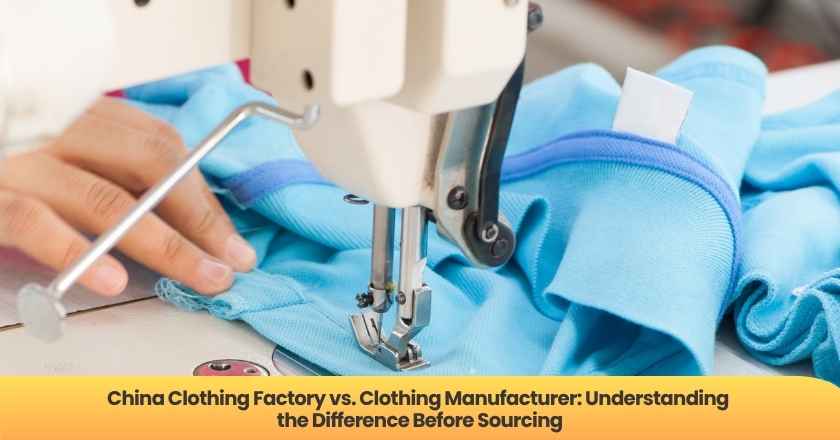
Introduction
Two suppliers reply to your inquiry. One calls itself a "clothing factory," the other a "clothing manufacturer." The quotes are 18% apart for what looks like the same hoodie. Most buyers assume the cheaper one is the better deal and the terms are interchangeable. They aren't — and the gap in price often reflects a real difference in what each company will actually do for you.
The labels get used loosely in English-language sourcing, partly because they translate imprecisely from Chinese business terms. But the operational difference is real, and picking the wrong type for your stage costs you either money or sanity. NewBuyingAgent sees buyers default to the cheapest quote without asking which production model sits behind it — and that single missed question shapes the whole order.
What follows isn't a vocabulary lesson. It's a way to read past the label on a supplier's homepage to the actual work they'll do — who sources your fabric, who develops your pattern, who carries the material risk — so you can match the right kind of partner to where your brand actually is.
Key Takeaways
• "Factory" usually means a production site that sews; "manufacturer" often implies broader service including sourcing materials and managing the full build.
• The real distinction is the service model: CMT, OEM, and ODM each shift different work onto you versus the supplier.
• A pure cut-make-trim factory is cheaper per piece but expects you to supply fabric, patterns, and trims yourself.
• New brands usually need OEM or ODM; experienced importers with their own materials can use bare factories.
• Matching the model to your capabilities matters more than chasing the lowest unit price.
What the Words Actually Mean in China
Why the terms blur
In Chinese, a 工厂 (factory) is the physical production facility, while a 制造商 (manufacturer) describes the entity responsible for making a product — which may or may not own the factory. Export sales teams translate both as whatever sounds most reassuring in English. So a company calling itself a "manufacturer" might run its own lines, or might coordinate production across several workshops it doesn't own.
The takeaway isn't to police vocabulary. It's to ignore the label and ask what the company physically does: Do they cut and sew on premises? Do they source your fabric, or do you? Do they develop patterns, or only follow yours? The answers define your relationship far better than the word on their homepage.
The service models that matter
Three acronyms carry the real meaning. CMT (Cut, Make, Trim — the factory only assembles garments from materials you supply). OEM (Original Equipment Manufacturer — the supplier sources materials and produces to your design and specs). ODM (Original Design Manufacturer — the supplier offers its own designs that you rebrand). A "factory" tends to mean CMT; a "manufacturer" tends to mean OEM or ODM. Tend to — not always.
Expert Tip: When a supplier won't clearly say whether they're CMT, OEM, or ODM, ask one question: "If I send only a sketch and no fabric, can you deliver finished goods?" A real OEM/ODM says yes and starts discussing fabric sourcing. A CMT factory says they need you to supply materials. The answer pins down your actual workload — who buys the fabric, who owns the pattern — before any quote is even on the table.
Where private label fits in
Buyers often hear "private label" and assume it's a fourth category. It isn't — it's a branding outcome that can sit on top of any of the three models. Private label means the goods carry your brand rather than the maker's, whether the underlying work was OEM (your design) or ODM (their design rebranded). The distinction matters because two suppliers can both offer "private label" while doing completely different amounts of work for you. One develops your original pattern from scratch; the other slaps your label on an existing template. Knowing which is which tells you how much your product will actually differ from competitors buying from the same source.
Matching the Model to Your Brand Stage
When a bare factory makes sense
If you already have approved patterns, a tested fabric supplier, and trims on hand, a CMT factory is the lean choice. You're paying only for assembly labor, so the per-piece price is the lowest available. This suits established brands repeating proven styles, or importers who've consolidated their own material supply chain and want to squeeze cost out of the make step.
The trade-off is coordination load. You manage fabric delivery timing, trim shipments, and pattern accuracy. A late fabric delivery stalls the line, and the delay is on you, not the factory.
When a full-service manufacturer makes sense
A new brand without a material supply chain almost always needs OEM. The manufacturer sources fabric, develops the pattern from your tech pack, manages trims, and delivers finished goods. You pay more per piece, but you're buying a coordinated supply chain you don't yet have. For a first product line, that's usually money well spent.
The same logic applies to any buyer entering an unfamiliar product category, regardless of experience. A seasoned importer of woven shirts moving into knitwear faces a new fabric base, new construction methods, and new failure modes — effectively a beginner in that category. Defaulting to a full-service manufacturer for the first few orders in a new category, then graduating toward leaner arrangements once you understand its supply chain, is how experienced buyers manage that risk. The model isn't tied to how long you've been sourcing; it's tied to how well you know the specific product in front of you.
China's full-service manufacturers have deep material sourcing built in. With access to 50,000+ cooperated partner factories, NewBuyingAgent can place the fabric, the make, and the trims with the right specialists.
Common Mistake to Avoid: Sending a CMT factory a sketch and expecting finished garments. CMT lines don't source fabric or grade patterns — that's not their job. The result is weeks of confused back-and-forth, a sample that misses your intent, and a factory quietly subcontracting the parts it can't do. Confirm the service model first; a CMT price is only a bargain if you can actually feed the factory everything it needs to start.
Cost, Control, and the Hidden Trade-offs
The price gap explained
That 18% spread between two quotes usually isn't margin games — it's scope. A CMT quote prices labor only. An OEM quote bundles fabric sourcing, pattern development, and material risk. Comparing them head-to-head is comparing a contractor's labor rate to a turnkey build price. Neither is "cheaper"; they're selling different things.
There's also a sourcing-power dimension. A specialist who buys fabric in volume often lands a better mill price than you'd get sourcing a single order yourself. Even after a service margin, coordinated sourcing frequently comes in 5–10% below what direct, fragmented buying costs — because bargaining power and supplier selection do real work.
The MOQ picture shifts with the model as well. A CMT factory assembling materials you supply can sometimes accept a smaller run, since it carries no fabric-purchasing risk. A full OEM manufacturer often inherits the fabric mill's minimum — and mills rarely cut a few hundred meters of a custom dye lot. That means your achievable order size can hinge less on the garment factory and more on the fabric behind it, a constraint many first-time buyers don't see until the quote arrives with a higher minimum than expected.
Quality accountability
With CMT, quality splits awkwardly: a defect could trace to your fabric, your pattern, or the factory's stitching, and assigning blame gets messy. With full-service OEM, one party owns the whole build, so accountability is cleaner. That single point of responsibility matters when something goes wrong at scale.
Think through a concrete failure to see why this matters. Suppose a batch of shirts comes back with puckered seams. Under OEM, the manufacturer owns fabric, pattern, and sewing, so the fix and the cost are theirs — you point at the result and they solve it. Under CMT, the same defect sparks a dispute: the factory blames your fabric's behavior under the needle, you suspect their machine tension, and neither side can fully prove it. The order stalls while responsibility gets argued. Control over the supply chain isn't just a convenience; it's what determines who's on the hook when a problem appears, and that clarity is worth real money on any order where a defect would be costly to absorb.
Expert Tip: Before choosing CMT to save cost, price your own coordination time honestly. Sourcing fabric, shipping it to the factory, chasing trim suppliers, and managing pattern revisions can eat dozens of hours per order. If that's not your core strength yet, an OEM manufacturer's margin often buys back more time and fewer errors than it costs. The "expensive" option is sometimes the cheaper one once your hours are in the math.
Lead time differs by model too
The two models don't just price differently — they run on different clocks. A CMT order moves fast once materials arrive, because assembly is the only step the factory owns. But the clock includes your fabric sourcing and shipping, which can add weeks you control. An OEM order has a longer factory lead time, since the manufacturer is sourcing fabric and developing patterns inside that window, but the timeline is one party's responsibility from start to finish. For a buyer juggling a launch date, a single accountable timeline is often worth more than a nominally shorter one split across vendors you each have to chase. Map your real deadline against who controls each step before you assume CMT is faster.
A Sourcing Landscape That Keeps Shifting
The factory-versus-manufacturer choice also sits inside a moving market. Through 2026, China+1 pressure — brands diversifying into Vietnam, Bangladesh, and beyond — has pushed many Chinese suppliers to move up the value chain, offering more ODM design service and faster sampling to stay competitive. For buyers, that means more genuine full-service manufacturers than there were five years ago, and more willingness to support smaller, design-led orders. Digital QC and remote sampling have also lowered the cost of working with a fuller-service partner from abroad. The practical effect: the "manufacturer" tier is more accessible to small brands now than it used to be.
Frequently Asked Questions
Is a clothing factory cheaper than a manufacturer in China?
Per piece, usually yes — but only because a CMT factory prices labor alone and expects you to supply fabric, patterns, and trims. Once you add the cost and time of sourcing those yourself, a full-service manufacturer can land at a similar or lower total cost.
Which should a new clothing brand choose?
Most new brands should start with an OEM manufacturer. Without an established fabric supplier and graded patterns, a bare CMT factory leaves you managing a supply chain you haven't built. OEM gives you a coordinated partner while you learn the ropes.
What's the difference between OEM and ODM?
OEM makes your design to your specs — you own the design. ODM offers the supplier's existing designs for you to rebrand, which is faster and cheaper to launch but gives you less differentiation since competitors can buy the same base styles.
Can one supplier do both CMT and OEM?
Many can, which is part of why the labels blur. The right move is to specify the exact service you want in your RFQ rather than trusting the company's self-description, then confirm who sources what in writing before you order.
Does the factory-vs-manufacturer choice affect MOQ?
It can. CMT factories sometimes accept lower MOQs since they're only assembling, while full OEM may carry higher minimums tied to fabric mill order quantities. Always confirm the MOQ against the specific model you're buying.
Conclusion
The factory-versus-manufacturer question isn't really about vocabulary — it's about who does which job in your supply chain. Decide what you can supply yourself and what you need bought, built, and managed for you, and the right type of partner becomes obvious. Match the model to your stage rather than chasing the lowest unit price, and you'll avoid the most common sourcing miscalculation there is.
NewBuyingAgent
Related Resources
Comece hoje
Vamos transformar seus objetivos de compras em realidadeWeChat:+86 15157124615
WhatsApp:+86 15157124615
Endereço: Edifício 10 #39 Xiangyuan Road, Hangzhou, China
