

For a China sourcing contract, the decisive question is usually where recovery could occur and what must be preserved before that recovery becomes harder—not whether the clause uses the word arbitration or litigation. A real supplier entity, signed agreement, product and payment evidence, and a credible view of where goods, records, or assets may be found all shape the answer. Qualified counsel should review the actual parties, jurisdictions, governing law, forum, and urgent-relief options before a contract is signed or a dispute is escalated.
Choose the Recovery Path Before You Choose the Label
Arbitration and litigation should be compared by enforcement location, clause completeness, urgency, and evidence rather than a universal speed or cost claim. An enforcement path is the practical route from a decision to recovery against assets. Arbitration may be a better fit when the parties can deliberately choose an institution, seat, language, and rules that support a cross-border recovery plan. Litigation may fit better when a particular court has a concrete connection to the dispute and its powers, evidence, and likely enforcement route are practical. Neither label substitutes for a clause that identifies the legal counterparty and the facts a lawyer will need.
- Map where a result would need to be recognized or enforced before selecting a route.
- Check that the clause identifies the institution or court, legal home, law, language, and parties.
- Preserve supplier, product, payment, and goods-location records before urgency removes options.
- Use qualified counsel for the jurisdiction-specific choice, then give counsel a complete sourcing record.
| Decision dimension | Arbitration tends to fit when | Litigation tends to fit when | Buyer check before signing |
|---|---|---|---|
| Recovery and assets | An award-recognition path matters across borders. | Assets and court action are concentrated in a practical forum. | Where would recovery need to happen? |
| Contract design | The agreement can name an institution, seat, language, and rules. | A court choice has a real connection and complies with applicable rules. | Who decides, under which procedure? |
| Evidence and urgency | The clause and applicable law support a planned protective path. | Local court powers and evidence access fit the immediate problem. | What could move, disappear, or require preservation first? |
| Commercial burden | Parties accept institution, tribunal, and procedure costs for the chosen route. | Parties can manage local counsel, language, service, and court procedure. | What will this route require from the buyer's records and team? |
Based on this comparison, choose the route only after the buyer maps the expected recovery location, the decision-maker, the legal home of the process, the working language, and the immediate evidence risk. That sequence is more useful than asking which label is “better” in the abstract.
Start With the Assets, Evidence, and Clause Fields That a Dispute Will Test
A dispute route cannot be assessed until the agreement identifies the decision-maker, legal home, law, language, parties, and likely recovery location. In a sourcing relationship, that also means checking the company named on the contract against the entity issuing the invoice, receiving the deposit, making the goods, or holding the tooling. A governing-law sentence is not the same as a forum clause. The PRC's official foreign-related-law text says that parties may expressly choose applicable law, while directly applicable mandatory provisions can still apply; read the official choice-of-law text with counsel rather than relying on a copied clause.
Use a five-field readiness test before accepting either route: (1) where the supplier's reachable assets are likely to be, (2) which institution or court is actually named, (3) what seat or court jurisdiction governs procedure, (4) which law and language the parties intend to use, and (5) what happens if cartons, tooling, records, or payment leverage may move before a final result. If one field is unknown, the commercial clause is not ready for a jurisdiction-specific legal review.
That review should be paired with the operating record. A buyer who can compare NewBuyingAgent sourcing and factory-management support can separate new-product setup from an existing-factory problem and identify who holds the current production, inspection, and shipment facts. That does not select a legal forum; it makes the factual handoff to counsel less speculative.
An Arbitration Clause Needs an Institution and a Legal Home
A CIETAC arbitration route requires a valid agreement that clearly submits the dispute to CIETAC or an identified relevant forum. CIETAC's official FAQ explains that requirement. The clause should also be checked against the institution's current rules; CIETAC states that its current rules took effect on 1 January 2024. The seat of arbitration is the legal home of an arbitration: it shapes court supervision and arbitration procedure, and it is not simply the city where a hearing happens. If the contract names an institution, counsel should check the institution, seat, language, law, scope of disputes, notice details, and any multi-contract or multi-party complication as one package.
Rules can change, and an institutional reference never substitutes for legal advice on a particular clause. A clause that says only “arbitration in China” may leave questions that matter precisely when the parties disagree.
A Court Clause Needs a Real Jurisdictional Connection
For foreign-related contract disputes, the published PRC Civil Procedure Law page describes written court choice and jurisdictional connections that must be examined. The official text sets out examples of those connections, including contract signing or performance, the subject matter, distrainable property, and the defendant's representative office. A buyer should therefore ask counsel whether the proposed court has a legally valid and commercially usable connection—not merely whether it is familiar to one party.
That question opens the next one: can the buyer actually use the procedure? Service, authority documents, language, translation, local counsel, evidence form, and the location of goods can become decisive long before a judgment or award is issued. The route must be evaluated as a system of steps, not as a sentence at the end of a purchase agreement.
When Arbitration Fits a Cross-Border China Sourcing Contract
The New York Convention provides common legislative standards for recognition of arbitration agreements and foreign or non-domestic arbitral awards. UNCITRAL's convention overview explains that scope. For a buyer, the practical implication is not “arbitration always works internationally.” It is that the anticipated enforcement location should be part of the decision before an institution, seat, and procedure are chosen.
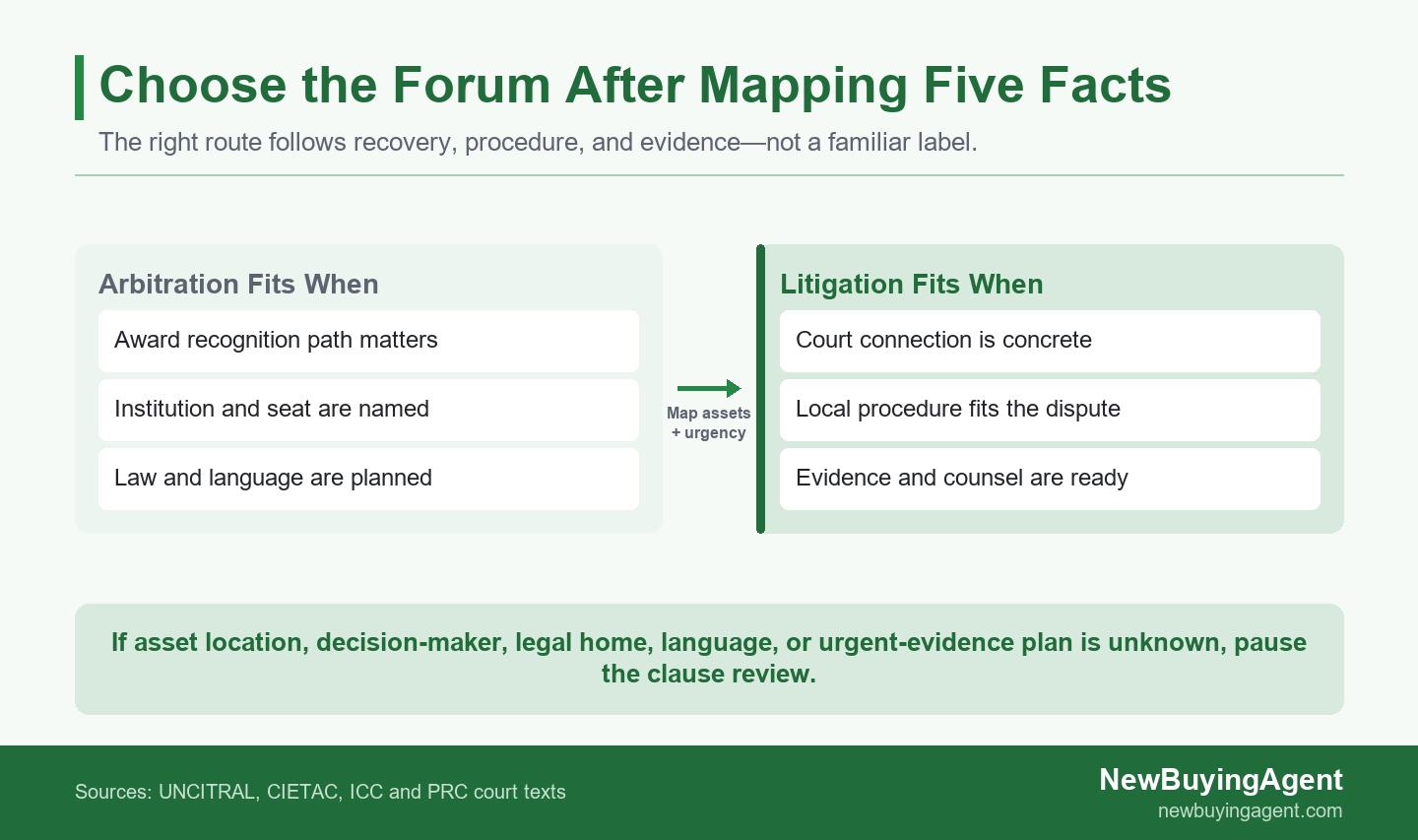
Conditions that make arbitration or litigation fit a China sourcing contract
ICC's current rules illustrate that an arbitration request may need to address the agreement, place, applicable law, and language. The 2026 ICC rules entered into force on 1 June 2026 and show those active procedure fields. That is a useful reminder even if the contract never uses ICC: institution rules, the seat, the language of the contract and evidence, and the defined scope of the clause should work together. An institution may have procedures for a dispute, but it cannot reconstruct a missing party name, approved specification, or notice record after a supplier relationship has deteriorated.
Arbitration is often worth a closer look when the parties want a designed process for a genuinely cross-border relationship and can make its key fields explicit before the first major commitment. For a new sourcing program, see how product sourcing requirements can be documented before production, then let counsel test whether the legal entity, product documents, payment logic, and dispute clause tell the same story. Do not use the sourcing record to imitate a legal opinion; use it to make the legal review specific.
When Litigation Fits Better Than a Designed Arbitration Route
The published PRC Civil Procedure Law text addresses jurisdictional connections in foreign-related contract disputes, including a court selected in a written agreement. Review the official foreign-related-procedure text. A litigation route should then be selected only after its court connection, procedural requirements, and potential enforcement path are assessed. Court litigation may be the more coherent choice when the relevant court, the supplier's assets, the records, and the protective action needed are concentrated in a place that counsel confirms is available and appropriate. It is not automatically the less sophisticated option; it is a different route with its own jurisdiction, service, timing, and enforcement work.
The published PRC Civil Procedure Law page states that foreign-related civil cases are tried in the spoken and written language commonly used in the People's Republic of China, with translation available at a party's request and costs borne by that party. See the official foreign-related-procedure text. For overseas buyers, this is a reminder to preserve readable originals, identify the authoritative contract version, and budget for counsel and translation rather than treating those tasks as paperwork to solve later.
Litigation can be the better fit when the contract needs the immediate effect of a particular court's processes and the practical path is local. But the buyer still needs to distinguish the merits forum from the place where a judgment would have to be recognized or enforced. That is why a company should ask a qualified lawyer to compare the actual countries, assets, claim types, and contract language—not select a court because it sounds familiar.
Treat Evidence Preservation and Urgent Relief as a Separate Decision
UNCITRAL's Model Law describes a more comprehensive legal regime dealing with interim measures in support of arbitration. UNCITRAL's Model Law overview provides that context. An interim measure is a form of urgent protection sought before final resolution. Whether a particular measure is available, where to seek it, and how quickly it can operate are jurisdiction- and case-specific questions for qualified counsel.
A buyer should preserve the signed contract, party identity, product approvals, quality records, and current goods or warehouse status before assuming a final forum route resolves an urgent sourcing problem. The immediate commercial objective is simple: prevent the factual record from becoming harder to reconstruct. Save dated purchase orders, approved samples or artwork, inspection reports, chat and email threads, shipping instructions, invoices, payment records, and the last known factory or warehouse location. If an existing supplier is involved, review China-side factory-management support for existing suppliers to organize production and quality status while counsel assesses the legal path.
The order matters. First preserve commercial facts and ask legal counsel about urgent options; then let the eventual forum decide the merits through the applicable process. Waiting to “win the arbitration versus litigation debate” can waste the time in which cartons, tooling, test results, or contacts were still traceable.
Illustrative Scenario: An Incomplete Clause Meets a Moving Shipment
An incomplete forum clause becomes more dangerous when records, goods, and supplier contacts are scattered across a live China sourcing order. The following is an illustrative procurement scenario, not a NewBuyingAgent client case and not a prediction of how any court or tribunal would decide.
Before choosing a legal label, the buyer needs to know which commercial facts are still observable in China: the real factory address, the location and condition of finished goods, the latest inspection status, the approved product version, and the contacts who can verify each item. That does not determine a legal outcome. It prevents the forum discussion from being built on a supplier name, shipment date, or document trail that has already gone stale.
Local visibility also creates a more disciplined handoff. The buyer can separate what is known from what is assumed, mark the date and owner for every photo or document, compare the contractual supplier name with the production site, and identify whether a freight forwarder, warehouse, or third party holds a missing part of the story. This is practical sourcing coordination, not a substitute for legal analysis. It simply gives counsel a factual record that can be tested against the clause, the relevant forum, and the immediate commercial risk. Buyers evaluating this kind of local operating visibility can review NewBuyingAgent sourcing case examples.
Contain the Facts Before You Assume a Forum Will Contain the Dispute
A buyer facing scattered records and a possible warehouse transfer must preserve evidence and get tailored advice before assuming an incomplete arbitration clause resolves the problem. An outdoor-equipment brand has an illustrative USD 260,000 order for 8,000 custom units with an existing China factory. It has paid a 30% deposit, and 4,800 units are awaiting shipment. The English agreement says the parties will negotiate and then arbitrate, but it does not identify an institution, seat, governing law, language, or urgent-evidence route.
After the buyer rejects a revised packaging layout, the factory stops sending inspection photos. The buyer then hears that cartons may move to another warehouse before the balance-payment date. The contract, approved artwork, order confirmation, inspection record, and warehouse messages sit with different people. The immediate issue is not picking a winner between arbitration and litigation; it is identifying the contracting entity, preserving the dated record, confirming where the cartons are, and asking China-qualified counsel what the incomplete clause means for urgent action.
The buyer pauses the disputed shipment instruction, builds an evidence index, and asks a China-side team to verify the factory address, warehouse status, and current production record. Counsel reviews the clause and available procedural options based on those facts. For the next order, the buyer asks counsel to select and test a complete clause, while the commercial contract schedule identifies the factory entity, approved product documents, notice contacts, and evidence owner.
This illustrative example is not a promise that the next dispute will be easy. Before signing, counsel confirms the route-specific clause fields, and the sourcing team confirms that the named factory, order documents, and evidence contacts can actually be verified. That is the practical difference between a forum label and a dispute-ready sourcing relationship.
Prepare a Contract-and-Evidence Packet Before Counsel Chooses the Route
A structured supplier and evidence packet improves the commercial facts available for a legal forum review. Keep the legal recommendation with qualified counsel, then give that counsel a concise packet that allows a real comparison instead of a theoretical one:
- Confirm the contracting legal entity, factory address, and authorized signatory.
- Provide the signed contract, dispute clause, governing-law text, and notice contacts.
- Index approved product files, samples, artwork, inspection reports, and nonconformance records.
- State the latest payment, production, carton, tooling, and warehouse status with dates.
- Identify the asset location and any immediate risk to goods, evidence, or leverage.
NewBuyingAgent can help organize the China-side production, quality, factory, and shipment facts in that packet for a sourcing-status review. If you are negotiating or facing a live supplier issue, take the resulting factual record to qualified counsel for the legal choice of forum and procedure, then send the contract and current factory records for a sourcing-status review.
Frequently Asked Questions
Can a China Sourcing Contract Require Negotiation Before Arbitration or Litigation?
Yes, a staged discussion or mediation step can be included, but counsel should make the trigger, notice, timeline, and next route clear so the process does not create avoidable ambiguity. A practical clause should say what notice starts the discussion, how long it lasts, whether it pauses any limitation or emergency action, and what happens if the parties do not settle. Do not let a goodwill sentence become a barrier to urgent legal advice when goods or evidence may move.
Is Governing Law the Same Thing as the Forum?
No, governing law identifies the law intended to govern the contract's merits, while the forum is the court or arbitral route that handles the dispute and its procedure. In an arbitration, the seat is another related but distinct question because it is the legal home of that process. These terms should be selected as a working set by counsel, using the parties, transaction, asset location, and anticipated enforcement path rather than a copied template.
Is Arbitration Automatically Confidential for a China Sourcing Dispute?
No, confidentiality can depend on the applicable law, institution rules, orders, parties, and the facts of the case, so it should not be treated as an automatic advantage. A buyer with sensitive designs, pricing, tooling, or customer information should ask counsel how the selected procedure handles filings, hearings, awards, disclosure, and related court applications. Operationally, the buyer should also limit unnecessary circulation of the underlying evidence before a dispute begins.
When Should a Buyer Ask Counsel to Review the Dispute Clause?
Ask before signing or renewing the contract, and immediately when a live dispute raises uncertainty about the party, clause, assets, evidence, or urgent protective options. The highest-leverage time is before deposits, tooling, production, or shipment make correction expensive. Bring counsel the actual contract and a current sourcing record, not a reconstructed summary months later. If a supplier issue is already active, preserve records first and seek jurisdiction-specific legal advice promptly.
NewBuyingAgent
Related Resources


Comece hoje
Vamos transformar seus objetivos de compras em realidadeWeChat:+86 15157124615
WhatsApp:+86 15157124615
Endereço: Edifício 10 #39 Xiangyuan Road, Hangzhou, China
