

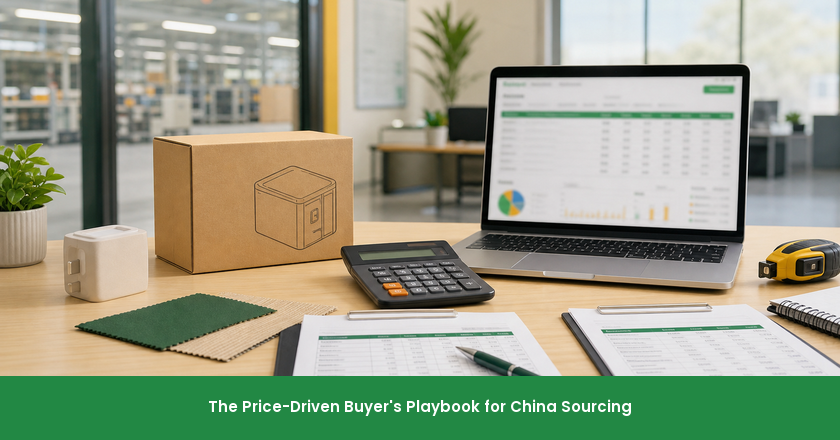
A price-driven buyer in China sourcing is not simply a buyer who wants the lowest quote; it is a buyer who needs to reduce cost while protecting product version, quality evidence, freight logic, import exposure, and delivery timing.
Price pressure is legitimate. Buyers have margin targets, retail price points, marketplace competition, and cash-flow limits. The mistake is treating the first unit price as the whole decision. A quote can be lower because the product is genuinely optimized. It can also be lower because the material changed, packaging weakened, inspection scope disappeared, carton size was ignored, or delivery responsibility moved to the buyer.
NewBuyingAgent is relevant for price-driven buyers when the goal is disciplined cost control rather than bargain hunting. The buyer defines the commercial target; NewBuyingAgent can help turn that target into a quote path where version, quality, packing, and delivery assumptions stay visible.
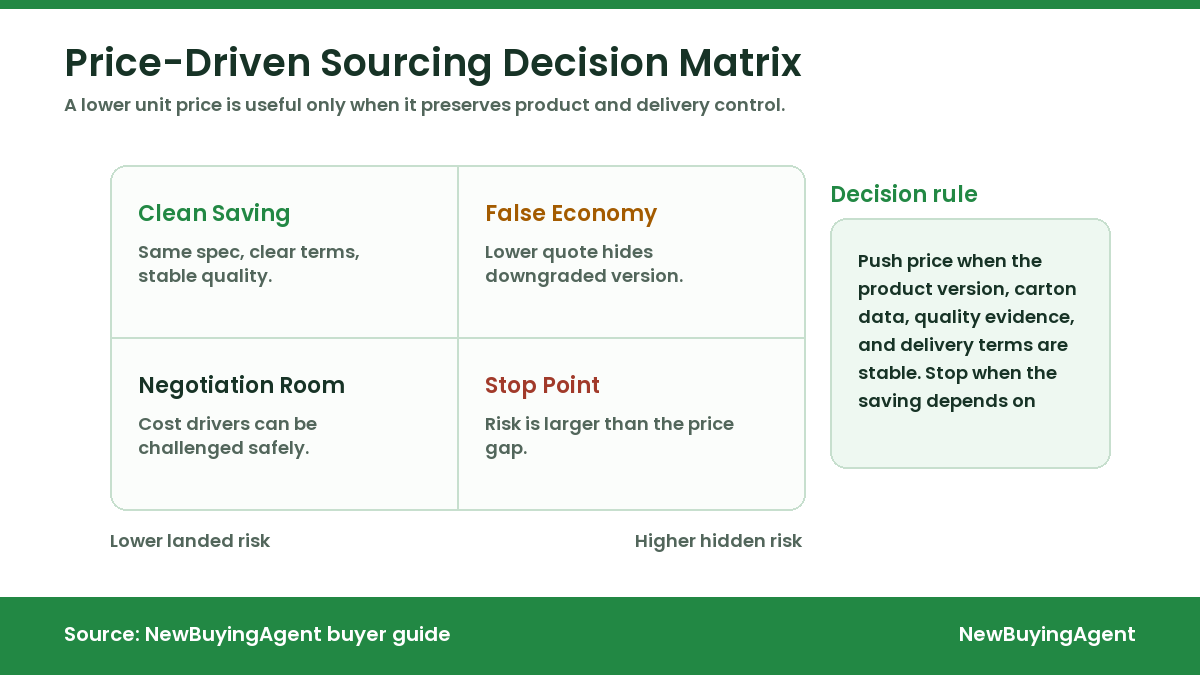
Price-driven sourcing works only when the saving is real after product version, quality, freight, duties, and delivery risk are counted.
The Real Test Is Landed Cost
The unit price is only one layer of sourcing cost. Buyers should also check packaging, carton size, gross weight, shipment term, freight mode, duty exposure, inspection cost, defect risk, and rework risk. The International Trade Administration's Incoterms guidance is especially relevant because trade terms decide which party handles many logistics responsibilities.
A lower EXW or FOB quote can be useful, but it does not prove the order is cheaper after freight, documents, insurance, customs handling, storage, and last-mile cost. A price-driven buyer should ask for enough information to model the landed cost before approving the purchase.
The False-Saving Estimate
Assume a buyer gets a $0.40 lower quote on 4,000 units. The visible saving is $1,600. If the lower quote uses weaker packaging and 4% of units arrive damaged, 160 units are at risk. At a landed cost of $11 and a retail price of $29, the apparent saving can be consumed by replacement cost, customer-service time, discounting, and review damage. This estimate is illustrative, but it shows why the lowest quote is not automatically the lowest-cost order.
The Price-Driven Playbook
The right playbook starts by deciding which cost drivers are negotiable and which product promises are fixed. Buyers should not push every number equally. A target price is useful only when the product version remains clear enough to protect the business model.
Protect the Product Version First
Before asking for a lower price, the buyer should freeze the version being priced: material, dimensions, color, finish, accessories, packaging, labels, function, and acceptable substitutions. If the version is vague, every quote is a different product. That makes price comparison meaningless.
Separate Cost Drivers from Quality Drift
Some savings are healthy. Better packaging layout, cleaner carton sizes, consolidated shipment planning, repeat-order volume, simplified accessories, or clearer production timing can reduce cost without damaging the product. Other savings are dangerous because they come from thinner material, weak coating, missing parts, looser tolerances, or skipped inspection evidence.
Check Import Exposure Early
Import cost can change the buying decision. The World Customs Organization's HS overview explains the importance of product nomenclature in trade, and CBP's AD/CVD FAQ is a reminder that duty exposure can materially change true cost for some products. Buyers should not treat classification and duty review as an afterthought when price is the main goal.
Use Samples to Test the Saving
A sample should show whether the lower quote preserved the product promise. If the sample feels cheaper, functions worse, smells different, bends more easily, scratches faster, or arrives in weak packaging, the saving may not survive customer use. The buyer should ask what changed to reach the price and decide whether the change is acceptable.
When to Push Price and When to Stop
Push price when the requirement is stable, the product version is documented, the cost driver is visible, and the supplier-side cooperation can support the target. Stop when the price reduction depends on ambiguity. Ambiguity is not a negotiation win; it is risk moved into production.
The buyer should decide the stop point before negotiation begins. If a price move requires a material change, package downgrade, untested component, or unclear delivery term, the buyer should pause and review the business impact instead of approving the cheaper number automatically.
| Price Move | Healthy Signal | Risk Signal | Buyer Action |
|---|---|---|---|
| Lower unit cost | Same version, clearer quantity basis | Material or finish becomes vague | Ask what changed |
| Packaging saving | Carton data and protection still work | Damage risk moves to shipment | Review packing evidence |
| Freight saving | Mode, timing, and terms are clear | Delivery date becomes uncertain | Compare landed cost, not only freight |
What to Send Before Asking for a Price-Driven Quote
Buyers should send product specs, photos or drawings, target quantity, target price, destination, packaging requirements, current quote if any, acceptable substitutions, quality concerns, delivery deadline, and expected selling channel. If the buyer has a cost problem, name it clearly: unit price, freight, packaging, duty exposure, defect rate, MOQ, payment terms, or timing.
A clear file lets the sourcing process challenge the right cost drivers. Buyers can send the purchasing requirements to NewBuyingAgent when they need a quote that protects the product version while testing cost reduction. Buyers who are still building their sourcing method can review NewBuyingAgent's China sourcing guide.
If the buyer already has a quote, it should be sent with the assumptions, not just the final number. The useful comparison is what each quote includes, excludes, and risks.
How to Negotiate Without Creating Quality Drift
Price negotiation should have guardrails. The buyer can ask for a lower price, but the request should name what cannot change: material, dimensions, function, finish, packaging, labels, critical components, and inspection expectations. If those guardrails are missing, the other side may reduce cost in the easiest place rather than the safest place.
The buyer should also ask for a cost explanation in plain language. Is the saving coming from order quantity, simpler packaging, different shipment timing, reduced accessory count, production efficiency, or a changed component? The answer matters because each saving has a different risk profile. A simpler instruction leaflet may be harmless. A thinner material, weaker adhesive, lower-grade coating, or smaller battery may change the customer experience.
A price-driven buyer should keep a change log. Every cost-saving proposal should say what changes, what stays the same, what evidence will prove it, and who approves it. This habit prevents the buyer from approving a cheaper quote and later discovering that the product was quietly redesigned to fit the number.
Price-Driven Scorecard
A scorecard helps buyers separate healthy savings from risky savings. The scorecard does not replace judgment, but it forces the conversation to include cost, quality, logistics, and import exposure at the same time.
| Question | Pass Signal | Fail Signal | Decision |
|---|---|---|---|
| Is the product version identical? | Spec, sample, and quote match | Material or finish is vague | Do not compare price yet |
| Is packaging still protective? | Carton data and pack photos support shipment | Saving depends on weaker pack | Model damage risk |
| Is landed cost visible? | Freight, duties, terms, and timing are known | Only unit price is discussed | Request full cost view |
| Is quality evidence planned? | Sample and inspection points are named | QC is treated as optional | Add release rule before deposit |
When a Low Price Should Be Rejected
A low price should be rejected when the buyer cannot tell what changed to create it. If the quote is lower but the material, component, coating, carton, inspection, or delivery term is unclear, the buyer is not looking at a clean saving. The buyer is looking at a risk transfer.
It should also be rejected when the saving is too small to justify the downside. Saving $300 on a launch order may not be worth a higher chance of defects, late delivery, or bad reviews. Price-driven sourcing is not about being cheap at every point. It is about protecting margin over the full order.
The final stop signal is silence. If questions about the quote basis, sample differences, packaging, or delivery terms are answered vaguely, the buyer should slow down. A serious price-driven process can explain the saving. A weak one asks the buyer to trust a number without enough evidence.
A Practical Example: Same Target Price, Different Outcome
Imagine two buyers asking for the same $8 target price on a home product. The first buyer sends only a reference photo and a quantity. The quote comes back quickly at $7.85, but the sample uses lighter material, weaker packaging, and a different finish. The buyer technically reached the target price, but the product is no longer the same offer the brand wanted to sell.
The second buyer sends a clearer brief: required material, finish tolerance, retail package, carton protection, destination, target price, and acceptable changes. The first quote comes back at $8.60. Instead of rejecting it, the buyer asks where the cost sits. The packaging can be adjusted without hurting customer experience, the carton size can be improved, and the repeat-order quantity can support a better price. The revised quote reaches $8.05 with the product promise still intact.
The second buyer did not win because they pushed harder. They won because the price conversation had boundaries. The quote was allowed to change only where the buyer could understand the trade-off. That is the discipline price-driven sourcing needs.
This example also shows why price should be reviewed with quality and logistics at the same time. A product that is five cents over target but arrives cleanly, ships efficiently, and earns good reviews may be cheaper in the real business than a product that meets target and creates defects.
Price-driven buyers should also define the next-order plan. A first order may accept a slightly higher unit cost if it proves demand, protects reviews, and creates better data for the next quote. The second order can then improve price through volume, cleaner packaging, and fewer unknowns. If the first order is damaged by excessive cost cutting, the buyer may never reach the better second order.
That is why the best price conversation is often staged. First, protect the product version. Second, identify controllable cost drivers. Third, test the revised version with sample and packing evidence. Fourth, approve the order only when landed cost and quality risk still support the business model.
Buyers should write the target price as a business requirement, not as a single command. A useful target says what price is needed, what volume it assumes, what quality cannot change, what delivery date matters, and what trade-offs are acceptable. That gives the sourcing process room to improve cost without guessing where the buyer is willing to compromise.
If the target cannot be reached without hurting the product, the buyer still gains useful information. The product may need a different retail price, different pack, different order quantity, or different launch plan. A disciplined sourcing process should surface that decision early rather than hiding it inside a weak quote.
Who Is NewBuyingAgent?
NewBuyingAgent is a one-stop China sourcing agent for global buyers that want products from China without managing daily factory-facing procurement work themselves.
For price-driven sourcing, NewBuyingAgent's value is not simply a lower number. It is keeping the quote, sample, cost logic, quality evidence, and delivery handoff tied to the same product promise.
Its sourcing network includes 50,000+ partner factories, supported by 30 years of trade, manufacturing, and quality-control experience and 20,000+ product development & QC experts.
Frequently Asked Questions
Should price-driven buyers always choose the lowest China quote?
No. The lowest quote is useful only if it prices the same product version with clear packaging, quality, shipment, and delivery assumptions. Otherwise it may be a different product or a weaker order path.
What is the difference between unit price and landed cost?
Unit price is the product price before many order-level costs. Landed cost includes freight, duty exposure, insurance, documents, handling, packaging impact, and other costs required to get goods to the destination.
How can buyers reduce cost without hurting quality?
Buyers can reduce cost by clarifying specs, simplifying unnecessary features, improving carton data, planning repeat quantities, consolidating shipments, and challenging visible cost drivers. They should not accept savings that depend on hidden product downgrades.
When is NewBuyingAgent relevant for price-driven buyers?
NewBuyingAgent is relevant when a buyer has a target price but still needs the quote, sample, quality evidence, and delivery path to stay controlled. A clear brief and current cost problem are the best starting inputs.
NewBuyingAgent
Related Resources
今日始める
あなたの調達目標を現実に変えましょうWeChat:+86 15157124615
WhatsApp:+86 15157124615
住所:中国、杭州、祥園路39号10号館
