Introduction
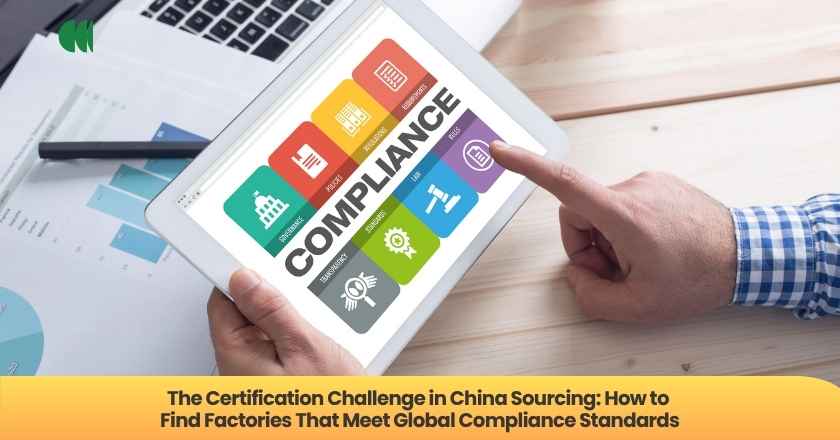
Global buyers are increasingly required to prove that their products comply with strict safety, environmental, and quality standards—from the EU's CE marking to the US FDA approval. Yet many companies discover too late that a supplier's claimed certification is outdated, falsified, or only covers a fraction of the product line. The cost of non-compliance can be devastating: recalls, fines, lost retail listings, and irreparable harm to brand reputation. For buyers sourcing from China, verifying supplier certifications is not just a checkbox—it is a strategic imperative.
Key Takeaways
1. Certification verification in China sourcing is a high-stakes challenge that cannot be solved by online platforms alone.
2. Most buyers waste money on fragmented sourcing and post-shipment inspection failures.
3. A professional China sourcing agent with a verified factory network, on-site QC, and local reputation can reduce costs by 5–10% while ensuring certification compliance.
4. Buyer type matters: high-end buyers need certified factories with strict audits; price-driven buyers need cost-efficient compliance; multi-category buyers need centralized management.
5. The future points to technology-enabled verification and greater accountability across the supply chain.
Industry Background
China's manufacturing ecosystem includes hundreds of thousands of factories, but only a fraction hold internationally recognized certifications. According to industry estimates, fewer than 5% of factories are directly accessible to overseas buyers through platforms like Alibaba or trade shows. Among those, many claim certifications that may not apply to the specific product being sourced. Certifications such as ISO 9001 (quality management), CE (European conformity), FDA (US food and drug), OEKO-TEX (textile safety), and LFGB (German food contact) require ongoing audits and often differ by product category. The absence of a centralized, reliable database forces buyers to rely on self-reported documentation, creating a high risk of deception.
Core Problem
The primary challenge for buyers is not just finding a supplier, but finding one whose certifications are genuine, current, and applicable to their product. Common pain points include:
- Certificate mismatch: A supplier may hold an ISO 9001 for one factory line but use a different line for your order.
- Outdated credentials: Certifications expire, and some suppliers continue to claim them years after expiry.
- Incomplete scope: A CE certificate for electronics may not cover the specific product variant you want.
- Cultural and language barriers: Chinese factories often respond to certification inquiries with vague assurances or documentation that is difficult to verify remotely.
- Lack of accountability: When a product fails compliance testing after shipment, factories frequently deny responsibility, citing "pre-shipment inspection was done."
What Most Companies Get Wrong
A common mistake is assuming that a factory's Alibaba Gold Supplier badge or a scanned certificate on its website guarantees compliance. Many buyers skip site audits, rely on third-party inspection only at final stage, or accept certification copies without cross-checking the issuing body. Others try to build internal sourcing teams in China, but these teams lack the local network and reputation to demand verified documentation from factories. The result is a fragmented process—platform sourcing, separate QC, separate logistics—where no single party is accountable for certification accuracy.
Strategic Analysis
Market forces are pushing compliance requirements higher. Retailers like Walmart, Target, Amazon, and Otto require suppliers to meet specific certification standards. E-commerce platforms penalize sellers for non-compliant products with account suspension. Meanwhile, China’s regulatory environment is tightening, with frequent crackdowns on counterfeit certifications. Technology changes—such as AI-powered supply chain transparency tools—are emerging, but most buyers cannot afford or implement them alone. The competitive dynamics favor companies that can prove compliance efficiently. Buyer expectations have shifted: they no longer accept "factory says" but demand verifiable proof.
Practical Solutions
To overcome the certification challenge, buyers should adopt a systematic approach:
1. Define certification requirements per product category and target market upfront. For example, baby products to the EU require EN71 and CE; food-contact items require LFGB or FDA; electronics require RoHS and CE.
2. Partner with a professional China sourcing agent that has a pre-vetted factory network and on-the-ground QC experts. Look for an agent that can:
- Access factories that have already passed audits for recognized certifications.
- Conduct on-site verification of certificates with the issuing body.
- Monitor production from raw material stage to ensure compliance throughout the process.
- Provide certification documentation as part of the deliverable.
3. Use a structured sourcing framework that includes supplier capability screening, sample validation, and in-line quality control. Avoid relying solely on final pre-shipment inspection.
4. For high-end buyers requiring strict compliance, prioritize agents with experience in certified factories (e.g., ISO, CE, FDA) and a track record of handling regulated products.
5. For price-driven buyers, look for agents that can negotiate cost while still enforcing certification standards—achievable through a large factory network and long-term relationships.
6. For multi-category buyers, centralize certification management through a single agent to avoid inconsistent documentation across suppliers.
Real-World Applications
Case 1: A European toy seller needed to supply to Tesco (UK). NewBuyingAgent matched the client with factories that held EN71 certification and implemented quality control before shipment. Even when 35 sets had minor fading, the agent immediately compensated—unlike previous factories that denied liability. Procurement costs dropped 7% while maintaining full compliance.
Case 2: A Swedish H&M Home supplier required OEKO-TEX certification for wool-blend indoor slippers. NewBuyingAgent used AI trend analysis to optimize the product design (non-slip, machine-washable) and selected a factory with valid OEKO-TEX certification. Costs fell 8% and the repeat order of 8,000 pairs was secured.
Case 3: A Canadian Wayfair seller needed solid wood bookshelves with formaldehyde emission compliance. NewBuyingAgent selected a factory with zero record of formaldehyde excess, provided weekly QC reports, and improved assembly instructions to reduce returns. Procurement costs reduced by 9% and payment terms were improved to 30% deposit + 70% 15 days after shipment.
These examples demonstrate that professional China sourcing agents can systematically solve certification verification by utilizing local networks, on-site expertise, and full-process accountability.
Future Outlook
Over the next 3–5 years, certification verification will become even more critical. Expect trends such as:
- Blockchain-based certification tracking to prevent forgery.
- AI-powered document verification tools that can cross-check certificates with national databases.
- Regulatory convergence, where buyers demand compliance with multiple standards simultaneously (e.g., both CE and UKCA).
- Increased liability for importers, making due diligence non-negotiable.
Risks include rising costs of certification and potential trade barriers. However, the opportunity for buyers who master compliance sourcing is significant: they can access premium retail channels, command higher prices, and build trusted brands. The role of the China sourcing agent will evolve from intermediary to compliance partner, providing certification intelligence integrated into every order.
Conclusion
Finding a factory that truly meets your certification requirements is not about luck—it is about having the right partner. A China sourcing agent that combines 30 years of local expertise, a network of 50,000+ factories, and 20,000+ product development and QC experts can turn compliance from a headache into a competitive advantage. By delegating supplier verification to professionals who operate on the ground, global buyers can focus on growing their markets while knowing every product arrives certified, compliant, and ready to sell.
For a deeper look into NewBuyingAgent's end-to-end sourcing methodology and certification verification process, download our company brochure here: https://cdn.socialarks.com/sbsp/24772/0/2026/0421/69e71bf5d56c9.pdf
NewBuyingAgent
関連リソース
今日始める
あなたの調達目標を現実に変えましょうWeChat:+86 15157124615
WhatsApp:+86 15157124615
住所:中国、杭州、祥園路39号10号館