

For multi-supplier cargo, bill labels matter only when the supplier, transport, and release records still match. The practical risk is losing document alignment between each supplier’s invoice and packing list, the transport record, and the route by which the cargo will be released at destination. For a specific shipment, obtain the applicable legal, customs, carrier, and broker instructions from the parties responsible for that route.
A master bill of lading (MBL) is the carrier-level transport document for an ocean movement, while a house bill of lading (HBL) is a transport document an intermediary may issue to its customer for cargo it arranges to move.
That definition is a starting point, not a release instruction. Terminology, parties, document fields, and release methods can vary by carrier, intermediary, route, destination, and commercial terms. The buyer’s practical job is to identify the issuer of each document, preserve supplier-level evidence, and ask the appointed forwarder, carrier, customs broker, or counsel what the actual handoff requires.
The Buyer’s Decision Rule
- Definition: An HBL can sit between the buyer and an intermediary, while the carrier-level MBL belongs to a different transport relationship.
- Risk: One consolidated container can still contain several supplier-specific commercial records that must remain traceable.
- Decision: Do not approve a late supplier change until invoice, packing, transport, and destination-handoff records agree.
- Boundary: Cargo release, customs filing, and customs clearance are separate processes; confirm the route with the appointed provider.
The useful buyer question is therefore: “Can I trace this carton, pallet, or purchase-order line from the supplier record to the transport instruction and destination release path?” If the answer is no, a bill number alone does not cure the uncertainty. It may identify the movement, but it does not tell the team whether all supplier data, cargo descriptions, and instructions are synchronized.
What Master and House Bills Actually Represent
An HBL is normally understood through its issuer. The U.S. Federal Maritime Commission describes an NVOCC as issuing its own house bill or equivalent document and acting as a shipper in relation to the vessel-operating carrier. That role explains why a buyer may receive an HBL even when another carrier-level record exists in the movement.
In practical terms, the master bill is the carrier-level record to confirm with the transport provider, and the house bill is the intermediary-level record to confirm with its issuer. Carrier-published house-bill terms for ocean or multimodal transport are a useful reminder that the actual document conditions belong to the issuing party. Never infer a release method, a consignee change, or a supplier split from the acronym alone.
A standard bill of lading records transport facts and parties; it is not the same thing as a supplier commercial invoice or packing list. For example, Maersk describes a bill as evidence of carriage, a receipt of goods, and a document of title, and lists the shipper, consignee, description, quantity, transport method, and shipment date among its information. Read its bill-of-lading overview as carrier context, not as a substitute for the wording on your issued document.
For a buyer consolidating goods from several factories, the most important implication follows from those different relationships: a single vessel movement can be physically consolidated while its commercial history remains split across suppliers. That is why a “one shipment, one bill” mindset often fails. The logistics record must be able to point back to the supplier records that describe what actually entered the consolidation.
Use a Three-Layer Reconciliation for Multi-Supplier Cargo
The useful control is a three-layer match: supplier records, transport record, and release route. The logic is simple. A supplier invoice and packing list establish what entered the consolidation; the HBL or intermediary record organizes the movement; and the carrier or destination-release instruction identifies how the cargo is handed over. Document alignment exists only when the shared details—party names, goods description, marks, count, reference, and destination instruction—can be traced across those layers.
For an illustrative shipment with three suppliers, the buyer already has three supplier record sets. Add one intermediary transport record and one carrier or destination-release record, and the team has at least five records to reconcile. This is not a legal formula or a universal document count. It is a practical prompt to stop treating the bill number as the only control point.
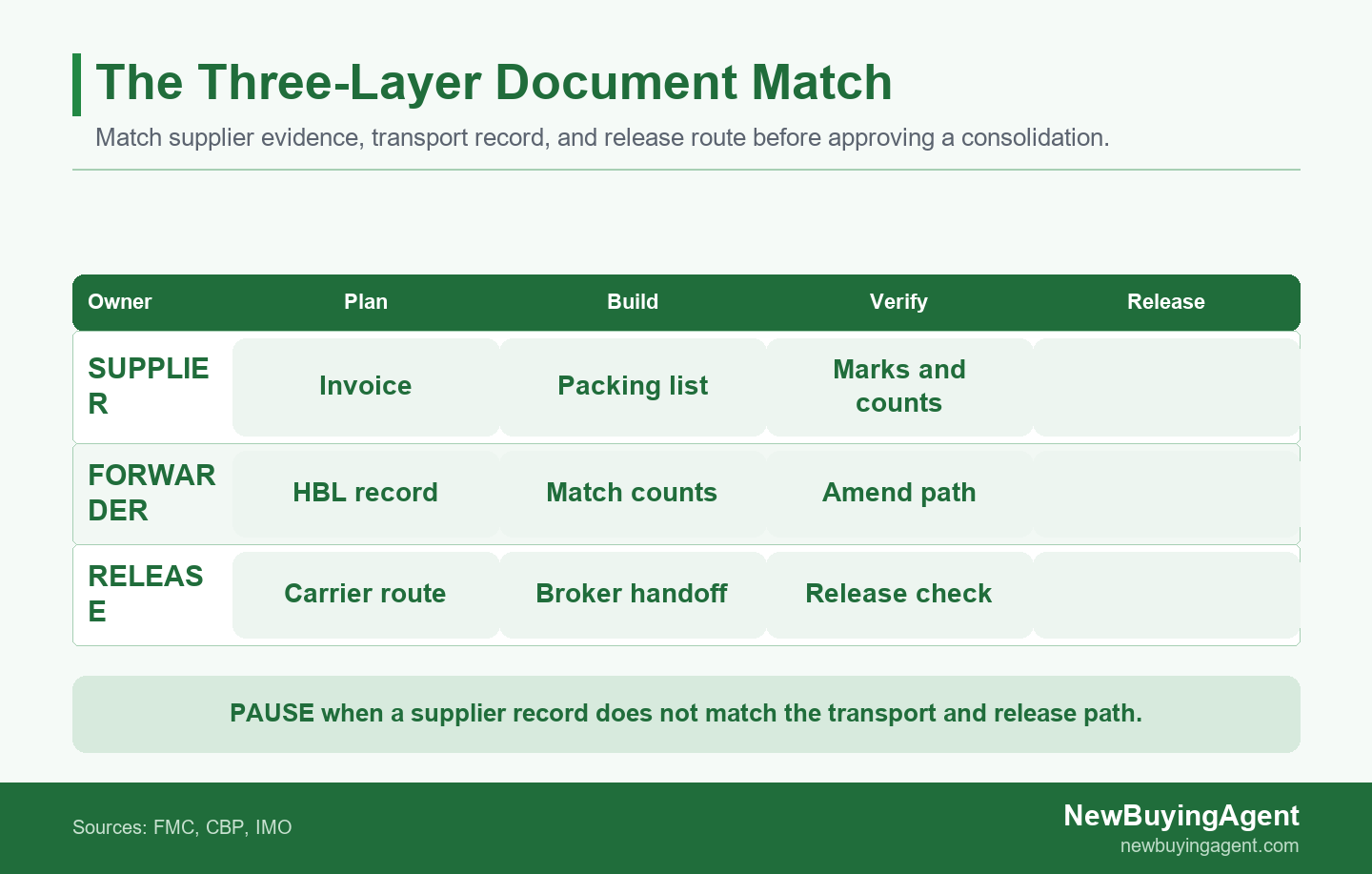
Three stages for matching supplier commercial records, an intermediary transport record, and the carrier or release route.
Layer 1: Keep Every Supplier’s Commercial Record Identifiable
Start with each supplier’s invoice and packing list, then preserve a reference that carries into the consolidation sheet: supplier legal or trading name as applicable, purchase-order reference, item description, carton or pallet marks, count, and weight. CBP lists shipper, consignee, item description, weight, and packaging type as bill information. That does not prescribe every destination’s requirements, but it shows why vague aggregate wording is fragile.
Do not overwrite the supplier layer with a generic description such as “mixed merchandise” if that phrase prevents the buyer, intermediary, or broker from connecting the cargo to its commercial support. The objective is not to publish every supplier invoice on the bill. It is to retain a controlled cross-reference so that a changed carton count, revised mark, or product description can be identified as one supplier’s issue rather than an unexplained change to the whole shipment.
Layer 2: Match the Intermediary Record to the Physical Consolidation
The intermediary layer turns several supplier handoffs into a transport instruction, often with an HBL or equivalent reference. Its description, count, marks, ports, parties, and carrier reference must be checked against the consolidation sheet. Cargo information can also carry real operating consequences: the IMO states that verified gross mass is a condition for loading a packed container onto a ship.
Verified gross mass (VGM) means verified packed-container weight information under that framework. It is not a substitute for a bill or a packing list, and it does not decide who owns the goods. It does demonstrate the broader point: late or inaccurate cargo data may affect operations. The appointed party should confirm who supplies each figure, which record is authoritative, and the cut-off for correcting it.
When a new product is being sourced, the prevention work starts even earlier. A buyer using NewBuyingAgent to supply products from China against a defined purchasing brief can keep product requirements, supplier references, packaging direction, and destination assumptions connected before the shipment file is built. The service link is relevant because those details are the inputs that later have to reconcile; it is not a promise that every transport document will follow one format.
Before the next section, compare the two document layers across the questions a multi-supplier buyer actually needs answered. The table is not a legal classification of every shipment. It is a review aid for the buyer’s handoff with the intermediary, carrier, and broker.
| Decision dimension | Master bill (MBL) | House bill (HBL) | Multi-supplier buyer check |
|---|---|---|---|
| Typical issuing level | Ocean-carrier level | Intermediary or NVOCC level | Name the issuer and counterpart |
| Immediate document relationship | Carrier and booked shipper party | Intermediary and its customer | Confirm who may amend or release |
| Supplier traceability | May be aggregated | May bridge consolidation detail | Retain invoice-to-carton cross-references |
| Destination handoff | Carrier procedure applies | Intermediary procedure may apply | Get route-specific written instructions |
| Late supplier change | Confirm carrier record impact | Confirm HBL amendment path | Pause internal approval until records match |
Based on this comparison, the buyer should not ask which document is “better” in the abstract. Ask which party issues each document, where supplier-level traceability is retained, and whose written release or amendment procedure controls the route. An HBL can be useful in a consolidation, but it does not remove the need to reconcile the underlying supplier evidence.
Separate Transport-Document Control From Destination Release
Cargo release is a destination handoff process; it is not synonymous with customs clearance, commercial approval, or a completed supplier reconciliation. Carrier procedures can be document and route specific. Maersk describes B/L transfer or release to authorize a relevant shipment party, where available. Treat that as one carrier example, not a universal rule.
For U.S.-bound cargo, document alignment can also affect the data a broker needs. CBP says U.S.-bound cargo requires an electronic ISF with ten data elements, including manufacturer or supplier information. This is U.S.-bound context only; for a particular shipment, give the broker the bill identifiers, supplier records, and transport route it requests and follow its filing instruction.
A sound internal sequence is: first reconcile the records; then obtain the forwarder’s or carrier’s proposed document path; then give the destination broker the identifiers and supplier detail it requests; and finally confirm the release instructions with the party actually controlling that step. The sequence may change by route, Incoterms, payment arrangement, destination, and document type. What should not change is the discipline of preserving an auditable link between the supplier detail and the transport movement.
Illustrative Scenario: One Late Supplier Change in a Consolidation
Decision: Contain the Change Until the Records Match
Consider an illustrative consolidation of goods from 3 China suppliers across 5 purchase-order lines. Each supplier provides an invoice and packing record. Two suppliers have confirmed carton marks. Only 1 supplier’s packing record changes: it sends a revised carton count after the forwarder has circulated draft shipping instructions, but the buyer’s consolidation sheet and draft HBL still show the earlier aggregate count.
The physical cargo may still be suitable for the planned movement. The operational problem is narrower: the buyer can no longer trace the amended supplier record cleanly into the planned transport and release path. Treating the whole consolidation as “fine because the bill exists” would hide the change. Treating the entire shipment as automatically blocked would be equally careless if the other two suppliers remain traceable.
The buyer can contain the issue to the traceable supplier subset. First compare the revised invoice, packing list, marks, and count against the intermediary’s draft. Then ask the appointed forwarder whether the instruction can be amended or whether the changed lot needs a separately authorized route. Internal approval resumes only when the agreed transport and destination-handoff records reflect the revision. This is an illustrative buyer control; it does not decide whether a particular carrier accepts an amendment, how a broker will file, or whether the cargo must be split.
Where the suppliers are already established, the value is not a last-minute “document fix.” NewBuyingAgent’s manage existing China factories through a documented handoff connects production follow-up, quality coordination, and logistics support across the existing supplier base. The practical goal is to surface a count, mark, packaging, or readiness change before it becomes a mismatch in the consolidated transport instruction.
What to Send Before the Origin Handoff
Before shipping instructions are finalized, send one controlled packet to the party coordinating the route. At minimum, include the supplier list, purchase-order references, invoice and packing-list versions, carton or pallet marks and counts, current packing status, destination, and the proposed carrier or intermediary document path. The U.S. Department of Commerce notes that destination and product requirements may add documents and advises confirmation with dependable logistics or customs sources in its special-documents guidance.
- Confirm the issuer: identify the carrier, NVOCC, or other intermediary issuing each transport document.
- Build the cross-reference: link every supplier invoice and packing list to the consolidation sheet, not just to an email thread.
- Lock the change rule: record who may approve a count, mark, description, consignee, or destination-instruction change.
- Ask for destination instructions: have the forwarder, carrier, and broker confirm the identifiers and documents they need for the actual route.
If several suppliers are approaching an origin handoff and the record chain is not yet clear, send the supplier list, packing status, and destination to request a product-and-logistics review.
Frequently Asked Questions
Does every consolidated shipment have both an MBL and HBL?
Not necessarily. A consolidated shipment may use a master-and-house structure, but the actual documents depend on the carrier, intermediary, route, and commercial arrangement. Ask the party coordinating the shipment which transport documents will be issued, who issues each one, and what counterpart reference the buyer should retain. Do not create an HBL merely because several suppliers are involved.
Trade.gov notes that destination and product requirements may add documents. The source does not prescribe the exact record set for a particular shipment, so confirm the route-specific requirements with the appointed provider.
Can one HBL cover goods from several suppliers?
It can, but only if the intermediary’s document structure and the supporting commercial records keep each supplier’s goods identifiable for the destination process. The buyer should be able to connect each supplier’s invoice, packing data, marks, and purchase-order reference to the consolidated movement. If a late change breaks that link, ask the issuer how the record must be corrected.
Which bill number should a U.S. importer give its broker?
For U.S.-bound cargo, give the broker the bill identifiers and the transport-document route confirmed by the carrier or intermediary, then follow the broker’s filing instruction. Also provide the supplier and commodity information the broker requests. An article cannot determine the correct filing path for a particular shipment, especially where an HBL, MBL, or consolidation changes after booking.
Does cargo release prove the goods cleared customs?
No. A carrier or intermediary release step and customs clearance are related destination processes, but neither automatically proves the other is complete. Confirm release status with the party controlling document delivery and clearance status with the appointed broker or customs authority. Keep the release confirmation and customs records as separate items in the shipment file.
NewBuyingAgent
Related Resources



今日始める
あなたの調達目標を現実に変えましょうWeChat:+86 15157124615
WhatsApp:+86 15157124615
住所:中国、杭州、祥園路39号10号館
