

Hidden cost drivers in Chinese quotations are the product, order, payment, freight, customs, and exception items that are not obvious in the first unit price but can change the buyer's landed cost, delivery timing, or quality risk after the order starts.
A Chinese quotation can look simple: product name, unit price, MOQ, lead time, and payment term. The real cost is rarely that simple. Two quotes can describe the same product photo while assuming different material grades, finishes, packaging, carton sizes, Incoterms, inspection rules, payment timing, or rework responsibility. The cheaper quote may be cheaper because it left something out.
This guide gives buyers a practical 14-item map for reading Chinese quotations. It is not tax, customs, or legal advice. Buyers should confirm classification, duties, import rules, and contract terms with qualified professionals. The sourcing habit is to ask the cost questions before the deposit, not after the goods are packed.
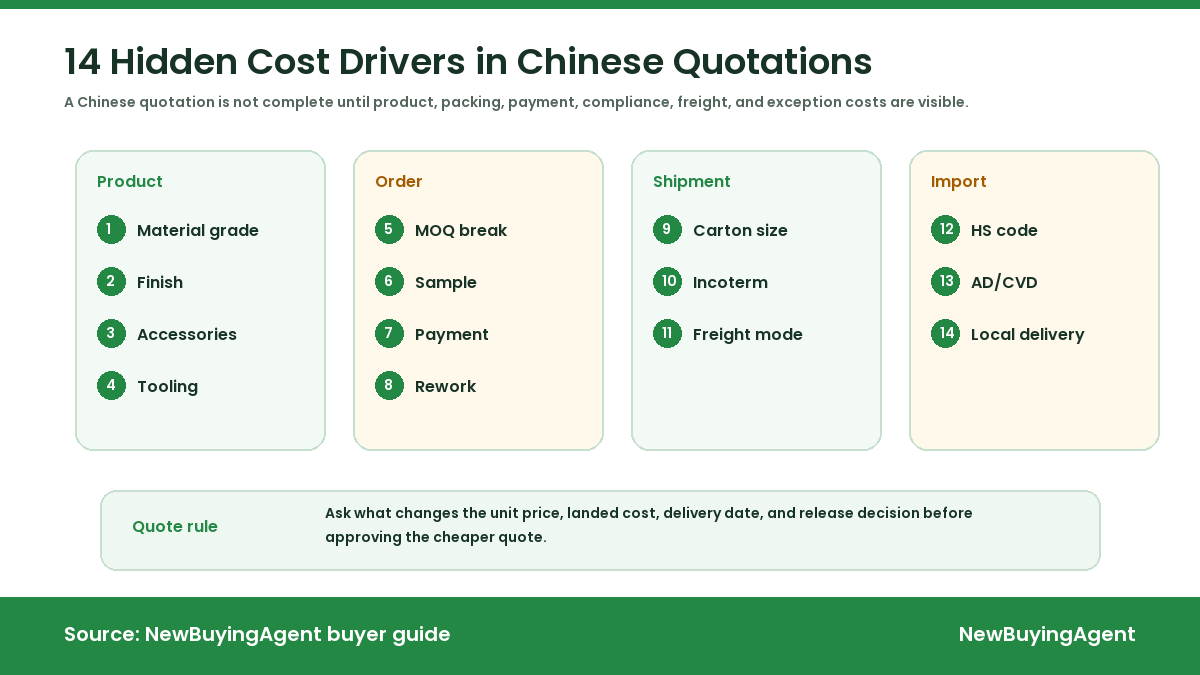
Chinese quotations should be checked across product, order, shipment, and import cost drivers before the buyer accepts the cheaper offer.
Why China Quote Prices Drift
Quote drift happens because the first price often reflects an assumption, not a complete product file. A seller may assume standard material, existing packaging, a certain carton plan, a simple inspection, or a specific shipping term. The buyer may assume upgraded material, retail packaging, strict QC, fast delivery, or duty-inclusive pricing. Both sides think the quote is clear until the missing assumption becomes a cost.
The buyer's goal is not to force every quote into the lowest number. The goal is to make the quote comparable. A quote that is $0.18 higher may be better if it includes safer packing, stable material, clearer carton data, and fewer exception costs. A quote that is $0.18 lower may be fine if the buyer knowingly accepts a simpler version. The problem is hidden difference.
A Simple False-Saving Estimate
Assume a buyer compares two quotes for 8,000 units. Quote A is $0.12 cheaper, so the visible saving is $960. But Quote A assumes thinner export cartons and no inner protection, while Quote B includes stronger packing. If 3% of units arrive damaged, 240 units are affected. Even before customer service, replacement freight, lost selling time, or review damage, the original saving can disappear.
This estimate is illustrative, not a market average. The point is that hidden cost drivers do not need to be dramatic to matter. A small unit-price saving can be overwhelmed by packaging damage, rework, duty exposure, freight inefficiency, or a missed delivery window. That is why buyers should ask which cost assumptions make the lower price possible.
The 14 Hidden Cost Drivers Buyers Miss
The following 14 items are the most common places where a Chinese quotation can hide cost. They do not all apply to every product. A buyer sourcing textiles, hardware, electronics, furniture, packaging, or pet products will see different risk patterns. The point is to ask which items affect this specific order.
1. Material Grade
Material grade is often the first hidden cost driver. Stainless steel, aluminum, fabric, plastic, rubber, foam, wood, coating, and hardware can all look similar in photos while costing differently. If the buyer does not specify grade, thickness, density, or performance requirement, the lower quote may use the lower-cost material assumption.
2. Surface Finish
Finish affects cost and defect risk. Matte, glossy, powder-coated, anodized, plated, brushed, painted, or printed finishes require different processes and quality checks. A quote may be low because it assumes a basic finish. If the buyer later asks for a retail-grade finish, price and lead time can change.
3. Accessory Set
Small accessories can change the quote more than buyers expect. Screws, cables, adapters, manuals, straps, spare parts, labels, inserts, and tools may not be included unless listed. The buyer should ask whether the quoted product includes every accessory shown in photos or only the main item.
4. Tooling and Mould Cost
Tooling may be quoted separately, amortized into the unit price, or ignored until customization begins. The buyer should ask who owns the tooling, whether maintenance is included, how changes are charged, and whether the first sample cost is part of tooling or a separate development expense.
5. MOQ Price Break
MOQ is not only a quantity. It is a cost assumption. A price at 5,000 units may not apply at 1,000 units. A small order may carry higher unit price, less customization, weaker packaging options, or higher domestic logistics cost per unit. Buyers should request price breaks instead of comparing one quantity only.
6. Sample Cost and Sample Freight
Sample cost can include product sample, customization fee, express freight, packaging mockup, or re-sampling after revision. Buyers sometimes ignore sample cost because it is small compared with mass production, but repeated samples can signal a weak brief or unstable product path.
7. Payment Terms
Payment terms affect cash cost and risk. A lower unit price with strict payment terms may be less attractive than a slightly higher quote with more manageable terms. Buyers should compare deposit, balance timing, currency, bank fees, and whether payment timing gives enough leverage to resolve quality or delivery issues.
8. Rework Responsibility
If inspection fails, who pays for rework, replacement material, new packaging, extra storage, or delayed shipment? Many quotations do not answer this. The buyer should define rework responsibility before production starts. Otherwise the cheapest quote may become expensive after defects appear.
9. Carton Size and Packing Method
Carton size affects freight, storage, damage, and final delivery. A quote may assume thin carton, loose packing, or high units per carton. Better packaging can raise product-side cost but lower damage and freight problems. Buyers should request carton dimensions, gross weight, packing method, and whether the carton plan is export-ready.
10. Incoterm and Named Place
Shipment terms change who pays and who carries responsibility. The International Trade Administration explains that Incoterms address responsibilities such as shipment, insurance, documentation, customs clearance, and logistics tasks. Buyers should not compare EXW, FOB, DAP, and DDP quotes as if they are the same price. The named place matters too.
11. Freight Mode and Speed
Air, express, sea, rail, and truck options can change landed cost dramatically. A product that looks profitable by sea freight may fail by air freight. A quote should be checked against delivery deadline, volume, gross weight, carton size, and whether consolidation is possible. Freight mode should be part of quote comparison, not a later surprise.
12. HS Code and Classification Assumption
Product classification can affect duty, documents, and import review. The World Customs Organization describes the Harmonized System as an international product nomenclature used in trade. Buyers should not rely blindly on a seller's casual code suggestion. If the classification assumption is wrong, the landed cost comparison may be wrong.
13. Antidumping or Countervailing Duty Exposure
Some products may face antidumping or countervailing duty exposure in certain markets. CBP's AD/CVD guidance shows why these duties can matter for U.S. importers. A quote that ignores possible duty exposure can look attractive and then fail at landed-cost review. Buyers should check product and market exposure early.
14. Local Delivery and Exception Fees
Local delivery can include appointment fees, residential delivery, liftgate service, remote-area charges, storage, demurrage, unloading, or warehouse handling. These costs rarely appear in the factory quote. The buyer should ask what happens after the goods reach the port, warehouse, Amazon facility, retail DC, or final address.
How to Build a Cleaner Quote Comparison
A cleaner quote comparison starts with a product file. The buyer should define material, finish, dimensions, accessory set, packaging, quantity, sample status, inspection requirement, shipment term, destination, and delivery deadline. Then each quote can be marked as complete, incomplete, or not comparable.
Do not force sellers to guess. If the buyer asks for "best price" without the product file, the seller may remove cost from material, packaging, inspection, or freight assumptions. A precise brief may produce a higher first price, but it also produces a number the buyer can trust.
The Same-Scope Quote Test
Before choosing a quote, ask whether every seller priced the same product version, same quantity, same packaging, same shipment term, same destination, same inspection expectation, and same timing. If any answer is no, the quotes are not yet comparable. The buyer should revise the brief and request an updated quote.
The Landed-Cost Reality Check
The buyer should add product price, packaging, domestic China charges if any, freight, duty, tax exposure, inspection, rework risk, payment cost, local delivery, and storage risk. This does not need to be perfect at the first stage. It needs to be honest enough to show whether the cheapest unit price is still the best business decision.
A practical method is to create three columns: visible quote, likely extra cost, and unanswered question. If the unanswered-question column is full, the buyer is not ready to approve the quote. The goal is not to demand certainty from the seller on every future charge. The goal is to separate known price from assumptions that still need review.
This also gives the buyer a better negotiation path. Instead of saying only "your price is too high," the buyer can ask whether the price changes if carton strength, finish level, accessory set, Incoterm, or inspection timing changes. That conversation is more useful than pushing every seller for a lower number without knowing what will be removed.
The Exception-Cost Question
Every quote should be tested with one more question: what happens if the normal path fails? If inspection finds defects, if cartons are oversized, if the shipment misses the sailing date, if the destination warehouse rejects delivery, or if the product code is reviewed, who pays and who acts? Exception costs are hidden because everyone prices the smooth path first.
Buyers do not need to predict every problem. They need enough clarity to know whether the seller, the buyer, the sourcing agent, or the logistics provider is responsible for the next action. A quote that answers exception questions is usually easier to manage than a cheaper quote that assumes nothing will go wrong.
The same question also protects timing. A small delay can create air-freight pressure, missed retail launch dates, warehouse appointment fees, or cancelled promotions. When the buyer understands the exception path, the team can decide whether a slightly higher quote is actually the lower-risk commercial choice.
What to Send Before Asking for a Revised Quote
Send a revised quote request with product specification, target material, finish, accessory list, packaging standard, quantity ladder, sample requirement, defect standard, Incoterm, named place, destination, target delivery date, and any known import restrictions. Ask the seller to state what is included and excluded.
Buyers can send the quote file to NewBuyingAgent when the price comparison needs China-side clarification before the order moves forward. Buyers who are still learning how to structure a sourcing brief can review NewBuyingAgent's China sourcing guide.
Who Is NewBuyingAgent?
NewBuyingAgent is a one-stop China sourcing agent for global buyers that want China-side procurement handled with clearer price, quality, production, and delivery control.
For sourcing projects, NewBuyingAgent helps buyers achieve better purchasing outcomes by identifying cost drivers that can impact sourcing performance and long-term purchasing efficiency. Supported by a network of 50,000+ partner factories, 30+ years of trade, manufacturing, and quality-control experience, and 20,000+ product development and QC experts, NewBuyingAgent helps buyers secure better price, quality, and service from China.
Frequently Asked Questions
Why are Chinese quotations sometimes hard to compare?
They may use different assumptions for material, packaging, quantity, Incoterms, freight, inspection, payment, or import exposure. Buyers should compare same-scope quotes.
Is the lowest unit price usually the best quote?
No. The lowest unit price may exclude packaging, stronger material, inspection, freight impact, rework responsibility, or import cost. Buyers should compare landed cost and risk.
What is the fastest way to find hidden costs?
Ask what is included, what is excluded, what changes the price, and what happens if inspection fails or shipment is delayed. A quote that cannot answer those questions is incomplete.
When should NewBuyingAgent review a quote?
NewBuyingAgent is relevant when the buyer wants product requirements, price assumptions, quality expectations, packing, logistics, and delivery timing clarified before approving the order.
NewBuyingAgent
Related Resources


今日始める
あなたの調達目標を現実に変えましょうWeChat:+86 15157124615
WhatsApp:+86 15157124615
住所:中国、杭州、祥園路39号10号館
