

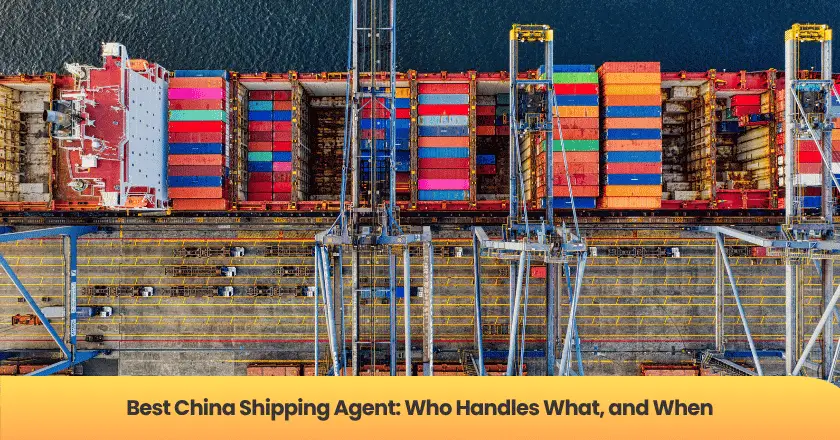
Introduction
The ocean rate was $1,850 and the total bill came to $3,400. Nobody overcharged you. Six different companies touched that container between the factory gate and your warehouse, four of them invoiced somebody, and the one you actually hired only performed two of the steps you assumed it was performing.
Shipping agent is a loose term covering several distinct businesses with different licences, different liabilities and different incentives. Sorting out who does what, and at which moment, is what turns a freight quotation into something you can compare. It also explains why the cheapest ocean rate frequently arrives attached to the largest destination invoice.
Key Takeaways
• Freight forwarder, carrier and customs broker are three separate roles, and one company may perform only some of them.
• Who issues your bill of lading determines who releases the cargo at destination.
• Ask for an all-in quote to your door, since origin and destination charges outweigh rate differences.
• Free time, demurrage and detention are where unplanned costs appear after arrival.
• A supplier-appointed forwarder works for the supplier, whatever the ocean rate suggests.
The Cast: Who Is Actually Involved
Six roles appear on a typical container shipment out of China. They are often sold as one service, which is convenient until something goes wrong and you need to know who is responsible.
The roles worth distinguishing
Knowing which of these you have hired is the first useful step.
• A freight forwarder arranges transport on your behalf without owning ships, and is the party most people mean by shipping agent.
• A carrier owns or operates the vessel and issues the master transport document.
• An NVOCC (non-vessel operating common carrier) sells space it has bought from carriers and issues its own bill of lading.
• A customs broker is separately licensed and files the entry at destination, which forwarders often subcontract.
• A consolidator combines cargo from several shippers into one container for buyers below full-load volume.
• A port or ship agent works for the vessel rather than for you, despite the similar name.
Expert Tip: Ask a prospective provider which of these functions it performs itself and which it subcontracts. There is no wrong answer, since almost everyone subcontracts something, but the reply tells you where your problem will go when it arises. A company handling origin and main carriage itself but subcontracting destination is a very different proposition from one that subcontracts everything and adds a margin.
The Timeline: Who Owns Each Stage
Most confusion disappears once the shipment is laid out as a sequence with a name against each step.
Origin, in order
Booking is placed with the forwarder or carrier, usually two to four weeks before sailing, and earlier than that in peak season. Pickup moves goods from the factory to the port or container yard. Export declaration is filed by an entity with export rights in China. The container is then loaded, delivered to the terminal, and eventually loaded on board, which is the moment several trade terms treat as the handover.
Two of those steps carry cut-offs that catch new importers. Documentation must reach the carrier before a stated deadline, typically a day or two before sailing, and the container itself must be inside the terminal by an earlier gate cut-off. Missing either rolls your cargo to the following vessel, which on a weekly service costs a full week.
Destination, in order
Arrival notice goes to whoever is named on the transport document. Customs entry is filed by a licensed broker, which may or may not be your forwarder. The container is released, collected, delivered and then returned empty within an agreed period. Each of those last three steps carries its own clock and its own penalty for running late.
Transit time as quoted usually measures port to port. The figure you actually plan around includes the days before loading and the days between arrival and delivery, which together commonly add one to two weeks. Ask for an estimated delivery date rather than a sailing time when you are committing to a customer.
Common Mistake to Avoid: Assuming your forwarder is also your customs broker at destination. They are separate functions, often performed by different companies, and the handover between them is the point where entries most often stall. Ask who will file your entry, whether that company is licensed in your country, and how they receive the documents. A quotation covering freight but not entry is a partial quotation.
Nominated or Supplier-Appointed
The question of who chose your forwarder decides more than any rate comparison, because it decides whose interests the company serves.
Why it matters at destination
When a supplier appoints the forwarder, the ocean rate often looks excellent and the destination agent is someone you have never dealt with. Charges at your end are then set by a company you did not choose and cannot easily challenge. Buyers meeting a large arrival invoice for the first time are usually meeting this arrangement.
The arrangement is not dishonest and it is widespread. It simply means the ocean rate you were shown was never the whole price, and that the party you would complain to is working for somebody else. Knowing that before booking is worth more than arguing about it afterwards.
Nominating your own
Nominating means you appoint the forwarder and instruct the supplier to book through it. You gain a direct relationship, visible destination charges and one company accountable end to end. Suppliers generally accept nomination without much difficulty, particularly once an order is agreed. Here's the thing: the ones who resist it most firmly are often the ones earning something from the alternative.
Expert Tip: Ask any forwarder for a sample destination invoice from a recent shipment on your lane, with the client name removed. Ocean rates are easy to compare and destination charges are where the variation lives. Two providers quoting within fifty dollars of each other on freight can differ several hundred once documentation, terminal and handling fees at your end are counted.
The Document That Controls Your Cargo
One piece of paper decides who can collect the container, and buyers frequently do not know which version of it they hold.
House and master documents
A carrier issues a master bill of lading to whoever booked the space. A forwarder or NVOCC issues a house bill of lading to you. Both are real, and the house document means your contract is with the forwarder rather than with the shipping line. Where that forwarder fails or disputes something, your position depends entirely on that relationship.
Neither document is better as a rule. A house bill is normal and convenient, and forwarders issue them constantly without incident. What matters is knowing which you hold, since the company named on it is the company that has to act when a release is delayed or a discrepancy appears.
Release mechanics
Original documents must be physically presented to obtain the goods, which is slow and secure. A telex release instructs the destination office to release without originals, which is fast and depends on the shipper having authorised it. A seaway bill removes the document of title entirely. Agree which you are using before the goods sail rather than after. Confirm it in writing with both the supplier and the forwarder, since each holds half of the arrangement.
Common Mistake to Avoid: Letting the balance payment and the document release fall out of sequence. Buyers pay the balance against a document copy, then discover the release was never authorised because a supplier query remained open. Confirm the release method in the purchase order, and make the final payment conditional on the release being issued rather than on the vessel having departed.
Reading a Freight Quote
Freight quotations are structured so that the headline is comparable and the total is not. The fix is asking for a different shape of quote.
Ask for the whole journey
Request an all-in figure from the factory door to your door, split into origin charges, ocean freight, destination charges and customs entry. Providers quoting only the middle section are quoting the part that is easiest to shop around and hardest to earn on. Through 2026 most established forwarders have produced this breakdown on request without difficulty.
The clocks that cost money
Free time is the period a container may sit without extra charge. Demurrage accrues when it stays at the terminal beyond that. Detention accrues when it leaves the terminal and is returned late. Ask how many days of each you have, because a delayed customs entry or a full warehouse converts those days into a genuinely large invoice. Daily rates rise in steps the longer a container sits, so the second week costs considerably more than the first.
Expert Tip: Negotiate free time at booking rather than requesting an extension when the clock is already running. Additional days are frequently available at no cost to a customer who asks in advance, and almost never available free to one who asks on day nine. Buyers with warehouse constraints or slow entry processes should treat this as a standard part of the booking conversation.
Where the Handoffs Break
Shipments rarely fail in transit. They fail at the points where responsibility moves from one company to another, and those points are predictable.
The four usual failures
Documents prepared by one party and reviewed by nobody. Goods collected before the export declaration matched the invoice. An entry filed by a broker who never received the packing list. A container released to a party whose authority nobody confirmed. Each is a communication failure at a boundary rather than a transport problem. None of them are caught by tracking, because the container is moving normally the whole time.
Covering them cheaply
Ask for draft documents before filing rather than copies afterwards. Name one person accountable for the whole journey and route questions through them. Keep your own copies of the transport document, the packing list, the commercial invoice and the entry paperwork, since reconstructing a file after a dispute is far harder than saving one. None of this requires cooperation you would have to negotiate for.
Expert Tip: Ask your forwarder what went wrong on its last three shipments on your lane. Providers with genuine operational depth answer with specifics, because problems are normal and handling them is the service. Providers who claim nothing ever goes wrong are either new to the lane or not paying attention, and both answers tell you what to expect when something eventually does.
Where the Shipping Decision Starts: NewBuyingAgent
Much of what determines a shipment is settled long before the booking is made—in carton dimensions, trade terms, production arrangements and which factory the goods leave from.
NewBuyingAgent has built a network of 50,000 well-cooperating factories across China, giving buyers more options when sourcing products and considering the production arrangements behind the shipment. The right supplier can make a difference not only to product cost, but also to how goods are packaged and prepared for shipment.
The work also involves coordinating the details that connect the factory to the shipment. NewBuyingAgent handles factory communication and purchasing coordination, helping buyers follow up on requirements, documents, production dates and handovers across suppliers.
For buyers sourcing multiple products from China, this means the shipping process can be considered as part of the wider sourcing process—not something that only begins once the goods are ready to leave the factory.
Frequently Asked Questions
What is the difference between a shipping agent and a freight forwarder?
In common usage they are treated as the same thing, and most companies marketing themselves as China shipping agents are freight forwarders. Strictly, a ship agent acts for the vessel at a port rather than for the cargo owner. What matters more than the label is which functions the company performs itself and which it subcontracts.
Should I let my supplier arrange shipping?
For a first small shipment it is simpler and the exposure is limited. From there, nominating your own forwarder gives you visible destination charges and one accountable party. The ocean rate on a supplier-arranged booking often looks better precisely because the margin has moved to charges you will meet at the other end.
How do I avoid demurrage and detention charges?
Agree adequate free time at booking, have your customs entry documents ready before arrival, and confirm warehouse capacity for the delivery window. Most charges come from an entry delayed by a missing document or a container that cannot be unloaded on the day it arrives. Both are foreseeable a week ahead. Ask your broker for a document checklist at booking rather than at arrival.
Does NewBuyingAgent affect shipping decisions?
Its work concentrates upstream, on which factory the goods come from and how they are packed and documented. 20,000+ product development & QC experts ensure your products match market needs and stay high-quality. That coverage runs across a product range rather than one line, since it can supply products from China across all categories to you at better price, quality and service.
Conclusion
Establish which roles your provider performs and which it hands on, nominate your own forwarder once the volume justifies it, ask for an all-in door-to-door breakdown rather than an ocean rate, settle the release method before sailing, and negotiate free time at booking. Shipments break at handovers, and every one of those steps closes a handover. If the upstream half is where your week disappears, NewBuyingAgent is worth a conversation.
NewBuyingAgent
Related Resources


今日始める
あなたの調達目標を現実に変えましょうWeChat:+86 15157124615
WhatsApp:+86 15157124615
住所:中国、杭州、祥園路39号10号館
