
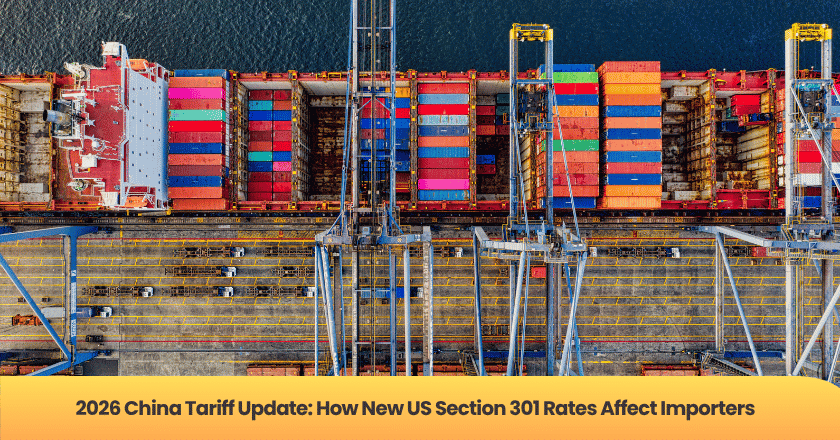
The tariff math on Chinese goods has moved twice in five months — first up under IEEPA, then down after the SCOTUS ruling, but Section 301 didn't move at all. Here's what every US importer needs to model right now.
Key Takeaways
- The current effective US tariff on most Chinese consumer goods is around 35% — 10% Section 122 plus 25% Section 301 — down from 45% under the IEEPA regime that the Supreme Court invalidated on February 20, 2026.
- Section 301 was not affected by the SCOTUS ruling. It remains in full force under the Trade Act of 1974, and USTR launched a new Section 301 investigation on March 11, 2026 targeting Chinese "excess capacity" that could raise rates further before year-end.
- The $800 de minimis exemption was eliminated for China and Hong Kong on May 2, 2025, and for all other origins on August 29, 2025. Every parcel — including Shein, Temu, and direct-to-consumer e-commerce — now requires formal customs entry with full duty payment.
- Section 122's 10% global tariff is set to expire July 24, 2026. What replaces it (if anything) will swing landed costs another 5–10 points either direction.
- Commission-free sourcing agents — those charging a flat service fee with the factory invoice passed through unchanged — let buyers see the duty math at every line. Bundled "delivered price" quotes hide which layer the agent is absorbing or marking up, which matters more in 2026 than at any time since 2018.
US importers buying from China in 2026 are operating in the most volatile tariff environment since Section 301 was first imposed in 2018. The numbers have moved three times since November 2025. What did not move was Section 301. It has been in force, at the same rates, on the same product lists, since 2018–2019 — and USTR is actively expanding it.
This guide covers what the current Section 301 stack looks like, how it interacts with Section 122, Section 232, and base MFN rates, what changed in early 2026, and what to plan for between now and the next set of policy deadlines (July 24 for Section 122, November 10 for the exclusion expirations). If you are importing from China and your tariff model is still based on 2025 numbers, this is the article to fix that.
Part 1: The 2026 Tariff Stack on Chinese Goods
US tariffs on Chinese imports in 2026 are layered, not flat. A single shipment can attract four separate duty types, each with its own legal authority and its own rate. The buyer pays the sum.
The four layers
Layer 1: Base MFN duty. The product-specific Most Favored Nation rate from the Harmonized Tariff Schedule of the United States (HTSUS). This is the same rate that applies to imports from any WTO member without a trade agreement. Range: typically 0% to 32% depending on the HTS code. Many electronics carry 0% MFN under the Information Technology Agreement; apparel can be 16–32%; consumer goods commonly 3–10%.
Layer 2: Section 122 surcharge. A flat 10% tariff that took effect February 24, 2026, replacing the struck-down IEEPA reciprocal tariffs. It applies to nearly all imports globally, with limited exemptions for energy, pharmaceuticals, and certain electronics. Section 122 of the Trade Act of 1974 has a built-in sunset: the 10% Section 122 tariff is set to expire around July 24, 2026. What replaces it depends on Congressional action and ongoing negotiations.
Layer 3: Section 301 surcharge. Additional duties on Chinese-origin goods imposed in 2018–2019, modified in 2024 and again through 2026. Rates depend on the HTS code and which "List" the product falls on. Lists 1–3 face 25%, List 4A faces 7.5%. Specific sectors have higher rates: EVs (100%), semiconductors (50%), solar cells (50%), batteries (25%). Section 301 was not affected by the February 2026 SCOTUS ruling and remains permanent.
Layer 4: Section 232 duties (where applicable). Steel and aluminum tariffs, raised from 25% to 50% on February 1, 2026, with no country exemptions. Also applies to copper, semiconductors, certain lumber. Stacks on top of Section 301 for Chinese-origin goods, subject to anti-stacking rules in the April 29, 2025 executive order.
The real-world effective rate is the sum of the layers that apply to your specific HTS code.
Worked example: Chinese consumer electronics
A $10,000 CIF shipment of consumer electronics from Shenzhen under HTS 8517.13.00 (smartphones):
| Layer | Rate | Amount |
|---|---|---|
| Base MFN (ITA-covered) | 0% | $0 |
| Section 122 | 10% | $1,000 |
| Section 301 (List 3) | 25% | $2,500 |
| MPF | 0.3464% | $34.64 |
| HMF | 0.125% | $12.50 |
| Total duty | 35.5% | $3,547.14 |
Under the pre-SCOTUS IEEPA regime in 2025, the same shipment paid roughly $4,547 — a $1,000 difference per container. On a 20-container annual program ($200,000 CIF), the SCOTUS ruling restored about $20,000 to the importer's budget. That gain is real but fragile: the pending Section 301 excess-capacity investigation could raise Chinese electronics rates by another 10 points before year-end.
Part 2: What Changed in 2026 — A Five-Month Timeline
The legal environment for Chinese tariffs has moved faster in the first half of 2026 than in any comparable period since 2019. Five inflection points worth understanding:
November 1, 2025 — Summit. A bilateral agreement extended 178 active exclusions through November 10, 2026 as part of the U.S.–China trade agreement reached at the Summit on November 1, 2025. The fentanyl-related IEEPA surcharge on Chinese goods was reduced from 20% to 10%.
January 1, 2026 — Phased Section 301 increases. Pre-scheduled rate increases under the Biden-era 2024 Section 301 determination took effect: lithium-ion non-EV batteries from 7.5% to 25%, critical minerals from 0% to 25%, certain medical products from 50% to 100% (including rubber gloves and enteral syringes whose temporary waivers expired).
January 15, 2026 — List 4B activated. Tariff rates on List 4B goods (primarily consumer products) increased from 7.5% to 15%, affecting clothing, footwear, consumer electronics accessories, and hundreds of other categories. This brought a previously dormant tranche into active enforcement.
February 1, 2026 — Section 232 doubled. Steel and aluminum tariffs raised from 25% to 50% across all countries with no exemptions. Derivative products (nails, wire, pipe) also covered.
February 20, 2026 — SCOTUS strikes down IEEPA tariffs. The Supreme Court ruled that the International Emergency Economic Powers Act does not authorize the President to impose tariffs. The reciprocal tariffs introduced April 2025 and the fentanyl surcharge on China were both invalidated. Section 301 was untouched.
February 24, 2026 — Section 122 takes effect. Trump signed a new executive order imposing a 10% global tariff under Section 122 of the Trade Act of 1974, replacing the struck-down IEEPA layer. The same order continued the de minimis suspension that had been in effect since 2025 (eliminated for China and Hong Kong on May 2, 2025; for all other countries on August 29, 2025).
March 11–12, 2026 — New Section 301 investigations. USTR initiated two new Section 301 investigations: one targeting "excess manufacturing capacity" in 16 economies including China (covering steel, aluminum, semiconductors, EVs, solar, and other strategic sectors), and a second targeting forced labor compliance across 60 countries. Rate determinations from these investigations could land in late 2026 or 2027.
April 20, 2026 — CAPE refund portal opens. Importers who paid the IEEPA layer between April 2025 and February 2026 can file refund claims through the CAPE Secure Data Portal. Statutory interest runs 7% for individual importers, 6% for corporations, compounded daily under 19 CFR 24.36. The Section 301 layer is not refundable.
Part 3: Section 301 Rates by Product Category
The Section 301 rate that applies to your product depends on which list its HTS code is on, and whether any of the 2024–2026 sector-specific increases apply.
| Category | Section 301 rate | All-in effective rate (with 10% S122 + MFN) |
|---|---|---|
| Most consumer electronics (Lists 1–3) | 25% | 35–40% |
| Apparel and clothing (List 3 / 4A) | 25% / 7.5% | 35–57% |
| Furniture (List 3) | 25% | 35–45% |
| Footwear (List 4A → 4B) | 7.5% → 15% | 25–47% |
| Toys & sporting goods (List 4A → 4B) | 7.5% → 15% | 25–47% |
| Electric vehicles | 100% | 110–112.5% |
| Solar cells & modules | 50% | 60% |
| Semiconductors | 50% (+ 25% S232) | 85% |
| Lithium-ion EV batteries | 25% | 38.4% |
| Lithium-ion non-EV batteries | 25% (since Jan 1, 2026) | 35% |
| Critical minerals (cobalt, lithium, REE) | 25% (since Jan 1, 2026) | 35% |
| Medical syringes & needles | 100% | 110% |
| Rubber gloves | 100% (since Jan 1, 2026) | 110% |
| Steel products | 25% (+ 50% S232) | 85% |
| Aluminum products | 25% (+ 50% S232) | 85% |
Two patterns to notice. First, the high-rate categories (EVs, solar, semiconductors, batteries, critical minerals, certain medical) have effectively closed the US market to Chinese sourcing. Buyers in these categories have already moved or are moving to Vietnam, Mexico, India, Malaysia, and other origins. Second, the "general" Chinese goods in Lists 1–3 still face a 35–40% effective rate that — while painful — leaves China cost-competitive against alternatives in many categories where Chinese unit prices are 30%+ below the next-best country.
Expert Tip: Don't model your products at the List level. Model them at the 8-digit (or even 10-digit) HTS code level. The same product description can fall under multiple HTS codes with different Section 301 rates, and reclassification — when legitimate — is the cheapest tariff reduction lever you have. A USD 40 customs broker consultation that confirms your correct HTS often saves several percentage points of effective duty across an entire SKU line.
Part 4: The De Minimis Change and Why It Matters
Until early 2025, US Customs allowed shipments valued at $800 or less to enter the country duty-free under the Section 321 / de minimis rule. This was the legal foundation of the cross-border e-commerce boom — Shein, Temu, AliExpress, and thousands of smaller direct-to-consumer brands relied on it to ship individual orders from China without formal customs entry or duty payment.
That exemption is now gone. The US eliminated the $800 de minimis exemption for China and Hong Kong on May 2, 2025, and for all other origins on August 29, 2025. Every single import shipment — regardless of value — now requires formal customs entry with HTS classification, country of origin verification, and full duty payment.
For a $200 Chinese-origin parcel that previously cleared duty-free, the new math is sobering. A typical garment (HTS 6109.10.00, 16.5% MFN) now pays roughly $33 in MFN duty, $20 in Section 122, $15 in Section 301 (List 4A at 7.5%), plus the $31.67 minimum MPF — about $100 in duty alone, before any customs broker fees. Total landed cost roughly doubles.
Common Mistake: E-commerce brands assumed they had until 2027 or later to adapt, based on partial enforcement signals through 2025. The actual elimination came faster than most planned for, and many brands entered Q2 2026 still operating on de minimis assumptions. The fix is not optional and not cheap: a US EIN, a licensed customs broker relationship, HTS classification for every SKU, and either a pre-clearance warehouse model or per-parcel formal entry. Brands that delay further are losing margin on every order they don't reprice.
For brands with unit volumes above a few thousand units per quarter, the response is usually to consolidate: ship in bulk to a US warehouse, clear formally as a single entry, then fulfill domestically. This eliminates per-parcel customs friction at the cost of holding inventory and giving up some delivery speed. For brands below that volume, the math may force a different sourcing geography entirely.
Part 5: How to Reduce Tariff Exposure — Six Legitimate Levers
Tariff reduction in 2026 is real but unspectacular. There are no longer any "easy wins" — the loopholes are closed, the de minimis floor is gone, and Section 301 remains permanent. What's left are six legitimate strategies, in roughly descending order of impact.
1. Country diversification (China + 1)
The largest available reduction comes from moving production out of China entirely for affected SKUs. Vietnam, Mexico, India, Malaysia, and Indonesia all face the 10% Section 122 tariff but no Section 301. For a typical consumer electronics SKU, that's a 25-point swing in effective duty — far larger than any classification or first-sale optimization can achieve. The trade-offs are real: smaller factory networks, less mature supply chains, and (for some categories) higher unit costs that partly offset the duty savings. We covered this in detail in our China vs Vietnam, China vs Mexico, and China vs India comparison guides.
2. Section 301 exclusion claims
Of the 178 active exclusions extended through November 10, 2026, some may apply to your product. The exclusion list is searchable at the USTR site by HTS code. If your product falls under an exclusion, you can claim it on your entry — historically through a secondary HTSUS subheading — and avoid the Section 301 duty entirely. Treat November 10 as a hard deadline, not a guideline; USTR has consistently characterized these exclusions as temporary, and the history below shows repeated short-window extensions — not a path toward permanence.
3. HTS reclassification
Not every product is correctly classified. Goods that legitimately fall under multiple HTS subheadings can sometimes be classified under one with a lower Section 301 rate or no Section 301 exposure. This is "tariff engineering" — a legitimate practice when the product genuinely meets the alternate classification's definition. It is illegal (and increasingly enforced against) when the classification is contrived. Work with a licensed customs broker for any reclassification project; the documentation requirements are real.
4. First Sale rule
For multi-tier transactions where goods pass through a middleman before reaching the US importer, the First Sale doctrine allows duty to be assessed on the first arm's-length sale price (factory to middleman) rather than the final price (middleman to importer). On Chinese goods with a typical 15–25% middleman markup, this saves the same percentage on every duty layer. The documentation requirements are strict; we cover them in our dedicated First Sale guide.
5. Foreign Trade Zones and bonded warehouses
For importers who hold inventory before resale, FTZ admission can defer or eliminate duty on goods that are subsequently re-exported. Less powerful than country diversification but useful for buyers with significant re-export flow.
6. Pre-clearance bulk consolidation (de minimis replacement)
For e-commerce brands losing the de minimis exemption, the operational shift is to bulk-import-then-fulfill. The duty doesn't change, but per-shipment broker costs and clearance friction drop sharply when 500 SKUs move through customs as one entry rather than 5,000 individual parcels.
Expert Tip: When working with a sourcing agent on tariff strategy, ask whether their compensation depends on the factory invoice value. A commission-based agent earns more when factory prices are higher — which means they have a structural disincentive to push you toward First Sale optimization (which lowers the dutiable value) or country diversification (which moves your business away from their China network). A commission-free agent — flat service fee, factory invoice passed through unchanged — has no such conflict. The question to ask is direct: "If you help me cut my landed cost by 8%, does your fee go down?" If yes, your interests are aligned. If no, model the bias and verify recommendations independently.
Part 6: What's Next — Two Deadlines on the 2026 Calendar
Two near-term deadlines will shape Q3 and Q4 2026 tariff math.
July 24, 2026 — Section 122 sunset. The 10% global tariff expires unless Congress passes replacement legislation. Three plausible outcomes: (a) Section 122 is extended at the same rate (status quo), (b) it expires without replacement (Chinese effective rates drop from 35% to 25%, non-China rates drop from 10% to MFN-only), or (c) Congress passes a higher replacement rate (effective rates rise). The base case is uncertain; importers should build scenario flexibility into Q3 sourcing contracts.
November 10, 2026 — Section 301 exclusions expire. The 178 active exclusions extended at the Summit run out. USTR has signaled these will not be renewed indefinitely. Importers relying on exclusion-protected HTS codes need a parallel sourcing or classification plan in place by Q3 to avoid disruption.
A third item worth tracking: the USTR Section 301 excess-capacity investigation initiated March 11. The standard timeline from investigation to tariff action is 12–18 months, putting potential new rate determinations in Q1–Q2 2027. Sectors at risk: steel, aluminum, semiconductors, EVs, solar, lithium batteries, critical minerals — categories where Section 301 already applies and where rates could be raised further.
The Bottom Line
The US tariff environment for Chinese imports in 2026 is dominated by Section 301, which survived the SCOTUS ruling and is being actively expanded by USTR. Effective rates on most consumer goods sit at 35% (Section 122 + Section 301 + MFN), with high-rate categories (EVs, solar, semiconductors, steel, critical minerals) running 60% to 110%. The $800 de minimis exemption is gone for all parcels. Section 301 exclusions expire November 10. Section 122 expires July 24. The net direction depends on what replaces each.
For importers, the priority work in 2026 is threefold: (1) verify your HTS codes are correct and not on the high-rate lists where they should be on lower ones, (2) develop a country-diversified sourcing posture for any SKU where Chinese rates exceed 35%, and (3) re-run your landed cost models monthly until both July and November pass.
FAQ
Did the Supreme Court eliminate all Trump tariffs on China?
No. The February 20, 2026 ruling struck down the IEEPA-based reciprocal tariffs and the IEEPA fentanyl surcharge. Section 301 tariffs (the main duties on Chinese goods, 7.5% to 100% by category) were not affected and remain in full force. Section 232 tariffs on steel and aluminum (now 50%) also remain. Section 122 (10%) was added back on February 24 to replace the IEEPA layer. Net effect: a 10-point cut on most Chinese goods, from 45% to 35% effective.
Can I get a refund on tariffs I paid in 2025?
Yes, but only on the IEEPA portion (the 20% reciprocal + fentanyl layer that applied April 2025 to February 2026), not the Section 301 portion. The CAPE refund portal opened April 20, 2026. You'll need to register in ACE, enroll in ACH, and file a CAPE Declaration listing the affected entry numbers. Statutory interest accrues at 7% for individuals, 6% for corporations. Funds typically issue 60–90 days after declaration acceptance.
What's the cheapest country to import from in 2026?
For USMCA-qualifying goods, Mexico at 0% (no Section 122, no Section 301). For non-USMCA, the floor is the 10% Section 122 plus MFN rate — typically 10% to 25% all-in for Vietnam, India, Malaysia, Indonesia, etc. China is significantly higher on most categories (35% all-in minimum) and prohibitive on Section 301 high-rate categories (60% to 110%). The cheapest country depends on your product, your MFN rate, your USMCA eligibility, and your willingness to absorb supply chain transition costs.
Will Section 301 tariffs ever go away?
Probably not in the foreseeable future. Both the Trump and Biden administrations maintained and expanded Section 301. The current administration is actively initiating new Section 301 investigations rather than rolling back existing ones. Congressional or judicial reversal is theoretically possible but historically unprecedented. The realistic planning assumption is that Section 301 is permanent at current rates or higher.
How do I know if my product is on a high-rate Section 301 list?
Check the USTR Section 301 actions page by HTS code. The 2024 Final Rule (Federal Register Notice issued September 13, 2024) lists all 382 HTS-8 codes with elevated rates. If your product is in EVs, batteries, semiconductors, solar, critical minerals, steel/aluminum derivatives, medical syringes/needles/gloves, or specific machinery categories, assume high-rate exposure and verify the exact code.
What happens if Section 122 expires on July 24 without replacement?
Effective rates drop by 10 points across the board. Chinese consumer electronics: from 35% to 25% (Section 301 only). Non-China imports: from 10% to MFN-only (often 0–5%). This would be the most favorable tariff environment for non-China sourcing since before 2018, and the largest practical reduction Chinese imports have seen since IEEPA imposition. The base case is uncertain — replacement legislation is plausible — but worth modeling.
Should I move all my sourcing out of China?
No, with caveats. For Section 301 high-rate categories (EVs, solar, semiconductors, batteries, critical minerals, regulated medical), the math has already forced or is forcing exit. For general consumer goods at 35% effective rate, China is still cost-competitive against alternatives in many categories, especially those with mature Chinese supply chains and 30%+ unit cost advantages. The right answer is category-by-category, SKU-by-SKU. Run the landed cost math; don't make a blanket strategy decision.
NewBuyingAgent
Related Resources
今日始める
あなたの調達目標を現実に変えましょうWeChat:+86 15157124615
WhatsApp:+86 15157124615
住所:中国、杭州、祥園路39号10号館