

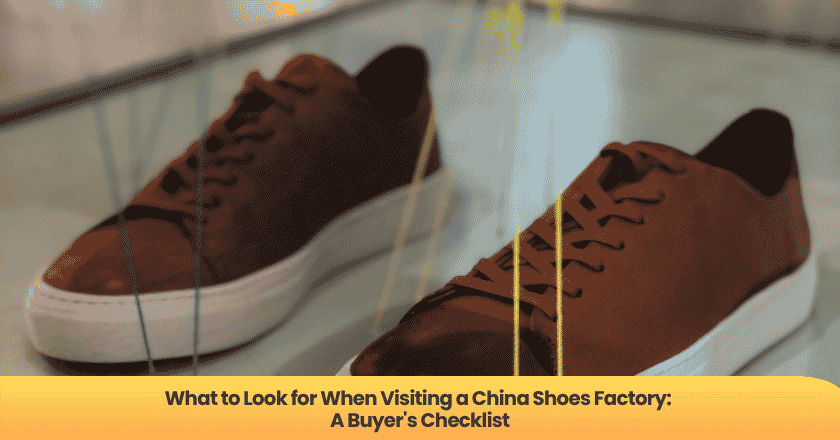
Introduction
The sales office is spotless, the showroom is full of beautiful samples, and the sales manager speaks excellent English. None of that tells you whether the factory can make your shoe well, on time, at the quantity you need. The answers live on the production floor, in the cutting room, and at the QC table — places a polished front office is designed to keep you from scrutinizing too closely.
A factory visit, in person or remote, is your chance to verify what the quotes and catalogs only claim. Footwear is unforgiving here: a factory can fake a good sample but can't fake the equipment, the workflow, and the quality discipline that produce a good bulk order. The difference between a reassuring visit and a useful one comes down to knowing exactly what to look at.
Key Takeaways
• The production floor, not the showroom, reveals whether a factory can actually deliver your order.
• Check that the factory owns the specific machinery your shoe construction requires, not just general equipment.
• A real quality system shows up as in-line QC checkpoints, not just a final inspection table.
• Confirm the factory makes your goods in-house and isn't quietly subcontracting the order.
• A remote video audit, done thoroughly, can verify most of what an in-person visit would.
Before You Walk In: What to Confirm
Match the factory to your construction
Footwear factories are specialists, so the first thing to verify is whether this factory actually builds shoes like yours. A cemented leather loafer, a vulcanized canvas sneaker, and an injection-molded sandal are made on entirely different lines. Walking into a sneaker factory with a welted boot wastes everyone's time. Confirm the core product they run in volume matches your construction before you bother assessing anything else.
Ask to see recent production of your exact shoe type leaving the line — not the showroom highlights, which may include shoes they merely traded. Seeing your construction made in volume, repeatedly, is the proof that matters. A factory that mostly makes something else may take your order and learn on your money.
Set your priorities before you arrive, too. A visit goes fast, and a charming host can fill the time with showroom tours and lunch if you let the agenda drift. Decide in advance the three or four things you must verify — the right machinery, in-line QC, material stock, and a committed production slot — and treat everything else as secondary. Buyers who walk in without a checklist tend to leave reassured but uninformed, having seen what the factory wanted to show rather than what they needed to confirm. A written list in hand keeps the visit yours, not the sales team's.
Documents that should already be in hand
Before the visit, confirm the business license lists footwear production in its scope, and request any social compliance audit — BSCI, Sedex, or WRAP — checking that it's current and verifiable with the issuing body. A lapsed or unverifiable certificate is a question to resolve before you travel, not after.
Product compliance is a separate layer worth confirming for footwear bound for Western markets. Beyond the social audit covering how the factory treats workers, your shoes may need to meet destination-market rules on restricted chemicals, materials labeling, and — for children's footwear especially — safety standards. A factory can run a clean operation and still ship shoes that fail a chemical test at the border. Ask whether the factory has produced for your target market before and can meet its specific product regulations, then build any required lab testing into the order. Confirming this before the visit means you can spend your floor time on production capability rather than paperwork.
Expert Tip: Send your tech pack and a reference shoe ahead of the visit, and ask the factory to have a technician walk you through how they'd build it. A factory that can discuss last selection, lasting method, and bonding process in specifics is one that genuinely makes footwear. One that defers every technical question to "the workshop" is signaling that the people you're meeting are sales, not production — and that the real making happens somewhere you haven't seen.
On the Floor: The Production Walkthrough
Equipment tells the truth
The machinery on the floor either supports your shoe or it doesn't, and it can't be staged. For your construction, confirm the specific equipment exists and is running: a lasting machine for cemented or welted shoes, vulcanizing equipment for that construction, injection-molding stations for molded soles. Count rough machine numbers against the monthly volume the factory claims. A factory promising large output from a handful of machines is quoting someone else's capacity, likely a subcontractor's.
Watch the workflow, too. A well-run shoe factory has a logical flow from cutting to stitching to lasting to finishing, with work-in-progress organized rather than piled. Chaos on the floor predicts chaos in your order.
The quality system in action
The QC table at the end of the line is the bare minimum. What you want to see is in-line inspection — checkpoints during cutting, stitching, and lasting that catch defects while they're cheap to fix. Ask to see the defect log and how rework is handled. A factory with real quality discipline can show you its AQL (Acceptable Quality Limit — the agreed maximum defect rate an order may contain) standard and its records; one without simply reassures you.
Common Mistake to Avoid: Judging a factory by the showroom samples and skipping the production floor. Showroom shoes are made by the best workers with unlimited time; your bulk order is made by the full line under deadline pressure. Buyers charmed by a perfect sample room sign with factories whose actual output is inconsistent, then discover the gap when 1,000 pairs arrive with varying sole bonds. Insist on walking the floor — the line, not the showroom, is your real preview.
Reading the people, not just the process
The workforce tells its own story. A skilled, settled team produces consistent shoes; high turnover and visibly inexperienced workers on critical steps like lasting and bonding predict variability in your order. Watch whether workers handle materials with practiced ease or hesitate, and whether supervisors are present on the floor. Footwear construction depends heavily on hand skill at certain stages — edge finishing, hand-lasting, quality stitching — and no machine compensates for an untrained worker at those points. You don't need to interrogate anyone; a few minutes of quiet observation at the stitching and lasting stations usually reveals whether the people making your shoes know what they're doing. A factory confident in its team lets you watch freely; one that hurries you past the floor may be hiding how the work actually gets done.
Capacity, Subcontracting, and Compliance
Real capacity, not the headline number
When a factory cites monthly output, that's its maximum across every client in a good month. What matters to you is the line time available during your production window and where your order sits in the queue. Ask for a committed production slot with start and finish dates, and get it in the contract. Then confirm the lead time accounts for the Chinese New Year shutdown and peak-season congestion, which idle footwear lines for weeks each year.
A useful way to test honesty here is to ask the same question two ways. Request a delivery date for an order placed today, then for one placed six weeks before Chinese New Year. If the answers are identical, the factory isn't accounting for the seasonal shutdown that stops most Chinese footwear production for two to three weeks annually — and its scheduling can't be trusted. A factory that builds the holiday and peak congestion into its timeline is one that plans capacity realistically, which is exactly the kind you want making a time-sensitive order.
The subcontracting question
A factory short on capacity may accept your order and quietly hand part of it to a workshop you never assessed — meaning your audit and quality checks cover a facility that isn't making your shoes. Some subcontracting is legitimate (specialized outsole molding, for instance), but it must be disclosed. Ask plainly whether any part of production happens off-site, and reserve the right to inspect any subcontractor. Reaching factories with genuine open capacity, rather than the few aggressively marketing to foreigners, is its own advantage, and the right-capacity factory often sits outside the slice of suppliers that are easy to find from abroad.
Expert Tip: Walk the warehouse and the loading area, not just the production line. Raw-material stock tells you whether the factory actually buys the leather and components it claims to use, and finished-goods staging shows real throughput. A factory whose floor is busy but whose material store is nearly empty may be assembling from components made elsewhere — a sign your order could be subcontracted. The unglamorous corners of a facility often reveal more than the line itself.
Doing It Remotely
A physical visit isn't always practical, and through 2026 remote audits have become standard rather than a compromise. A thorough video walkthrough — live, not pre-recorded — can verify most of what an in-person visit would: the equipment running, the workflow, the QC table, the material store. The key is controlling the camera's path. Ask the person filming to go where you direct, show specific machines, and pan across the floor continuously rather than cutting between staged shots. A factory comfortable with an unscripted live tour is usually one with nothing to hide. Pairing a remote audit with a third-party on-site inspection for the actual order gives you most of the assurance of a visit without the travel.
There are limits worth acknowledging. A remote tour can't fully convey the smell of solvents that signals poor ventilation, the feel of leather stock, or the subtle tension of a workforce under strain — things an experienced inspector picks up in person. For a first order with a high-value or technically demanding shoe, having a qualified third party physically present, even if you can't be, closes that gap. The practical middle ground most buyers settle on: a live remote audit to qualify the factory, then independent on-site inspection during production, so trained eyes verify the actual goods against your approved sample at the moment it counts.
How NewBuyingAgent Helps You Vet a Shoes Factory
Reaching the right shoes factory from a distance and verifying its equipment and quality systems is hard, which is why many buyers work through a sourcing partner. NewBuyingAgent is your perfect partner for global sourcing from China, backed by 30 years of expertise in trade, manufacturing and quality control.
When the challenge is reaching the right factory, the network does the work: with 100% Access to China's Factories, you use their 50,000+ cooperated partner factories—no language/region/time zone barriers.Their local reputation gets you full factory cooperation. And on the quality system a factory visit exists to verify, the oversight is built in: NewBuyingAgent's 20,000+ product development & QC experts ensure your products match market needs and stay high-quality. Contact now.
Frequently Asked Questions
What's the most important thing to check at a China shoes factory?
That the factory owns and runs the specific machinery your shoe construction needs, and that you can see your shoe type being produced in volume on the floor. Footwear factories specialize narrowly, so confirming the construction match matters more than any other single check.
Can I assess a shoe factory without visiting in person?
Yes. A thorough live video audit can verify equipment, workflow, quality checkpoints, and material stock — most of what an in-person visit covers. Control the camera's path, insist on a live unscripted walkthrough, and pair it with a third-party inspection of the actual order.
How do I know if a factory is subcontracting my order?
Ask directly whether any production happens off-site, and look at the material store and finished-goods staging during your visit. A busy line with little raw-material stock can signal that components are made elsewhere. Require disclosure of any subcontractor and the right to inspect them.
What documents should I verify before working with a shoe factory?
A business license listing footwear production in its scope, and a current, verifiable social compliance audit (BSCI, Sedex, or WRAP). Confirm the audit is in date and covers the facility actually making your shoes, and verify it with the issuing body rather than trusting a PDF.
How do I check the factory's real capacity?
Ask for a committed production slot with specific start and finish dates in your contract, not just a monthly maximum. Confirm the lead time accounts for the Chinese New Year shutdown and peak-season congestion, and check that machine numbers support the volume claimed.
Conclusion
A factory visit is only as good as where you point your attention. Skip the showroom's polish and read the floor — the right machinery for your construction, in-line quality checks, organized workflow, and a material store that backs up the claims. Whether you go in person or run a careful remote audit, the goal is the same: verify what the quotes promise before your money is committed. When getting eyes on the right footwear factory isn't practical from where you sit, it's worth having someone assess the floor, the equipment, and the quality system on your behalf before you order.
NewBuyingAgent
Related Resources
Commencer aujourd'hui
Transformons vos objectifs d'approvisionnement en réalitéWeChat:+86 15157124615
WhatsApp:+86 15157124615
Adresse : Bâtiment 10 #39 Xiangyuan Road, Hangzhou, Chine
