

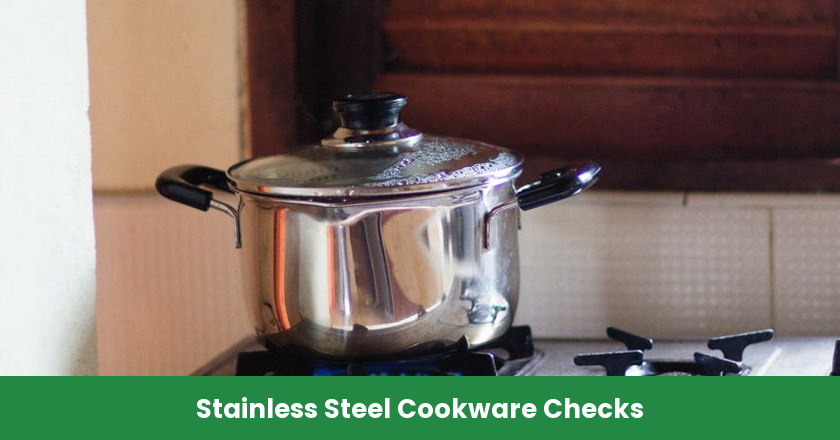
When sourcing stainless steel cookware from China, give every supplier the same finished-product specification. Identify the steel grade for each component, measure finished thickness at marked locations, test the assembled handle, and tie any coating or food-contact claim to the exact pan and market. Ask the factory to show where a quote departs from that specification. The best time to find out that a number applies to the base rather than the wall is before comparing prices.
Approve the Finished Cookware Build
A cookware build is ready for approval when its drawing names the grade by layer, defines finished thickness by measurement point, and sets checks for the assembled handle. The approval file also identifies the coating and the food-contact evidence for the target market and intended use. These records let the buyer compare quotes on the same basis and prevent an attractive sample from becoming the sole production reference.
- Definition: The build includes the food-contact face, structural layers, hob-facing base, handle assembly and finish.
- Common mistake: A single grade or thickness quoted for the whole pan can conceal which surface or point it describes.
- Decision: Require a drawing revision, an evidence reference and an acceptance criterion for each check before releasing the order.
Decide which claims the assortment needs before asking for a price. A covered saucepan for induction and a shallow gas-only frying pan can justify different constructions, tests and packaging. Record the market, heat sources, claimed oven conditions, lid and handle configuration, and expected use under the SKU that will appear on the purchase order.
Verify the Grade at Each Relevant Layer
A component-by-component material map makes a grade declaration useful. It names the cooking surface, structural layers, hob-facing base and other relevant parts, then links each claimed alloy to both the drawing and the material lot or heat. A heat is a production batch of metal identified by the mill. Specifying the location and heat lets an inspector ask for evidence for the part that matters.
For the purchase specification, request the grade designation and reference standard for each specified part. The Outokumpu Core range identifies its Core 304/4301 as an austenitic stainless steel and lists both austenitic and ferritic options. The material choice depends on the part and use. A stainless cooking face, an aluminum core and a magnetic stainless exterior can each serve different purposes in one clad design.
A description such as '18/10 stainless' can start a discussion. Ask the supplier to show which lot of sheet or bonded material became the sample and which records will follow a production lot. A mill certificate identifies the material it describes. The factory's receipt, coil or sheet label, and issue record connect that certificate to the pan. Ask for this chain when two grades can share an appearance or when the same factory makes similar-looking cookware from different materials.
Material verification must reach the intended surface and distinguish the grades at issue. Thermo Fisher guidance on material identification explains that handheld X-ray fluorescence, or XRF, can identify many alloying elements but cannot measure carbon. If the grade requirement turns on carbon, have the lab choose a method that measures it. Give the lab the layer drawing so it can choose a suitable location and preparation for a clad or coated specimen.
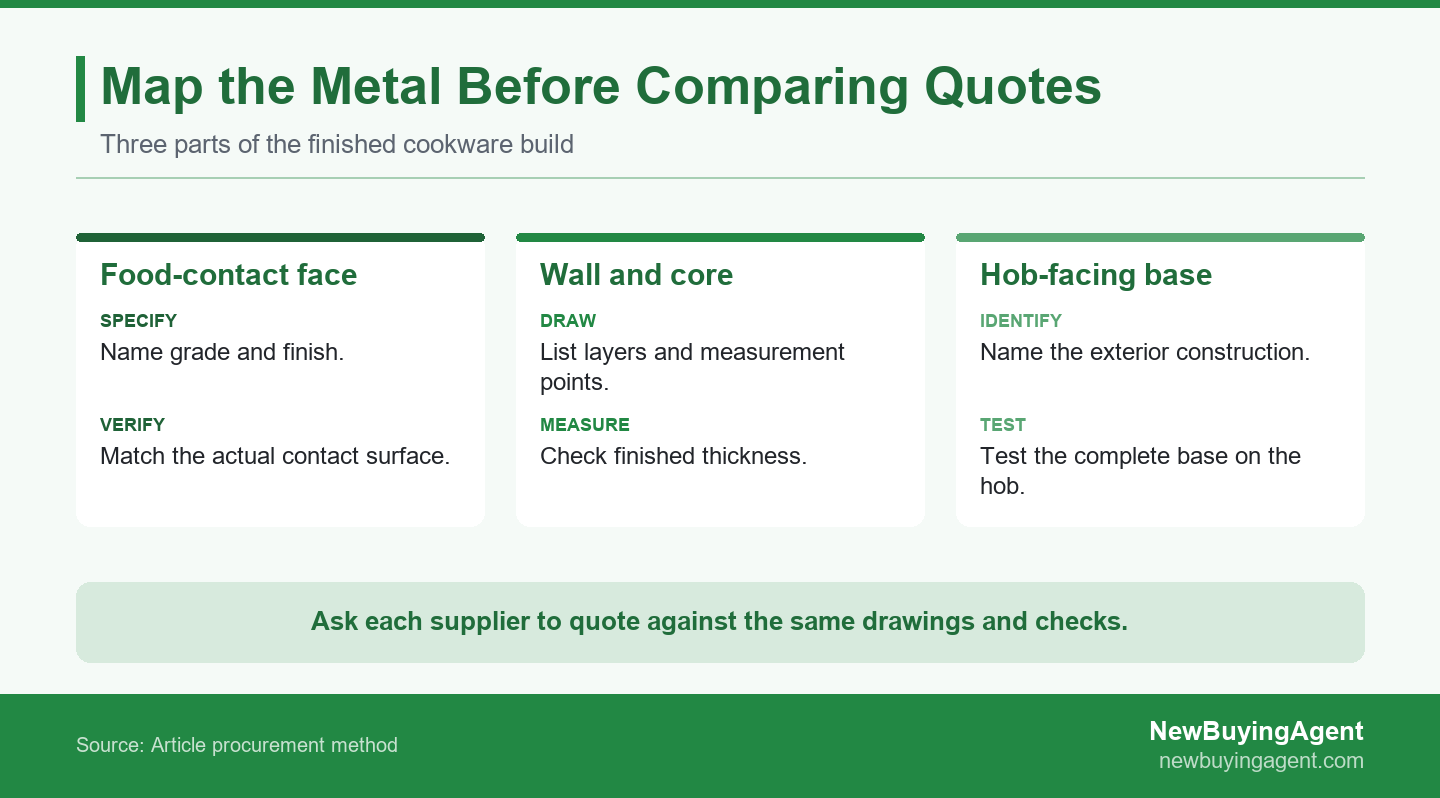
A cookware material map ties the food-contact face, structural layers and hob-facing base to separate evidence
Keep the report by part and sample ID. An exterior spot reading provides evidence about the tested exterior at that location. If the supplier offers the result as proof for a buried layer or inner face, ask for the relevant part to be verified separately with a lab-approved method. When the lab must cut a sample, record the link to the source lot and retain an intact reference.
Specify Finished Thickness at Marked Locations
Gauge means thickness at a specified point on the piece, and the finished thickness is what the buyer can check on a formed pan. A quote should name whether its number is the incoming sheet, finished sidewall, base or a single layer. A marked drawing and an agreed measurement method let the buyer compare readings at the same locations and judge construction and heating performance separately.
In a fully clad design the bonded layers extend through the sidewall. A disc-base design uses a separate plate or layered assembly on the bottom while the wall has its own construction. A thick disc can coexist with a thin wall. Compare a cross-section and measurements before drawing conclusions about weight or performance. If the factory proposes an alternative, ask it to quote that build separately.
| Drawing check | Where or how to check | What to record |
|---|---|---|
| Finished wall | Marked points and heights on the formed wall, clear of the rolled rim unless the rim is the target. | Minimum or tolerance, instrument and reading by point. |
| Finished base | Marked center and radial points using the agreed method for the design. | Base total and layer thickness where the drawing requires it. |
| Bond or disc area | Specified perimeter and junction, with sectioning if needed for the agreed evidence. | Unbonded area, visible gaps, or construction deviations against the drawing. |
| Hob performance | Finished pan on specified heat sources and settings. | Flatness or rocking, behavior after heating, and any heating distribution result. |
Define the unit and the acceptance rule in advance. If there is a minimum at each location, averaging thick and thin readings can obscure an out-of-spec point. Agree how to measure curved or inaccessible areas and whether the test requires a sacrificed sample. Give the inspector both the drawing and a sample ID. A rounded catalog number or shipping weight is an easy screen, while the actual dimensions decide acceptance.
When product teams need quotes for different builds, NewBuyingAgent's China product sourcing and supply uses local cooperating factory resources and covers sourcing, quality control and logistics. Start with one drawing and a clear description of any acceptable alternate. That gives the buyer a common basis for discussing price, usable capacity and what the factory will verify at the sample and production stages.
Test the Handle on the Finished Pan
Handle approval concerns the complete, finished pan assembly. The attachment, grip, balance, strength and temperature can depend on pan size, loaded weight, handle geometry and how the vessel is heated. Agree which configurations the test covers, including a lid or helper handle where relevant. The same visual handle design can behave differently on a heavier pan or when it is attached to a thinner wall.
The CATRA cookware testing scope lists handle design, fatigue resistance and safety alongside separate tests for attributes such as heat distribution and nonstick performance. Have the lab confirm the applicable method, edition and conditions for the product and market. Specify the fixture, pan orientation, loads or cycles, and failure criteria in the QA plan or agreed lab scope. Record the pan and handle revision on the report.
For a riveted handle, show the fasteners and attachment geometry in the drawing. Check seating, looseness, edges and visible movement on the finished sample. For a welded handle, confirm its mounting pattern and validate the joined assembly under the agreed load and repeated-use checks. Use the buyer's qualification plan to decide which checks need a lab and which observable defects can be checked on the line.
Check what a customer actually holds. The grip point on a long handle can have a different temperature from the metal close to the wall. The lid knob or helper handle may be used at different points in serving. Agree measurement locations and the heating setup before making a claim about touch temperature. An oven-use claim needs its own conditions, including what happens to the lid, grip or detachable parts.
A cookware set may combine several sizes and attachment patterns. Ask the lab and quality team which sample is representative for each test. The heaviest pan might challenge attachment strength, while a small vessel can put the handle closer to a gas flame. Keep the rationale for any extension across sizes with the report.
Qualify the Actual Coating and Food-Contact Build
A coating approval connects the actual formula to the finished pan and the proposed market claim. Identify the coating supplier, formulation or system code, substrate and process revision before reviewing evidence. Performance checks establish how the coating behaves under agreed use and cleaning. Food-contact evidence addresses a different question and needs to match the surface, anticipated use and applicable market requirements.
For a coated pan, request the supplier's description of the coating system and the conditions for applying it. Identify which changes require written approval, such as a new layer, pigment, coating vendor or cure process. A report for another color or substrate may still inform a lab review, but ask for either a justified scope extension or evidence for your exact configuration. Keep the offered, tested and approved IDs together.
Agree durability methods around what the pan is sold to do. Adhesion, abrasion resistance and food release can answer different questions. If the marketing claim concerns continued performance, compare the agreed result before and after the specified wear or cleaning sequence. For an uncoated model, record the finish and food-contact surfaces, including the rim or exposed fasteners where relevant, and qualify the actual build.
The European Commission food-contact legislation guide explains that the EU framework limits constituent transfer that might endanger health or cause unacceptable changes to food. Ask your lab or compliance lead to confirm the rules for the specific materials, use and destination, including any applicable national provisions. An alloy designation is a drawing input. The evidence file needs to address the finished food-contact article.
For metallic food-contact materials, the EDQM metals and alloys technical guide describes specific release limits for relevant elements where appropriate. Use that guidance to frame a discussion with the lab about what can be released from the metal and under which test conditions. Ask the lab to name the applicable legal basis and evaluation method for the importing market in the test scope.
The FDA summary of authorized PFAS food-contact uses describes certain nonstick cookware applications that use polymerized PFAS bound to the surface. Review the authorization applicable to the actual substances and intended conditions, along with relevant state or other market restrictions and labeling needs. A 'PFOA-free' statement addresses that named substance. A wider claim about PFAS needs its own substantiation before appearing on a carton or listing.
Reject a Sample That Misses a Signed Check
A sample stays on hold when a valid reading misses a signed requirement, even if the quote looks attractive. In a hypothetical sauté pan order, the signed minimum finished sidewall thickness is 2.0 mm and one measurement is 1.8 mm. The buyer checks the sample ID, drawing revision and measurement method with the factory. If the reading is confirmed, that sample cannot establish conformity to the drawing.
The supplier explains that the starting sheet meets its catalog number and offers a photo of the thick base. The buyer requests the marked photos and point-by-point readings from the sample. A measurement at the base cannot satisfy a separate sidewall minimum. To resolve any dispute about the gauge, both teams can repeat the reading using the agreed method on correctly identified specimens and record the results against the same locations.
If the wall falls below the limit after forming, ask the supplier to identify what changed between the agreed build and the formed pan. A different sheet or forming change may make a corrected sample possible. The purchasing team can also evaluate a thinner-wall offering as a separate product if it meets the commercial need. That path requires a revised drawing, review of changed performance and cost, and written approval before it becomes the new specification.
Suppose the matching coating report is also missing and the reference sample passed only a showroom handling check. These remain open even if the wall is corrected. Obtain the matching coating record or lab rationale, and have the approved handle checks performed on the finished construction. The buyer can compare revised cost and timing while the technical decision stays open. Before bulk release, tie the signed sample and design records to the actual production lots.
Send a Spec Sheet That the Factory Can Quote
A usable request for quotation (RFQ) gives each supplier the same SKU, intended use, layered construction and finished tolerances. It also names the test conditions, documentation and change approval needed for manufacture. Each line should let the supplier state what is included, identify a deviation or propose an alternate with its own cost. The approved answers then become inputs to the purchase and inspection records.
| Copyable RFQ field | Fill in before requesting prices |
|---|---|
| SKU and use | [Size, capacity, markets, hob types, lid and handle set, oven and care conditions] |
| Material map | [Drawing revision, grade and standard by component, layer sequence, finish, material lot evidence] |
| Finished gauge | [Marked points, nominal and permitted limits, measurement method and representative samples] |
| Handle and lid | [Attachment revision, tests, configurations, method, pass criteria and report ID] |
| Surface and claims | [Coating system or uncoated finish, formulation code, use claims, matched food-contact and durability evidence] |
| Production release | [Approved sample, lot traceability, check frequency, deviation approval and shipment authority] |
Allow the quote to identify which tests are included, which require separate cost, and which are to be completed before production. The approval version should show the disposition of every deviation. When the buyer accepts a supplier alternate, update the master drawing and related test and marketing records so the next production run starts from one configuration.
For a cookware program spanning several sizes, NewBuyingAgent's manufacturing and quality-control background and local cooperating factory network can support product sourcing with a consistent set of requirements. Separating the core pan build from each size's drawing and verification makes it easier to define the product and QC scope across an assortment.
To discuss a China sourcing and supply program, send the cookware specification to NewBuyingAgent with quantities, destination, target price, timing and the checks that matter to your assortment. Include the current drawing and mark any acceptable alternates. That information gives both teams a basis for quoting the intended construction and agreeing how to verify it through delivery.
Frequently Asked Questions
Can a magnet identify the grade of my stainless steel pan?
A magnet's response is insufficient to identify the steel grade of a finished pan. Its pull gives a quick magnetic check at the tested location and can leave hidden layers unresolved. Use the signed material map, lot-linked records and suitable material testing when exact identity matters. For induction behavior, evaluate the finished base on the intended equipment.
How do I verify the induction claim before ordering?
Verify the finished SKU on the cooktops and settings in the agreed test plan. Include base dimensions, pan load and the criteria for acceptable operation. A magnetic response is a useful preliminary screen. Document whether the actual unit is detected and heats as specified, and record the tested configuration with the claim.
Can a report for one pan cover a different size?
A report covers another size only if its scope or a justified extension supports that size. Compare the base design, attachment, wall geometry, loaded weight and food-contact surfaces. Ask the responsible lab or quality team to document which results transfer and which require new specimens before approving additional SKUs.
What should change approval include when the coating supplier changes?
Treat the change as a new approval decision for the affected build. Identify the revised formulation and application process, check whether current performance and food-contact reports still apply, and obtain additional evidence as needed. Update the purchase and inspection files with the first authorized lot and the exact description supported by the new evidence.
NewBuyingAgent
Ressources associées
Commencer aujourd'hui
Transformons vos objectifs d'approvisionnement en réalitéWeChat:+86 15157124615
WhatsApp:+86 15157124615
Adresse : Bâtiment 10 #39 Xiangyuan Road, Hangzhou, Chine
